President Donald Trump spearheaded a day of high-stakes political maneuvering and international diplomacy on February 19, 2026. While hosting the inaugural meeting of his “Board of Peace” in Washington D.C. to address Gaza’s future and issue a stern warning to Iran, he simultaneously visited Georgia to bolster Republican support ahead of critical midterm elections. This dual focus underscored his administration’s ambitious foreign policy initiatives and ongoing domestic battles, from economic disputes to persistent claims about past elections. The day’s events highlighted significant pledges for Gaza relief, the controversial expansion of presidential power regarding tariffs, and simmering international tensions.
Trump Unveils “Board of Peace” for Gaza Relief and Global Stability
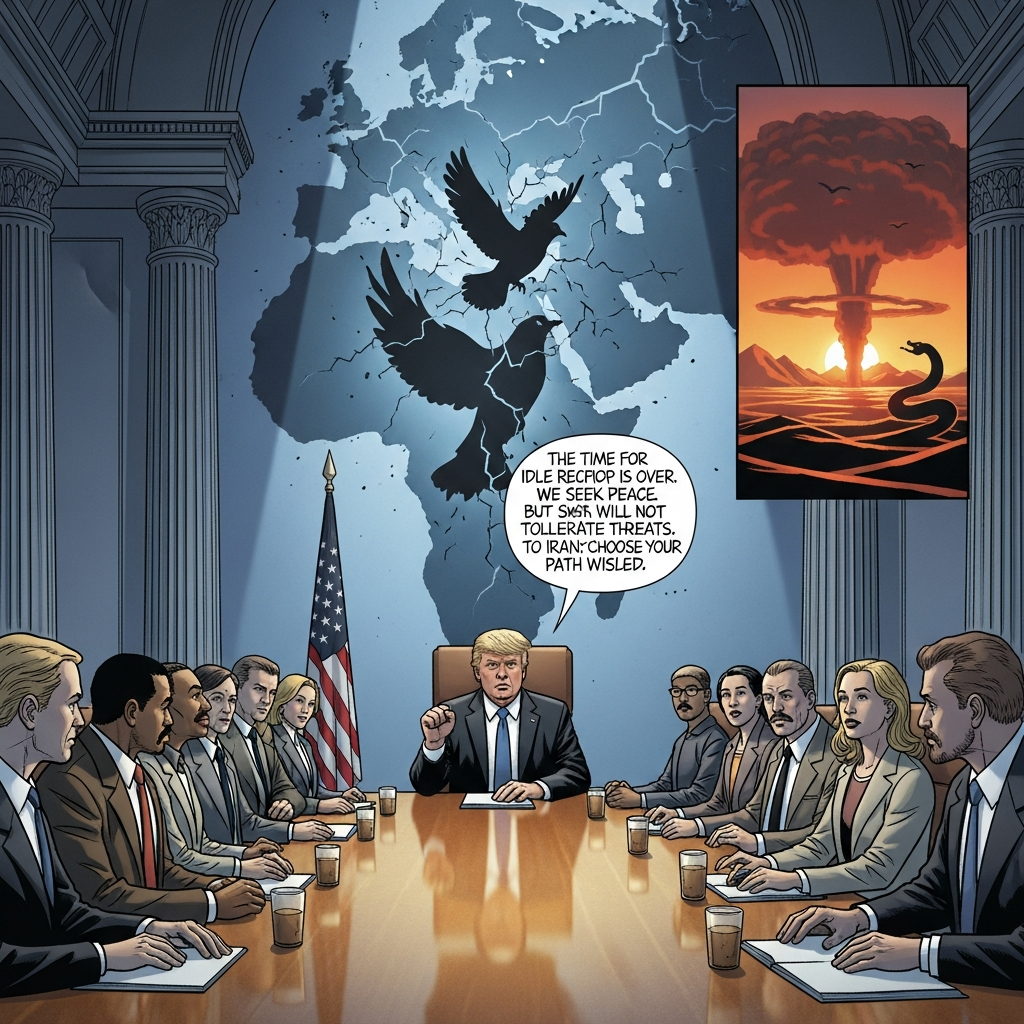
In a significant diplomatic move, President Trump convened the first meeting of his much-anticipated “Board of Peace” at the renamed Donald J. Trump U.S. Institute of Peace. He declared it “one of the most important” endeavors of his second term. The board’s primary focus was the dire humanitarian situation and reconstruction needs in war-battered Gaza. This new body immediately drew both significant international participation and skepticism, particularly from established global institutions like the United Nations.
Historic Pledges for Gaza Reconstruction
The inaugural session saw nine nations — Kazakhstan, Azerbaijan, UAE, Morocco, Bahrain, Qatar, Saudi Arabia, Uzbekistan, and Kuwait — collectively pledge a substantial $7 billion for a Gaza relief package. The United States committed an additional $10 billion to the Board of Peace, signaling its robust financial backing. Billionaire investor Marc Rowan, a key member of the board’s executive committee, unveiled an ambitious long-term reconstruction blueprint. This plan initially targets Gaza’s southern city of Rafah, aiming to build 100,000 homes for 500,000 people and invest $5 billion in infrastructure. Rowan projected that, “over time,” the plan would expand to 400,000 new homes for Gaza’s entire population, supported by a massive $30 billion in infrastructure projects.
Beyond housing and basic infrastructure, FIFA President Gianni Infantino outlined a unique commitment to rebuilding hope through sports. FIFA pledged $50 million for a new national football stadium capable of hosting 20,000-25,000 spectators, $15 million for a FIFA academy, and $7.5 million for 50 mini-pitches and five full-sized pitches across Gaza. These initiatives aim to foster community and provide vital recreational opportunities. However, Israeli Prime Minister Benjamin Netanyahu reiterated a critical precondition for any reconstruction: “There will be no reconstruction of the Gaza Strip before the demilitarization of the Gaza Strip.”
Forging an International Stabilization Force
To ensure security amidst the reconstruction, five nations — Indonesia, Morocco, Kazakhstan, Kosovo, and Albania — committed troops to a newly formed International Stabilization Force for Gaza. Neighboring Egypt and Jordan also agreed to provide crucial training for local police and security forces. Maj. Gen. Jasper Jeffers, leader of this emerging force, announced plans for a robust presence, including 12,000 police and 20,000 soldiers, emphasizing that these “first steps” would help bring essential security to the region.
Escalating Tensions with Iran
The Board of Peace meeting, ironically, occurred against a backdrop of heightened U.S.-Iran tensions. President Trump issued a stark warning to Iran, declaring that “bad things will happen” if a nuclear deal isn’t reached within the “next, probably, ten days” to fifteen days. He declined to specify the nature of any potential military action, simply stating, “We’re either going to get a deal or it’s going to be unfortunate for them.” This ultimatum followed years of deadlocked talks and coincided with Iran holding annual military drills with Russia. The U.S., in turn, further bolstered its military presence in the Middle East with a second aircraft carrier. A senior regional government official, speaking anonymously, reportedly advised Iranian officials to take Trump’s threats at “face value,” citing the president’s past international actions as evidence of his resolve.
A Challenge to the United Nations’ Authority
The launch of the Board of Peace ignited a debate over its role in global conflict resolution, particularly its perceived rivalry with the United Nations. The UN Security Council expressed concerns, and Vatican Secretary of State Cardinal Pietro Parolin stressed that the UN “should above all be the U.N. that manages these crisis situations.” White House Press Secretary Karoline Leavitt defended the board as a “legitimate organization” that is “doing” rather than just “talking.” President Trump himself criticized the UN for not living up to its potential, asserting that the Board of Peace would “almost be looking over the United Nations” to ensure it “runs properly” and even suggesting the U.S. would help “fix up even the building.” Notably, key U.S. allies like the UK, France, and Canada had not yet joined the initiative, which Trump alluded to as “playing a little cute.” Amid these discussions, the Trump administration made a $160 million partial payment towards its $2.196 billion in outstanding dues to the UN’s regular budget.
Domestic Priorities: Georgia, Tariffs, and Election Claims
Away from the international stage, President Trump traveled to Georgia with a clear domestic agenda: boosting Republican standing ahead of the midterms. His visit focused heavily on economic issues, a long-standing emphasis of his administration.
The Tariff Battle Reaches the Supreme Court
During a tour of Coosa Steel Corporation, President Trump expressed significant frustration over the Supreme Court’s pending decision on the legality of his tariffs. He lamented waiting “forever” for a ruling, arguing he had the constitutional “right to do it as president.” Andrew Saville, the owner of Coosa Steel, stood alongside Trump, praising the tariffs for having “leveled the playing field” for American businesses. However, new research from the JPMorganChase Institute challenged the administration’s claims that foreign entities bore the cost of tariffs. The study revealed that these additional taxes, affecting companies employing 48 million people in the U.S., were largely absorbed by American businesses through higher prices, reduced workforces, or lower profits, leading to economic disruption. Despite these challenges, the U.S. trade deficit saw a modest decline in 2025, slipping to just over $901 billion from $904 billion the previous year.
Reiterating Contested Election Allegations
While in Georgia, Trump continued to press unsubstantiated claims about the 2020 election. During a stop at The Varsity restaurant in Rome, he alleged that “all those crooked ballots were taken” in Fulton County, referencing a recent FBI search. This statement echoed his long-held, discredited belief that the election was stolen from him, a fabrication previously rejected by audits, state officials, courts, and even his own former attorney general.
Broader Political Developments and Lingering Questions
The day’s events provided glimpses into broader political currents, from future GOP leadership to ongoing governmental controversies.
Vice President JD Vance, speaking at the Board of Peace, linked international stability to American prosperity, highlighting the “trillions of dollars of investment” and millions of U.S. jobs supported by the board’s participating nations. Meanwhile, President Trump fueled speculation about his potential 2028 successor, publicly contrasting the leadership styles of Vance and Secretary of State Marco Rubio, both considered frontrunners.
At the National Governors Association’s annual meeting in Washington, partisan divisions were evident. Trump had notably excluded some Democratic governors from White House events, contrasting with the group’s traditional bipartisan spirit. Virginia Governor Abigail Spanberger was also selected to deliver the Democratic response to Trump’s upcoming State of the Union address, positioning her as a prominent counter-voice.
Controversy also surrounded the White House itself, as a Trump-appointed arts commission approved his plan to build a ballroom twice the size of the White House on the former East Wing site. This project had already sparked public outcry and a lawsuit from the National Trust for Historic Preservation, with litigation still pending. Elsewhere, President Trump offered a cryptic “I don’t have an opinion on it” when asked about alien visitors, while expressing “sadness” over the arrest of former Prince Andrew.
Frequently Asked Questions
What is the purpose of Trump’s Board of Peace, and what were its key outcomes?
Trump’s Board of Peace was established to address global conflicts, with its inaugural meeting on February 19, 2026, focusing on the humanitarian crisis and reconstruction in Gaza. Key outcomes included $7 billion in pledges from nine countries plus an additional $10 billion from the U.S. for Gaza relief, along with ambitious long-term plans for housing and infrastructure led by Marc Rowan. Additionally, five nations committed troops to an International Stabilization Force for Gaza, with Egypt and Jordan providing training. The board also served as a platform for President Trump to issue a direct warning to Iran regarding its nuclear program.
Which countries pledged funds and troops for Gaza relief through the Board of Peace?
For financial relief in Gaza, nine countries pledged a combined $7 billion: Kazakhstan, Azerbaijan, UAE, Morocco, Bahrain, Qatar, Saudi Arabia, Uzbekistan, and Kuwait. The United States also pledged an additional $10 billion to the Board of Peace. For the International Stabilization Force, five countries agreed to deploy troops: Indonesia, Morocco, Kazakhstan, Kosovo, and Albania. Egypt and Jordan committed to training local police and security forces for the region.
What are the primary challenges facing Gaza’s reconstruction and the Board of Peace’s initiatives?
Gaza’s reconstruction faces significant hurdles, including an estimated $70 billion in needed funds, far exceeding the initial pledges secured by the Board of Peace. A major political challenge comes from Israeli Prime Minister Benjamin Netanyahu, who stated that reconstruction would not commence until Hamas is disarmed. The Board of Peace itself faces skepticism and potential rivalry from established international bodies like the United Nations, which stressed its own paramount role in crisis management. Additionally, the absence of key allies like the UK, France, and Canada from the board suggests ongoing diplomatic hurdles.
Conclusion
February 19, 2026, marked a day of intense activity for President Donald Trump, showcasing his distinctive approach to both international relations and domestic governance. The inaugural Board of Peace meeting successfully secured substantial financial and military commitments for Gaza’s reconstruction, albeit under the shadow of a stern warning to Iran and a clear challenge to the United Nations’ traditional role. Concurrently, Trump’s Georgia visit reaffirmed his focus on economic nationalism and his unwavering stance on past election claims. These events collectively underscore a presidency defined by bold initiatives, confrontational diplomacy, and a determination to reshape both global and domestic landscapes, setting the stage for continued political and economic debates in the months ahead.