The electrifying atmosphere of a Champions League knockout match was dramatically interrupted when Real Madrid’s star forward, Vinicius Júnior, allegedly became the target of racist abuse during a heated clash against Benfica. Following a stunning goal that put Real Madrid ahead 1-0 in Lisbon, the Brazilian international reported that Benfica’s Gianluca Prestianni directed a racial slur at him. This incident not only overshadowed Real Madrid’s hard-fought victory but also reignited urgent conversations about racism’s persistent presence in football and the effectiveness of existing anti-discrimination protocols. The match, held at the Estádio da Luz on February 17, 2026, was delayed for a tense 10 minutes, exposing raw emotions and drawing global condemnation.
A Stunning Goal, A Shocking Interruption
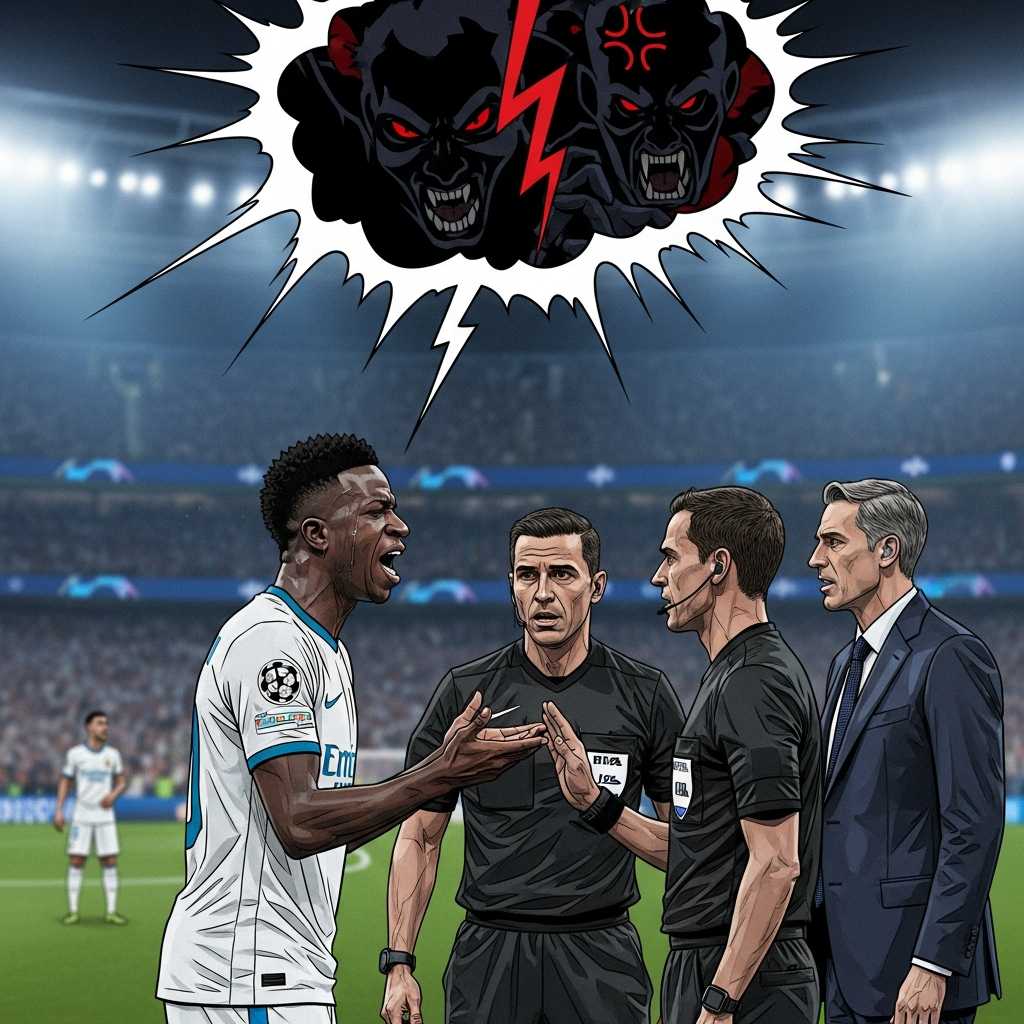
The pivotal moment arrived five minutes into the second half. Vinicius Júnior, known for his dazzling skill and goal-scoring prowess, weaved past a defender before unleashing an unstoppable curling shot into the top corner of Benfica’s net. His celebration, a dynamic samba dance near the corner flag, drew immediate attention—and a yellow card for “disrespect.” More critically, it reportedly sparked a confrontational exchange with Benfica’s Gianluca Prestianni. Vinicius immediately alerted referee François Letexier, alleging Prestianni had called him a “monkey.” Teammates and officials corroborated that Prestianni had covered his mouth with his shirt while speaking, a gesture that further fueled suspicion.
The referee’s swift action, crossing his arms to activate FIFA’s anti-racism protocol, brought the high-stakes match to a standstill. Players were momentarily ushered off the field, plunging the stadium into a tense silence that stretched for 10 minutes. During this stoppage, Vinicius was visibly distraught, prompting Benfica coach José Mourinho to cross the technical area and console him—a stark visual emphasizing the incident’s gravity beyond the competitive scoreline. The temporary suspension of play underscored the severity of the alleged abuse and amplified calls for decisive action against discriminatory behavior on the pitch.
Player Reactions: Unwavering Support and Outraged Condemnation
The aftermath of the incident saw an outpouring of support for Vinicius Júnior and strong condemnation of the alleged abuse. On social media, Vinicius himself did not mince words, declaring, “Racists are above all cowards. They need to put their shirts in their mouths to show how weak they are. But they have by their side the protection of others who, theoretically, have the obligation to punish.” He expressed frustration at the “poorly executed protocol that served no purpose,” lamenting the necessity of speaking out despite it overshadowing his team’s significant victory. This sentiment resonated deeply with fans and players alike, highlighting the emotional toll such repeated incidents take.
Kylian Mbappé, a teammate close to the incident, unequivocally backed Vinicius. Mbappé asserted that he heard Prestianni call Vinicius a “mono” or “monkey” five times, directly confronting Prestianni and calling him “a bloody racist.” Mbappé vehemently stated, “I cannot let things like this go,” and powerfully suggested that Prestianni should be permanently banned from playing in the Champions League. Real Madrid coach Álvaro Arbeloa echoed this unwavering support, stating, “We have to be totally intolerant of racism; we cannot allow things like this to happen on the pitch in 2026.” Arbeloa confirmed the team would have stood by Vinicius had he chosen to walk off, emphasizing their collective stance against any form of discrimination.
Benfica’s Response and Broader Implications
Benfica’s head coach, José Mourinho, offered a more nuanced and, for some, controversial perspective. Initially expressing confusion over Vinicius’s celebration style, Mourinho later adopted a “balanced tone” when the racism allegation became clear. He refrained from directly calling Vinicius a liar or Prestianni innocent, preferring to focus on the “perspective” of both sides. Mourinho also defended Benfica’s club history, noting that its biggest figure, Eusebio, was Black, implying the club’s non-racist nature. However, his remarks also included a broader statement, “A stadium where Vinicius plays something happens, always,” which was widely interpreted as an attempt to shift blame or question the frequency of incidents involving the Brazilian.
This particular comment drew sharp criticism from pundits like former Real Madrid midfielder Clarence Seedorf, who argued Mourinho “made a big mistake today to justify racial abuse.” Seedorf stressed that such remarks could imply that “it’s OK when Vinicius provokes you, that is it OK to be racist,” a notion he strongly condemned. Meanwhile, Gianluca Prestianni, through a statement shared by Benfica, denied the racist allegations, claiming Vinicius “misunderstood what he thought he heard” and that he was “never racist with anyone.” This conflicting account underscores the challenges in verifying such incidents in real-time and the reliance on witness testimony and official investigations.
The Protracted Battle Against Racism in Football
The incident at the Estádio da Luz is far from an isolated event for Vinicius Júnior, who has frequently been a target of racist abuse throughout his career, particularly in Spain’s La Liga. This recurring pattern highlights a pervasive issue within football stadiums globally. In 2023, three Valencia fans were notably jailed for eight months for racially abusing Vinicius, marking a significant legal precedent in Spain. Additionally, five individuals received suspended prison sentences in 2025 for a separate incident of racial abuse against the player in 2022. These legal outcomes, described as “unprecedented,” underscore the growing, albeit slow, judicial recognition and punishment of racial discrimination in sports.
Despite the activation of FIFA’s anti-racism protocol during the Benfica match, questions persist about the protocol’s effectiveness and enforcement. Vinicius’s criticism of a “poorly executed protocol that served no purpose” echoes concerns from many players and anti-racism advocates. The referee’s reported statement that he “hadn’t heard anything” despite activating the protocol suggests a disconnect between procedural activation and tangible consequences. Such incidents continually push governing bodies like UEFA and FIFA to re-evaluate their anti-discrimination measures, demanding stronger disciplinary actions, better in-match enforcement, and enhanced support systems for targeted players. The broader football community awaits concrete steps to ensure player safety and maintain the sport’s integrity against the backdrop of prejudice.
Frequently Asked Questions
What exactly happened during the Champions League match involving Vinicius Jr and Gianluca Prestianni?
During the Champions League match between Benfica and Real Madrid on February 17, 2026, Real Madrid’s Vinicius Jr scored a goal and celebrated. Immediately afterward, he reported to the referee that Benfica’s Gianluca Prestianni had racially abused him, allegedly using the slur “mono” or “monkey.” The referee activated FIFA’s anti-racism protocol, leading to a 10-minute stoppage in play. While Prestianni denied the allegations, Vinicius Jr and teammates like Kylian Mbappé condemned the alleged abuse, reigniting debates about racism in football.
What is the anti-racism protocol, and how effective was it in this situation?
FIFA’s anti-racism protocol involves a referee stopping play and, if necessary, temporarily suspending or even abandoning a match in response to confirmed racist incidents. In this case, referee François Letexier activated the protocol, pausing the game for 10 minutes. However, Vinicius Jr criticized the protocol as “poorly executed” and “serving no purpose,” noting the referee reportedly stated he hadn’t heard the abuse himself. This incident highlights ongoing challenges in fully implementing and enforcing anti-racism measures effectively in real-time match scenarios.
What are the potential consequences for Gianluca Prestianni or Benfica following these allegations?
While the article doesn’t detail specific sanctions against Prestianni or Benfica from this incident, similar past cases and calls for action suggest various possibilities. Kylian Mbappé publicly called for Prestianni to be banned from the Champions League. Governing bodies like UEFA and FIFA typically investigate such allegations. Outcomes can range from fines for the club, stadium bans for fans, or suspensions for players if the accusations are substantiated. The incident also puts pressure on Benfica as a club to demonstrate its commitment to combating racism within its organization and among its supporters.
The 1-0 victory provides Real Madrid with a crucial advantage for the return leg, but the enduring narrative of the match will undoubtedly center on the alleged racism. This incident serves as another stark reminder that while progress is being made in football’s fight against discrimination, the battle for true inclusivity and respect remains ongoing. The spotlight now turns to the sporting authorities to ensure that such powerful stands by players like Vinicius Júnior translate into meaningful and lasting change within the beautiful game.