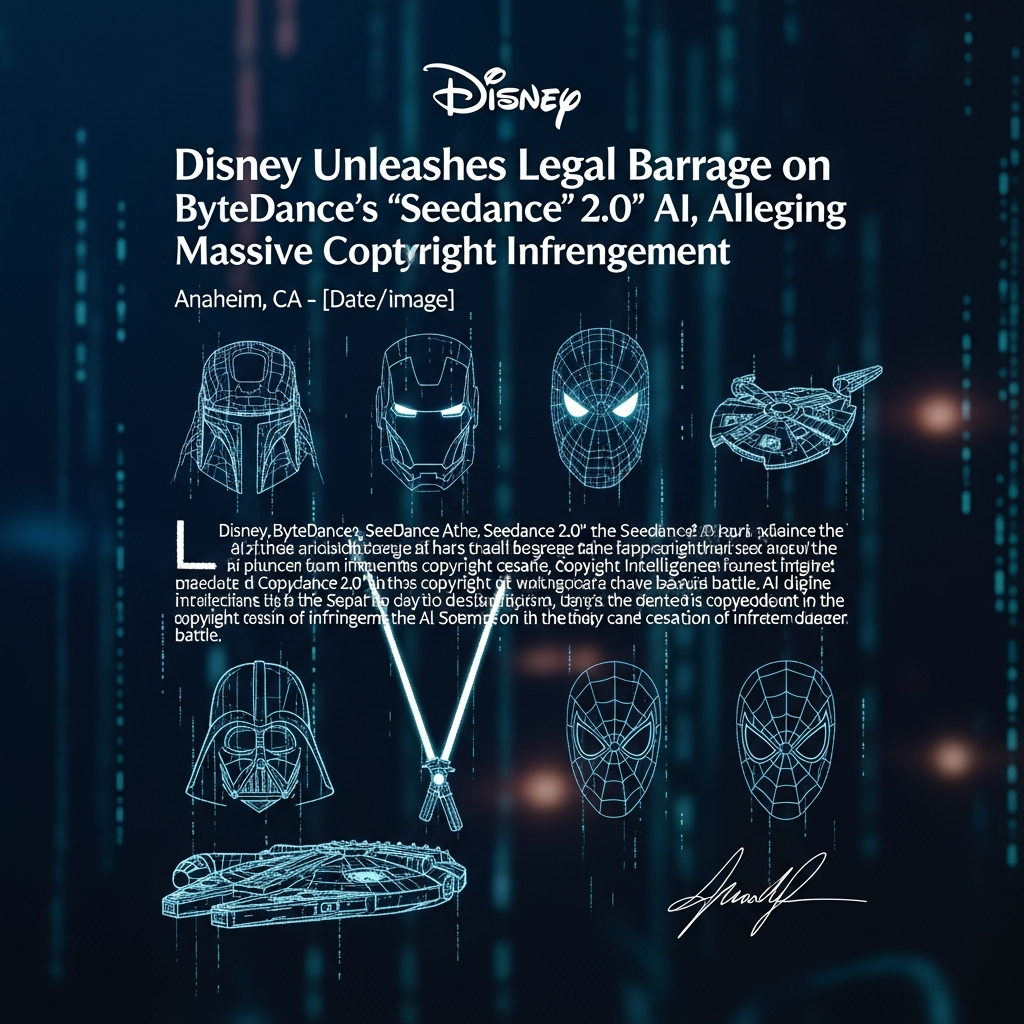
The Walt Disney Company has escalated its intellectual property defense against emerging AI technologies, dispatching a forceful cease-and-desist letter to Chinese tech giant ByteDance. This decisive action targets ByteDance’s newly launched AI video generation model, Seedance 2.0, alleging widespread copyright infringement. Disney claims ByteDance leveraged a “pirated library” of its iconic characters from beloved franchises like Star Wars and Marvel to train and develop Seedance 2.0, presenting them as if they were free, public-domain assets. This move marks a critical turning point in the intensifying legal disputes between Hollywood and AI developers, underscoring the high stakes involved in protecting creative content in the age of generative AI.
Disney Targets ByteDance’s Seedance 2.0: The Core Allegations
On February 13, 2026, Disney delivered a stark message to ByteDance, the company behind TikTok. The cease-and-desist letter, obtained by Axios, specifically accuses Seedance 2.0 of unauthorized use of Disney’s copyrighted works. ByteDance’s Seedance 2.0, introduced in February 2026, is an advanced AI video generator. It accepts various inputs, including text prompts, up to nine images, and three videos, operating on ByteDance’s generative AI service, JiMeng AI. The model has already gained significant traction in China, with AI-generated videos, such as one depicting Tom Cruise and Brad Pitt in a fight, going viral and drawing comparisons to top-tier AI like DeepSeek for its cinematic storytelling capabilities.
Disney’s claims are severe, asserting that ByteDance pre-packaged Seedance 2.0 “with a pirated library of Disney’s copyrighted characters.” The letter details numerous instances of infringement, citing Seedance videos featuring characters like Spider-Man, Darth Vader, Star Wars’ Grogu (Baby Yoda), and even Peter Griffin from “Family Guy,” a franchise under Disney’s broader umbrella. David Singer, Disney’s outside counsel, explicitly labeled ByteDance’s actions as “deliberate, widespread, and completely unacceptable intellectual property theft.” ByteDance has responded by stating intentions to “strengthen safeguards” on Seedance 2.0 to prevent unauthorized use of copyrighted material and celebrity likenesses. However, they have yet to offer a direct comment on Disney’s cease-and-desist.
The Broader Battle: Hollywood’s Stance Against AI Infringement
Disney’s aggressive stance against ByteDance is not an isolated incident; it reflects a growing consensus within Hollywood. The entertainment industry is increasingly united in denouncing generative AI models that allegedly infringe upon studio and talent rights. Just as Disney issued its letter, Paramount Skydance also reportedly sent a cease-and-desist to ByteDance, accusing the firm of “blatant infringement” of its intellectual property.
Industry leaders are rallying behind Disney. Charles Rivkin, President and CEO of the Motion Picture Association of America (MPA), publicly urged ByteDance to “immediately cease its copyright infringement activities.” Similarly, the Human Artistry Campaign, a coalition representing numerous creative organizations including the Directors Guild of America, called for legal action to “stop this massive theft.” This widespread condemnation highlights a crucial moment where content creators are demanding clear boundaries and fair compensation for the use of their works in AI training and generation.
Disney’s Dual AI Strategy: From Enforcement to Partnership
The ByteDance controversy illuminates Disney’s calculated, dual-pronged approach to artificial intelligence. On one hand, the company is fiercely protecting its vast catalog of intellectual property. On the other, it’s strategically embracing AI through authorized partnerships.
Aggressive Enforcement: Protecting the Magic Kingdom
Disney has been particularly proactive in defending its characters from unauthorized AI use. A notable precedent occurred on September 18, 2025, when Disney sent a cease-and-desist to Character.AI, an AI chatbot company. Disney accused Character.AI of “blatantly infringing” its copyrights and trademarks by hosting interactive chatbots of its characters. The company alleged that these chatbots were “trained without authorization on Disney’s copyrighted works,” exploiting them and misleading consumers into believing Disney endorsed the service.
Critically, Disney also cited reports alleging that some Character.AI chatbots were “sexually exploitative and otherwise harmful and dangerous to children,” causing significant damage to the Disney brand. A wide array of characters, from “Frozen’s” Anna and Elsa to Marvel’s Spider-Man and Star Wars’ Darth Vader, were listed as infringing. Character.AI promptly removed the specified Disney characters, asserting that user-generated content was akin to “fan fiction” and expressing a desire to partner with rights holders.
This aggressive enforcement extends to other AI platforms as well. Disney, alongside Universal and Warner Bros. Discovery, has initiated lawsuits against Chinese AI company MiniMax, claiming its Hailuo image and video generator was built on stolen IP. Warner Bros. Discovery separately sued Midjourney, mirroring Disney’s past accusations that the image-generating AI operates as a “bottomless pit of plagiarism.” These actions underscore Disney’s unwavering commitment to preventing any unauthorized commercial exploitation of its creative assets.
Strategic Partnerships: Licensing for Innovation
In stark contrast to its legal battles, Disney has also forged significant alliances with AI developers, demonstrating a willingness to integrate AI on its own terms. On December 11, 2025, Disney announced a landmark licensing agreement with OpenAI. Under this deal, Disney invested an estimated $1 billion, granting OpenAI permission to use characters from its Star Wars, Pixar, and Marvel franchises in its Sora video generator. This agreement specifically allows for the creation and sharing of AI-generated videos featuring Disney-branded characters, though actor likenesses and voices are excluded.
This 3-year licensing deal, with a 1-year exclusivity period, reveals Disney’s strategic vision. By engaging in authorized collaborations, Disney aims to shape the future of generative AI. This simultaneously allows the company to explore new creative avenues while reinforcing its legal standing to vigorously pursue unauthorized AI applications. This dual approach signals a clear message: Disney is open to innovation, but not at the expense of its intellectual property.
The Evolving Landscape: AI, Copyright, and Creator Rights
The legal skirmishes involving Disney and ByteDance are part of a much larger global conversation about the intersection of AI, intellectual property, and creative rights. The rapid evolution of AI tools has ignited substantial concerns across various industries. During the 2023 writers’ and actors’ strikes in Hollywood, a central demand was robust protection against AI replacing human work. Beyond Hollywood, authors, news outlets, and major music labels like Sony, Warner, and Universal have filed lawsuits against prominent tech companies, including OpenAI, Microsoft, Anthropic, Suno, and Udio, all alleging unauthorized use of their content for AI training.
The core legal debate often revolves around concepts like “fair use” and “transformative use” – whether AI models merely copy or genuinely transform copyrighted material. The implications of these cases are profound, potentially setting precedents for how AI companies acquire and utilize training data, how creative works are protected in the digital age, and ultimately, who benefits from the rapid advancements in generative AI.
The Stakes: Shaping the Future of Content Creation
The current legal climate suggests a defining period for AI and intellectual property law. Disney’s actions, coupled with those of other major studios, highlight the immense value creators place on their intellectual property. The outcome of these battles could significantly influence the business models of AI developers, compelling them to seek proper licensing or face substantial legal and financial repercussions.
Furthermore, the ethical dimension of AI use, particularly concerning child safety, adds another layer of complexity. Character.AI, for instance, has faced multiple lawsuits and Senate hearings over allegations of “grooming, sexual exploitation, and emotional manipulation” of child users by its chatbots. While Character.AI has implemented safeguards, these incidents amplify calls for greater regulation and accountability for AI platforms, especially when dealing with popular, recognizable characters.
Frequently Asked Questions
What specific allegations has Disney made against ByteDance’s Seedance 2.0?
Disney alleges that ByteDance’s Seedance 2.0, an AI video generator, uses a “pirated library” of Disney’s copyrighted characters for training and content generation without authorization or compensation. The cease-and-desist letter, sent on February 13, 2026, claims ByteDance presents iconic characters from franchises like Star Wars, Marvel, and even “Family Guy” as if they were public-domain clip art. Specific examples cited in Seedance 2.0 videos include Spider-Man, Darth Vader, and Grogu. Disney views this as “deliberate, widespread, and completely unacceptable intellectual property theft.”
How does Disney’s response to ByteDance compare to its actions against other AI platforms?
Disney’s action against ByteDance is consistent with its broader, aggressive strategy to protect its intellectual property from unauthorized AI use. On September 18, 2025, Disney sent a similar cease-and-desist to Character.AI, alleging infringement and highlighting concerns about “sexually exploitative” content involving its characters. Character.AI subsequently removed the characters. Disney has also joined lawsuits against image-generating AIs like Midjourney and MiniMax. In contrast, Disney entered a strategic licensing agreement with OpenAI on December 11, 2025, investing $1 billion to allow its characters to be used in OpenAI’s Sora video generator under controlled, authorized terms. This shows a dual approach: fierce protection against unapproved use while pursuing strategic partnerships.
What are the broader implications of Disney’s legal battles for the future of AI and creative content?
Disney’s legal battles, alongside those of other major studios and creators, set crucial precedents for the future of AI and creative content. These cases will define the boundaries of copyright law in the age of generative AI, particularly concerning what constitutes “fair use” for AI training data. They could force AI developers to seek proper licensing, ensuring content creators are compensated. Furthermore, these disputes highlight the urgent need for ethical guidelines and safety measures for AI, especially given concerns about child exploitation on platforms like Character.AI. Ultimately, these legal battles are shaping how intellectual property is valued, protected, and integrated with rapidly advancing AI technologies.
Conclusion
The legal confrontation between Disney and ByteDance over Seedance 2.0 represents more than just another corporate dispute; it is a critical battlefront in the global war over artificial intelligence and intellectual property rights. Disney’s aggressive defense of its vast creative catalog, coupled with its strategic partnerships with authorized AI developers, paints a clear picture of how legacy content owners are navigating the challenges and opportunities of the generative AI era. As legal frameworks struggle to keep pace with technological innovation, the outcomes of these high-stakes lawsuits will undoubtedly shape the future landscape for creators, tech companies, and consumers alike, determining who owns and controls the digital creations of tomorrow.