Beneath Antarctica, a profound geological mystery is intensifying: a vast “gravity hole” where Earth’s gravitational pull is notably weaker. For decades, scientists have tracked this unusual anomaly, now discovering it has grown significantly stronger over millions of years. This isn’t just a fascinating quirk of planetary physics; it’s a critical piece in understanding Antarctica’s past, present, and vulnerable future amidst accelerating climate change. Researchers are racing to decode its implications, especially as the continent faces unprecedented threats.
Unpacking Antarctica’s Enigmatic Gravity Hole
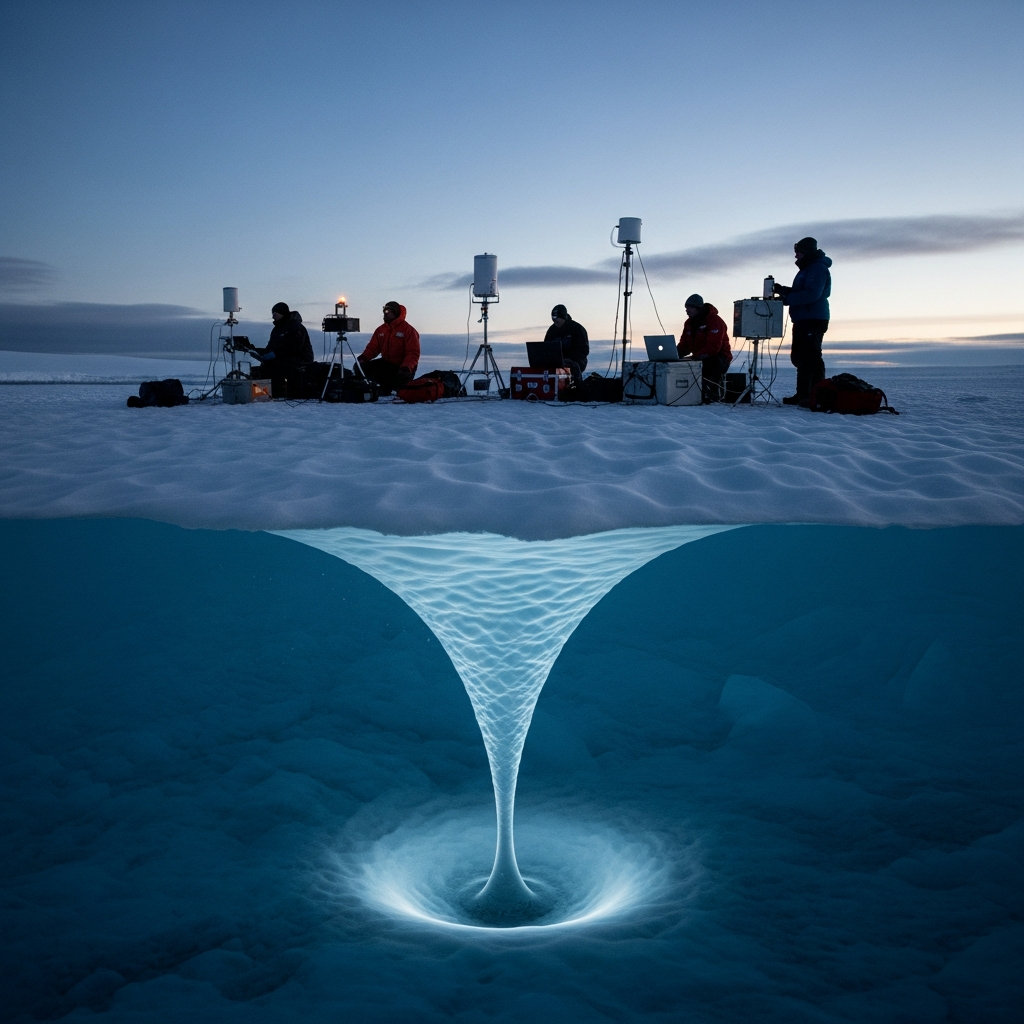
What exactly is a “gravity hole”? On Earth, gravity isn’t uniform. Our planet’s surface, particularly the ocean’s irregular shape known as the geoid, is sculpted by these subtle variations in gravitational force. While these differences are too minute for us to feel in our daily lives, they have a substantial impact on water. Areas with weaker gravity, like parts of Antarctica, naturally experience lower-than-expected sea levels because water tends to flow towards regions with stronger gravitational pull. Scientists from the Paris Institute of Earth Physics describe this phenomenon as a “broad depression in Earth’s gravity field caused by a deficit of mass at depth.”
How Gravity Shapes Our Oceans
These gravitational variances profoundly influence global oceans. Imagine Earth’s surface as a bumpy, dynamic landscape where invisible forces dictate water movement. In regions like Antarctica where gravity is locally diminished, the surrounding ocean water is subtly drawn away. This results in the ocean surface being slightly lower than it would otherwise be. Understanding these intricate interactions is vital, as sea levels and ocean dynamics are deeply intertwined with global climate patterns. Any shift in this delicate balance could have far-reaching consequences.
A Deep Dive into Earth’s Ancient History
New research, published in Scientific Reports, reveals the “gravity hole” beneath Antarctica is not static. Instead, it has a dynamic history. The study indicates that this gravitational anomaly was initially much weaker but underwent significant strengthening between 50 and 30 million years ago. This period is no mere coincidence; it precisely aligns with a pivotal geological era when widespread glaciation began to envelop the Antarctic continent. This discovery suggests a profound, interconnected relationship between Earth’s deep internal processes and the dramatic climate and geological shifts observed on the surface.
Seismic Scans: Illuminating Earth’s Interior
To reconstruct this ancient history, the research team employed an innovative technique akin to performing a “CT scan of the whole Earth.” Since conventional X-rays aren’t an option for planetary-scale imaging, scientists utilize global earthquake recordings. These seismic waves act as “light,” penetrating and reflecting off structures deep within the Earth. By combining this seismic data with geodynamic and mineral-physics information, the team created a detailed 3D model of Earth’s interior. This model allowed them to account for complex factors such as mantle dynamics, gravity field data, and even subtle changes in Earth’s rotational behavior over millions of years.
The Mantle’s Role: A Dance of Hot and Cold
The simulations unveiled a fascinating geological ballet driving the gravity hole’s evolution. Initially, the low gravitational force near Antarctica was primarily attributed to the sinking of cold, dense material deep into the Earth’s mantle. However, a crucial transformation occurred approximately 50 to 30 million years ago. During this epoch, hotter, lighter mantle material began to ascend from deeper regions within the planet. This redistribution of mass—the combined effect of cold, sinking mantle and hot, rising mantle—served to amplify the overall deficit of mass beneath Antarctica. This complex interplay directly led to the observed strengthening of the gravity hole over geological timescales.
Connecting Deep Earth to Surface Challenges
The implications of these deep Earth processes are far-reaching. As the planet warms, understanding the stability of Antarctica’s massive ice sheets becomes paramount. The intricate connections between Earth’s interior, gravitational fields, and sea levels offer critical insights into factors that govern ice sheet growth and stability. Senior author Alessandro Forte, a geophysicist at the University of Florida, emphasizes that comprehending these deep linkages can provide a clearer picture of Antarctica’s geological history and its potential future.
Antarctica’s Broader Battle: Ice Melt and Invisible Threats
The gravity hole is just one dimension of Antarctica’s complex environmental challenges. The continent’s vast ice sheets are undergoing unprecedented changes. For instance, the Thwaites Eastern Ice Shelf, part of the infamous “Doomsday Glacier,” is exhibiting a clear, staged weakening and irreversible collapse. Researchers have tracked the alarming proliferation of cracks within the ice, creating a destructive feedback loop where fractures concentrate stress, accelerating ice flow, which in turn generates new fractures. This highlights how internal stresses and dynamic fracture patterns are critical drivers of ice shelf destabilization. Like the gravity hole, these processes underscore the intricate internal mechanisms at play, whether within the Earth or within the ice itself.
Furthermore, even Antarctica’s most resilient life forms are facing new threats. Studies have revealed that Belgica antarctica, the continent’s only native insect, is now ingesting microplastics. While plastic levels are lower than elsewhere, this discovery signals a subtle but pervasive infiltration of pollutants into even the planet’s most remote ecosystems. Scientists are employing innovative methods, like the deployment of tiny robotic Argo floats, which can spend months under the ice shelves, collecting invaluable data on ocean temperatures and salinity. These diverse research efforts, from studying deep Earth dynamics to tracking microplastics, are collectively enhancing our understanding of this rapidly changing polar region.
The Critical Need for Ongoing Research
A better understanding of this powerful gravity anomaly is essential for several reasons. Sea levels and tide dynamics significantly influence global climate patterns. By elucidating how Earth’s internal structure shapes gravity and, consequently, sea levels, scientists gain crucial insights into factors that directly impact the growth and stability of large ice sheets. This research provides a historical context for understanding Antarctica’s past glaciation events and offers vital clues for predicting the future stability of its ice, which holds enough water to drastically alter global coastlines. Continuing to monitor and model these deep Earth dynamics is key to preparing for the challenges posed by a warming world.
Frequently Asked Questions
What exactly is Antarctica’s ‘gravity hole’ and how does it affect the continent?
Antarctica’s “gravity hole” is an area beneath the continent characterized by a significantly weaker gravitational force compared to the global average. This anomaly is caused by a deficit of mass deep within the Earth’s mantle below Antarctica. Its primary impact is on sea levels; water tends to flow towards areas of stronger gravity, so regions with weaker gravity, like parts of Antarctica, typically have lower-than-expected sea levels. Understanding these variations is crucial because sea levels and ocean dynamics are intricately linked to global climate patterns and the stability of the continent’s vast ice sheets.
How do scientists study changes deep within Earth to understand Antarctica’s gravity?
Scientists study changes deep within Earth by analyzing global earthquake recordings, similar to how a medical CT scan uses X-rays. Earthquake waves act as “light,” illuminating the planet’s interior as they travel through different materials. Researchers combine this seismic data with geodynamic and mineral-physics information to reconstruct a 3D model of Earth’s internal structure. This approach allows them to “rewind the flow of rocks” in the mantle, tracking changes in mass distribution and mantle dynamics over tens of millions of years, which directly influences the strength of the “gravity hole.”
Why is understanding Antarctica’s gravity hole crucial for predicting future sea levels and climate change?
Understanding Antarctica’s gravity hole is crucial because it provides insights into the complex interplay between Earth’s deep interior and its surface climate. The historical strengthening of the gravity hole between 50 and 30 million years ago coincided with major glaciation events in Antarctica. By understanding how Earth’s internal processes shape gravity and influence sea levels, scientists can better predict factors affecting the growth and stability of large ice sheets. This knowledge is vital for improving models of future sea-level rise and for anticipating the long-term impacts of climate change on the planet’s most sensitive ice reservoirs.