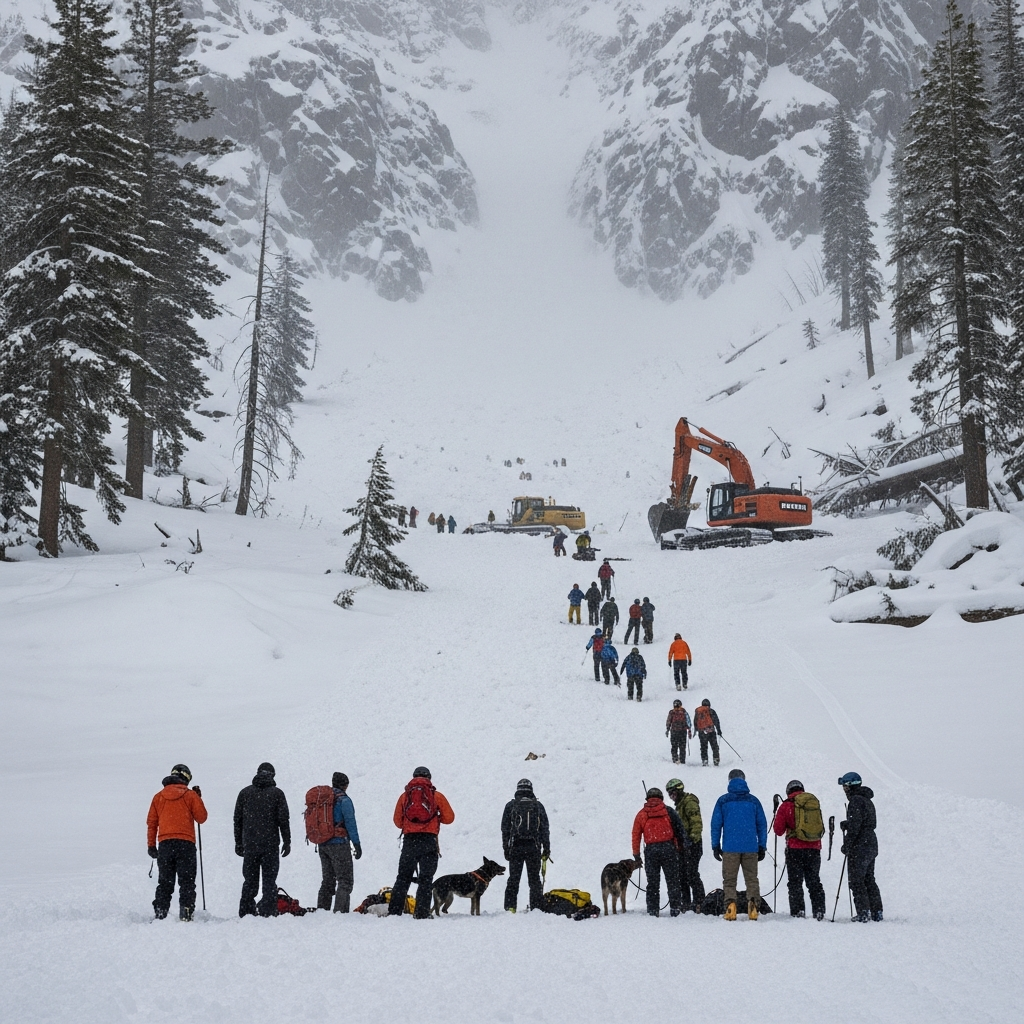
A powerful winter storm brought unprecedented danger to California’s Sierra Nevada mountains this week, culminating in a tragic avalanche that left a group of backcountry skiers in peril. On Tuesday, February 17, 2026, a search and rescue operation was launched after an avalanche struck near Castle Peak, northwest of Lake Tahoe, entombing members of a guided skiing expedition. Six individuals have been found alive and are awaiting extraction, but a harrowing search continues for ten others still missing amidst extreme blizzard conditions.
This unfolding California avalanche incident highlights the critical risks associated with venturing into uncontrolled terrain, especially during severe weather. The region, a popular destination for backcountry skiing, was under a “high avalanche danger” warning, making this a chilling reminder of nature’s formidable power.
The Avalanche Strikes: A Harrowing Incident in the Sierra Nevada
The alarm was raised around 11:30 a.m. on Tuesday when the Nevada County Sheriff’s Office received a 911 call reporting an avalanche with people buried. The group involved was a guided expedition of 16 individuals – four experienced guides and 12 clients – from Blackbird Mountain Guides. They were on the final day of a challenging three-day backcountry skiing trip, having spent two nights in wilderness huts and navigating several miles of rugged, snow-covered terrain.
The incident occurred specifically in the Frog Lake area, a remote and challenging section of the Castle Peak region. This 9,110-foot (2,777-meter) peak in the Donner Summit area is renowned for its dramatic landscapes but also carries a somber history of winter perils, notably linked to the infamous Donner Party tragedy. The unexpected avalanche caught the group off guard, thrusting them into a life-or-death struggle against the overwhelming force of sliding snow.
The Immediate Aftermath and Survival
Miraculously, six of the skiers were located alive following the slide. They were found trapped but able to communicate with rescue teams using emergency beacons, which possess text messaging capabilities. These survivors were advised by officials to shelter in place and await rescue, an agonizing wait in the brutal elements. Showing incredible resourcefulness, the group managed to construct a makeshift shelter using a tarp, an act of sheer will to survive the frigid temperatures and relentless snow.
This incident underscores the vital importance of carrying essential safety equipment like emergency beacons, which played a crucial role in locating the survivors and establishing communication. Without these devices, the chances of a successful outcome in such remote and dangerous conditions would be significantly diminished.
Battling Blizzard Conditions: The Challenging Rescue Operation
The rescue effort is a testament to the bravery and dedication of emergency responders. A massive operation, involving 46 emergency first responders, was immediately mobilized by the Nevada County Sheriff’s Office, its Search & Rescue team, and the California Department of Forestry and Fire Protection. Crews are deploying a variety of resources including snowcats, snowmobiles, and highly skilled individuals on skis to reach the remote location.
However, the rescue is proving to be a slow and arduous process. Rescuers are contending with severe blizzard conditions, treacherous visibility, and the omnipresent threat of triggering additional avalanches. Captain Russell Greene of the Nevada County Sheriff’s Office confirmed that the challenging terrain and extreme weather are significantly impeding progress, making every step forward a calculated risk. The safety of both the missing skiers and the rescue personnel remains paramount.
Communication and Makeshift Shelters
The ability of the located skiers to communicate via their emergency beacons has been a game-changer, providing crucial updates on their condition and location to the rescue coordination center. This intermittent contact offers a glimmer of hope as teams inch closer to their position. The resourcefulness demonstrated by the survivors in creating a temporary shelter with a tarp highlights their preparation and training for unexpected wilderness survival situations. This proactive measure is likely contributing to their ability to withstand the harsh conditions while help is on its way.
The Science of Danger: Why This Avalanche Occurred
The California avalanche was a direct consequence of a powerful winter storm that has been “walloping” the state. This storm brought a dangerous combination of treacherous thunderstorms, gale-force winds, and extremely heavy snowfall to California’s mountain regions. The Sierra Avalanche Center of the Tahoe National Forest, based in Truckee, had issued a “high avalanche danger” warning for the Central Sierra Nevada, including the Greater Lake Tahoe region, effective from Tuesday morning and extending into Wednesday. Large slides were anticipated.
Brandon Schwartz, the lead avalanche forecaster for Tahoe National Forest, explicitly stated that conditions in the backcountry were “particularly dangerous right now just because we’re at the height of the storm.” The primary cause of these hazardous conditions was rapidly accumulating snowfall layering on an already fragile and unstable snowpack, further exacerbated by the powerful winds. This scenario created a ticking time bomb where new snow’s weight and wind-drifted slabs could easily overwhelm weak underlying layers.
Understanding Avalanche Warnings and Backcountry Risk
Avalanche warnings are not to be taken lightly, especially in the backcountry. Unlike regulated ski resorts, which typically implement comprehensive avalanche mitigation programs, the backcountry is uncontrolled wilderness. Here, every decision rests on the judgment and expertise of individuals. During periods of “high avalanche danger,” travel in, near, or below avalanche terrain is strongly discouraged. Even experienced backcountry skiers and guides recognize the need to respect such warnings and avoid unnecessary risks when nature’s forces are at their peak.
More Than Just Snow: Widespread Impact Across California
Beyond the immediate tragedy, the severe winter storm has wreaked havoc across a wide swath of California. Roadways from Sonoma County to the Sierra Nevada experienced significant disruptions. Interstate 80 near the Nevada state line, a critical artery, saw temporary closures in both directions due to numerous spinouts and crashes, as reported by the California Department of Transportation. The sheer volume of snow also presented significant challenges.
The nearby town of Soda Springs recorded at least 30 inches (76 centimeters) of snow in just 24 hours. Forecasters predicted that the western slope of the Sierra Nevada in northern Shasta County, including portions of Interstate 5, and parts of the state’s Pacific Coast Range could receive up to a staggering 8 feet (2.4 meters) of snow before the storm system is expected to move out late Wednesday. This level of snowfall creates immense pressure on infrastructure and significantly increases the risk of further slides.
The Donner Summit: A History of Peril
The Castle Peak area, part of the Donner Summit, holds a grim place in California history. It was here, in 1846-47, that the ill-fated Donner Party met their tragic end, trapped by insurmountable snows. While modern technology and infrastructure have vastly improved, the inherent dangers of this mountainous region in winter remain. The historical context serves as a stark reminder of the unforgiving nature of the Sierra Nevada when severe storms descend, particularly in the deep wilderness that backcountry skiers seek.
Essential Backcountry Skiing Safety: Lessons from the Slopes
This incident serves as a powerful cautionary tale for anyone venturing into uncontrolled winter terrain. Backcountry skiing, also known as off-piste skiing, involves gliding into wilderness areas outside the marked boundaries of ski resorts. This pursuit offers unparalleled beauty and challenge but comes with inherent and often severe risks not present in regulated areas.
To minimize these risks, comprehensive training in avalanche assessment and rescue is not just recommended, but absolutely essential. Skiers must understand how to identify dangerous snowpack, interpret weather patterns, and recognize avalanche terrain. Equally critical is carrying a complete set of safety equipment, including an avalanche transceiver (beacon), probe, and shovel, and knowing how to use them effectively in an emergency. Traveling in a group, never alone, and ensuring all members are proficient in rescue techniques are non-negotiable safety protocols.
The dangers of avalanches are a grim reality of winter sports in the mountains. Annually, 25 to 30 people die in avalanches across the United States, according to the National Avalanche Center. Just last January, a snowmobiler tragically died in an avalanche in this same region, reinforcing the consistent threat these natural phenomena pose. Even for seasoned adventurers, the mountains demand respect and meticulous preparation.
Frequently Asked Questions
What caused the severe avalanche conditions near Lake Tahoe during this incident?
The dangerous conditions were primarily caused by a powerful winter storm bringing rapidly accumulating snowfall and gale-force winds. This new, heavy snow piled onto already fragile and unstable layers of existing snowpack, creating immense stress. The strong winds further contributed by drifting snow into unstable slabs, making the entire structure highly susceptible to collapse and leading to a “high avalanche danger” warning from the Sierra Avalanche Center.
What safety equipment and training are crucial for backcountry skiing?
For safe backcountry skiing, essential safety equipment includes an avalanche transceiver (beacon) for locating buried victims, a probe for pinpointing their exact position, and a shovel for efficient snow removal. Beyond equipment, comprehensive training in avalanche assessment, rescue techniques, and wilderness first aid is critical. Understanding snow science, weather patterns, and proper group travel protocols are also paramount for mitigating risks in uncontrolled terrain.
Is backcountry skiing safe during extreme winter storms, and how does it compare to resort skiing?
Backcountry skiing is significantly more dangerous than resort skiing, especially during extreme winter storms like the one that caused this California avalanche. Resort areas have avalanche mitigation programs, patrolled terrain, and controlled conditions. In contrast, the backcountry is unmanaged wilderness with inherent risks like unstable snowpacks, hidden hazards, and no immediate emergency services. During “high avalanche danger” warnings, travel in backcountry avalanche terrain is strongly discouraged, regardless of skill level, as the risk is deemed unacceptable.
The ongoing rescue operation near Castle Peak stands as a stark reminder of the profound power of nature and the inherent risks of venturing into its most extreme environments. While the immediate focus remains on locating the missing ten skiers and safely extracting the six who have been found, this tragic event also serves to underscore the indispensable need for rigorous preparation, essential safety equipment, and an unwavering respect for the mountain environment. As the search continues, the hopes of the community remain with the missing, and a deep appreciation is extended to the courageous first responders battling unimaginable conditions.