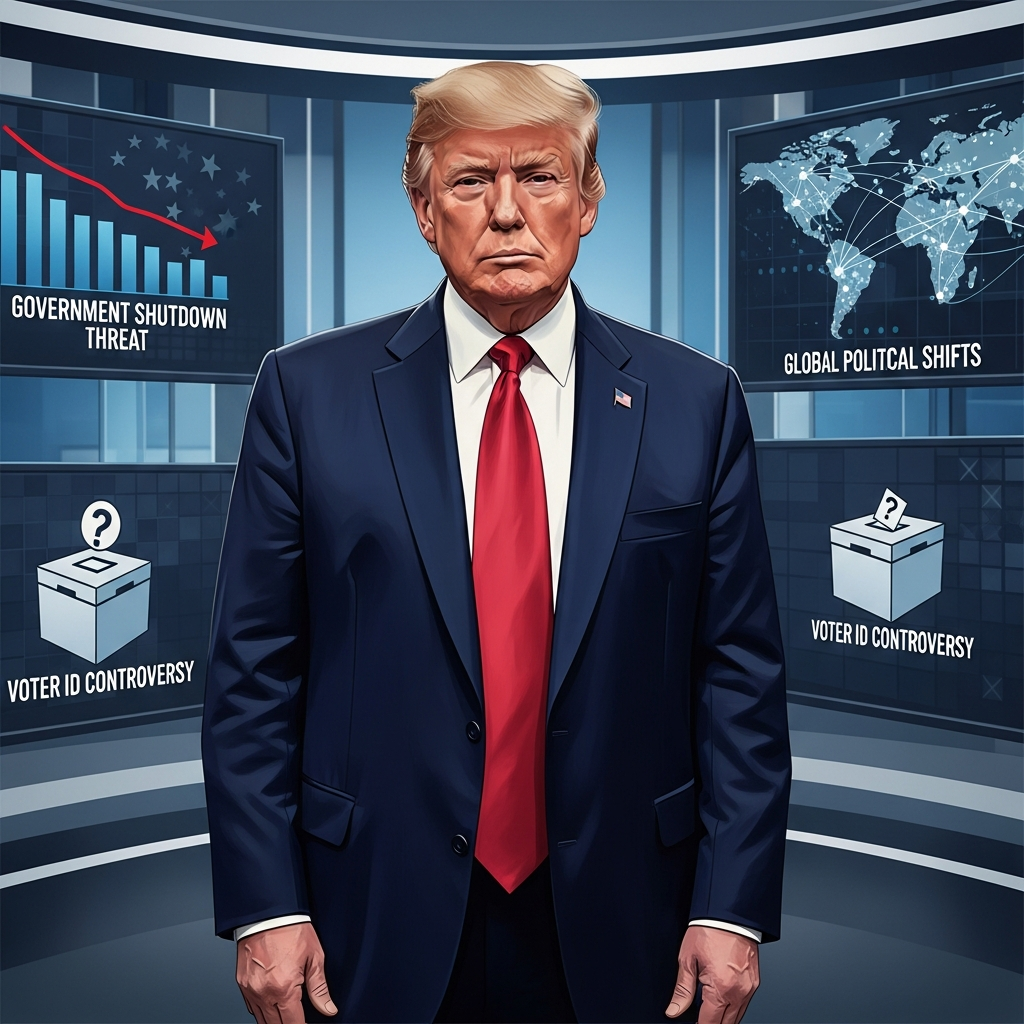
February 13, 2026, marked a whirlwind of activity for the Trump administration, with critical deadlines and controversial policies dominating headlines. From the looming Department of Homeland Security (DHS) shutdown to a defiant stance on voter identification and a turbulent international presence, the day underscored the administration’s confrontational approach to governance. This comprehensive overview dissects the key events, offering insights into their immediate implications and potential long-term impacts across domestic and foreign policy.
Government on the Brink: The DHS Shutdown Standoff
The nation faced the precipice of a DHS shutdown at midnight on February 13, 2026, amid an acrimonious battle over federal immigration enforcement funding. President Donald Trump remained noncommittal on a deal with Democrats, famously stating the party had “gone crazy.” This impasse threatened to disrupt vital services and highlighted deep divisions over border policy.
Immigration Enforcement at the Core
Democrats had laid out a series of demands in negotiations, pushing for independent oversight of Immigration and Customs Enforcement (ICE) and an end to the administration’s “roving” patrols. They viewed these measures as crucial steps to curb what they called the “brutalization” of immigrants. Republicans, however, staunchly opposed these conditions, leading to a fierce legislative stalemate.
Congressional Gridlock and Trump’s Stance
House Democratic Leader Hakeem Jeffries indicated that Democrats were formulating a counterproposal to send to the White House, hoping to break the deadlock. However, Trump’s pessimistic outlook suggested a swift resolution was unlikely. The president praised ICE and Border Patrol, asserting his satisfaction with DHS Secretary Kristi Noem’s performance.
Impact on Essential Services
A funding lapse would directly affect numerous DHS agencies, including the Transportation Security Administration (TSA), the Federal Emergency Management Agency (FEMA), and the Coast Guard. While essential personnel would likely continue to work without pay, the partial shutdown would undoubtedly strain operations and personnel morale.
ICE and CBP Funding Loophole
Despite the looming shutdown, critical operations for ICE and Customs and Border Protection (CBP) were largely insulated. This was due to substantial funding — $75 billion for ICE and $64 billion for CBP — allocated through a separate “big, beautiful bill” enacted during Trump’s presidency. This legislation also granted Secretary Noem broad authority to reallocate funds, essentially providing a “slush fund” that Democrats criticized as enabling continued enforcement despite congressional opposition.
Election Integrity Battle: Trump’s Voter ID Mandate
On February 13, President Trump escalated his push for national voter identification, vowing to implement requirements for the upcoming November midterm elections “whether approved by Congress or not.” This declaration sparked immediate debate regarding presidential authority and the future of election administration.
Executive Order Threat Amid Congressional Push
Trump announced on Truth Social his intention to present an “irrefutable” legal argument for national voter ID via an executive order. This move came despite elections traditionally being managed by state and local officials, with the Constitution not explicitly granting the president a role in setting voting rules. This wasn’t Trump’s first attempt to dictate election guidelines; he had previously signed an executive order requiring citizenship documents for voter registration, which three judges subsequently blocked.
The SAVE Act and Proof of Citizenship Debate
Earlier in the week, the GOP-controlled House passed the “Safeguard American Voter Eligibility (SAVE) Act.” This bill, a key Trump initiative, would mandate photo ID for federal elections and proof of U.S. citizenship for voter registration, while also restricting mail-in ballots (with exceptions). Though it passed the House, the SAVE Act faced a formidable challenge in the Senate, requiring bipartisan support unlikely to materialize. External research highlighted that an earlier version of this bill, which required proof of citizenship before each ballot cast, faced heavy criticism due to the millions of Americans lacking such specific documents.
Constitutional Questions and State Authority
Trump’s insistence on federalizing voter ID directly confronts the U.S. Constitution, which designates states as responsible for administering elections. Critics argued that the president’s proposed executive action would represent an unprecedented overreach, challenging the foundational principles of federalism.
Bipartisan Support vs. Disenfranchisement Concerns
Despite the political controversy, a 2025 Pew Research Center study indicated strong bipartisan support for photo ID requirements, with 95% of Republicans and 71% of Democrats in favor. However, voting rights advocates and Democratic leaders remained steadfast in their opposition. They argued that obtaining photo identification could be a significant barrier for low-income and marginalized communities, potentially disenfranchising eligible citizens. They viewed Trump’s renewed focus on voter ID as a strategic move ahead of the midterms, aimed at energizing his base and addressing his declining poll numbers, while also expressing concerns about potential impeachment if Democrats took control of the House.
Foreign Policy Crossroads: Global Tensions and Alliances
The Trump administration’s foreign policy continued to be a focal point on February 13, marked by mixed messages, escalating tensions, and skepticism from international allies.
Munich Security Conference: US Credibility Questioned
At the Munich Security Conference, European leaders expressed “significant unease” over Trump’s policies. German Chancellor Friedrich Merz noted a “divide” between Europe and the U.S., warning that the international world order “no longer exists” and that the U.S. claim to leadership might be “lost.” California Governor Gavin Newsom, attending as a counter-voice, observed that world leaders viewed the U.S. as a “wrecking ball” and “unreliable,” questioning its ability to return to its previous form.
AOC’s Critique: Dismantling Alliances and Authoritarianism
Adding to the chorus of concern, Representative Alexandria Ocasio-Cortez delivered a sharp critique at Munich. She accused Trump of actively dismantling transatlantic alliances and attempting to usher in an “age of authoritarianism.” Ocasio-Cortez condemned specific US actions, including the capture of Venezuela’s Nicolás Maduro, Trump’s threats to annex Greenland, and the administration’s “unwavering support” for Israel’s actions in Gaza, which she controversially linked to “genocide.” She also expressed concern that Trump aimed to dominate the Western Hemisphere as his “personal sandbox,” while allowing figures like Vladimir Putin to assert influence in Europe.
Escalating Pressure on Iran
President Trump revealed plans to deploy a second U.S. aircraft carrier group, the USS Gerald R. Ford, to the Middle East. This escalation was intended to exert pressure on Iran amidst ongoing, yet pessimistic, nuclear deal negotiations. Trump expressed doubt about Iran’s sincerity in talks, even suggesting that “regime change” might be “the best thing that could happen.” He reaffirmed that further military action was possible if a “right deal” wasn’t reached, even implying that recent strikes had “obliterated” Iran’s nuclear facilities.
Venezuela: A Shifting Relationship
In a surprising turn, Trump praised Venezuela’s acting President Delcy Rodriguez, claiming the relationship between the two countries was “now a 10.” This statement came as he prepared to honor U.S. service members at Fort Bragg for their role in capturing former Venezuelan President Nicolás Maduro. Trump touted the operation as a “signature foreign policy achievement,” even as Ocasio-Cortez criticized it at Munich. Trump hinted at a future visit to Venezuela, highlighting perceived cooperation on oil production.
US Strikes on Alleged Drug Trafficking Boats
The U.S. military conducted another strike against an alleged drug-trafficking boat, resulting in three fatalities. This incident, confirmed by U.S. Southern Command, brought the total death toll in “Operation Southern Spear” to 124. The campaign targets suspected narco-trafficking routes in the Caribbean, with the administration asserting it aims to curtail narcotics flow.
Domestic Policy and Legal Challenges Under Scrutiny
Amid the international and legislative drama, several domestic policy decisions and ongoing legal battles continued to shape the administration’s narrative.
NY Tunnel Funding Unfrozen Amid Legal Battle
A federal judge intervened to unfreeze some funding for the crucial Gateway rail tunnel project connecting New York and New Jersey. District Judge Jeannette Vargas ruled that the administration must release federal funds, citing the “immediate and severe impact” of a work stoppage. Despite an appeals court declining to immediately pause Vargas’ order, the Trump administration had previously linked the release of funds to Senate Minority Leader Chuck Schumer agreeing to rename New York’s Penn Station and Virginia’s Dulles International Airport after President Trump. The Gateway Development Commission confirmed receiving an initial $30 million, with a full $205 million expected, allowing them to plan for resuming construction.
Controversial Vaccine Guidelines for Children
The Trump administration faced legal challenges over its revamped vaccine guidelines for children. Medical groups, including the American Academy of Pediatrics, sought a court order to block the changes, arguing that Health and Human Services Secretary Robert F. Kennedy Jr. bypassed proper legal channels due to his “anti-vaccine agenda.” They also requested the cancellation of an upcoming meeting of the Advisory Committee on Immunization Practices (ACIP). The administration countered, asserting Kennedy’s legal authority to make these modifications. This development unfolded as a healthcare advocacy group had also called for Kennedy’s resignation after he made controversial remarks downplaying Covid risks.
State Department Reorganization and USAID’s Fate
Sources close to CNN revealed the State Department’s plan to form a new bureau for disaster response and humanitarian assistance. This reorganization followed the Trump administration’s earlier elimination of the U.S. Agency for International Development (USAID) and the transfer of its responsibilities. While some saw institutional logic in combining these efforts, significant concerns remained regarding funding and staffing, especially given the previous sharp cuts to humanitarian aid and the widespread job losses at USAID. The new bureau would be led by a Senate-confirmed assistant secretary, reporting to Jeremy Lewin, a former Department of Government Efficiency (DOGE) official instrumental in dismantling USAID.
Minneapolis Economic Hardship from Immigration Crackdown
Minneapolis Mayor Jacob Frey publicly appealed to the Trump administration for financial assistance, citing a staggering $203 million in economic hardship suffered by the city in January due to an aggressive immigration crackdown dubbed “Operation Metro Surge.” This operation deployed approximately 3,000 federal officers, causing widespread fear and leading to lost wages, decreased small business revenue, increased rent assistance needs, and hotel cancellations. Mayor Frey demanded reimbursement for emergency response and “humanitarian assistance,” questioning the value of an operation that inflicted such measurable damage.
El Paso Airspace Closure Controversy
An abrupt and unexplained 10-day closure of airspace over El Paso, Texas, sparked a blame game within the administration. While the White House reportedly faulted the Federal Aviation Administration (FAA) for failing to alert senior aides, President Trump publicly praised Transportation Secretary Sean Duffy, dismissing concerns by saying, “People learn.”
Racism Allegations and GOP Backlash
President Trump privately railed against Republican lawmakers who condemned a racist video posted to his Truth Social account, depicting the Obamas as apes. Sources reported his anger at Senator Tim Scott and Senator Katie Britt, questioning their loyalty and vowing consequences. Britt’s office denied the account, while Scott’s declined comment. Trump had earlier refused to apologize for the video and stated no White House staffer had been disciplined for the offensive content.
Key Supreme Court Immigration Cases Impacting the Nation
The Supreme Court continued to be a battleground for significant immigration policy on February 13, with four major cases underscoring the legal complexities and the administration’s persistent efforts to reshape immigration law.
Birthright Citizenship Under Threat (Trump v. Barbara)
Perhaps the term’s most high-profile case, Trump v. Barbara, scheduled for April 1, challenges birthright citizenship. The justices are reviewing an executive order signed by Trump that aims to deny automatic citizenship to children born in the U.S. to parents temporarily or illegally present. This policy directly targets the 14th Amendment’s citizenship clause, with the administration arguing it was intended for “newly freed slaves and their children,” not universal application. Challengers cite an 1898 Supreme Court precedent affirming birthright citizenship for nearly all persons born in the U.S. A ruling, expected by early July, could fundamentally alter U.S. immigration law.
Asylum Seekers and Border Crossing Rules (Noem v. Al Otro Lado)
Set for argument on March 24, Noem v. Al Otro Lado examines whether asylum seekers must physically cross the border to “arrive in the United States” and apply for asylum. This case originated from the Trump administration’s “metering” policies, which turned away asylum seekers at the border. The 9th Circuit Court of Appeals had ruled that presenting oneself to immigration officials, even in Mexico, constitutes “arrival.” The Supreme Court’s decision will significantly impact future border policies across administrations.
Defining Persecution for Asylum (Urias-Orellana v. Bondi)
In Urias-Orellana v. Bondi, the Court is deliberating the extent to which federal courts must defer to the Board of Immigration Appeals (BIA) when determining if an asylum seeker has experienced or fears persecution. Justices during oral arguments appeared to lean towards considering this a factual inquiry, which would limit appellate court oversight and potentially reduce an asylum seeker’s chances of successfully challenging a BIA denial.
Green Card Holders’ Rights (Bondi v. Lau)
The case of Bondi v. Lau, set for April 22, concerns the rights of lawful permanent residents (LPRs) charged with, but not yet convicted of, deportable crimes. The Court will decide if immigration officers can “parole” LPRs back into the country, rather than readmitting them, thereby making them immediately subject to inadmissibility criteria and easier to deport upon conviction. A ruling against the LPR in this case would grant the federal government increased power to channel individuals into the “immigration detention and deportation pipeline.”
Judicial Intervention: Protecting the Wrongfully Deported
The day also saw judicial scrutiny of the administration’s immigration practices, particularly concerning wrongful deportations and alleged disregard for court orders.
The Case of Any Lucia Lopez Belloza
A U.S. District Judge mandated the Trump administration to facilitate the return of Any Lucia Lopez Belloza, a 19-year-old Babson College student wrongfully deported to Honduras. Her deportation on November 22, 2025, directly violated a court order barring her removal from Massachusetts. The administration offered an apology, attributing the error to a “mistake of one ICE agent,” but resisted efforts to facilitate her return, citing an older removal order and questioning the court’s authority to intervene.
Pattern of Disregarding Court Orders
Critics viewed Lopez Belloza’s case as part of a troubling pattern. Previous instances included Kilmar Abrego Garcia, a Salvadoran father wrongfully deported despite a court order, and OCG, a Guatemalan man deported despite protection due to fears of persecution as a gay man. Both individuals were eventually returned to the U.S. following further court intervention, with OCG’s deportation explicitly noted as lacking “any semblance of due process.” These cases underscored broader accusations that the Trump administration often disregarded judicial rulings and violated due process rights in its aggressive immigration crackdowns.
Beyond the Headlines: Other Notable Developments
Beyond the major policy debates, February 13, 2026, brought other significant news items.
Epstein Files and Political Connections
New Jeffrey Epstein files continued to generate headlines. Democratic Representative Ro Khanna named six individuals on the House floor, alleging they were “wealthy, powerful men that the DoJ hid.” However, the Department of Justice clarified that four of these had no apparent connection to Epstein. Separately, Kathy Ruemmler, Goldman Sachs’s top lawyer, resigned after emails in the Epstein files revealed a close relationship with the convicted sex offender.
Inflation Moderates, but Tariffs’ Lingering Impact
U.S. inflation moderated in January, falling to 2.4%, a decrease attributed to the easing of price fluctuations initially triggered by Trump’s tariffs from the previous year. The Consumer Price Index (CPI) rose by a modest 0.2% from December to January, with core CPI increasing by 0.3%.
XAI and Environmental Concerns
Elon Musk’s artificial intelligence company, xAI, faced scrutiny after it was found to be fueling its datacenters with unpermitted gas turbines in Mississippi, allegedly violating an EPA ruling.
DOJ Sues Harvard Over Discrimination Claims
The Department of Justice filed a new lawsuit against Harvard University, accusing it of failing to comply with a federal investigation into alleged racial discrimination in its admissions process. This marked an escalation in the Trump administration’s ongoing legal challenges against the esteemed institution. Additionally, a new congressional investigation revealed the administration had spent over $32 million to deport approximately 300 immigrants to countries with which they had no connection, many subsequently deported to their home nations at additional taxpayer expense.
Frequently Asked Questions
What were the main issues leading to the potential DHS shutdown on February 13, 2026?
The primary driver behind the looming Department of Homeland Security (DHS) shutdown was a bitter funding dispute over federal immigration enforcement. Democrats demanded increased oversight of ICE and an end to certain Trump administration immigration patrols, while President Trump remained unyielding on these concessions. The impasse threatened to cut funding for agencies like TSA and FEMA, though ICE and CBP operations remained largely funded by a separate “big, beautiful bill” and the DHS Secretary’s discretionary “slush fund.”
How did the Trump administration’s proposed voter ID mandate challenge existing election laws?
On February 13, 2026, President Trump vowed to impose national voter identification requirements for the midterms, even without congressional approval, threatening an executive order. This directly challenged the U.S. Constitution, which assigns states, not the federal government, the authority to administer elections. Trump’s proposed “irrefutable” legal argument and the House-passed SAVE Act, which sought to nationalize voter ID and restrict mail-in ballots, sparked debate over federal overreach and potential voter disenfranchisement, despite high public support for voter ID.
What significant Supreme Court cases on immigration could reshape US policy following February 13, 2026?
Following February 13, 2026, the Supreme Court was poised to rule on several critical immigration cases. Trump v. Barbara directly challenges birthright citizenship under the 14th Amendment, potentially altering a foundational aspect of U.S. law. Noem v. Al Otro Lado questions whether asylum seekers must physically cross the border to apply for asylum. Urias-Orellana v. Bondi addresses federal court deference to the Board of Immigration Appeals in persecution determinations, and Bondi v. Lau examines the rights of green card holders charged with deportable crimes, impacting the government’s power to deport.
Conclusion
February 13, 2026, presented a complex snapshot of the Trump administration’s priorities and ongoing challenges. From domestic policy battles like the DHS shutdown and the contentious voter ID debate to the intricate dance of international diplomacy at the Munich Security Conference and escalating tensions with Iran, the day’s events underscored a presidency marked by assertive action and profound political polarization. The unfolding legal battles, particularly at the Supreme Court regarding immigration, hint at a potentially transformative period for American law and society. As these stories continue to develop, they will undoubtedly shape the political landscape and influence global perceptions of U.S. leadership.