High-Stakes Diplomacy: Trump and Xi Address Global Flashpoints
In a pivotal moment for international relations, U.S. President Donald Trump and Chinese President Xi Jinping engaged in a wide-ranging phone call on Wednesday, February 4, 2026. This crucial discussion spanned critical issues including mounting tensions with Iran, complex trade dynamics, and the sensitive status of Taiwan. The call underscored the United States’ intensifying push for Beijing and other nations to further isolate Tehran, highlighting a period of significant geopolitical reorientation. President Trump characterized his personal relationship with President Xi as “extremely good,” emphasizing its vital importance for global stability. However, Beijing’s official readout of the call, while acknowledging discussions on upcoming major summits, notably omitted any mention of Trump’s anticipated April visit to China, signaling underlying strategic differences.
The conversation comes amidst a backdrop of elevated global uncertainty, with the U.S. actively pursuing a peace and nuclear weapons deal with Iran. This diplomatic exchange between the leaders of the world’s two largest economies has far-reaching implications, shaping alliances and trade flows worldwide.
Unpacking the Iran Conundrum: US Pressure vs. Enduring Ties
The situation in Iran dominated a significant portion of the Trump-Xi dialogue. Tensions between Washington and Tehran remain critically high following Iran’s bloody crackdown on nationwide protests last month. President Trump indicated he is actively considering military action against the Middle Eastern nation. His administration has consistently pressed Iran for concessions on its nuclear program, asserting that its capabilities were significantly “set back” by a U.S. bombing campaign on three Iranian nuclear sites during a 12-day conflict initiated by Israel in June.
In a diplomatic development, U.S. and Iranian officials have agreed to hold high-level talks on Friday in Oman, a location change insisted upon by Iran from the initially planned Turkey. While the U.S. administration expressed “deep skepticism” about the talks’ success, it agreed to the shift out of respect for regional allies. To bolster its efforts to isolate Tehran, Washington had previously announced a substantial 25% tax on imports from any country continuing business with Iran. This policy directly targets China, which stands as Iran’s largest and most reliable trading partner.
Beijing’s Economic Lifeline to Tehran
Despite years of international sanctions designed to cripple its economy and halt nuclear advancements, Iran demonstrated remarkable resilience in 2024. The World Trade Organization reported Iran conducted nearly $125 billion in international trade that year. A substantial $32 billion of this trade was with China, highlighting Beijing’s critical role as an economic lifeline for Tehran. Other key partners included the United Arab Emirates with $28 billion and Turkey with $17 billion. These figures underscore the considerable challenge Washington faces in its efforts to achieve complete economic isolation for Iran, as major global players maintain strategic economic ties.
Taiwan’s Status: A Persistent Geopolitical Fault Line
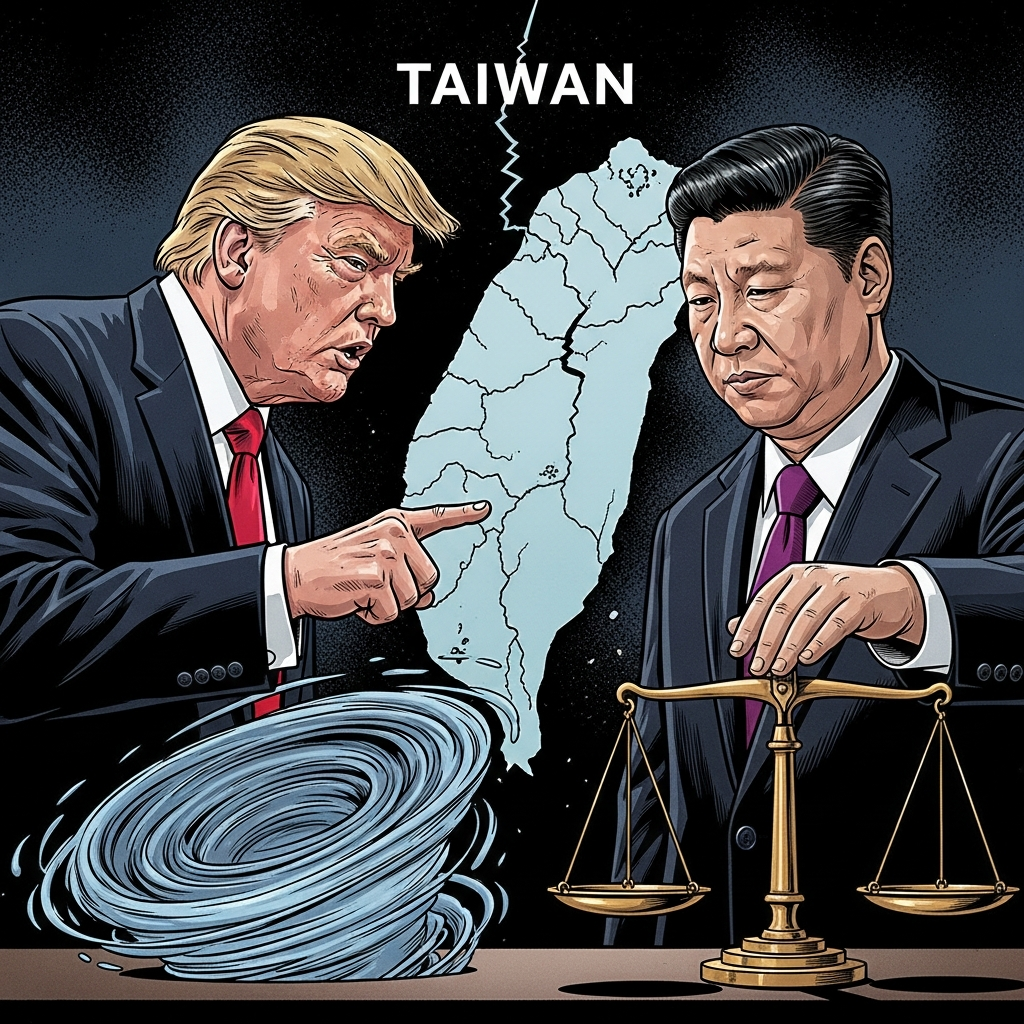
The sensitive issue of Taiwan also featured prominently in the Trump-Xi discussions. China explicitly reiterated its unwavering “long-term plans of reunification” with Taiwan, a self-governing, democratic island that operates independently despite Beijing’s claims of sovereignty. The Chinese government statement was resolute: “Taiwan will never be allowed to separate from China.” This firm declaration arrived in the wake of the Trump administration’s massive arms sales package to Taiwan in December. Valued at over $10 billion, the deal included medium-range missiles, howitzers, and drones, drawing an “angry response” from Beijing, which urged the U.S. to handle arms sales to Taiwan with “prudence.” This ongoing arms assistance continues to be a significant flashpoint in US-China relations, challenging Beijing’s “One China” principle.
Beyond Bilateral: Broader Global Power Shifts
The phone call between Trump and Xi did not occur in a vacuum but against a backdrop of complex and intersecting global events. On the very same day, President Xi also spoke with Russian President Vladimir Putin, signaling a strengthening of ties between Beijing and Moscow. This engagement holds particular weight as the New START treaty, the last remaining nuclear arms pact between Russia and the United States, was set to expire the following day. Its expiration threatened to remove caps on the world’s two largest atomic arsenals for the first time in over half a century. President Trump has voiced a strong desire to maintain limits on nuclear weapons but insists on China’s inclusion in any potential new treaty, stating, “China should be a member of the extension” and “a part of the agreement.”
Simultaneously, the Trump administration convened a ministerial meeting in Washington with several dozen European, Asian, and African nations. The primary objective of this gathering was to discuss strategies for rebuilding global supply chains for critical minerals without reliance on Beijing. Vice President JD Vance emphasized this “opportunity at self-reliance,” aiming for nations to become independent for these essential ingredients used in high-tech products like jet engines and smartphones—a market currently dominated by China. Notably, discussions did not include President Trump’s controversial and repeatedly rebuffed calls for the U.S. to acquire Greenland, the Arctic territory controlled by Denmark, a proposal that has drawn strong opposition from Denmark and other European leaders.
Reshaping Global Trade and Alliances
Trump’s tariff policies have significantly disrupted global trade, compelling many U.S. economic partners to seek expanded trade and investment opportunities elsewhere. This trend is evident in recent diplomatic achievements: Vietnam and the European Union upgraded their ties to a comprehensive strategic partnership last month. The EU and India also announced a free-trade agreement shortly thereafter. Furthermore, Canada struck a deal to reduce its 100% tariff on Chinese electric cars in return for lower tariffs on Canadian farm products. These developments highlight a broader strategic realignment as nations navigate the complexities of international trade and geopolitical competition. Despite these tensions, economic ties remain crucial; China has notably committed to purchasing 20 million tons of U.S. soybeans for the current season and 25 million tons for the next, alongside significant purchases of U.S. oil and gas.
Frequently Asked Questions
What were the primary discussion points between Trump and Xi?
The crucial phone call between U.S. President Donald Trump and Chinese President Xi Jinping on February 4, 2026, covered a comprehensive agenda. Key topics included the escalating situation in Iran, with the U.S. urging China to isolate Tehran, as well as complex trade relations and the contentious issue of Taiwan’s status. They also touched on broader geopolitical concerns like the expiring New START nuclear treaty, critical mineral supply chains, and Trump’s unconfirmed plans to visit Beijing in April.
How do US tariffs impact China’s trade relationship with Iran?
The U.S. administration’s announcement of a 25% tax on imports from countries doing business with Iran directly targets China, which is Iran’s largest trading partner. Despite years of sanctions, Iran conducted nearly $125 billion in international trade in 2024, with China accounting for a significant $32 billion. These tariffs aim to pressure China to reduce its economic ties with Tehran, but China’s strategic interests and its role as a crucial lifeline for Iran’s economy make complete disengagement challenging, highlighting the complexities of enforcing U.S. sanctions.
What are the wider geopolitical implications of these US-China discussions?
The extensive Trump-Xi call underscores a period of profound global geopolitical shifts. It highlights escalating tensions over Iran, the enduring flashpoint of Taiwan, and the crucial race for control over critical mineral supply chains. The simultaneous Xi-Putin call and the impending expiration of the New START treaty further emphasize a shifting global power balance, potentially signaling a more multipolar world. Moreover, U.S. tariff policies are compelling other nations to forge new trade alliances, reshaping international economic and political landscapes.
Conclusion: Navigating a Complex Global Chessboard
The wide-ranging call between Presidents Trump and Xi underscores the intricate web of global challenges and the delicate balance of power that defines international relations in 2026. From the immediate pressures on Iran and the enduring dispute over Taiwan to the strategic competition for critical resources and the uncertain future of nuclear arms control, the discussions reveal a world in constant flux. While leaders articulate desires for stable relationships, underlying geopolitical realities and national interests often dictate a more complex and competitive path. The outcomes of these high-stakes dialogues will undoubtedly continue to shape international alliances, economic policies, and the pursuit of global stability for years to come.