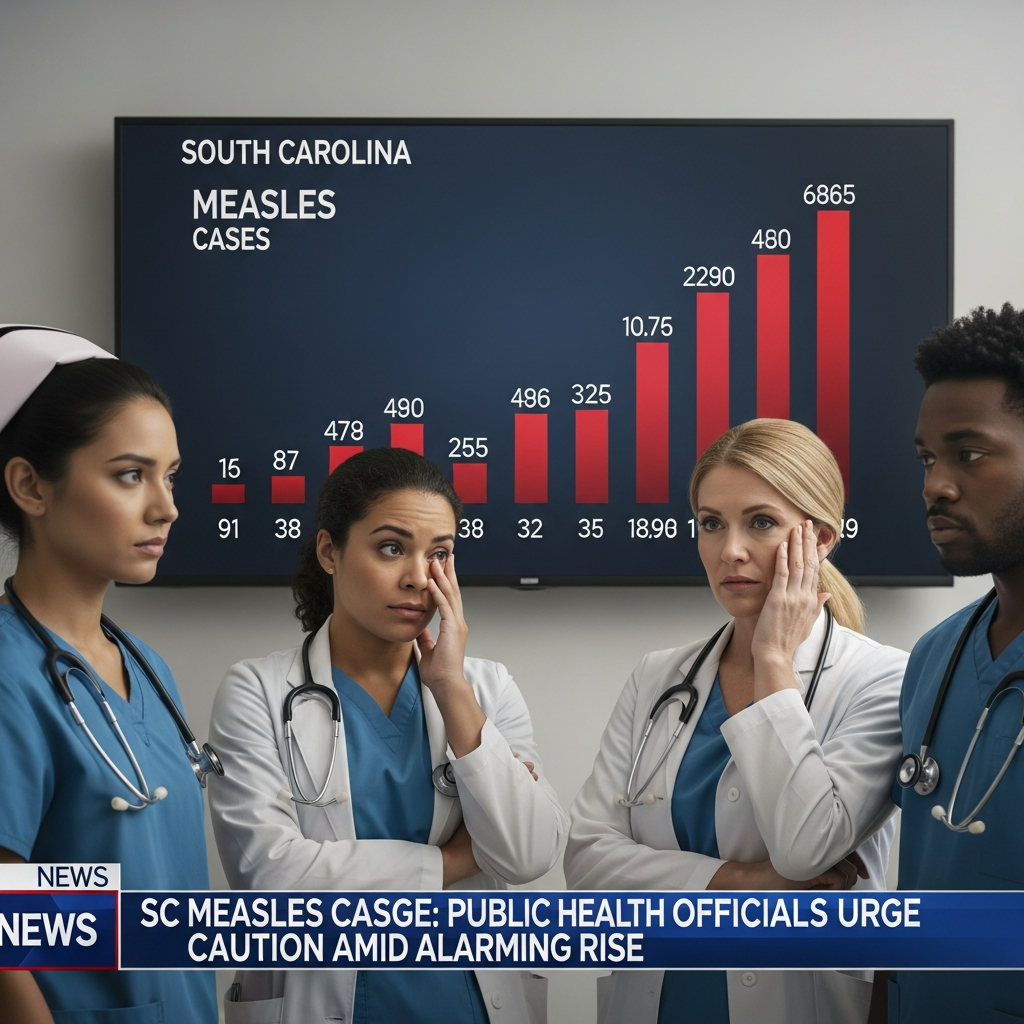
South Carolina is grappling with a rapidly intensifying measles outbreak, now reaching a staggering 876 confirmed cases. This represents a significant public health challenge, with 29 new infections reported since January 30 alone. The escalation places immense pressure on local health authorities and underscores a growing national concern over vaccine-preventable diseases. This report details the severity of the South Carolina crisis, examines its broader implications across the U.S., and briefly touches on other critical public health developments concerning long COVID and influenza vaccines.
South Carolina’s Escalating Measles Crisis
The South Carolina Department of Public Health (DPH) confirms the state’s measles outbreak total has climbed to 876 cases. This rapid increase, with 29 new cases since January 30, signals a highly active transmission chain. Public health officials are working diligently to contain the spread.
The primary epicenter remains Spartanburg County, accounting for a vast majority of cases. A shocking 96% (841 cases) of the total infections are concentrated here. Smaller clusters have also emerged in nearby Upstate counties. Greenville County reports 28 cases, while Anderson and Cherokee counties each have fewer than five.
A recent development includes a confirmed measles case in a Sumter County resident. This county, located in the central Pee Dee region, is now under scrutiny. Investigators are actively determining if this new infection links to the Spartanburg outbreak or if it stems from a separate exposure source. This case highlights the potential for wider geographical dissemination.
The Alarming Role of Unvaccinated Individuals
A stark reality of the current outbreak is the vaccination status of those affected. An overwhelming 800 confirmed case-patients were unvaccinated against measles. This represents roughly 97% of all cases where vaccination status is known. Only 22 individuals were fully vaccinated, and 16 were partially vaccinated. The vaccination status for 38 patients remains unknown.
The outbreak disproportionately impacts younger age groups. Almost two-thirds of cases (555) have occurred in patients aged 5 to 17 years. Additionally, 233 cases are in children under the age of 5. These numbers emphasize the vulnerability of unvaccinated youth to this highly contagious virus.
Public Exposure Sites and Contagion Risks
DPH has identified multiple sites of possible public exposure. These include restaurants and grocery stores within Sumter County. Such public locations underscore the ease with which measles can spread in a community.
Measles is one of the most infectious viruses known. It can remain airborne in a room for up to two hours after an infected person has left. Furthermore, up to 90% of unvaccinated individuals exposed to the virus will become ill. Infected individuals can also be contagious for four days before the characteristic rash appears. This makes undetected transmission a significant challenge for containment efforts. Currently, 354 people are in quarantine and 22 in isolation in South Carolina to prevent further spread.
The outbreak has severely impacted educational settings. Officials have identified measles exposures in 23 schools. In 20 of these, hundreds of unvaccinated and exposed students have been identified and quarantined. A total of 557 students are currently under quarantine. This disrupts education and adds considerable stress for families.
A National Health Alert: Beyond South Carolina
The South Carolina outbreak is not an isolated incident. It is part of a concerning national trend. This surge poses a grave risk to the United States’ measles elimination status, achieved in 2000. Experts note that 2025 was the worst year for measles spread in the U.S. since 1991. It recorded 2,255 confirmed cases across nearly 50 different outbreaks.
By Thursday of the current year, the U.S. Centers for Disease Control and Prevention (CDC) had already confirmed 416 measles cases nationwide. This figure represents nearly 20% of the previous year’s total, highlighting a rapid escalation. Beyond South Carolina, cases have been reported in at least a dozen other states. These include California, Florida, Georgia, Idaho, Kentucky, Minnesota, North Carolina, Ohio, Oregon, Utah, Virginia, and Washington.
Other Major Outbreaks Across the U.S.
Several other significant outbreaks are contributing to the national concern. Ave Maria University in Florida has reported at least 12 confirmed cases. Four of these patients required hospitalization. Health officials suspect student holiday travel from another state as the origin. Similar outbreaks have affected the University of Wisconsin-Madison and Clemson University.
Another major cluster is concentrated along the Utah-Arizona border towns of Hildale and Colorado City. Health officials in Arizona have documented 222 cases in Mohave County. Utah has confirmed 216 cases, with 55 emerging in just the past three weeks. These outbreaks underscore the widespread nature of the current measles threat.
North Dakota, despite having no active cases, is actively preparing for a potential outbreak. Fourteen states are currently reporting measles cases, a substantial increase from previous years. This proactive approach by North Dakota’s Department of Health and Human Services (HHS) reflects the national urgency.
Declining Vaccination Rates: The Underlying Challenge
A critical factor fueling these outbreaks is a nationwide decline in childhood vaccination rates. This trend has been observed since the COVID-19 pandemic. An increasing number of parents are claiming religious or personal conscience waivers. These waivers exempt their children from required vaccinations.
This decline directly undermines “herd immunity.” Herd immunity requires a vaccination rate typically above 95% to prevent widespread transmission. When vaccination coverage falls below this threshold, communities become highly vulnerable to outbreaks. The MMR (Measles, Mumps, and Rubella) vaccine is highly effective. Two doses provide 97% protection against measles and offer lifelong immunity. Restoring high vaccination rates is crucial for protecting public health.
Understanding Measles: Symptoms, Risks, and Prevention
Measles begins with an initial infection of the respiratory tract. It then spreads throughout the body. Symptoms typically emerge 7 to 14 days post-exposure, though the incubation period can extend up to 21 days. Initial signs include a high fever, runny nose, cough, and red watery eyes. These are followed by the characteristic measles rash. The rash typically appears on the face and spreads downwards.
While most people recover, measles can lead to severe complications. These include pneumonia, blindness, brain swelling (encephalitis), and even death. Unvaccinated individuals, especially young children and those with compromised immune systems, are at highest risk for severe outcomes. Prompt diagnosis and isolation of infected individuals are essential to prevent further transmission.
The MMR vaccine remains the most effective prevention strategy. Children typically receive their first dose between 12 and 15 months old. A second dose is recommended between 4 and 6 years old. Maintaining the recommended vaccination schedule is vital for community protection.
Broader Public Health Insights: Long COVID & Flu Vaccine Advances
Beyond the immediate measles threat, other significant public health challenges are being addressed globally. Recent research sheds light on the long-term impact of COVID-19 and the potential of advanced influenza vaccines.
Long COVID: Persistent Impairments Years Later
A recent cohort study published in BMC Public Health reveals concerning insights into Long COVID, or post-COVID-19 condition (PCC). Researchers from Karolinska Institutet followed non-hospitalized adults with PCC for up to 2.5 years after infection. They found persistent physical and mental health impairments were common.
Participants, mostly middle-aged women, showed slow and incremental recovery. However, these improvements were often not clinically meaningful. At 2.5 years, about half of the participants still reported severe shortness of breath (dyspnea). They also experienced symptoms of moderate to severe depression. Additionally, 42% exhibited impaired lower-body strength. Factors such as impaired physical performance, low physical activity, depression symptoms, and older age were linked to poorer long-term health. These findings highlight the ongoing need for research into PCC recovery trajectories.
The Future of Flu Prevention: WHO’s Vision for Improved Vaccines
A new World Health Organization (WHO) report projects a massive potential impact from improved seasonal influenza vaccines. Titled “The Full Value of Improved Influenza Vaccine Assessment,” the report evaluates the health, economic, and policy implications of next-generation vaccines. It estimates that broad use of these enhanced vaccines could prevent 6.6 to 18 billion additional influenza cases globally between 2025 and 2050. This could also avert 2.3 to 6.2 million deaths and 21 to 57 million disability-adjusted life years (DALYs).
The report emphasizes the significant economic benefits of more effective and long-lasting flu vaccines for most WHO member states. The market for seasonal influenza vaccines remains large and commercially viable. These vaccines could be cost-saving or cost-effective in many countries when priced appropriately. The WHO stresses that addressing development, market demand, and implementation challenges will be key to significantly reducing the global influenza burden. This is particularly crucial in low- and middle-income countries.
Frequently Asked Questions
How severe is the current measles outbreak in South Carolina, and which areas are most affected?
The South Carolina measles outbreak is severe, with 876 confirmed cases reported. It has seen a rapid escalation, making it one of the largest in the U.S. in recent history. The vast majority of cases (96%, or 841) are concentrated in Spartanburg County. While smaller numbers are in Greenville, Anderson, and Cherokee counties, a new case in Sumter County in the Pee Dee region is under investigation, indicating potential spread beyond the Upstate epicenter.
What actions can individuals take to protect themselves and their communities from measles?
The most effective action is vaccination with the MMR (Measles, Mumps, and Rubella) vaccine. Two doses are 97% effective and provide lifelong protection. Ensuring children receive their doses at 12-15 months and 4-6 years old is critical for herd immunity. Additionally, recognizing measles symptoms (fever, rash, cough) and isolating immediately if infected helps prevent spread. Public health guidance on potential exposure sites should be followed carefully.
What other significant public health challenges were highlighted in recent reports?
Recent reports highlighted two other major public health challenges. A study from the Karolinska Institutet revealed that non-hospitalized adults with Long COVID (PCC) often experience persistent physical and mental impairments, such as severe shortness of breath and depression, for up to 2.5 years after infection. Separately, a WHO report projected that improved seasonal influenza vaccines could prevent billions of cases and millions of deaths globally between 2025 and 2050, emphasizing their significant health and economic impact.
Conclusion: A Call for Vigilance and Vaccination
The escalating measles outbreak in South Carolina serves as an urgent reminder of the fragility of public health. With cases rapidly approaching 900, fueled primarily by unvaccinated individuals, the crisis threatens the nation’s measles elimination status. The highly contagious nature of the virus, coupled with declining vaccination rates, creates an environment ripe for widespread transmission.
Protecting communities requires collective action. Upholding vaccination schedules, particularly for the MMR vaccine, is paramount to restoring herd immunity and preventing further outbreaks. As health authorities work tirelessly to contain current cases, public cooperation and adherence to health guidelines are essential. Staying informed, vigilant, and vaccinated are the best defenses against preventable diseases like measles. This ongoing challenge, alongside the long-term impacts of COVID-19 and the potential of advanced flu vaccines, underscores the continuous need for robust public health initiatives and personal responsibility.