NASA’s ambitious Artemis II mission, poised to send humans on an unprecedented journey around the Moon, recently faced significant hurdles during a critical pre-launch test. This full dress rehearsal, involving the towering Space Launch System (SLS) rocket and Orion spacecraft, highlighted the persistent challenges of deep space exploration. While engineers meticulously worked through simulated countdown procedures, recurring hydrogen leaks and other technical issues complicated the process, casting uncertainty on the mission’s immediate launch window.
The Critical Wet Dress Rehearsal: A Final Test Before Deep Space
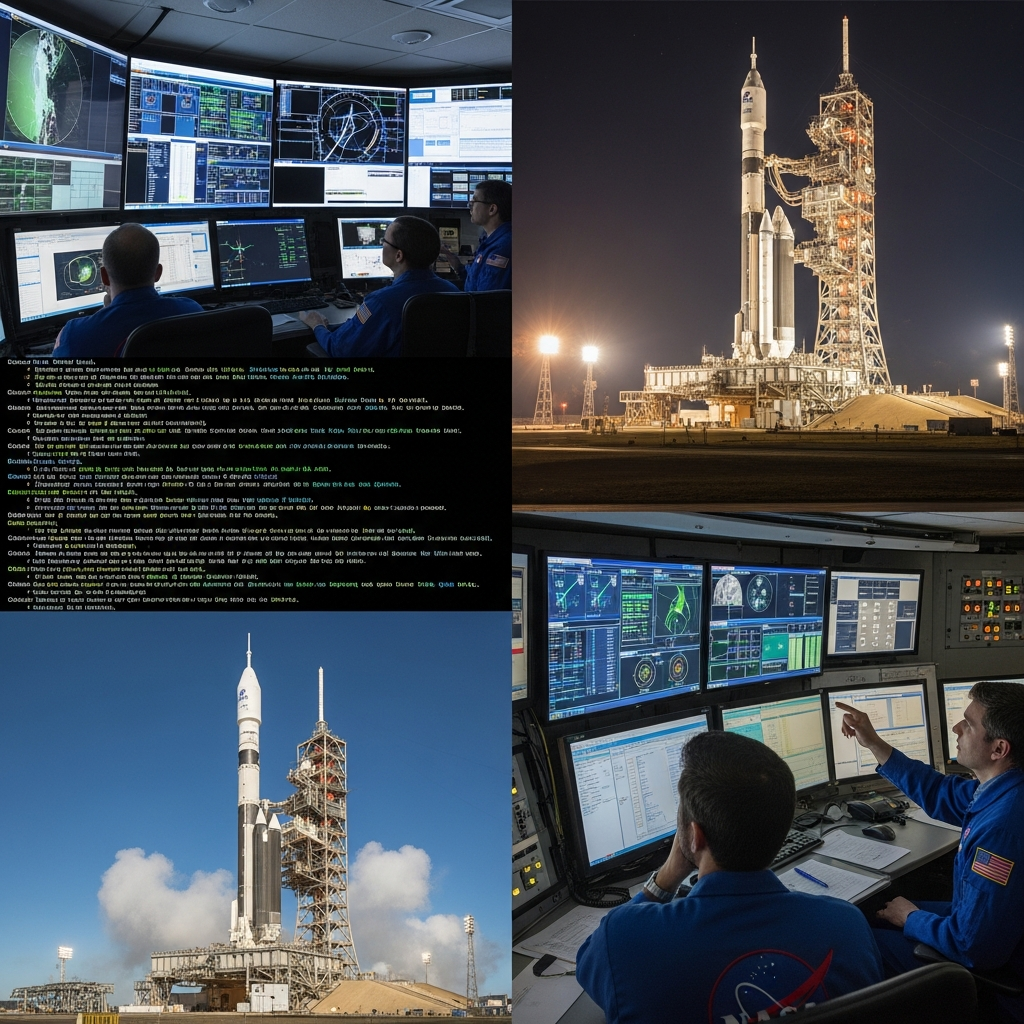
In early February 2026, NASA’s Kennedy Space Center in Florida became the focal point for a crucial “wet dress rehearsal” (WDR) for the Artemis II mission. This make-or-break test is a comprehensive simulation of launch day, designed to power up, fuel, and thoroughly check the integrated SLS rocket and Orion spacecraft at Launch Pad 39B. It represents one of the final significant steps before four astronauts embark on the first crewed lunar voyage in over half a century.
The operation involved loading more than 700,000 gallons (2.6 million liters) of super-cold liquid hydrogen and oxygen into the 322-foot (98-meter) rocket’s tanks. The process demands meticulous precision, as these cryogenic propellants must remain on board for several hours, simulating the final stages of an actual launch countdown. Despite the launch team being on-site, the Artemis II crew – NASA astronauts Christina Koch, Victor Glover, and Reid Wiseman, alongside Canadian Space Agency’s Jeremy Hansen – monitored the extensive process remotely from Houston, where they were in pre-flight quarantine.
Hydrogen Leaks: A Persistent Challenge for the SLS Rocket
Hours into the complex fueling process on Monday, February 2, NASA engineers encountered familiar difficulties. Liquid hydrogen (LH2) loading into the SLS core stage was halted due to a leak detected at the tail service mast umbilical. This specific type of issue has plagued the SLS rocket before, notably during the Artemis I wet dress rehearsals in 2022, which resulted in a six-month delay for the uncrewed test flight.
Liquid hydrogen, stored at an incredibly frigid minus 423 degrees Fahrenheit, is notoriously fickle. Its tiny molecular structure makes it exceptionally difficult to contain, often leading to leaks. Engineers paused fueling, leveraging troubleshooting procedures developed from previous experiences. While liquid oxygen loading continued, the hydrogen leaks persisted, even after resuming. Despite efforts to manage hydrogen concentrations within acceptable limits, the recurring nature of these leaks proved problematic.
The Fickle Nature of Cryogenic Propellants
The inherent challenges of handling super-chilled propellants like liquid hydrogen are a constant factor in rocket launches. Prior to fueling, a crucial cryogenic chilldown procedure is performed on propellant lines to prepare them for the extreme temperatures. Even with these precautions, the smallest imperfection can lead to a leak. The need for pristine seals and robust systems is paramount, as demonstrated by the consistent issues encountered during these high-stakes rehearsals. Each leak, no matter how minor, requires careful assessment to ensure mission safety.
Simulating Launch Day: Close Calls and Early Termination
Throughout the wet dress rehearsal, the mission aimed to simulate nearly every aspect of a real launch countdown. This included powering up the SLS core stage and the Interim Cryogenic Propulsion Stage (ICPS) and performing crucial chilldown procedures. Even with the hydrogen leaks, NASA initially managed to fully fuel both SLS stages, executing two pauses for troubleshooting.
Later in the rehearsal, a “closeout team” encountered another issue. This jumpsuit-clad group, responsible for the final securing of the Orion capsule, discovered a valve that had been “inadvertently vented.” While this issue was being addressed, the larger problem of the persistent hydrogen leak intensified.
Ultimately, the wet dress rehearsal was terminated early on Tuesday morning, February 3, at the T-5:15 minute mark—just over five minutes before the simulated liftoff. The cause was once again the liquid hydrogen leak at the interface of the tail service mast umbilical, which showed unacceptably high concentrations. Following the termination, launch control teams immediately began the process of securing the rocket and draining its fuel tanks. This early halt underscored the critical nature of resolving all technical issues before a crewed flight.
Artemis II: Beyond Apollo’s Reach and Toward a Lunar Future
The Artemis II mission is far more than just a test flight; it’s a foundational step towards establishing a sustained human presence on the Moon. This 10-day journey will carry its four astronauts deeper into the solar system than any humans have traveled, surpassing the record set by Apollo 13 astronauts in 1970. The primary objective is to rigorously test the Orion capsule’s life support systems and other vital equipment in the harsh environment of deep space, circling the Moon’s far side before returning to Earth.
While this mission will not include a lunar landing, it is a crucial precursor to future Artemis missions that aim to put astronauts back on the lunar surface. The crew members—NASA’s Christina Koch, Victor Glover, and Reid Wiseman, along with the Canadian Space Agency’s Jeremy Hansen—have been in quarantine in Houston to prevent illness, a standard procedure before liftoff. Jenni Gibbons also stands ready as a backup astronaut. Their anticipated arrival at Kennedy Space Center, originally planned after the WDR, was subject to reevaluation following the test’s outcome.
Narrowing Launch Windows and Future Implications
The initial launch window for Artemis II was narrow, targeting opportunities between February 8 and 11, with additional windows available in March and April. The test itself was delayed by two days due to a bitter cold snap at Kennedy Space Center, immediately shortening the February window. The early termination of the wet dress rehearsal due to the persistent hydrogen leaks has introduced significant uncertainty.
NASA officials had previously stated that an official launch date would only be set after a thorough review of the WDR data. The need to address these leaks could necessitate extensive work, potentially involving rolling the SLS rocket and Orion spacecraft back into the Vehicle Assembly Building (VAB) for further repairs. Such a scenario would likely push the launch beyond the February window, making March or April more plausible. Furthermore, the Artemis II schedule has ripple effects; a February launch would delay the Crew-12 mission to the International Space Station, originally scheduled from a nearby pad, until at least February 19.
Lessons Learned and the Road Ahead for Artemis
Charlie Blackwell-Thompson, the Artemis launch director, expressed cautious optimism ahead of the test, stating, “Why do we think that we’ll be successful in Artemis II? It’s the lessons that we learned.” She emphasized that insights from the Artemis I campaign have been integrated into the procedures for the Artemis II vehicle. However, the recurrence of critical issues underscores the immense complexity and unforgiving nature of spaceflight.
NASA has historically taken an iterative approach to space development, where each test, regardless of outcome, provides invaluable data. The ability to identify and address issues on the ground is paramount for crewed missions. While the recent wet dress rehearsal revealed challenges, it also offered a final, comprehensive opportunity to fine-tune systems before the historic journey. The Artemis program’s long-term vision—to establish a sustained human presence on the Moon—depends on this meticulous and often challenging testing process. The agency remains committed to ensuring the SLS rocket and Orion spacecraft are as safe and reliable as possible for their astronaut crew.
Frequently Asked Questions
What is the purpose of NASA’s Artemis II wet dress rehearsal?
The Artemis II wet dress rehearsal (WDR) is a crucial, full-scale simulation of launch day procedures, designed to thoroughly test the Space Launch System (SLS) rocket and Orion spacecraft. Its primary purpose is to power on and load over 700,000 gallons of super-cold liquid hydrogen and oxygen propellants into the rocket’s tanks, practice the entire countdown sequence, and verify all systems are ready for a crewed mission around the Moon. This dress rehearsal identifies potential issues, like the recent hydrogen leaks, before astronauts are on board.
Why are hydrogen leaks a recurring challenge for the SLS rocket?
Hydrogen leaks are a persistent challenge for the SLS rocket due to the extremely volatile nature of liquid hydrogen. Stored at minus 423 degrees Fahrenheit, its tiny molecular structure makes it incredibly difficult to contain, allowing it to escape through even microscopic gaps in seals or connections. The recent leaks at the tail service mast umbilical during the Artemis II WDR mirror issues experienced during the uncrewed Artemis I test, highlighting the complex engineering required to manage such super-chilled cryogenic propellants under high pressure.
When could the Artemis II mission realistically launch following the recent test issues?
The Artemis II mission’s immediate launch window in early February was significantly impacted by the early termination of the wet dress rehearsal due to persistent hydrogen leaks. While initial targets included February 8-11, the need for extensive troubleshooting and potential repairs means a launch within February is now uncertain. NASA will conduct a thorough review of the WDR data to determine if a launch in subsequent windows, such as those available in March or April, is more realistic. Any required rollback to the Vehicle Assembly Building would further extend the timeline.
The challenges encountered during the Artemis II wet dress rehearsal underscore the inherent complexities of human spaceflight. While the persistent hydrogen leaks and other technical snags have introduced delays, they also highlight NASA’s rigorous commitment to safety and operational readiness. Each test, whether fully successful or not, provides invaluable data that refines processes and systems. As the Artemis program pushes the boundaries of human deep space exploration, these meticulously observed hurdles are critical steps toward ensuring the success and safety of future missions to the Moon and beyond.