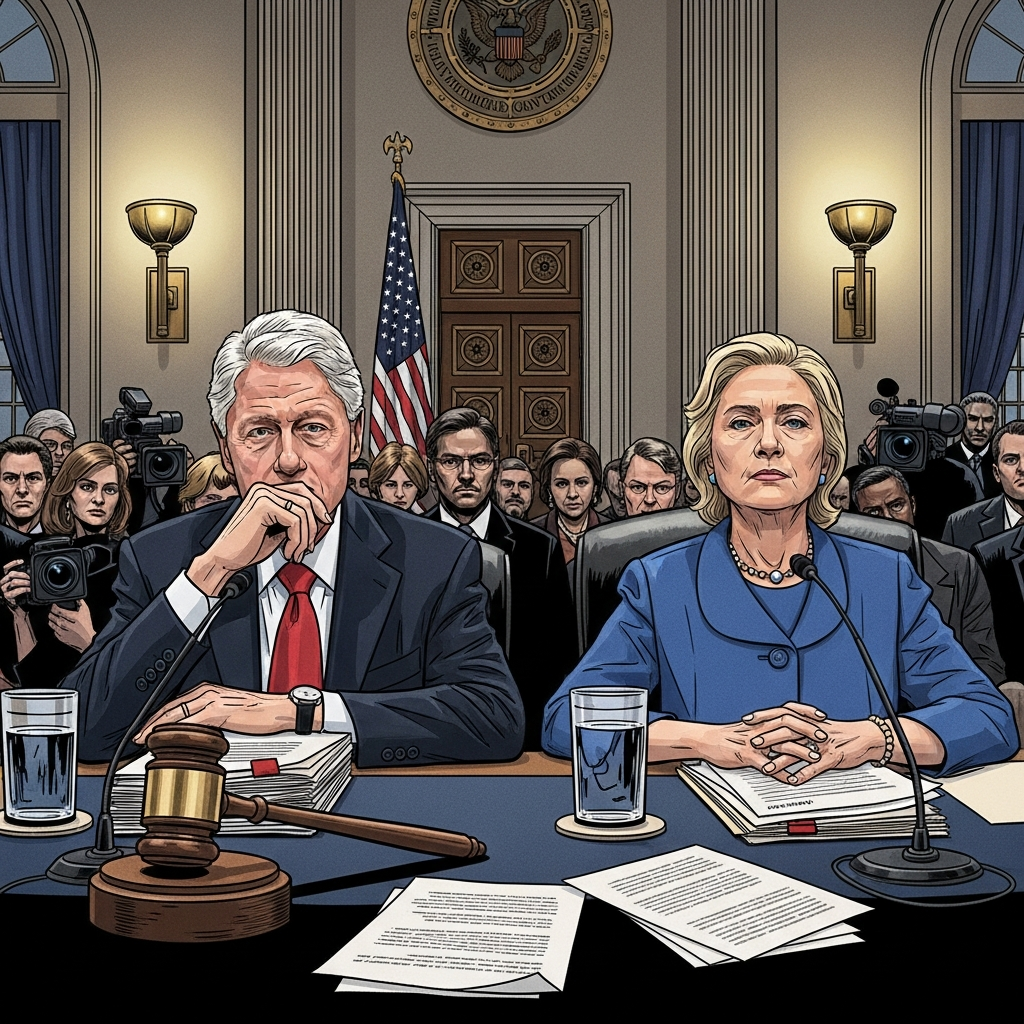
In a dramatic eleventh-hour development, former President Bill Clinton and former Secretary of State Hillary Clinton have agreed to provide in-person depositions. This decision aims to avert a looming House contempt of Congress vote related to the congressional Jeffrey Epstein investigation. After months of resistance and rejected offers, the Clintons’ concession marks a significant turn in the ongoing probe. Their agreement to testify in Washington, D.C., came as House lawmakers prepared to advance contempt charges. This move underscores the high stakes involved in the pursuit of transparency surrounding Epstein’s illicit activities.
High Stakes: The Looming Contempt Vote
For nearly six months, the House Oversight Committee, led by Chairman James Comer, pursued testimony from the Clintons. Subpoenas were issued in August, with original deposition dates set over three months ago. However, the former first couple repeatedly refused to appear. Their prolonged non-compliance prompted the committee to act. In January, the House Oversight Committee voted, with bipartisan support, to advance resolutions holding both Clintons in contempt of Congress.
Facing a full House vote that week, the pressure intensified. A contempt of Congress charge carries serious legal consequences. These can include substantial fines and even incarceration. Chairman Comer voiced his frustration with the Clintons’ perceived desire for “special treatment.” He characterized their stance as an “affront to the American people’s desire for transparency.” The stage was set for a potentially unprecedented confrontation between Congress and former high-ranking officials.
Clintons’ Initial Offers and Chairman Comer’s Rejection
Before this latest agreement, the Clintons’ legal team made several attempts to negotiate alternative arrangements. On January 31, their attorneys, Ashley Callen and David E. Kendall, submitted a detailed offer. This proposal outlined specific conditions for Bill Clinton’s testimony. He offered a four-hour voluntary, transcribed interview in New York City. The interview’s scope would be strictly limited to the Epstein probe. Additionally, Clinton requested both his team and the committee be allowed to have their own transcribers present. For Hillary Clinton, the offer suggested a second sworn declaration or a similar in-person interview format. In exchange, the attorneys sought the withdrawal of all subpoenas and contempt resolutions.
Chairman Comer quickly rejected this offer, deeming it “unreasonable.” He expressed “serious concerns” with multiple aspects. Comer adamantly insisted on a sworn deposition over a voluntary interview. A voluntary interview, he argued, would allow Bill Clinton to refuse answers without asserting privilege. This could leave the committee with no recourse. He also objected to the proposed scope limitation. Comer worried Bill Clinton would avoid questions about his “personal relationship” with Epstein and Ghislaine Maxwell. The four-hour time limit was also insufficient, he believed. Comer feared a “loquacious individual” could easily “run out the clock” with lengthy answers. Furthermore, the request for a personal transcriber was questioned. An official court reporter would already be present, provided by the panel. Comer noted that if a voluntary interview had been offered earlier, the situation might have played out differently. He drew a parallel to Hunter Biden, who ultimately agreed to a sworn deposition after a contempt vote. Comer rejected all proposals for Hillary Clinton’s testimony, emphasizing the “necessity” of her in-person testimony over “simple sworn declarations.”
The Eleventh-Hour Concession: In-Person Depositions
The turning point arrived late Monday evening. As Chairman Comer was testifying about the contempt proceedings, the Clintons’ attorneys sent an email. This message confirmed their agreement to appear for in-person depositions in Washington, D.C. This direct concession to the committee’s demands effectively put the brakes on the imminent contempt vote.
Following this development, House Rules Committee Chairwoman Virginia Foxx announced a postponement of the contempt resolutions. However, she warned that the panel might reconsider them if further progress wasn’t made swiftly. Clinton spokesperson Angel Ureña quickly took to X (formerly Twitter) with a defiant post. He stated the Clintons “negotiated in good faith” and had already provided information “under oath.” Ureña added that they looked forward to “setting a precedent that applies to everyone.” He also accused Comer of politicizing the investigation.
Chairman Comer, while acknowledging the offer, initially expressed reservations. He stated the “terms lack clarity yet again” and that no specific dates for the depositions had been provided. Comer suggested the Clintons’ agreement only materialized because the House had moved forward with the contempt proceedings. Despite Comer’s caution, the top Democrat on the Oversight Committee, Rep. Robert Garcia, expressed confidence. He believed Comer would accept the offer, noting the Clintons had “accepted every single term” laid out by the chairman. Other Democratic figures, like Hakeem Jeffries, had previously criticized Comer’s actions, calling them a “charade.”
Why the Sudden Shift? Avoiding Legal and Political Fallout
The Clintons’ sudden capitulation reflects a strategic decision to avoid the significant legal and political repercussions of a contempt charge. The potential for a former U.S. president to be held in contempt of Congress carries immense historical weight. It would be an unprecedented event. While some former presidents have testified voluntarily, none have been compelled to do so under threat of contempt.
Their agreement to provide sworn testimony in Washington D.C. signifies a complete reversal from their prior stance. This move ensures they will face direct questioning from lawmakers. It is important to note that neither Bill nor Hillary Clinton has been accused of wrongdoing in connection with Epstein’s crimes. Both have consistently denied having any knowledge of his illicit activities. No Epstein survivor or associate has publicly alleged inappropriate behavior by either Clinton. However, Republicans have intensely focused on Bill Clinton’s well-documented relationship with Epstein in the late 1990s and early 2000s. They continue to push for greater accountability and transparency in the wake of Epstein’s 2019 suicide. This eleventh-hour agreement allows the Clintons to mitigate immediate legal threats. It also provides them an opportunity to publicly clarify their knowledge and involvement.
Next Steps: Clarifying Terms and Setting Dates
Despite the agreement in principle, the precise path forward still requires clarification. Chairman Comer stated his intention to solidify the terms and discuss next steps with his committee members. Securing mutually agreeable dates for the in-person depositions is the immediate priority. The House Rules Committee’s decision to postpone contempt resolutions is conditional. If substantial progress on these terms and dates falters, the threat of contempt charges could resurface. This ongoing negotiation highlights the committee’s insistence on comprehensive, sworn testimony. It underscores their commitment to ensuring accountability and transparency in the overarching Jeffrey Epstein investigation. The coming days will reveal whether these new terms lead to a swift resolution or further deliberation.
Frequently Asked Questions
What exactly did the Clintons agree to do in the Epstein investigation?
The Clintons agreed to provide in-person, sworn depositions in Washington, D.C., as part of the House Jeffrey Epstein investigation. This move is a significant departure from their previous offers, which included voluntary, transcribed interviews with limitations on scope and time. This agreement directly addresses the House Oversight Committee’s demand for full, formal testimony.
Why was a contempt of Congress vote a possibility for the Clintons?
A contempt of Congress vote became a possibility because Bill and Hillary Clinton repeatedly refused to comply with subpoenas issued by the House Oversight Committee for months. The committee sought their testimony in the Jeffrey Epstein investigation. After their consistent non-compliance and missed deposition dates, the committee voted with bipartisan support to advance contempt resolutions, pushing them closer to a full House vote with potential legal consequences.
What were the specific points of contention regarding the Clintons’ initial offer to testify?
Chairman James Comer rejected the Clintons’ initial offer due to several key issues. The offer proposed a voluntary, transcribed interview instead of a sworn deposition, which would allow them to refuse questions. It also included a limited scope of questioning, a strict four-hour time limit that Comer feared would allow them to “run out the clock,” and a request for their own transcriber despite an official court reporter being present. Comer deemed these conditions “unreasonable” and an “affront to transparency.”