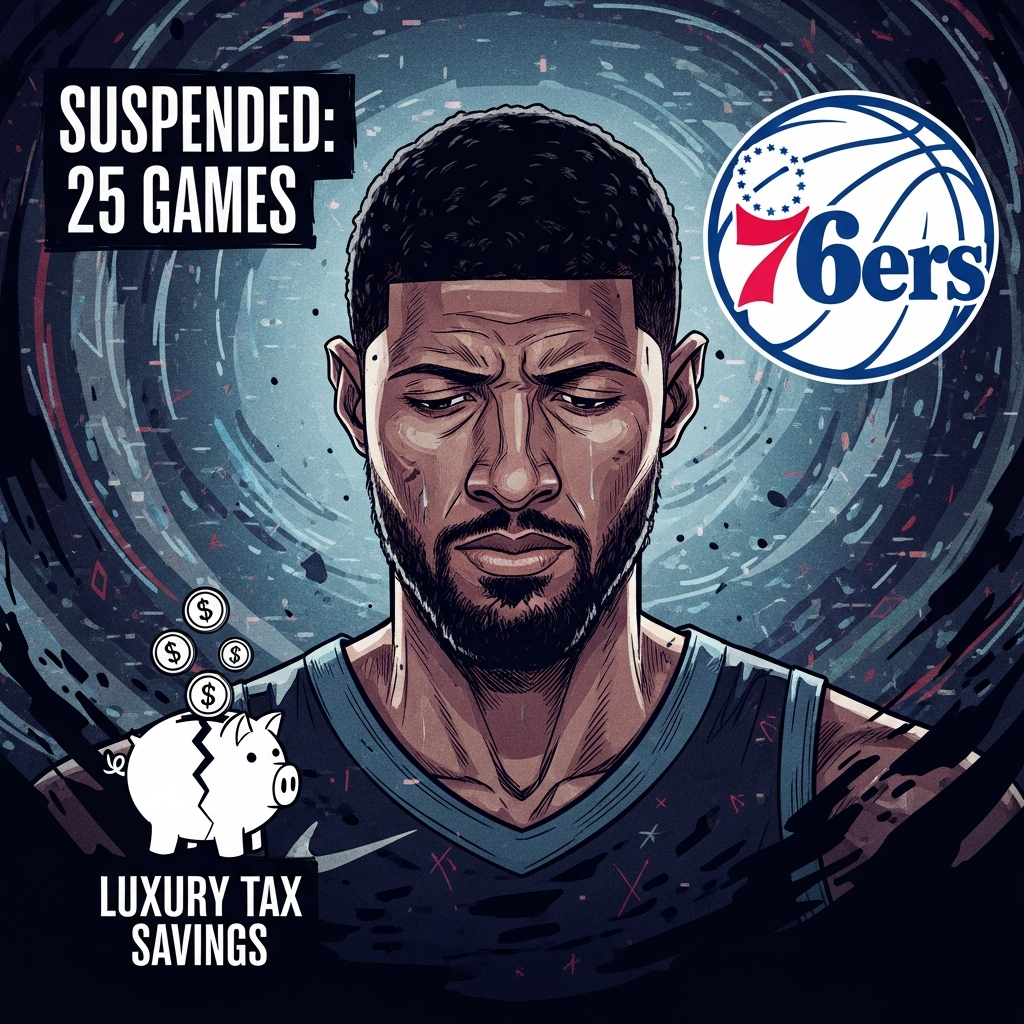
A seismic event has rocked the NBA, with Paul George facing a 25-game suspension for violating the league’s substance abuse policy. While a significant blow to any team, this suspension has paradoxically presented the Philadelphia 76ers with an unforeseen and crucial financial lifeline. This unexpected development offers the Sixers a path to escape a looming luxury tax penalty, strategically reshape their roster, and gain critical flexibility ahead of the impending NBA trade deadline. For a franchise already navigating complex financial waters and a tight playoff race, this twist of fate transforms a major setback into a surprising strategic advantage.
George, a pivotal wing player, took full responsibility for what he termed a “gargantuan error,” attributing it to “improper medication” taken while seeking treatment for a mental health issue. His absence leaves a gaping hole in Philadelphia’s lineup, particularly given his role as their “third best player” and “best and most versatile defender.” Despite the on-court ramifications, the intricacies of the NBA’s Collective Bargaining Agreement (CBA) have unveiled a unique financial boon for the franchise, drastically altering their pre-deadline predicament.
Philadelphia’s Dire Financial Straits Before the Ban
Prior to the Paul George suspension, the Philadelphia 76ers were in a precarious financial position. They found themselves more than $7.13 million above the luxury tax line. This put the front office in a bind, struggling to find ways to reduce their payroll without trading away essential contributors. Key players like Andre Drummond, with a $5 million salary, or Kelly Oubre, at $8.4 million, were considered potential trade chips. Shedding these players, alongside a couple of smaller contracts, seemed the only viable route to get below the tax threshold.
The problem wasn’t just about avoiding a tax bill. Philadelphia also faced an urgent need to secure key contributors Dominic Barlow and Jabari Walker. Both players were on two-way contracts, limiting them to just 50 regular-season games and making them ineligible for any postseason action. Converting these players to standard contracts was a priority, but doing so would further exacerbate their luxury tax woes. Star center Joel Embiid had publicly urged the organization to improve the roster rather than “ducking the tax,” adding pressure to an already challenging situation. The trade deadline loomed large, demanding immediate and difficult decisions.
The Unexpected CBA Loophole That Saves Millions
Enter the Paul George suspension. What initially seemed like an unmitigated disaster has, thanks to a specific clause in the NBA’s Collective Bargaining Agreement, turned into a significant financial reprieve. The CBA stipulates a crucial detail regarding suspended players: only half of their forfeited salary counts against a team’s luxury tax calculation. This distinction is paramount, especially when dealing with a player of George’s substantial earning power.
How George’s $51.7 Million Salary Yielded Major Savings
With an enormous annual salary of $51.7 million, George’s 25-game suspension translates to a hefty forfeited salary of $11.74 million. This figure, by itself, is a significant personal cost for the player. However, under the aforementioned CBA rule, only half of this amount, or $5.87 million, impacts the Sixers’ luxury tax bill. This immediate reduction slashes Philadelphia’s tax liability considerably, making their path to financial compliance much smoother.
This single rule adjustment dramatically reshapes the Sixers’ financial outlook. They are now just $1.26 million over the luxury tax line. This vastly reduced figure is a stark contrast to their previous deficit and can be managed with far greater ease and less impact on their core roster.
Newfound Roster Flexibility and Strategic Maneuvers
This newfound financial wiggle room provides the Philadelphia 76ers with unprecedented strategic advantages. What was once a “vexing financial problem” is now a solvable puzzle, unlocking several crucial roster management opportunities ahead of the trade deadline.
Bridging the Final Tax Gap
The remaining $1.26 million deficit is a manageable sum. The Sixers can now easily get under the tax line by trading a little-used veteran like Eric Gordon. This move, potentially sweetened with cash or a late second-round pick, would allow another team to absorb his contract without significant expenditure. Successfully executing this trade would not only bring Philadelphia below the tax threshold but could also allow them to receive money from other tax-paying teams, a remarkable reversal of fortune.
Securing Key Contributors and Expanding Depth
The most immediate benefit is the ability to finally sign Dominic Barlow and Jabari Walker to standard contracts. With the financial constraints eased, the Sixers can convert these two-way players, ensuring they are active for more than 50 regular-season games and, crucially, eligible for the postseason run. This addresses a critical need for depth, particularly with George out.
Beyond these conversions, the Paul George suspension provides further roster enhancement opportunities. Once George has missed five games due due to his ban, the Sixers can place him on the ‘suspended list.’ This special CBA provision allows them to sign a 16th player to their roster for the duration of his absence, adding vital depth. This spot could be filled by a current 10-day contract signee, such as Charles Bassey, or another promising prospect, strengthening the back end of the roster when they are critically thin on wings and defenders.
Balancing On-Court Impact with Financial Relief
While the financial benefits of the Paul George suspension are undeniable, the on-court impact remains a significant concern for the Philadelphia 76ers. George’s absence for 25 games means the team will be without their “best connector” and a “significant offensive engine” during a crucial stretch of the season. The Sixers currently hold a precarious 6th seed in the Eastern Conference at 26-21, just one game ahead of the 8th spot and 3.5 games clear of the 10th. Their margin for error is “razor thin.”
Stars like Joel Embiid and Tyrese Maxey will bear an “even more of a load to carry.” Rookie V.J. Edgecombe will be thrust into a more prominent scoring role, while players such as Quentin Grimes and Kelly Oubre Jr. must elevate their defensive contributions to compensate for George’s versatility. This situation underscores the bittersweet nature of the suspension: an unexpected financial boon at the cost of immediate competitive strength. The pressure on the front office to make impactful moves at the trade deadline is immense, needing to address the basketball void created by George’s absence even as his ban provides tax relief.
Expert Insights: A Complex Calculus for the Sixers
According to veteran NBA analyst John Hollinger, whose two decades of experience include pioneering advanced metrics like PER and serving as the Memphis Grizzlies’ VP of Basketball Operations, this situation presents a complex calculus for the 76ers. While the financial relief is substantial, the true measure of its impact will depend on how effectively the front office leverages this newfound flexibility to bolster a roster that is suddenly critically thin.
This isn’t merely about avoiding a tax bill; it’s about transforming a liability into an asset. The Paul George suspension enables the Sixers to make moves they previously couldn’t afford, allowing them to not only retain valuable two-way players but also explore options for additional depth. This strategic pivot, albeit forced, could ultimately position the team for a stronger postseason run by ensuring a more robust and compliant roster, even if it means weathering a challenging mid-season stretch without a key star. The coming days leading up to the trade deadline will reveal how adeptly Philadelphia’s strategists navigate these choppy waters.
Frequently Asked Questions
Why was Paul George suspended, and what are the direct consequences for him and the 76ers?
Paul George received a 25-game suspension from the NBA for violating the league’s substance abuse policy. He took responsibility, stating he used “improper medication” while seeking mental health treatment. For George, this means a personal financial hit of $11.74 million in forfeited salary. For the 76ers, it means losing their “third best player” and “best and most versatile defender” for a crucial 25 games, significantly impacting their on-court performance and playoff aspirations during that period.
How does the NBA’s Collective Bargaining Agreement impact suspended player salaries for luxury tax purposes?
The NBA’s Collective Bargaining Agreement (CBA) includes a specific provision for suspended players’ salaries and their effect on the luxury tax. Crucially, only half of a suspended player’s forfeited salary counts against the team’s luxury tax bill. In Paul George’s case, while he forfeited $11.74 million, the 76ers’ luxury tax bill was reduced by half that amount, or $5.87 million, providing a significant financial advantage that deviates from the full impact of his salary.
What strategic advantages does Paul George’s suspension provide the Philadelphia 76ers ahead of the trade deadline?
The Paul George suspension offers the Philadelphia 76ers unexpected strategic advantages. It significantly cuts their luxury tax bill by $5.87 million, bringing them from over $7.13 million above the line to just $1.26 million over. This allows them to easily get under the tax by trading a minimum-salary player like Eric Gordon. This financial flexibility also enables them to convert key two-way players, Dominic Barlow and Jabari Walker, to standard contracts, making them eligible for the postseason. Furthermore, after George misses five games, the Sixers can utilize the ‘suspended list’ to sign a 16th player, bolstering their roster depth during his absence.
Conclusion
The Paul George suspension is a complex, multi-faceted event that has simultaneously dealt a blow to the Philadelphia 76ers’ immediate on-court strength while providing an extraordinary financial and strategic boon. What began as a crisis has, through the intricate rules of the NBA’s Collective Bargaining Agreement, transformed into an unprecedented opportunity for the Sixers to alleviate their luxury tax burden and enhance their roster flexibility.
As the trade deadline rapidly approaches, the 76ers’ front office faces the challenge of maximizing this unexpected advantage. They must carefully balance the urgent need for competitive depth to secure a playoff spot with the long-term benefits of a more financially stable and strategically sound roster. While the path ahead is undeniably choppier without George, the “Paul George suspension 76ers luxury tax” impact ensures the team enters the crucial trade period with renewed options, poised to make moves that could define the remainder of their season.