Apple has fundamentally transformed its online purchasing experience for the Mac lineup, shifting away from pre-configured models to an entirely bespoke, step-by-step customization journey. This revolutionary overhaul, implemented in early 2026, impacts every Mac model, from the versatile MacBook Air to the powerful Mac Pro. Gone are the days of selecting from a limited set of pre-built options; customers are now empowered to design their ideal machine from the ground up, echoing the highly personalized ordering process already familiar to iPad and iPhone users.
This significant update promises a deeper level of personalization for buyers while streamlining Apple’s internal processes. The change comes amidst ongoing advancements in Apple Silicon, including the recent release of the M5 chip, and sets the stage for future hardware innovations, such as the anticipated M5 Pro and M5 Max variants. While offering unparalleled flexibility, this new build-to-order approach also presents unique considerations for users accustomed to the previous purchasing flow.
The End of Pre-Configured Macs: A New Era of Customization
For years, the online Apple Store presented Mac customers with a curated selection of “pre-configured” or “standard” models. Buyers would first choose a base configuration, perhaps with a specific chip, RAM, and storage, and then have the option to make minor upgrades. This approach, while providing clear starting points and pricing, often meant compromising on certain specifications or comparing various pre-packaged bundles to find the closest match.
The Shift from “Choose Your Mac” to “Build Your Own”
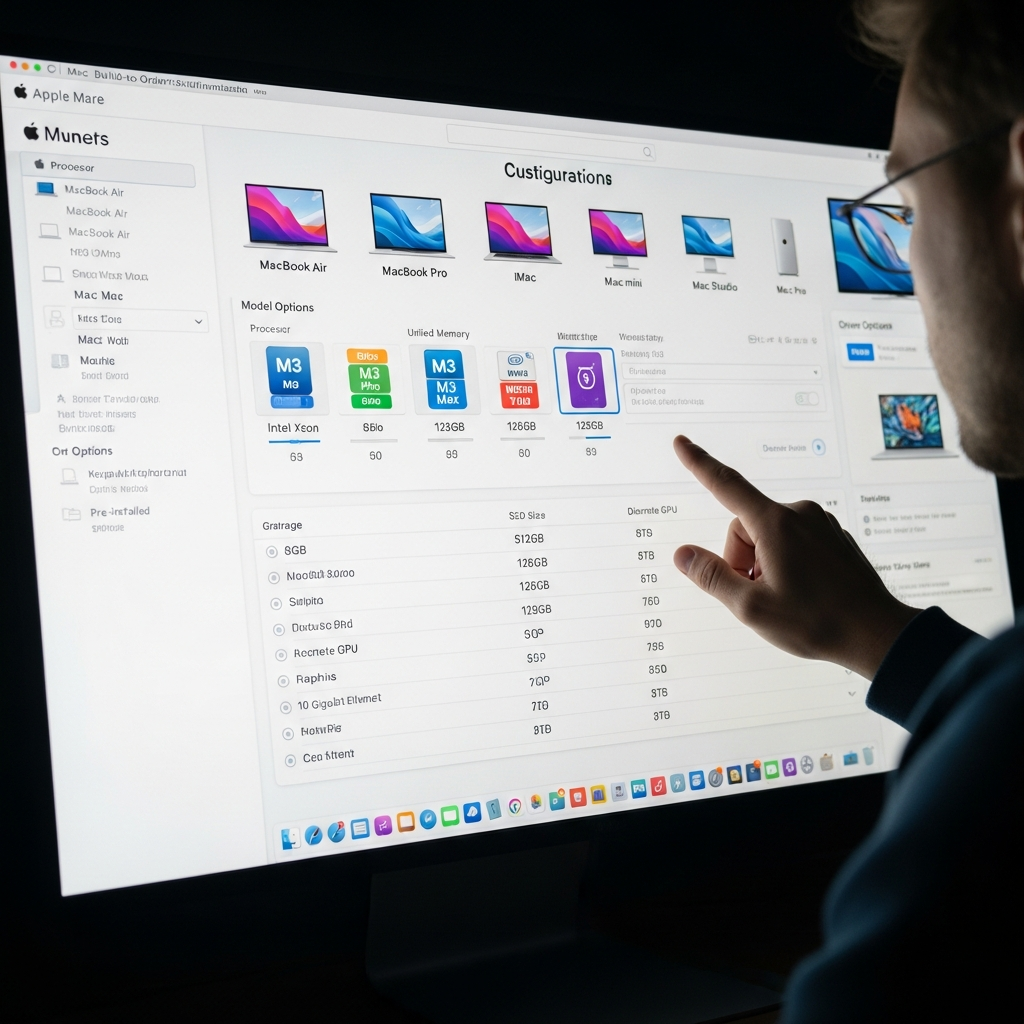
With the latest revamp to the Apple Mac ordering process, this intermediary “Choose Your New Mac” landing page has been completely eliminated. Now, when a customer clicks the “Buy” button for any Mac – be it a MacBook Pro, iMac, or Mac mini – they are immediately directed into a comprehensive configurator. This direct-to-configurator model means that “essentially, every Mac is now built from scratch,” allowing for granular control over each component. This critical change empowers users to select precisely what they need, rather than settling for a pre-defined package.
Unifying the Apple Shopping Experience
A key motivation behind this strategic shift is Apple’s drive to unify the user experience across its entire product ecosystem. The step-by-step configuration flow for Macs now mirrors the familiar process for ordering an iPhone, iPad, or Apple Watch. This consistency aims to create a more intuitive and seamless shopping journey for customers who might be purchasing multiple Apple devices. While the exact sequence of choices may vary slightly between Mac models, the underlying principle of a guided, highly customizable build remains consistent, fostering a more cohesive brand interaction.
Diving Deep into the New Customization Process
The updated Mac ordering interface guides users through a series of choices, ensuring every aspect of their new device can be tailored to their exact preferences and workflow requirements. This granular control is a boon for professionals and power users who demand specific hardware configurations.
Step-by-Step Configuration: What to Expect
When configuring a new Mac, customers will typically proceed through a logical sequence of selections. For a MacBook Pro, for instance, the process begins with selecting the desired display size (e.g., 14-inch or 16-inch) and the device’s color. Following this, users might encounter options like a nano-texture display upgrade. The customization then delves into core technical specifications: choosing from available M-series chips and their corresponding core counts, which are dependent on the selected model and size. Users then specify the amount of unified memory (RAM) and SSD storage capacity. Further options include selecting the power adapter type, preferred keyboard language, and even pre-installing professional applications like Final Cut Pro or Logic Pro. The journey concludes with options for trade-in, payment methods, and essential AppleCare coverage. This comprehensive approach ensures that the final machine is truly bespoke.
Beyond the Basics: True Personalization
The enhanced Mac customization options extend beyond mere technical specifications. It’s about empowering users to create a machine that perfectly fits their lifestyle and professional demands. For example, the Apple online store is the only place where users can configure an iMac with a Magic Trackpad instead of a Magic Mouse, or maximize the unified memory on a Mac mini or Mac Studio. Such configurations are vital for users running demanding tasks like multiple machine learning models or high-fidelity audio production. This level of deep personalization differentiates Apple’s direct sales channel from other retailers.
The M5 MacBook Pro and What’s Next for Mac Silicon
This comprehensive ordering system update arrives shortly after Apple’s announcement of the new 14-inch MacBook Pro featuring the powerful M5 chip in October 2025. This timing is highly strategic, as the flexible build-to-order framework is ideally suited to integrate future advancements in Apple Silicon.
Unpacking the Power of the M5 Chip
The M5 chip represents a significant leap forward, particularly in AI capabilities on the Mac. It integrates a next-generation GPU with a Neural Accelerator in each core, delivering up to 3.5 times faster AI performance than the M4 and up to 6 times faster than the M1. Graphics performance sees a 1.6 times boost over the M4, while the 10-core CPU offers up to 20 percent faster multithreaded performance. An enhanced 16-core Neural Engine and over 150GB/s unified memory bandwidth accelerate demanding tasks, from app launches to on-device large language models (LLMs) and diffusion models. Benchmarks show impressive gains in AI video enhancement, 3D rendering, gaming, and code compiling. This powerful chip, now fully configurable, provides professional users with unparalleled performance. The M5 MacBook Pro also boasts up to 24 hours of battery life, faster SSD performance, and premium features like a Liquid Retina XDR display with an optional nano-texture finish. It runs macOS Tahoe, seamlessly integrating Apple Intelligence capabilities for enhanced productivity and privacy.
Anticipating M5 Pro and M5 Max: Laying the Groundwork
While the standard M5 chip is available, the professional community still anticipates the release of MacBook Pro models featuring the M5 Pro and M5 Max chips. The new, highly customizable online ordering process is widely seen as a preparatory step for this imminent launch. This revamped framework would smoothly accommodate even more granular customization options that rumors suggest might be introduced with these advanced processors, such as user-selectable CPU and GPU core counts. By establishing this flexible system now, Apple is future-proofing its sales platform for upcoming generations of its powerful silicon.
Implications for Users and the Market
The shift to a fully customizable Mac ordering experience brings both distinct advantages and potential challenges for consumers and the broader market. Understanding these implications is key to navigating the new landscape.
Navigating the New Experience: Pros and Cons
For users who know exactly what specifications they need, the new customization process is a dream come true. It offers unparalleled control and ensures they don’t pay for features they won’t use. However, for those less familiar with technical specifications, the absence of predefined “starting places” could lead to decision fatigue or confusion. Previously, pre-configured options provided a helpful baseline for comparison. Now, directly comparing prices between specific configurations becomes more challenging without those clear, distinct bundles. Users may need to spend more time researching components to make informed choices.
Where to Find Pre-Configured Macs (Resellers)
Despite Apple’s direct online store moving entirely to custom builds, pre-configured models of Macs will continue to be distributed to authorized resellers like Best Buy and Amazon. This provides a crucial alternative for customers who prefer the convenience of selecting a standard configuration, often at competitive prices. These retailers serve as a vital channel for those who prioritize simplicity and immediate availability over deep customization, ensuring a diverse purchasing ecosystem for Mac buyers.
Apple’s Strategic Vision: Price Adjustments and Future-Proofing
Beyond user experience, this new system holds strategic implications for Apple. It allows the company to subtly integrate future price adjustments, especially as component costs (like memory) are projected to rise through 2026. Rather than announcing price hikes for specific pre-configured models, Apple can adjust individual component pricing within the customized build, making these changes less prominent. Furthermore, the granular build-to-order model provides a highly adaptable framework for integrating future technological advancements, ensuring that Apple’s online store remains at the cutting edge of personalized computing.
Frequently Asked Questions
What exactly has changed in Apple’s online Mac ordering process?
Apple has completely removed pre-configured Mac options from its online store. Previously, customers selected from a limited set of standard models on a landing page before customizing. Now, clicking “Buy” for any Mac model immediately directs users to a detailed, step-by-step configurator. This means every Mac is essentially built from scratch, allowing users to select components like display size, chip, unified memory, and storage individually, creating a highly personalized machine. This aligns the Mac buying experience with that of iPhones and iPads.
Should I still consider buying a pre-configured Mac from a third-party retailer?
Yes, absolutely. While Apple’s online store now focuses on deep customization, authorized resellers like Best Buy and Amazon will continue to offer standard, pre-configured Mac models. These options are ideal for users who prefer the convenience of selecting a ready-to-go machine without navigating extensive customization choices. Such resellers often provide competitive pricing and immediate availability, offering a valuable alternative for those who don’t require highly specialized configurations or who find the new detailed process tedious.
How does the M5 chip fit into Apple’s new Mac customization strategy?
The powerful M5 chip, released in October 2025 for the 14-inch MacBook Pro, is fully integrated into Apple’s new customization strategy. Its advanced AI capabilities, faster CPU, and enhanced GPU are now available for users to select as part of their bespoke Mac configuration. This updated ordering process is also seen as crucial groundwork for the anticipated M5 Pro and M5 Max chips, which are expected to offer even more granular customization options for CPU and GPU cores. The flexible build-to-order system ensures that Apple can seamlessly introduce and integrate these future silicon advancements.
Conclusion
Apple’s complete overhaul of its online Mac ordering process marks a significant strategic move, emphasizing personalized choice and a unified brand experience. By empowering users to build their Mac entirely à la carte, Apple is not only catering to the demands of a diverse user base but also laying critical groundwork for future Apple Silicon advancements, including the highly anticipated M5 Pro and M5 Max chips. While the transition from pre-configured models to a fully customizable system may require a slight adjustment for some users, the benefits of crafting a machine perfectly tailored to individual needs and budget are undeniable. As technology continues to evolve, Apple’s direct online store remains the ultimate destination for those seeking the deepest level of Mac personalization and access to the latest innovations.