NASA’s Perseverance rover has achieved a groundbreaking feat, completing the very first drives on another planet powered entirely by artificial intelligence. This monumental achievement, led by the innovative minds at NASA’s Jet Propulsion Laboratory (JPL), ushers in a new era of autonomous rover navigation and deep-space exploration. Executed on December 8 and 10, 2025, these AI-planned Mars drives demonstrate how generative AI can revolutionize complex decision-making tasks, traditionally performed by human mission planners, enabling rovers to chart their own courses across the challenging Martian landscape.
AI Takes the Wheel: A New Chapter in Martian Exploration
On two pivotal dates, December 8 and 10, 2025, the six-wheeled Perseverance rover ventured across the Jezero Crater’s rim, not under direct human command, but guided by an AI-planned Mars drive. The rover’s navigation cameras meticulously captured its movements, providing invaluable data for reconstruction. This demonstration marks a significant leap from traditional planning, where human teams meticulously map routes, to a future where intelligent systems can independently navigate and explore.
NASA Administrator Jared Isaacman hailed this milestone, emphasizing how such autonomous technologies will enhance mission efficiency and expand our capacity to explore distant worlds. He highlighted the potential for increased scientific returns and improved responses to challenging terrains, especially as missions venture further from Earth. This responsible application of cutting-edge technology sets a precedent for future extraterrestrial operations.
Charting the Course: How AI Navigates Mars
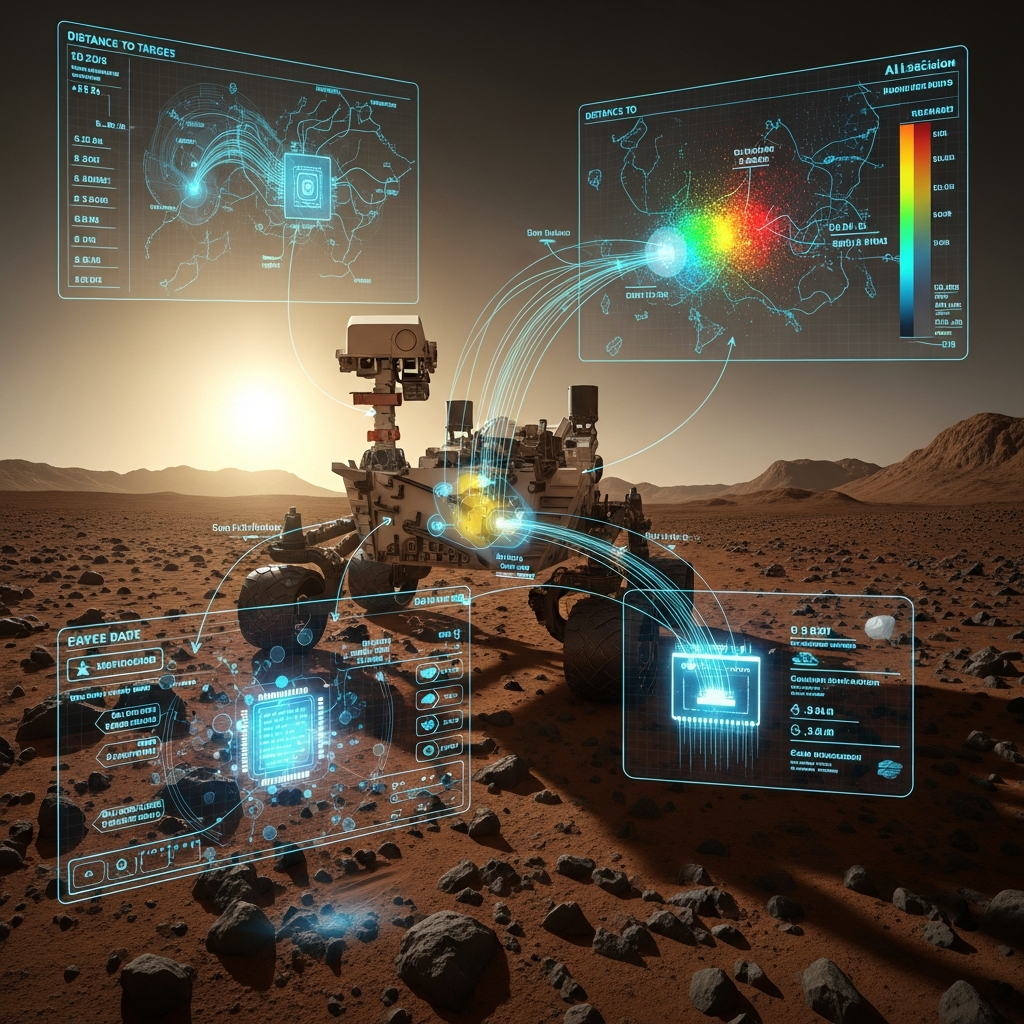
The core of this innovation lies in a specialized form of generative AI: vision-language models. Developed in collaboration with Anthropic, utilizing their Claude AI models, this system analyzed vast datasets from JPL’s surface mission archive. Crucially, the AI processed the same high-resolution orbital imagery from NASA’s Mars Reconnaissance Orbiter’s HiRISE camera and terrain-slope data that human planners rely on.
The AI’s task was to identify critical Martian features such as bedrock, outcrops, hazardous boulder fields, and sand ripples. From this analysis, it generated a continuous, safe path, complete with waypoints – fixed locations where the rover receives new instructions. Unlike human planners who typically space these waypoints no more than 330 feet (100 meters) apart, the AI system demonstrated the capacity for more fluid and extensive path generation. This capability is vital given the immense distance to Mars, averaging 140 million miles (225 million kilometers), which causes significant communication delays, making real-time “joy-sticking” impossible. For nearly three decades, human “drivers” have meticulously sketched these routes, a labor-intensive process now streamlined by JPL generative AI.
Ensuring Safety: The Digital Twin Advantage
Before any AI-planned Mars drive commands were transmitted across the vast cosmic distance, NASA engineers undertook rigorous safety verification. The generative AI’s instructions were first processed through JPL’s “digital twin” – a virtual replica of the Perseverance rover. This critical step involved verifying over 500,000 telemetry variables, ensuring absolute compatibility with the rover’s flight software.
This meticulous pre-deployment validation underscores NASA’s unwavering commitment to operational safety and reliability, even when pushing the boundaries of Mars exploration technology. Once confirmed safe, the commands were sent via NASA’s Deep Space Network, culminating in Perseverance successfully driving 689 feet (210 meters) on December 8, and an impressive 807 feet (246 meters) two days later. These successful traverses, meeting all operational safety limits, vividly proved the AI’s capability to plan complex maneuvers in an extraterrestrial environment.
Perseverance’s Journey: Miles Ahead with Advanced Autonomy
This AI breakthrough complements Perseverance’s already robust autonomous capabilities. The rover has demonstrated remarkable durability, having traveled approximately 25 miles (40 kilometers) across the Martian surface in nearly five years. Engineers project it is capable of operating until at least 2031, with rotary actuators certified for at least another 37 miles (60 kilometers) of optimal performance. This longevity is supported by its “Enhanced Autonomous Navigation” (ENav) planning tool, which allows the rover to scan up to 50 feet (15 meters) ahead, independently identify obstacle-free paths, and direct its wheels.
Over 90% of Perseverance’s journey has relied on such autonomous rover navigation, enabling faster and more efficient sample collection. The rover is now heading to a new region, “Lac de Charmes,” to gather more rock core samples. Previous discoveries, like a sample from “Cheyava Falls” in September 2025, hinting at past microbial life, underscore the scientific value of this extended mission. The combination of ancient olivine and carbonates in Jezero Crater provides powerful insights into Mars’ geological and atmospheric evolution, and advanced autonomy, including the new AI capabilities, ensures these crucial samples can be efficiently collected.
Streamlining Science and Exploration with Space Robotics
Vandi Verma, a space roboticist at JPL, highlighted the immense potential of generative AI to streamline autonomous navigation’s core pillars: perception (identifying terrain features), localization (knowing the rover’s position), and planning and control (deciding and executing the safest path). She envisions a future where such intelligent tools allow surface rovers to undertake kilometer-scale drives with minimal operator workload. Furthermore, this space robotics advancement will enable AI to automatically flag intriguing surface features for scientific analysis by sifting through vast volumes of rover images.
The Future of Space Exploration: Beyond Mars
The implications of this AI-planned Mars drive extend far beyond Perseverance. Matt Wallace, manager of JPL’s Exploration Systems Office, envisions a future where intelligent systems are not only Earth-based but also integrated as “edge applications” directly into rovers, helicopters, drones, and other surface elements. These systems, trained with the collective wisdom of NASA engineers, scientists, and astronauts, represent a “game-changing technology.”
This technology is seen as essential for establishing the infrastructure and systems required for a permanent human presence on the Moon and advancing U.S. missions to Mars and beyond. The success of AI navigation on Mars sets a precedent for missions like NASA’s Europa Clipper, slated to arrive in 2030, and the European Space Agency’s Juice, expected in 2031, which will explore other icy moons with potential for life. This pivotal step with Perseverance proves that the journey to more distant worlds can be smarter, safer, and more efficient through the power of artificial intelligence.
Frequently Asked Questions
What exactly is generative AI’s role in planning Perseverance’s Mars drives?
Generative AI, specifically vision-language models like Anthropic’s Claude AI, analyzed high-resolution orbital imagery and terrain data from the Martian surface. Its role was to autonomously identify critical terrain features, such as bedrock, sand ripples, and potential hazards, and then generate a safe, continuous path complete with waypoints for the Perseverance rover to follow. This process replaces the traditional manual route planning by human operators, enabling faster and more extensive autonomous navigation on Mars.
Why is AI-driven navigation crucial for future Mars and deep-space missions?
AI-driven navigation is crucial because of the significant communication lag between Earth and distant celestial bodies like Mars, which makes real-time control impossible. By allowing rovers to autonomously plan routes, navigate challenging terrain, and make decisions on-site, AI enhances mission efficiency, reduces operator workload, and increases scientific return. This technology is foundational for enabling longer, more complex traverses and is considered “game-changing” for establishing a permanent human presence on the Moon and facilitating future human missions to Mars and beyond.
How did NASA ensure the AI’s safety and reliability during these pioneering drives?
NASA implemented a rigorous safety verification process. Before any AI-generated drive commands were sent to the Perseverance rover on Mars, they were first processed through a “digital twin” – a virtual replica of the rover at JPL. This digital twin performed over 500,000 telemetry variable checks to ensure the AI’s instructions were fully compatible with the rover’s flight software and adhered to all safety protocols. This meticulous validation ensured the AI-planned drives met operational safety limits, proving the technology’s reliability in an extraterrestrial environment.
Conclusion
The successful AI-planned Mars drive by NASA’s Perseverance rover marks a profound shift in how humanity approaches space exploration. By empowering the rover with the ability to autonomously navigate the complex Martian terrain using advanced generative AI, NASA has not only demonstrated a remarkable technological leap but also paved the way for more efficient, ambitious, and scientifically productive missions in the future. This innovative application of autonomous rover navigation signifies a critical step towards unlocking the secrets of Mars and venturing further into our solar system, relying on intelligent systems trained with human wisdom to explore the unknown.