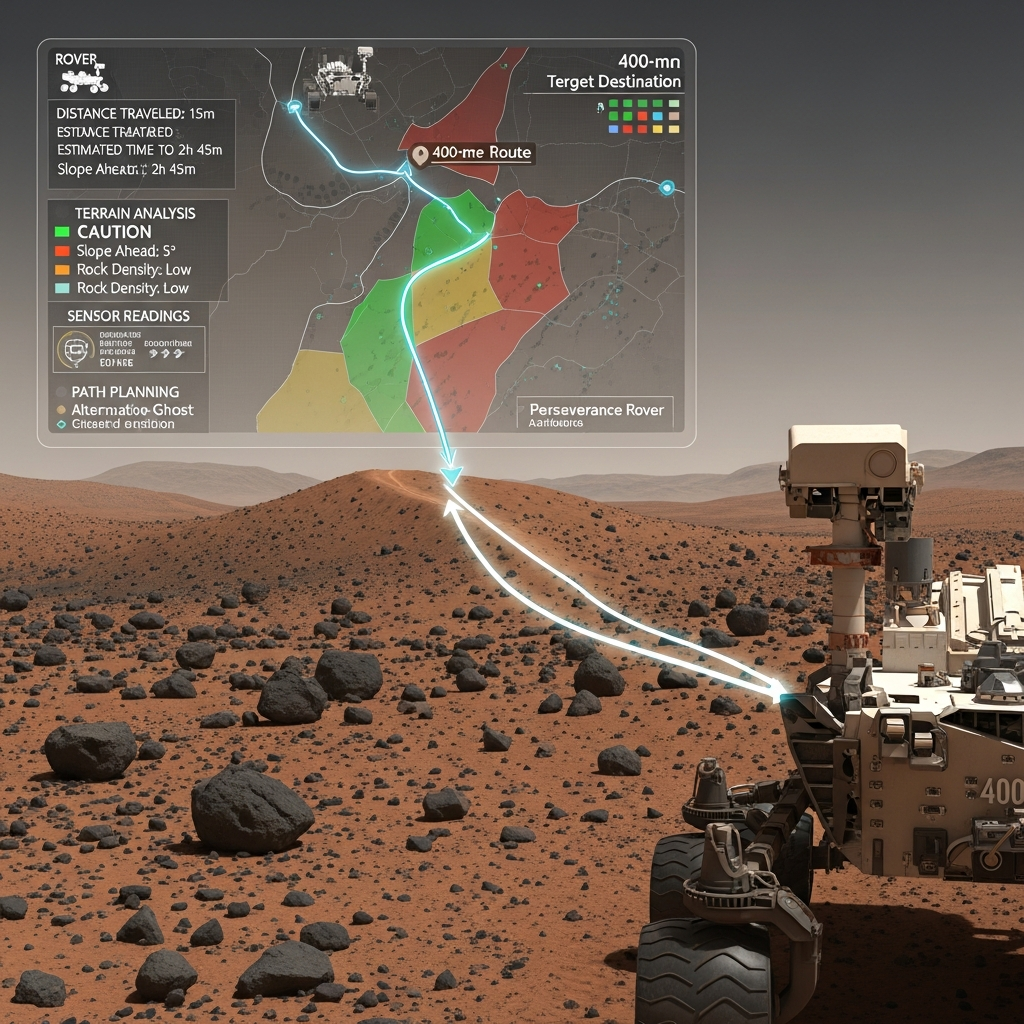
Humanity’s quest to explore distant worlds is being dramatically reshaped by artificial intelligence, with NASA leading the charge. A groundbreaking achievement recently saw the Perseverance rover on Mars autonomously chart its own 400-meter driving route, marking a pivotal moment in interplanetary exploration. This isn’t just a technological marvel; it’s a fundamental shift in how space agencies will conduct remote planetary operations, promising to accelerate scientific discovery and overcome the immense challenges of deep space communication.
The Martian Challenge: Why AI is Essential for Exploration
Exploring Mars presents unique and formidable obstacles, paramount among them being the vast communication delay between Earth and the Red Planet. This lag, which can stretch from four to twenty-four minutes, means mission controllers operate with significantly outdated information. Real-time navigation, as we know it on Earth, is simply impossible. Traditionally, moving a rover even short distances has been a laborious, multi-day process.
Numerous specialized human teams—including mission planners, rover engineers, scientists, and navigation specialists—painstakingly analyze orbital and stereo imagery. They meticulously plot safe paths, constantly battling the communication bottleneck. This conventional workflow creates delays, limiting the rover’s mobility and, consequently, its scientific output. Each decision, each kilometer traveled, requires immense human effort and patience. The stakes are incredibly high; a single navigation error in the harsh Martian environment could spell the end of a multi-billion-dollar mission.
A New Era of Exploration: Perseverance’s AI-Powered Journey
In a monumental step forward, NASA engineers have successfully deployed Anthropic’s Claude AI to autonomously plan a significant driving route for the Perseverance rover. This pioneering feat represents the first time an AI system has independently charted a navigation path on another planet. Imagine a machine taking stereo images from the rover’s navigation cameras and, in mere minutes, generating a viable driving route. This task previously consumed hours or even days of human effort. The 400-meter route is substantial, considering Perseverance typically covers 100 to 300 meters per Martian day. This autonomous planning capability holds the potential to significantly boost the rover’s range and scientific productivity, achieving in weeks what might traditionally take months.
Decoding Claude: How AI Charts a Path on Mars
At its core, Claude is fed stereo imagery and specific mission parameters, allowing it to interpret the three-dimensional Martian terrain. The AI system identifies hazards like scattered rocks, treacherous sand patches, and steep slopes. Crucially, it plots paths that expertly balance scientific objectives with vital safety constraints. Yuchen Jin, a researcher on the project, highlighted Claude’s remarkable ability to understand spatial relationships and reason about physical limitations. This includes predicting how the rover’s mechanical systems, such as its ground clearance and wheel capabilities, would interact with various terrain features. This advanced reasoning ensures that the routes are not only efficient but also safe and practical for the rover’s design.
Safety First: The “Human-in-the-Loop” Approach
Despite the impressive autonomy, NASA has implemented robust safety protocols, embracing a “human-in-the-loop” approach. AI-generated routes are meticulously reviewed by human experts who possess the authority to override or modify any plan if concerns arise. This provides an essential safety net, ensuring accountability while still maximizing efficiency gains. This rigorous validation process has also revealed Claude’s sophisticated understanding of rover operations. It demonstrated an ability to reason about complex trade-offs between route efficiency, safety margins, and scientific targets—a nuanced decision-making capability usually found only in highly experienced human planners. This collaborative model augments human expertise, freeing teams from tedious analytical tasks to focus on higher-level mission objectives.
Beyond Mars: AI’s Transformative Role in Future Space Missions
The success of this experiment carries profound implications for future deep space missions. For destinations like the icy moons of Jupiter or Saturn, where communication delays can be measured in hours, greater autonomy for robotic explorers becomes not just beneficial but absolutely essential. This AI-driven technology could enable more dynamic mission operations, allowing rovers to execute multiple autonomous drives daily and respond to groundbreaking discoveries in near real-time. The applications extend broadly to lunar rovers, asteroid explorers, and even future crewed missions, making machine intelligence an indispensable partner in extending humanity’s reach across the cosmos. Economically, this could allow space agencies to operate multiple rovers with the same human resources, making planetary exploration more cost-effective and yielding increased scientific returns.
NASA’s Diverse AI Frontier: Exploring Beyond Navigation
NASA’s integration of artificial intelligence extends far beyond the Perseverance rover’s navigation. Under the guidance of leaders like David Salvagnini, NASA’s Chief Artificial Intelligence Officer, AI and machine learning are fundamental to a vast array of programs, from scientific discovery to medical support for astronauts. AI enables machines to learn concepts, recognize objects, identify patterns, make predictions, and operate autonomously, fundamentally helping humans solve complex problems more efficiently.
Medical Support for Astronauts in Deep Space
For long-duration human spaceflights to the Moon and Mars, NASA is partnering with Google to develop the Crew Medical Officer Digital Assistant (CMO-DA). This AI-powered medical assistant acts as a Clinical Decision Support System, empowering astronauts to diagnose and treat symptoms independently when real-time consultation with Earth-based doctors is impossible due to communication delays. Trained on extensive spaceflight literature, CMO-DA provides real-time analyses of crew health, incorporating text, speech, and images. Preliminary tests show high accuracy in diagnosing conditions like ankle injuries and flank pain. Future plans include integrating medical device data and making the AI “situationally aware” of unique space medicine conditions, such as the physiological effects of microgravity.
Unlocking Cosmic Secrets: Exoplanet Discovery and Beyond
AI is revolutionizing the search for celestial objects. The ExoMiner system, for instance, uses machine learning to identify exoplanets in distant solar systems from data collected over 15 years ago, revealing objects previously overlooked. AI has also empowered citizen scientists to identify over 10,000 pairs of binary stars, vital for discovering new planets and understanding star formation processes. Astronauts also utilize AI “digital assistants” for medical recommendations, especially when communication with Earth is interrupted during distant missions.
Protecting Our Planet: Climate and Disaster Relief
On Earth, NASA employs AI to bolster disaster relief efforts during and after natural catastrophes like hurricanes and wildfires. AI can analyze satellite images to count tarps on roofs, providing rapid assessments of storm damage. In collaboration with IBM, NASA launched the AI Prithvi-weather-climate foundational model, offering a flexible solution for predicting short-term weather and projecting long-term climate changes, with its data openly accessible. Meteorologists at NASA use machine learning for these crucial climate projections.
Autonomous Orbital Operations and Space Sustainability
AI also enhances air travel safety and efficiency by helping flight controllers and pilots plan optimized flight routes. In low Earth orbit, experimental grippers on Astrobee robotic free-flyers inside the International Space Station utilize AI to perform tasks autonomously. An Earth-observing satellite recently demonstrated onboard AI autonomously pointing an instrument and analyzing imagery in under 90 seconds, showcasing significant gains in efficiency. Furthermore, with the rapid increase in space activity, AI will be crucial for the detection of orbital debris and enabling autonomous actions by space systems for remediation, aligning with NASA’s Space Sustainability Strategy. NASA’s Marshall Space Flight Center is even pitching AI-enabled mission management systems to the Department of Defense for automated command and data processing functions in complex defense systems, showcasing the dual-use potential of space technologies.
Navigating the Future: Challenges and Opportunities for AI in Space
Implementing AI in space presents distinct challenges compared to terrestrial applications. Space systems lack access to powerful cloud computing backends, and engineers must contend with extreme environments, radiation exposure, stringent power budgets, and severe compute and weight limitations inherent to spacecraft. NASA, drawing on its history of overcoming complex challenges, is actively addressing these unique constraints.
Beyond technical hurdles, ethical and responsible use, privacy, and transparency are recognized concerns. While NASA’s role differs from public service agencies, the agency acknowledges the need to build comfort and address these issues carefully. Culturally, managing workforce adaptation is key, with some employees eager to adopt AI and others more reserved. NASA is committed to equipping its diverse workforce to use AI tools responsibly and effectively, balancing innovation with prudent risk management. The future of AI in space promises enhanced adaptiveness, allowing systems to respond reliably to dynamic conditions and achieve higher degrees of situational awareness—a testament to human ingenuity augmented by machine intelligence.
Frequently Asked Questions
How does AI help the Perseverance rover navigate Mars, overcoming communication delays?
Artificial intelligence, specifically Anthropic’s Claude AI, allows the Perseverance rover to autonomously plan its own driving routes on Mars. This innovation addresses the significant communication delay between Earth and Mars (4-24 minutes) by enabling the rover to process stereo images from its cameras, interpret three-dimensional terrain, identify hazards like rocks and slopes, and plot safe, scientifically optimal paths in minutes, a task that previously took human teams hours or days. This dramatically increases the rover’s mobility and scientific productivity, bypassing the need for constant real-time human intervention.
What are some other key ways NASA is using artificial intelligence beyond Mars rover navigation?
NASA utilizes AI across a wide spectrum of missions and programs. For astronauts, it’s developing the Crew Medical Officer Digital Assistant (CMO-DA) with Google to provide medical diagnoses and treatment recommendations in deep space. AI systems like ExoMiner help discover exoplanets from vast datasets. On Earth, AI assists with disaster relief by analyzing satellite imagery for damage assessment and aids in climate modeling through projects like the Prithvi-weather-climate foundational model. AI also powers autonomous operations for orbital spacecraft, optimizing tasks like instrument pointing and assisting Astrobee robots on the International Space Station.
Why is a “human-in-the-loop” approach crucial for AI systems like Perseverance’s route planner?
A “human-in-the-loop” approach is vital for AI systems like Perseverance’s route planner to ensure safety and maintain human oversight. While AI can generate efficient plans rapidly, human experts review and validate these plans, retaining the ability to override or modify them if any concerns arise. This provides a critical safety net, especially in high-stakes environments like Mars where a single error could jeopardize a multi-billion-dollar mission. This collaborative model ensures that AI augments human expertise, leveraging machine efficiency while preserving invaluable human intuition and decision-making for complex, critical judgments.
Conclusion
The autonomous navigation of the Perseverance rover by artificial intelligence represents a paradigm shift in space exploration. By overcoming the formidable challenges of interplanetary communication and streamlining complex planning processes, AI is poised to unlock unprecedented levels of efficiency and scientific discovery. From charting safe routes on Mars to providing medical support for astronauts, detecting exoplanets, and monitoring Earth’s climate, AI is rapidly becoming an indispensable partner in NASA’s ambitious endeavors. As humanity ventures further into the cosmos, the symbiotic relationship between human ingenuity and artificial intelligence will undoubtedly drive the next era of groundbreaking exploration and discovery.