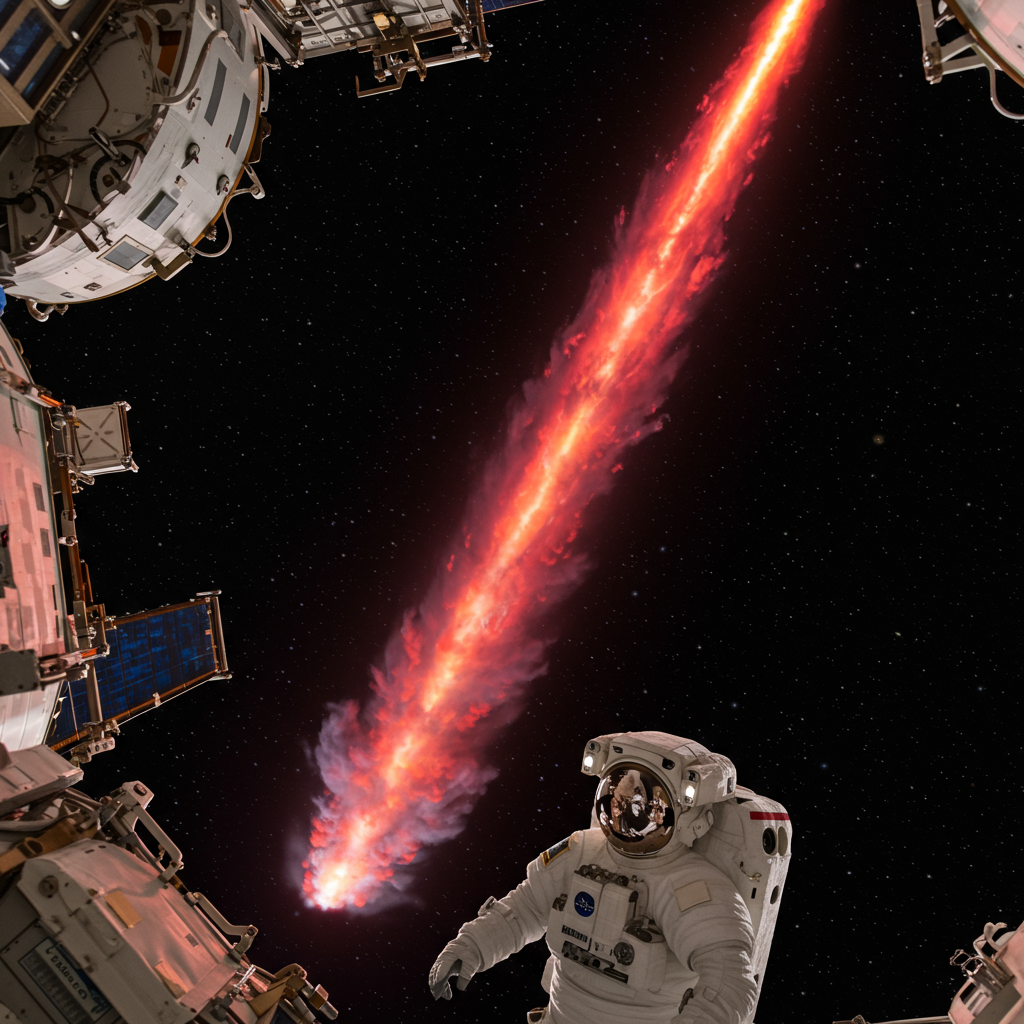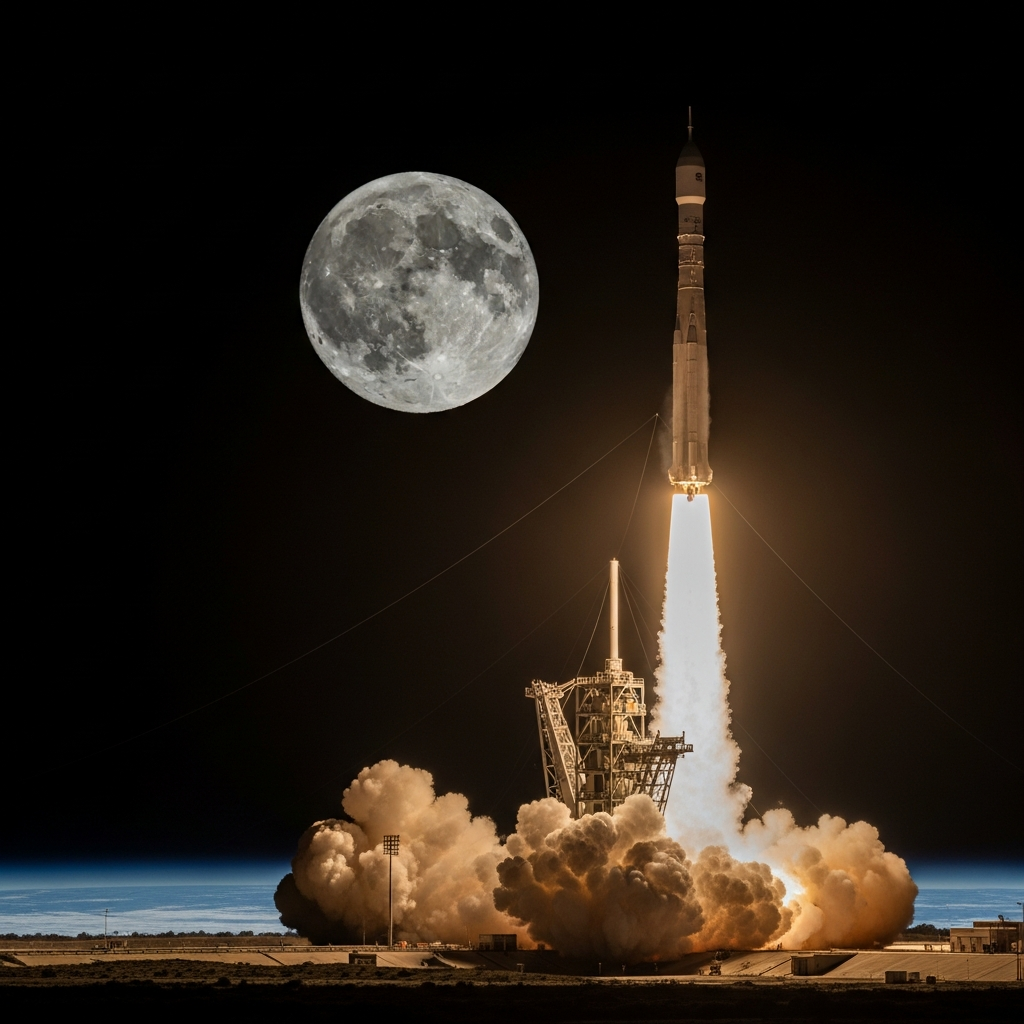
Humanity stands on the brink of a monumental achievement: a return to the Moon after more than half a century. The Artemis II mission, set for launch as early as February 6, 2026, represents a new era of lunar exploration. This historic journey isn’t just a nostalgic echo of the Apollo missions; it’s a bold step forward, aiming to establish a sustained human presence on our celestial neighbor. With a trailblazing crew and advanced technology, Artemis II will redefine our relationship with deep space, blending the lessons of the past with aspirations for the future.
Echoes of Apollo: The Legacy of Humanity’s First Lunar Foray
Fifty-eight years ago, in 1968, the Apollo 8 crew embarked on an unprecedented mission. They were the first humans to leave Earth’s orbit and venture towards the Moon. This audacious flight captured the world’s imagination, arriving during a turbulent year marked by assassinations and unrest. Yet, the mission was fraught with peril. NASA’s flight director, Chris Kraft, faced a difficult decision between a safer flyby and a riskier lunar orbital mission.
Frank Borman, Apollo 8’s commander, had a concerned wife, Susan. She famously buttonholed Kraft, expressing her deepest fear: if the crew became stranded in lunar orbit, it would “ruin the moon for everyone.” The image of three lost astronauts circling the Moon forever would be a permanent stain on humanity’s view of the night sky. Despite these profound anxieties, Kraft authorized the orbital mission. On Christmas Eve 1968, Apollo 8 successfully orbited the Moon ten times, beaming back awe-inspiring images of the desolate lunar surface to over a billion people. The crew’s reading from the Book of Genesis offered a profound moment of unity and hope. One anonymous letter perfectly encapsulated the mission’s impact: “Thank you. You saved 1968.” This powerful legacy sets the stage for the Artemis II mission today.
Artemis II: Charting a New Course to the Moon
The Artemis II mission marks the first human expedition to the Moon since Apollo 17 returned in 1972. While this mission won’t land on the lunar surface, its primary objective is to thoroughly test the vital systems of NASA’s powerful Space Launch System (SLS) rocket and the Orion spacecraft with a human crew. This 10-day journey around the Moon is a critical precursor to future lunar landings. It signifies humanity’s commitment to returning to deep space, not just for a brief visit, but for a sustained presence.
The mission is tentatively scheduled for its earliest launch window on February 6, 2026, from Launch Complex 39B at the Kennedy Space Center in Florida. Pre-launch preparations are extensive, including the impressive 12-hour rollout of the nearly 100-meter-tall SLS rocket and Orion capsule to the launch pad. This meticulous process underscores NASA’s paramount commitment to crew safety, a non-negotiable priority for every stage of the mission.
Meet the Trailblazing Crew of Artemis II
The four-person crew of Artemis II embodies the diverse and collaborative spirit of modern space exploration. Commander Reid Wiseman, Pilot Victor Glover, Mission Specialist Christina Koch, and Canadian Space Agency (CSA) astronaut Jeremy Hansen will etch their names into history. Their selection reflects NASA’s core values of equity and inclusion, making this mission a significant demographic and cultural shift.
Victor Glover: From LA Streets to Deep Space
Victor Glover’s journey to the Moon began in a cold Los Angeles in 1986. A difficult childhood fueled his determination for academic excellence. He excelled in sciences, eventually studying engineering at California Polytechnic State University. Glover then became a Navy aviator, amassing extensive flight experience before making a pivotal career shift in 2012. He applied for both a Naval legislative fellowship and the NASA astronaut program. The NASA call came during his Capitol Hill fellowship, welcoming him to the astronaut team. Now 49, Glover has already spent 168 days aboard the International Space Station (ISS) and will become the first person of color to travel to the Moon.
Christina Koch: From Antarctic Ice to Orbital Records
Christina Koch’s childhood fascinations were Antarctica and space. Born in Grand Rapids, Michigan, she pursued electrical engineering and physics at North Carolina State University. After two years at NASA Goddard Space Flight Center, her Antarctic itch led her to spend nearly three years researching at the Amundsen-Scott South Pole Station, enduring extreme isolation and temperatures down to -111°F. In 2013, she turned back to space, joining NASA’s astronaut class. Now 47, Koch holds the record for the longest single spaceflight by a woman (328 days on the ISS) and participated in the first all-woman spacewalk. She will be the first woman to travel to the Moon.
Jeremy Hansen: Canada’s Pioneer in Lunar Exploration
Jeremy Hansen, 49, is the sole rookie in the Artemis II crew, making his debut spaceflight. His path began on a farm in Ailsa Craig, Ontario, driven by an early passion for flying. He joined the Royal Canadian Air Cadet Squadron at age 12, earning his glider license by 16 and private pilot’s license a year later. After completing a master’s degree in physics and serving in the Royal Canadian Air Force, including patrolling the Arctic with NORAD, Hansen was selected by the Canadian Space Agency in 2009. After 17 years of rigorous training, he received the call in April 2023, confirming his spot on the Moon mission. Hansen will be the first non-American to venture to the Moon.
Reid Wiseman: Commander Forging the Path Forward
Reid Wiseman, 50, commander of Artemis II, brings a wealth of experience. A graduate of Rensselaer Polytechnic Institute and Johns Hopkins University with degrees in systems engineering, he became a Naval aviator in 1997. Wiseman served five deployments during the Iraq War, flying combat missions that he now reflects on with a sober perspective. In 2008, he applied to NASA’s astronaut program and was selected among thousands. He completed a 165-day rotation on the ISS in 2014 and served as head of the NASA astronaut office from 2020 to 2022. Wiseman, following in the footsteps of Apollo commanders, jokes about the “weight of history” but emphasizes taking “the next right step in a sustained lunar presence.”
The Technological Powerhouse: SLS and Orion
At the heart of the Artemis II mission is NASA’s formidable Space Launch System (SLS) rocket. Standing nearly 100 meters tall, the SLS generates a staggering 8.8 million pounds of thrust at liftoff. This makes it the most powerful rocket ever built, surpassing even the legendary Saturn V of the Apollo program. The SLS’s immense power is necessary to propel the Orion spacecraft, with its crew, out of Earth’s gravitational pull and towards the Moon.
The Orion spacecraft is designed for deep-space travel, equipped with advanced life support, navigation, and communication systems. A vital international contribution comes from the European Space Agency’s (ESA) European Service Module (ESM), built by Airbus. This module, situated behind the crew capsule, is indispensable. It provides Orion with propulsion to reach the Moon, generates all electrical power through its large solar arrays, and supplies astronauts with the oxygen, nitrogen, and water essential for their survival. The meticulous manufacturing of each ESM takes approximately 18 months, highlighting the precision required for astronaut safety.
The Artemis II Mission Profile: A Journey Beyond Records
The Artemis II mission will follow a complex, yet meticulously planned, trajectory. After launch, the SLS rocket will propel Orion into an initial Earth orbit. Following two high, looping orbits around Earth, the spacecraft will fire its engine to execute a translunar injection (TLI) maneuver, breaking free from Earth’s grip and heading moonward.
Unlike Apollo 8, Artemis II will follow a “safe” circumlunar trajectory, flying around the far side of the Moon without entering lunar orbit. The crew’s closest approach will be approximately 4,000 miles above the lunar peaks. The mission will travel a whopping 4,700 miles beyond the lunar backside, shattering the previous human distance record of 158 miles set by the crippled Apollo 13 spacecraft. From this unprecedented distance, the crew will capture dramatic photographs of Earth and Moon spheres in a single frame. The 10-day mission serves as a critical test for all integrated systems, preparing for future lunar landings.
The return journey to Earth will conclude with a challenging “skip-entry” reentry into Earth’s atmosphere at a blazing 25,000 mph. This maneuver, perfected during the Apollo era, involves entering the atmosphere, climbing back into space, and then reentering to bleed off heat and gravitational forces. Orion’s heat shield will endure blistering temperatures of 5,000°F – half as hot as the surface of the sun. The mission will conclude with a splashdown in the Pacific Ocean, where NASA and Department of War teams will be ready for recovery.
A Global Endeavor: The Artemis Accords and International Cooperation
The Artemis II mission is a testament to global collaboration. The inclusion of a Canadian astronaut, Jeremy Hansen, symbolizes this international spirit. Hansen emphasizes that “global problems require global solutions,” a sentiment echoed by NASA’s broader vision. In 2020, NASA and the U.S. State Department established the Artemis Accords, a pact now signed by 61 countries. These accords bind member states to the peaceful exploration of space and invite contributions to the Artemis program, fostering a “global standing army” for lunar exploration, much larger and more diverse than the 400,000 largely American personnel involved in Apollo.
The long-term goal of the Artemis program is to establish a permanent base near the Moon’s south pole. This region is vital due to abundant ice deposits, which can serve as a crucial source of water, rocket fuel, and breathable oxygen for future astronaut residents. This international effort signifies a collective human endeavor to push the boundaries of exploration and scientific discovery.
The Road Ahead: Artemis III and the Lunar Landing Challenge
While Artemis II is a significant step, the ultimate goal of landing humans on the Moon rests with Artemis III. Originally targeted for 2024, the launch date for Artemis III has repeatedly slipped, with experts now anticipating it no earlier than 2028, despite NASA’s “no earlier than” 2027 estimate. A major hurdle is the lunar landing craft, which, inconveniently, does not yet exist.
SpaceX was awarded the contract in 2021 to develop the Human Landing System (HLS) based on its massive Starship vehicle. However, the Starship lander presents significant challenges. It’s a colossal 165-foot-tall silo, requiring up to 20 fuel tankers to refuel it in Earth orbit before it can head to the Moon. Repeated test failures and delays have pushed the project far behind schedule. This situation has fueled concerns about a “second space race” with China, which aims to land its astronauts on the Moon by 2030. NASA has since opened the contract to other companies, with Blue Origin and Lockheed Martin submitting proposals for alternative landers, intensifying the competition and aiming to accelerate the path to a lunar landing.
Beyond the Horizon: The Enduring Spirit of Lunar Exploration
The Artemis II mission is more than a technical marvel; it’s a beacon of hope and inspiration. Just as Apollo 8 offered uplift during a tumultuous 1968, Artemis II has the potential to reignite humanity’s collective spirit. Michael Collins, Apollo 11’s command module pilot, famously recalled the international reaction to the first Moon landing: “unanimously the reaction was, ‘We did it. We humans finally left this planet.’”
Artemis II promises to be a similarly shared human triumph. It will add four new names to the short list of those who have ventured to the cosmic deep, representing the 8.3 billion people who remain earthbound. This mission, with its diverse crew, international collaboration, and ambitious goals, embodies the enduring human drive to explore, discover, and unite under the vastness of space. It’s a powerful reminder of what we can achieve when we reach for the stars together.
Frequently Asked Questions
What is the primary purpose of the Artemis II mission?
The primary purpose of the Artemis II mission is to serve as a critical crewed test flight for NASA’s Space Launch System (SLS) rocket and the Orion spacecraft. While it will not land on the Moon, it will carry four astronauts on a 10-day journey around the Moon. This mission aims to thoroughly evaluate Orion’s life support, navigation, communication, and other vital systems in deep space, ensuring they are safe and reliable for future lunar landing missions like Artemis III.
Who are the astronauts on the Artemis II mission, and why is this crew historic?
The Artemis II crew consists of Commander Reid Wiseman, Pilot Victor Glover, Mission Specialist Christina Koch, and Canadian Space Agency (CSA) astronaut Jeremy Hansen. This crew is historic for several reasons: Victor Glover will be the first person of color to travel to the Moon, Christina Koch will be the first woman, and Jeremy Hansen will be the first non-American astronaut on a lunar mission. Their diverse representation highlights NASA’s commitment to equity, inclusion, and international collaboration in space exploration.
When is the Artemis II mission scheduled to launch, and what are the next steps for Moon landings?
The Artemis II mission is tentatively scheduled for its earliest launch window on February 6, 2026, from the Kennedy Space Center in Florida, with alternative launch opportunities identified in February, March, and April. After Artemis II, the next major step is the Artemis III mission, which aims to land astronauts near the lunar south pole. However, the target date for Artemis III has repeatedly slipped, with experts anticipating it no earlier than 2028, largely due to challenges in developing the lunar landing craft.