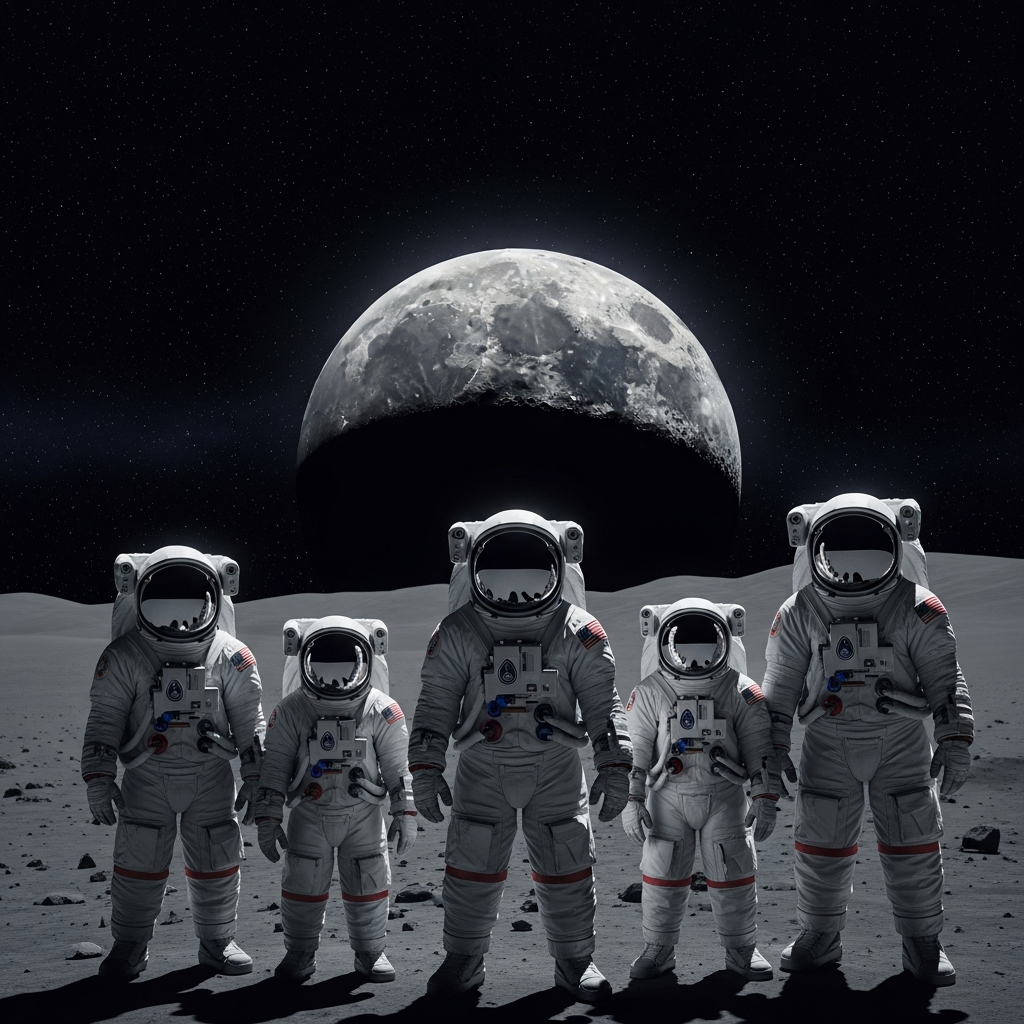
The world holds its breath as NASA’s Artemis II mission prepares to embark on a historic voyage. This isn’t just another space launch; it’s humanity’s triumphant return to lunar exploration after more than five decades. Poised to send four astronauts farther into deep space than any humans before, Artemis II is a critical stepping stone in NASA’s ambitious plan to establish a sustained human presence on the Moon and eventually venture to Mars. Get ready to discover the crew, the colossal rocket, and the crucial preparations underway for this epic lunar flyby.
Artemis II: A Historic Lunar Flyby, Not a Landing
NASA’s Artemis II mission stands as the second mission in the Artemis program and the first to carry a human crew. While it will not land on the lunar surface, its significance cannot be overstated. This 10-day expedition will send the Orion spacecraft and its four-person crew on a sweeping trajectory around the Moon, journeying approximately 4,700 miles beyond the lunar far side. This path is designed to test the Orion capsule’s vital life support, navigation, and communication systems under the extreme conditions of deep space.
The primary objective of this daring flyby is to thoroughly evaluate the spacecraft and its systems in a crewed environment, collecting invaluable data that will directly inform future lunar missions. Essentially, Artemis II is the ultimate dress rehearsal for Artemis III, the mission slated to achieve humanity’s next lunar landing. It confirms that the hardware and procedures are safe and reliable for longer, more complex deep-space endeavors.
Meet the Trailblazing Artemis II Crew
A quartet of exceptional astronauts will undertake this groundbreaking journey, marking the first time a woman and a person of color will be part of a lunar mission. The crew members for the Artemis II mission are:
Commander Reid Wiseman: A seasoned astronaut with previous spaceflight experience.
Pilot Victor Glover: Making history as the first African American to fly around the Moon.
Mission Specialist Christina Hammock Koch: Set to become the first woman to voyage around the Moon.
Mission Specialist Jeremy Hansen: Representing the Canadian Space Agency, the first Canadian to venture beyond low-Earth orbit.
These intrepid individuals entered a mandatory “health stabilization program,” or quarantine, in Houston on January 23, 2026. This standard protocol minimizes the risk of illness, ensuring the crew remains in peak health for the demanding mission. They will relocate to NASA’s Kennedy Space Center (KSC) in Florida roughly six days before launch, continuing simulations and final medical checks in a secure environment.
The Mega Moon Rocket: Powering Beyond Earth
The powerhouse behind the Artemis II mission is the Space Launch System (SLS) rocket, one of the world’s most formidable active rockets. Standing at an imposing 322 feet (98 meters), taller than the Statue of Liberty, the SLS is a marvel of modern engineering, primarily built by Boeing and Northrop Grumman. Perched atop this colossal rocket is the Orion capsule, constructed by Lockheed Martin, designed to safely transport the crew to the Moon and back.
On January 17, 2026, the fully stacked SLS rocket and Orion spacecraft were ceremoniously rolled out to Launch Pad 39B at KSC in Cape Canaveral, Florida. This massive mobile launcher, rocket, and capsule combination now stands ready, undergoing meticulous final checks by ground teams as the countdown to launch continues. The sight of this integrated vehicle on the pad electrifies space enthusiasts worldwide.
Crucial Pre-Launch Milestones Ahead
Before a definitive launch date can be set for the Artemis II mission, NASA must successfully complete several critical pre-flight tests. The most significant of these is the “wet dress rehearsal.” This comprehensive test involves loading the SLS rocket with its full complement of approximately 700,000 gallons (2.6 million liters) of super-cold cryogenic propellants, followed by a simulated launch countdown. Engineers practice every step of a launch day, then drain the propellants, evaluating systems and procedures. This crucial rehearsal was targeted for as early as 9 p.m. ET on January 31, 2026, potentially extending into the early hours of February 1st.
Following a successful wet dress rehearsal, mission management will conduct a “flight readiness review.” This in-depth assessment scrutinizes all aspects of the spacecraft, rocket, ground systems, and crew preparedness. NASA adheres to a strict “fly when we’re ready” philosophy, prioritizing safety and mission success above any fixed schedule. This methodical approach ensures that every system is thoroughly vetted before committing to a launch.
Targeting the Launch: Windows of Opportunity
Pinpointing an exact launch date for a lunar mission is incredibly complex. Specific “launch windows” are dictated by the precise alignment of Earth’s rotation, the launchpad, the Moon’s position, and critical factors like lighting, communication, and safety parameters. These orbital mechanics create limited opportunities.
NASA has publicly identified several potential launch windows for the Artemis II mission:
February 2026: Specific opportunities between February 6-8 and February 10-11.
March 2026: Potential windows on March 6-9 and March 11.
April 2026: Opportunities identified for April 1, April 3-6, and April 30.
Should further preparation time be required, short launch windows are anticipated to be available in most subsequent months. The ultimate decision on a launch date will depend heavily on the successful completion of the wet dress rehearsal and the subsequent flight readiness review. The entire Artemis II mission is a delicate dance between meticulous preparation and the unforgiving mechanics of orbital alignment.
Overcoming Challenges on the Path to Launch
Even with advanced planning, challenges are an inherent part of human spaceflight. NASA technicians are proactively addressing issues as the launch window approaches. For instance, an Arctic blast brought colder-than-expected temperatures to Florida. This required adjustments to environmental control systems to maintain optimal operational temperatures for the sensitive SLS rocket and Orion spacecraft.
Furthermore, initial samples from the Orion capsule’s potable water system, designed to provide drinking water for the crew, showed higher-than-expected levels of organic carbon. Engineers are diligently working to resolve this to ensure the crew’s health and safety throughout their 10-day mission. These ongoing efforts underscore NASA’s commitment to mitigating risks and ensuring every component performs flawlessly.
Artemis: Laying the Foundation for Lunar & Martian Futures
The Artemis II mission is far more than an isolated lunar flyby; it is a pivotal step in NASA’s overarching Artemis program. This ambitious, multi-billion-dollar initiative aims to re-establish a continuous human presence on the Moon for the first time since the Apollo era concluded in 1972. The program’s foundation was laid by Artemis I, an uncrewed Orion capsule test flight that successfully orbited the Moon in November 2022, proving the vehicle’s capabilities.
Looking beyond Artemis II, the program envisions a lunar settlement, specifically targeting the Moon’s south pole. This location is strategically chosen for its potential abundance of water ice. This ice could be extracted and processed for drinking water, breathing air, and even as a source of hydrogen and oxygen for rocket fuel. Ultimately, this sustained human presence on the Moon would serve as a critical base of operations and a proving ground for the audacious goal of sending the very first crewed missions to Mars. The Artemis program truly represents humanity’s next giant leap.
How to Follow the Historic Journey Live
For those eager to witness this momentous occasion, NASA plans extensive coverage of all major Artemis II events. This includes the crucial fueling test, mission briefings, and, of course, the launch itself. Livestreams will be readily available across multiple platforms:
NASA’s Official YouTube Channel
NASA+ Streaming Service
NASA’s Facebook Page
- X.com (formerly Twitter)
- mashable.com
- www.usatoday.com
- www.livescience.com
- www.yahoo.com
- www.space.com
A continuous livestream of the majestic 322-foot SLS mega moon rocket has been available on Launch Pad 39B since its rollout. Further details regarding third-party streaming services are expected to be announced closer to the official launch date. Prepare to tune in and be part of history as humanity sets its sights on the Moon once more.
Frequently Asked Questions
What is the primary goal of NASA’s Artemis II mission, and will it land on the Moon?
The primary goal of the Artemis II mission is to thoroughly test the Orion spacecraft’s critical systems—including life support, navigation, and communications—in deep space with a human crew. This 10-day mission will involve a flyby around the Moon, journeying approximately 4,700 miles beyond its far side. However, the mission will not land on the Moon. It serves as a crucial preparatory step for the subsequent Artemis III mission, which aims to achieve the first human lunar landing in over 50 years.
How can I watch NASA’s Artemis II mission events and updates live?
NASA plans to broadcast all significant Artemis II mission events, including the wet dress rehearsal, mission briefings, and the eventual launch. You can follow the live coverage on several official platforms. These include NASA’s YouTube channel, the NASA+ streaming service, the NASA Facebook page, and X.com. A continuous livestream of the SLS rocket on Launch Pad 39B is already available. Additional details for third-party streaming services are expected to be released closer to the official launch date.
What are the potential launch windows for the Artemis II mission, and what factors influence the final date?
NASA has identified several potential launch windows for the Artemis II mission spanning from early February to early April 2026. Specific opportunities include February 6-8 and 10-11; March 6-9 and 11; and April 1, 3-6, and 30. The definitive launch date is influenced by multiple critical factors, including the successful completion of a “wet dress rehearsal” (a full fueling test and simulated countdown) and a “flight readiness review” by mission engineers. Orbital mechanics, like the precise alignment of Earth and the Moon, and favorable lighting and communication conditions, also constrain these windows. NASA emphasizes a “fly when we’re ready” approach, prioritizing safety and readiness over a fixed schedule.
The Future of Human Spaceflight Awaits
The Artemis II mission is more than just a test flight; it’s a profound statement about humanity’s enduring drive to explore. With its trailblazing crew, the immense power of the SLS rocket, and the meticulous preparations underway, this mission sets the stage for our return to the Moon and paves the way for our ultimate journey to Mars. As the world watches, NASA continues to push the boundaries of what’s possible, inspiring generations and reaffirming our place among the stars. The next chapter in human space exploration is ready to unfold.