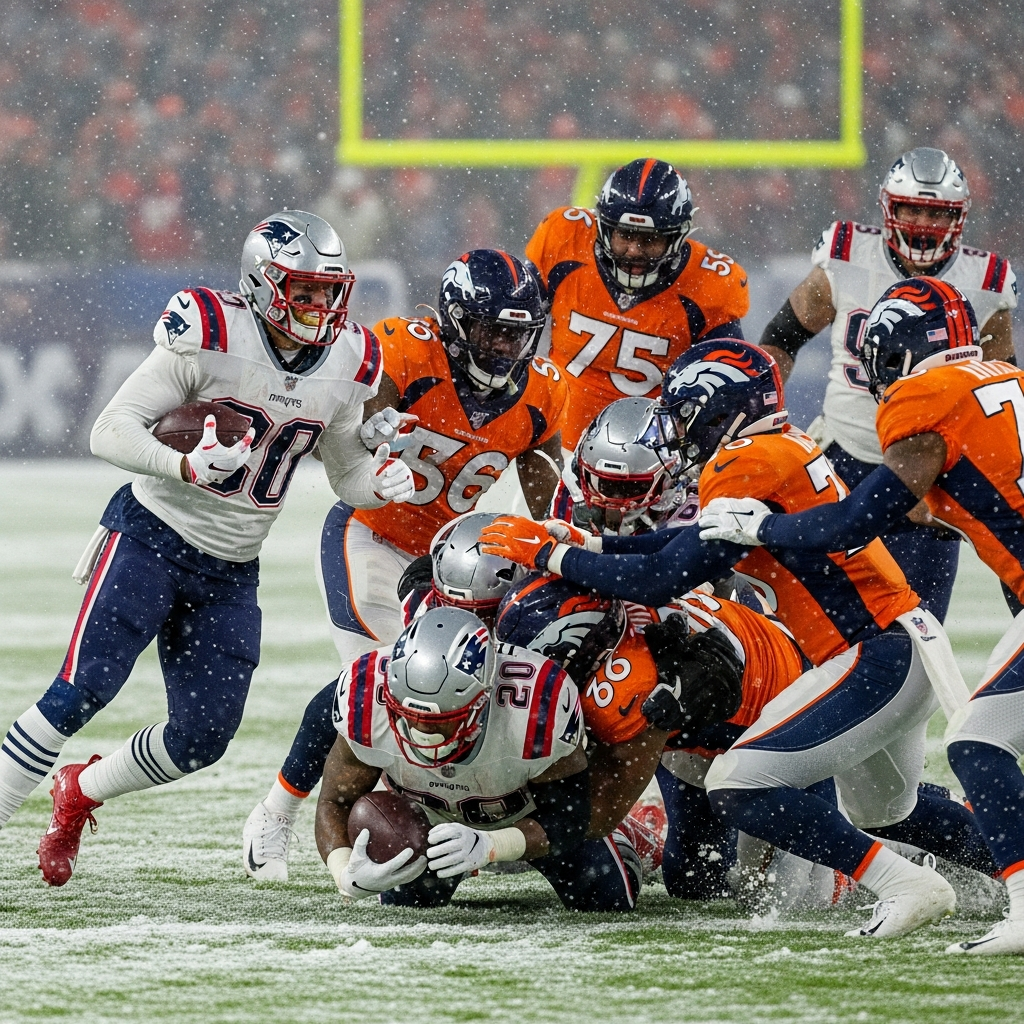
Championship Sunday delivered an “ice fight” for the ages as the New England Patriots battled the Denver Broncos in a brutal AFC Championship showdown. In a frigid, snow-swept Empower Field at Mile High, the Patriots clawed their way to a hard-fought 10-7 victory on January 25, 2026, securing their berth in Super Bowl LX against the Seattle Seahawks. This gritty win, characterized by dominant defense, crucial special teams heroics, and a resourceful quarterback performance, revealed the true mettle of a New England team built to win even when conditions are at their worst.
The “Ice Fight”: When Mother Nature Joined the Battle
From the opening whistle, it was clear this would not be a typical shootout. However, by the second half, the game transformed into a true “snow globe,” with wind and heavy snowfall turning offensive play into a monumental struggle. Both teams entered the contest with identical 14-3 records, but the Patriots, favored by 4.5 points, ultimately adapted better to the brutal conditions.
New England’s defense, led by coordinator Mike Vrabel, rose to the occasion, answering all lingering postseason questions with a resounding display of force. After allowing an early 52-yard splash play to Marvin Mims Jr. that set up Denver’s sole touchdown—a 6-yard pass to Courtland Sutton—the Patriots’ defensive unit completely shut down the Broncos. They allowed a mere 32 yards on five possessions in the entire second half. Facing backup quarterback Jarrett Stidham, who was thrust into action due to an ankle injury sidelining starter Bo Nix, the Patriots denied Denver any significant ground attack, limiting them to 3.3 yards per carry and just three rushing first downs.
The defensive line was particularly disruptive, with Milton Williams and Elijah Ponder each recording a team-high four pressures. Christian Barmore and Cory Durden also contributed to the relentless pressure. They sacked Stidham three times, allowed only one completion on 10 pass attempts under pressure, and held the Broncos to a dismal 4 of 14 on third downs. This suffocating defense, along with a crucial second-half interception by Christian Gonzalez, sealed Denver’s fate, allowing only four first downs on the Broncos’ final eight possessions.
Drake Maye’s Playoff Metamorphosis: Legs Over Arm
While the Patriots’ defense shone, the offense had its struggles. Second-year quarterback Drake Maye, a legitimate MVP candidate during the regular season, endured an “ugly” passing performance in the “ice fight.” He completed just 10 of 21 pass attempts for a modest 86 yards and took five sacks. The Patriots’ offense managed only 12 total yards in the first quarter, their lowest since Week 17 of the previous season, and a mere 74 first-half yards, marking their fewest in a playoff game since 1998. Running back Rhamondre Stevenson also found little room, averaging just 2.8 yards per carry.
Despite these struggles, Maye showcased his “steely mettle” and dynamic athleticism, proving pivotal with his legs. Unlike his counterpart, Maye avoided turnovers, which was crucial. He scrambled 10 times for 65 yards, scoring New England’s only touchdown. His key runs—a 28-yard scramble on third-and-9 to set up the go-ahead field goal, and a 7-yard scramble on third-and-5 to ice the game late—were critical “inflection points.” These gains (28, 16, and 13 yards) were the longest of any player on either team.
This performance further solidified Maye’s unique playoff narrative. He became the first quarterback to win three playoff games against top-five total defenses in a single postseason. While his passing numbers weren’t sparkling, Maye’s ability to win “ugly games” by leveraging his mobility and minimizing mistakes proved the difference, a trait that bodes well for the challenges ahead in Super Bowl LX. Wide receiver Mack Hollins, returning from injury, provided a rare bright spot in the passing game, catching two passes for 51 yards.
Broncos’ Costly Errors and Payton’s Regret
For the Denver Broncos, the AFC Championship loss marked a disappointing end to a “dream-like season.” Much of their struggle stemmed from quarterback Jarrett Stidham’s performance and crucial decisions made by Head Coach Sean Payton. Stidham, making his first start in over 700 days due to Bo Nix’s ankle injury, began wobbling. Although he briefly settled down with a 52-yard dime to Marvin Mims Jr. and a short touchdown pass to Courtland Sutton, the pressure soon mounted.
Stidham made a critical error in the second quarter, attempting to avoid a third-down sack deep in his own territory. He flipped the ball backward, resulting in a fumble that gave the Patriots a short field and directly led to Maye’s game-tying touchdown. Stidham himself admitted, “I can’t put our team in a bad position like that… Probably should have just eaten the sack, anyway.” He struggled immensely under pressure, completing just 1 of 10 passes for 4 yards with an interception, ultimately finishing 17 of 31 for 133 yards with a touchdown and a late interception that ended Denver’s final hopes.
Sean Payton later expressed significant regret over a controversial decision in the first half. With Denver leading 7-0 and driving in the red zone, Payton elected to go for it on fourth-and-1 instead of attempting a field goal that would have extended their lead to a critical 10-0. The play failed dramatically under heavy duress, turning over possession. Given the challenging weather conditions and having a backup quarterback, this decision proved costly. As Payton lamented, “We needed more than that.” This, combined with Wil Lutz’s missed 54-yard field goal in the final minute of the first half, allowed the Patriots to control the narrative as the snowstorm intensified.
Special Teams Heroics: The Block Heard ‘Round Denver
While the Patriots’ offense wasn’t at its best and punter Bryce Baringer struggled throughout the contest, their special teams delivered when it mattered most. Rookie kicker Andres Borregales missed two field goal attempts (63 and 46 yards), but he did connect on a crucial 23-yarder after halftime that gave the Patriots their decisive 10-7 lead.
However, the defining special teams moment came with 4:46 left in the game. With the Broncos lining up for a 45-yard field goal that would have tied the contest, practice squad call-up Leonard Taylor III made an incredible play. Taylor surged through the line and got a hand on Wil Lutz’s low-trajectory kick, forcing it wide of the uprights. This massive field goal block was a game-changing play in such a tight, low-scoring affair, preserving New England’s narrow lead. The Patriots’ special teams unit, despite some earlier struggles, ultimately provided the critical play to send them to Santa Clara.
On to Super Bowl LX: A Gritty Path Ahead
The New England Patriots’ 10-7 victory over the Denver Broncos wasn’t pretty, but it was effective. It highlighted a team capable of winning in adverse conditions, relying on a dominant defense and a resourceful quarterback. NFL Research noted that the Patriots averaged just 18.0 points per game this postseason, the fewest by any team to make the Super Bowl since the 1979 Rams (15.0). This statistic underscores their defensive strength and ability to grind out wins.
New England now prepares to face the Seattle Seahawks in Super Bowl LX in Santa Clara, California. The Seahawks, with their “ruthless defense,” will present another formidable challenge, especially after quarterback Sam Darnold’s near-flawless performance in the NFC Championship. While Drake Maye’s playoff passing statistics might not be dazzling, the Patriots have proven they are “talented everywhere you turn,” capable of winning in multiple ways. This gritty, defensive-minded approach, paired with Maye’s clutch playmaking, sets the stage for what promises to be an intense Super Bowl battle. The AFC Championship win serves as a powerful testament to their resilience and championship aspirations.
Frequently Asked Questions
How did the weather impact the Patriots-Broncos AFC Championship Game?
The AFC Championship Game on January 25, 2026, was severely impacted by brutal “snow globe-like” weather conditions, especially in the second half. Heavy snowfall and wind transformed the game into a defensive battle, making offensive traction extremely difficult. This favored the New England Patriots’ dominant defense, which smothered the Broncos and allowed minimal yardage after halftime, while also forcing both offenses to rely on opportunistic plays rather than sustained drives.
What was the significance of Sean Payton’s fourth-down decision in the AFC Championship?
Broncos Head Coach Sean Payton’s decision to go for it on fourth-and-1 instead of kicking a field goal early in the second quarter was highly significant and ultimately costly. With Denver leading 7-0 and driving in the red zone, a field goal would have extended their lead to 10-0. The failed fourth-down conversion, under immediate pressure on backup quarterback Jarrett Stidham, shifted momentum, denying Denver a crucial two-score lead. Payton later expressed regret, acknowledging the missed points became critical as the weather worsened.
What does the Patriots’ AFC Championship victory suggest about their Super Bowl LX chances?
The Patriots’ 10-7 AFC Championship victory, despite an “ugly” offensive performance from Drake Maye and the team, suggests they are a resilient, defense-first contender. Their ability to win in brutal conditions, rely on game-changing defensive plays (like the field goal block by Leonard Taylor III) and Maye’s crucial scrambling, indicates a team with significant depth beyond just passing heroics. While they averaged a low 18.0 PPG in the postseason, their dominant defense and clutch play-making ability demonstrate they can win “ugly games” against top competition, preparing them for a challenging Super Bowl LX matchup against the Seattle Seahawks.