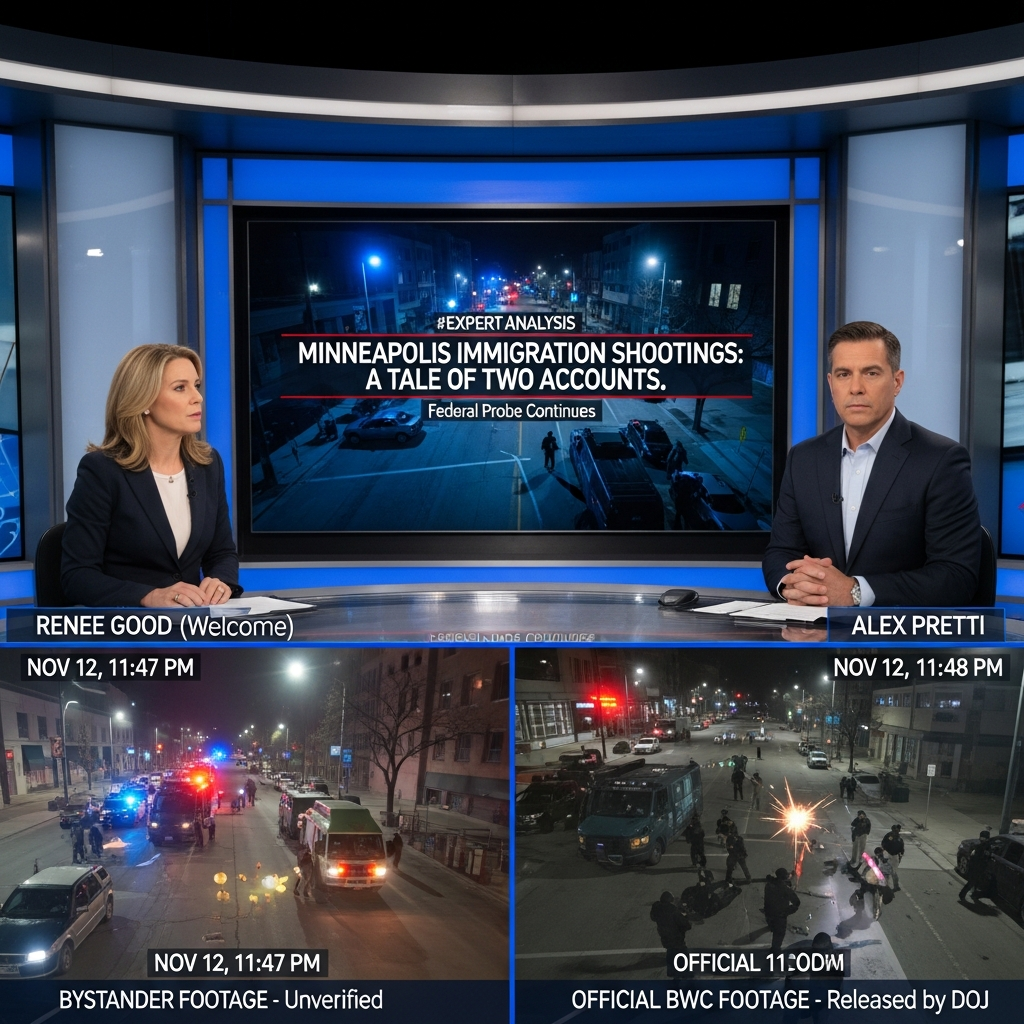
Minneapolis has become a focal point of national debate following two tragic fatal shootings involving federal immigration agents. Both incidents, which claimed the lives of Renee Good and Alex Pretti, have ignited fierce controversies and spotlighted stark contradictions between official accounts and compelling bystander video evidence. This article delves into a meticulous frame-by-frame Minneapolis shooting analysis, revealing crucial details that challenge prevailing narratives and underscore the vital role of visual forensics in modern journalism. We’ll unpack how expert examination of video footage has illuminated a complex, often disputed, reality.
Unpacking the Controversies: Federal Agents & Fatal Encounters
The backdrop to these events is a city already grappling with heightened tensions. A significant deployment of 2,000 federal agents to the Twin Cities, described as the largest in ICE history, preceded these fatal encounters. This heavy federal presence immediately created friction with local authorities and the community.
The Alex Pretti Shooting: A Frame-by-Frame Deconstruction
On January 24, 2026, 37-year-old intensive care nurse Alex Pretti was shot and killed by federal agents on Nicollet Avenue. Federal officials, including US Homeland Security Secretary Kristi Noem, quickly claimed Pretti was shot for “brandishing” a legally registered handgun. This narrative, however, dramatically clashed with local authority statements and detailed video analysis.
Minneapolis Police Chief Brian O’Hara asserted that Pretti, a legal gun owner with no criminal record, was not brandishing his weapon. He was shot after the gun had been removed. Bellingcat’s granular analysis of multiple synchronized bystander videos provides a critical counter-narrative. Footage showed an agent approaching Pretti, who was filming. After being sprayed with a substance and wrestled by multiple agents, a crucial sequence unfolded.
An agent in a grey jacket was seen removing a Sig Sauer P320 handgun from Pretti’s waistband before any shots were fired. This distinctively customized weapon matched one later displayed by DHS as belonging to Pretti. Approximately twelve seconds after reaching for the gun, the agent walked away with it. Immediately after this, another agent, with a clear line of sight, drew his own weapon and fired the first shot. Pretti’s hands were visible on the ground, away from his holstered weapon, just moments before. Bellingcat’s slowed footage indicates Pretti’s gun was not fired. Shots continued even after Pretti collapsed, with several fired at his motionless body. This rigorous Minneapolis shooting analysis directly refuted claims of an “armed struggle.”
Adding to the controversy, federal agents initially barred Minnesota Bureau of Criminal Apprehension (BCA) investigators from the scene, even after a state search warrant was obtained. Minnesota Attorney General Keith Ellison described this as an “extraordinary” and alarming step, leading to a temporary restraining order compelling DHS to preserve evidence. Further complicating matters, federal claims about the target of their operation, Jose Huerta Chuma, were also disputed by the Minnesota Department of Corrections, which stated Chuma had no felony convictions and only minor traffic offenses from over a decade prior.
The Renee Good Shooting: Challenging the “Self-Defense” Claim
Weeks earlier, on January 7, 2026, Renee Nicole Good, a 37-year-old US citizen, was fatally shot by an ICE agent in her SUV. Homeland Security Secretary Kristi Noem claimed officers acted in self-defense, alleging Good “weaponized her vehicle” by attempting to ram agents. This narrative was also immediately met with skepticism and was largely contradicted by extensive video analysis.
Retired ICE agent Eric Balliet, reviewing bystander video, highlighted several tactical concerns. He noted a lack of officers identifying themselves and questioned the placement of an agent directly in front of an occupied vehicle. Balliet stressed that fleeing alone does not justify deadly force. The critical analysis from ABC News, The New York Times, and The Washington Post, using synchronized footage, revealed Good was turning her steering wheel away from the agent just over a second before the first shot was fired. This directly challenged the claim she was attempting to ram him.
The agent, positioned to the front-left of Good’s vehicle, fired three shots rapidly – the first two just 399 milliseconds apart, followed by a third 299 milliseconds later. Importantly, the shooting agent was also seen holding a phone and filming while firing. Despite federal claims that the agent was struck, video evidence shows him remaining upright as the vehicle passed. Minneapolis Mayor Jacob Frey vehemently rejected the self-defense claim, calling it “bulls—” and demanding ICE leave the city.
The Power of Visual Forensics: How Video Evidence Reshaped Narratives
In both the Pretti and Good cases, widely available raw bystander video footage became a linchpin. However, as researcher Ståle Grut predicted, raw video alone is often insufficient. It requires sophisticated “visual investigative competence” to clarify contradictory or unclear elements. News organizations like Bellingcat, The New York Times, and The Washington Post demonstrated this crucial capability.
They utilized visual forensics tools, synchronizing multiple angles and conducting frame-by-frame examinations. This detailed Minneapolis shooting analysis allowed them to pinpoint precise timings, positions, and actions that were otherwise obscured. For instance, The New York Times synchronized various clips of the Good shooting, concluding that the agent was to the left of the SUV, with its wheels pointing away from him, at the moment of firing. Bellingcat’s analysis in the Pretti case meticulously showed the gun being removed before the first shot. These rigorous methods provided concrete evidence that directly challenged the official government narratives, underscoring the indispensable role of independent media in verifying facts during controversial events.
Broader Implications: Accountability, Policy, and Public Trust
These incidents have sparked widespread outrage and ignited significant political and societal reactions. Minnesota Governor Tim Walz repeatedly demanded President Trump withdraw federal agents, labeling the situation an “inflection point.” Trump, conversely, accused Minnesota officials of a “criminal cover-up” and called for cooperation with federal immigration enforcement. This deep partisan divide reflected broader national tensions over immigration policy and the authority of federal agents.
Questions surrounding ICE and DHS use-of-force policies have become central. The 2023 ICE/DHS policy permits officers to fire into a moving vehicle only under specific, dire circumstances – if a deadly weapon is present or if the vehicle poses an imminent threat with no other defensive option. Expert analysis in the Good shooting suggested these conditions were not met.
The business community, including major Minnesota-based companies like Target and Best Buy, signed an open letter calling for de-escalation and cooperation. Within Trump’s own Republican party, some figures, including Senator Bill Cassidy, called the shootings “incredibly disturbing.” The NRA also weighed in, condemning statements implying that legally carrying a firearm equates to a “death sentence.” These events underscore the delicate balance between law enforcement, civil liberties, and public trust, especially when video evidence contradicts official accounts.
Frequently Asked Questions
What were the main discrepancies between official claims and video evidence in the Minneapolis shootings?
In both the Alex Pretti and Renee Good shootings, official federal claims of self-defense or “brandishing a weapon” were heavily contradicted by detailed video analysis. For Pretti, federal officials stated he brandished a handgun, but video evidence analyzed by Bellingcat showed an agent removing Pretti’s holstered gun before any shots were fired, with multiple shots fired at his motionless body. In Good’s case, federal claims stated she “weaponized her vehicle” by attempting to ram an agent. However, synchronized video from multiple sources indicated Good was steering away from the agent just before the shots were fired, challenging the self-defense narrative.
Which organizations provided key video analysis of these incidents?
Several prominent organizations conducted crucial video analysis that debunked official narratives. Bellingcat provided detailed, frame-by-frame analysis of the Alex Pretti shooting, focusing on the sequence of events leading to the shooting and the removal of Pretti’s weapon. For the Renee Good shooting, The New York Times, The Washington Post, and ABC News performed synchronized video analyses, confirming Good was steering away from the agent. CBS Minnesota also featured analysis from retired ICE agent Eric Balliet, who critiqued the tactical decisions made by the agents involved. These journalistic investigations leveraged visual forensics to clarify conflicting accounts.
How has the Minneapolis shooting analysis impacted public discourse on federal agent accountability?
The meticulous video analysis of both the Alex Pretti and Renee Good shootings has significantly intensified public discourse on federal agent accountability and use-of-force policies. The clear contradictions between official statements and documented visual evidence have fueled calls for greater transparency, independent investigations, and reforms in federal law enforcement operations, particularly those involving immigration agents. This Minneapolis shooting analysis has highlighted the power of bystander video and forensic journalism in holding authorities accountable, fostering a national conversation about civil liberties, the limits of federal power, and the critical need for unbiased fact-finding in controversial incidents.
Conclusion: Seeking Clarity Amidst Conflicting Accounts
The tragic events in Minneapolis underscore a profound and escalating tension between federal immigration enforcement and local communities. The extensive Minneapolis shooting analysis performed by multiple journalistic outlets has provided invaluable clarity. This rigorous examination of bystander video has not only exposed critical discrepancies in official narratives but also reaffirmed the indispensable role of visual forensics in upholding journalistic integrity and public trust. As investigations continue, the demand for transparency, accountability, and a re-evaluation of use-of-force policies for federal agents remains paramount. These incidents serve as a stark reminder of the power of independent scrutiny in shaping informed public understanding and driving meaningful change.