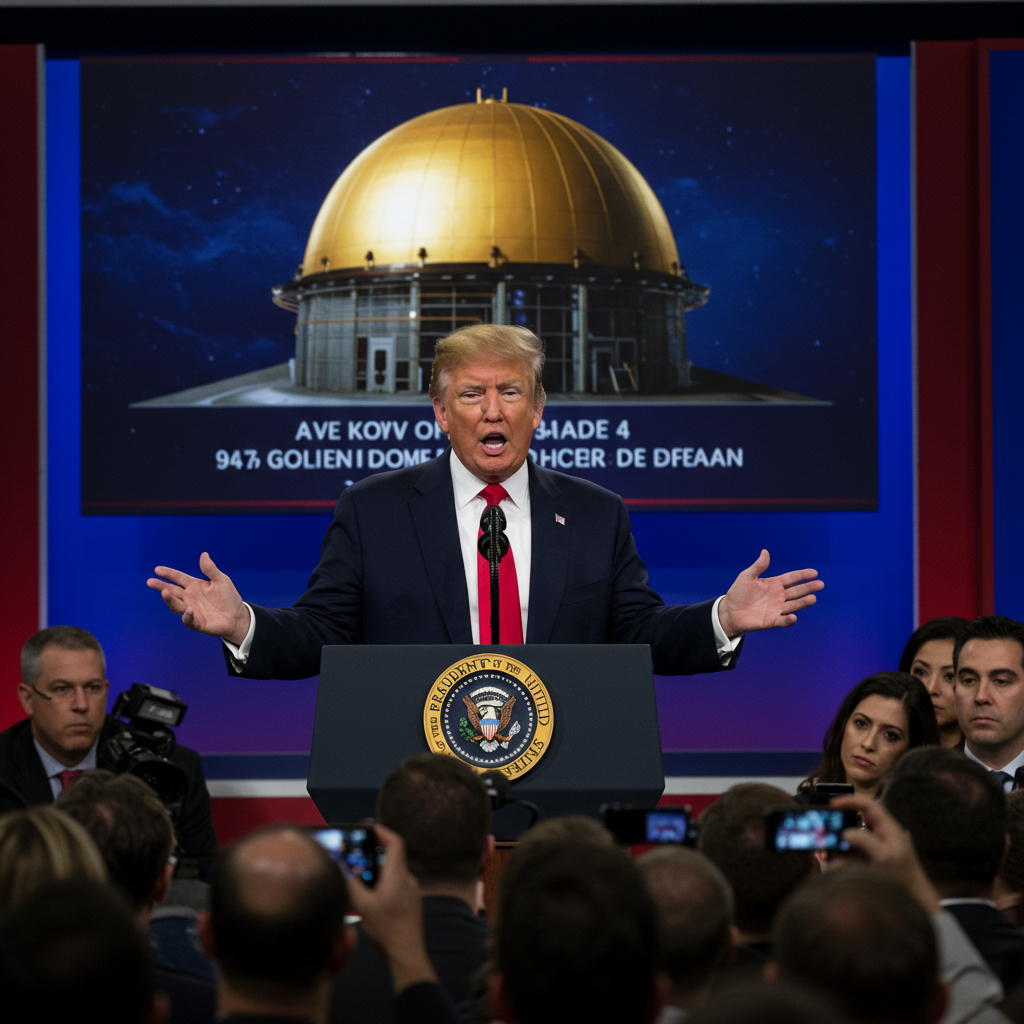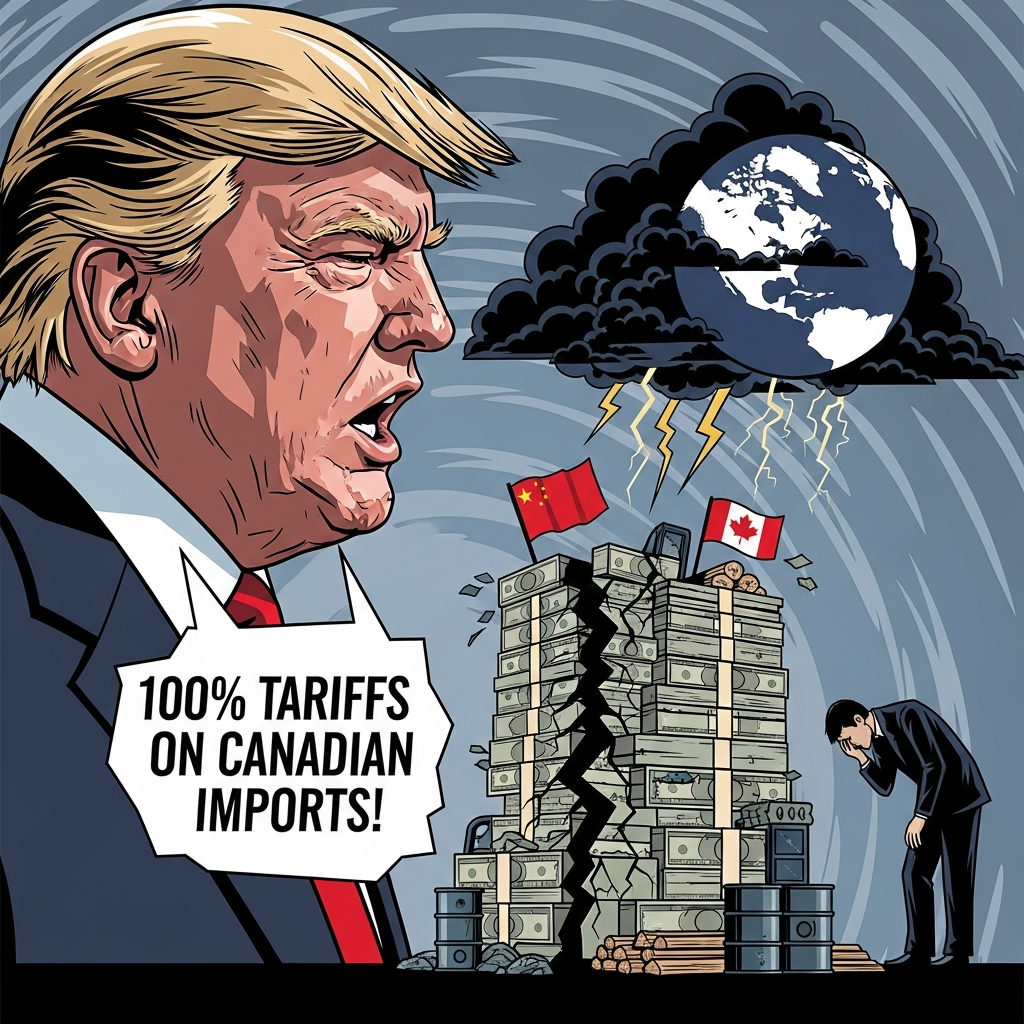
Former U.S. President Donald Trump has issued a formidable threat, vowing to levy a massive 100% tariff on all Canadian imports if Canada proceeds with any trade agreement with China. This dramatic declaration, made on his Truth Social platform, accuses Canada of potentially becoming a “Drop Off Port” for Chinese goods intended for the American market, a move Trump vehemently opposes. The escalation highlights deepening tensions and a significant divergence in trade policy between two historically close allies.
Trump’s warning comes amidst a complex backdrop of shifting global alliances and Canada’s deliberate strategy to diversify its trade partnerships beyond the United States. While the specific deal Trump referred to in his post remains somewhat ambiguous, it clearly targets Canada’s recent efforts to forge stronger economic ties with Beijing. This situation has ignited a fierce war of words, prompting swift responses from Canadian leadership and raising questions about the future of North American economic relations.
Trump’s Tariff Ultimatum: A Staggering Threat
In his direct social media message, Donald Trump left no room for interpretation: “If Canada makes a deal with China, it will immediately be hit with a 100% Tariff against all Canadian goods and products coming into the U.S.A.” He underscored his concern, stating, “China will eat Canada alive, completely devour it, including the destruction of their businesses, social fabric, and general way of life.” This strong language reflects a protectionist stance often seen in Trump’s trade rhetoric, aiming to prevent what he perceives as economic exploitation by rival nations.
The former president’s “Drop Off Port” analogy suggests a belief that Canada could be used as a conduit for Chinese products to bypass U.S. tariffs, an outcome he has vowed to prevent. This aggressive posture aligns with his historical use of tariff threats as a negotiating tool, though he has sometimes walked back extreme positions in the past. The threat isn’t just about trade; it’s a clear message about geopolitical influence and the hierarchy of power within North America.
The Context of Canada’s Outreach to China
This latest friction follows Canadian Prime Minister Mark Carney’s recent visit to Beijing, where he announced a “strategic partnership” with Chinese President Xi Jinping. This agreement aims to foster closer bilateral ties and notably included resolutions on several key tariff issues. The move signals Canada’s serious intent to diversify its economic partnerships, reducing its heavy reliance on the U.S. market, a strategy that gained urgency amidst the uncertainty created by Trump’s previous on-again-off-again tariff policies.
Under the new Canada-China agreement, China committed to significantly lowering its import levies on Canadian canola oil, reducing them from 85% to a mere 15% by March. In return, Canada agreed to tax Chinese electric vehicles (EVs) at a more favorable most-favoured-nation rate of 6.1%, a substantial drop from the previous 100% tariff. This deal represents a breakthrough after years of strained relations and retaliatory tariffs, potentially opening doors for increased Chinese investment in Canada.
A Diplomatic Firestorm: Davos and Beyond
The recent tariff threat is not an isolated incident but rather the latest flashpoint in an escalating war of words between Trump and Prime Minister Carney. Tensions dramatically surged after Carney’s impactful speech at the World Economic Forum in Davos. Without directly naming Trump or the United States, Carney delivered a thinly veiled critique of the current global landscape, declaring that the “US-led world order had been ruptured.”
Carney passionately urged “middle powers,” such as Canada, to collaborate and collectively assert themselves against economic coercion by “greater powers.” He warned that the “rules-based order is fading” and that “if you are not at the table, you are on the menu.” This powerful statement, which reportedly “outshined and upset Trump,” positioned Canada as a model for cooperation in a rapidly evolving geopolitical environment.
Trump’s Retaliation and the “Board of Peace”
Trump’s response to Carney’s Davos remarks was swift and cutting. In his own speech the following day, Trump asserted, “Canada lives because of the United States. Remember that, Mark, the next time you make your statements.” He further amplified his displeasure by withdrawing Canada’s invitation to join his new “Board of Peace,” a U.S.-led council intended to manage Gaza’s post-war future. This act was perceived as a significant diplomatic snub.
Adding to the slights, Trump repeatedly referred to Prime Minister Carney as “Governor Carney” in his social media posts, a dismissive nickname he has used for Canadian leaders in the past. This terminology has often been interpreted as a suggestion of Canada’s subservient role, echoing past remarks where Trump mused about Canada becoming the 51st U.S. state. Such rhetoric underscores a deeply strained relationship at the highest levels.
Unpacking Contradictions and Broader Geopolitics
One striking aspect of Trump’s latest threat is its apparent contradiction of his earlier stance. Just days prior, when asked about Canada’s growing engagement with China during Carney’s visit, Trump had reportedly stated, “That’s what he should be doing. It’s a good thing for him to sign a trade deal. If you can get a deal with China, you should do that.” This stark reversal highlights a fluid and often inconsistent approach to foreign policy.
This pattern of issuing severe threats only to later adjust or walk them back is not new for Trump. A notable parallel can be drawn to his previous threats of sweeping tariffs on European nations if they did not agree to his efforts to acquire Greenland. He later rescinded these threats after announcing a “framework of a future deal” for the Arctic island. Such tactics reveal a strategy of using economic leverage to exert political influence, regardless of the target.
Canada’s Firm Stance on Sovereignty
In response to Trump’s provocative statements, Canadian leaders have emphasized their nation’s sovereignty and strategic independence. Canada’s U.S. trade minister, Dominic LeBlanc, issued a clear statement, clarifying that Canada is “not pursuing a free trade deal with China.” He stressed that the recent agreement focused on resolving “several important tariff issues” as part of Canada’s broader goal of strengthening trade partnerships globally to build a robust domestic economy.
Prime Minister Carney himself directly challenged Trump’s assertion that “Canada lives because of the United States.” He declared, “Canada thrives because we are Canadian. We are masters in our own house. This is our country. This is our future. The choice is ours.” While acknowledging the enduring and “remarkable partnership” between Canada and the U.S. across economic, security, and cultural spheres, Carney’s remarks firmly asserted Canada’s right to chart its own course on the international stage.
Deep Economic Ties and Future Implications
Despite the current political friction, the economic ties between Canada and the United States remain incredibly vast and deeply interdependent. Canada stands as the top export destination for 36 U.S. states, with an astounding C$3.6 billion (US$2.7 billion) in goods and services crossing the border daily. Canada supplies a significant 60% of U.S. crude oil imports and 85% of its electricity imports. Furthermore, Canada is a critical supplier of steel, aluminum, and uranium to the U.S., possessing 34 essential critical minerals and metals vital for Pentagon national security interests.
The current escalation signals a significant moment for North American trade and geopolitics. Prime Minister Carney views the progress made with China as strategically positioning Canada “well for the new world order,” indicating a deliberate and long-term shift away from its traditional reliance on the United States. While Canada acknowledges disagreements with China on human rights, its foreign policy has become less aligned with the U.S. under Trump, creating new opportunities for engagement with other global powers. The lingering question remains: how will these trade tensions ultimately impact this crucial bilateral relationship and the global economic landscape?
Frequently Asked Questions
What exactly was Trump’s tariff threat against Canada, and why did he issue it?
Former U.S. President Donald Trump threatened a 100% tariff on all Canadian goods entering the U.S. if Canada makes a trade deal with China. He announced this on Truth Social, accusing Canada of potentially becoming a “Drop Off Port” for Chinese products to bypass U.S. tariffs. Trump asserted that such a deal would allow China to “eat Canada alive,” expressing strong concerns about China’s growing influence and economic impact on a key North American ally.
How does Canada’s new agreement with China impact specific goods?
Canada’s recent strategic partnership with China involves significant tariff adjustments for key products. China committed to lowering its levies on Canadian canola oil from 85% to 15% by March. In return, Canada agreed to tax Chinese electric vehicles (EVs) at a most-favoured-nation rate of 6.1%, a substantial reduction from a previous 100% tariff. This agreement, spearheaded by Prime Minister Mark Carney, aims to diversify Canada’s trade relationships and resolve long-standing tariff disputes.
What are the wider implications of these US-Canada-China trade tensions?
These escalating trade tensions have broad geopolitical implications. They highlight Canada’s strategic push to diversify its trade away from the U.S., its largest partner, in response to uncertainty from past Trump-era tariffs. The disagreement also underscores a divergence in foreign policy, with Canada advocating for “middle powers” to challenge “greater powers” and build a “new world order.” This friction could strain the historically strong US-Canada relationship, impacting economic ties, diplomatic alliances, and global trade dynamics as nations navigate a shifting international landscape.
The ongoing rhetoric and policy shifts underscore a period of profound uncertainty in international trade. As Canada seeks to redefine its global economic position, the responses from major powers like the United States will undoubtedly shape the future of these critical relationships.