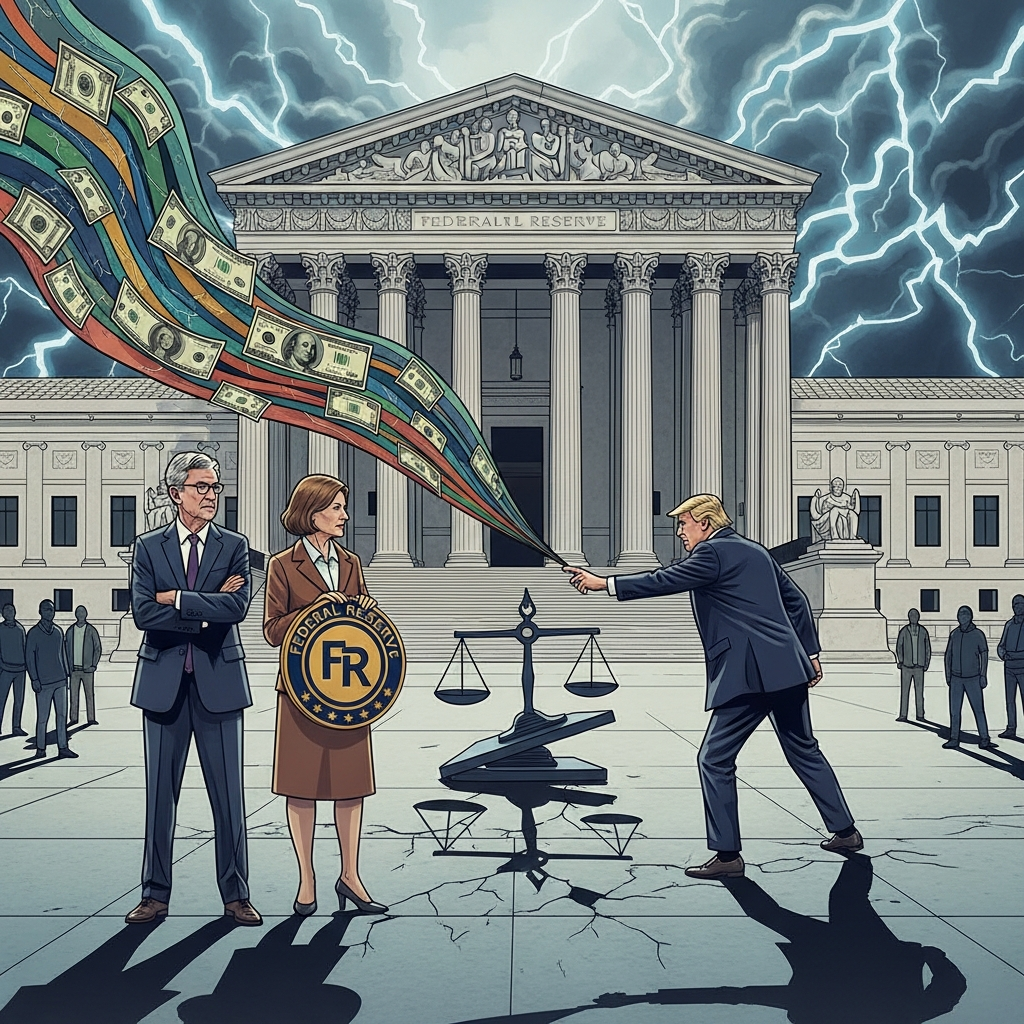
The stage is set for a monumental confrontation at the Supreme Court, challenging the very foundation of the Federal Reserve’s independence. Former President Donald Trump’s relentless efforts to exert control over the U.S. central bank, marked by personal attacks on Chair Jerome Powell and the controversial firing of Governor Lisa Cook, have forced the highest court to weigh in. This pivotal case will test whether the conservative-majority court, often seen as eager to expand executive power, will carve out a singular exception for the institution safeguarding America’s economic stability.
This complex legal battle isn’t just about one firing; it’s a high-stakes question with profound implications for the global economy and the balance of power within the U.S. government. The Federal Reserve, designed to operate free from political interference, finds itself at the epicenter of a constitutional debate that could redefine presidential authority for generations.
Trump’s Unprecedented Campaign Against the Central Bank
Donald Trump has a well-documented history of clashing with institutions he perceives as roadblocks to his agenda. His approach to the Federal Reserve, particularly regarding interest rates, has been particularly aggressive. He has publicly disparaged Fed Chair Jerome Powell, calling him “stupid” and threatening his job for not cutting interest rates to his desired levels. These tactics escalated to an “unprecedented assault,” including a Justice Department investigation into Powell’s testimony about renovations at the Fed’s headquarters. Despite intense pressure, the Fed has largely remained steadfast in its monetary policy decisions.
Trump’s strategy of bullying and threatening to fire officials when persuasion fails has been a consistent theme throughout his presidency. He often succeeded in other areas of the federal government, largely due to a judiciary that, until now, seemed broadly supportive of expanding executive authority. However, with the Federal Reserve, Trump appears to have encountered an unexpected and formidable opponent.
The Lisa Cook Firing: A Litmus Test for Independence
The immediate catalyst for this Supreme Court showdown is Trump’s abrupt firing of Federal Reserve Governor Lisa Cook in August. The dismissal followed unverified social media accusations of mortgage fraud, alleging she listed multiple properties as primary residences to secure better rates. Within days, Trump removed Cook without a formal investigation or hearing. A lower federal court temporarily reinstated her, leading Trump to appeal to the Supreme Court.
Cook’s dismissal raises critical legal questions for the court to address:
Were her due-process rights violated due to the lack of a formal hearing or investigation?
Does alleged pre-appointment mortgage fraud constitute “cause” for removal, given that Fed officials can only be fired “for cause” under the Federal Reserve Act?
Was the case appropriately escalated to the Supreme Court without a more thorough review by lower courts?
These questions probe the very definition of “cause” for removal, a term that remains undefined in the law establishing the Fed. Cook, the first Black female Fed governor, asserts she is a “political pawn” in a broader effort to influence the board’s interest rate policies, maintaining that the accusations against her are “manufactured.”
The Broader Battle Over Executive Power
The Cook case unfolds against a backdrop of the Supreme Court’s recent history of bolstering presidential authority. The conservative majority has often appeared sympathetic to the “unitary executive” theory, which posits that the president should have the unchecked power to fire any executive branch officer. This perspective argues that the electorate alone should check the president’s power, not legislative or judicial constraints.
This judicial philosophy has been evident in several prior rulings. Last year, the court allowed Trump’s firings of independent officials from the National Labor Relations Board (NLRB) to stand. A highly anticipated landmark ruling is also pending on the firing of Federal Trade Commission (FTC) Commissioner Rebecca Slaughter. Many conservative legal scholars advocate for overturning Humphrey’s Executor v. United States, a pivotal 1935 case that limited a president’s power to remove officials from independent agencies without specific cause. Overturning Humphrey’s Executor would grant presidents sweeping new power, potentially allowing them to dismiss officials of independent agencies at will and reshape the federal bureaucracy.
Chief Justice John G. Roberts Jr. has previously articulated an expansive view of presidential power, suggesting the Constitution grants the President “unrestricted power of removal” over executive officers. Conservative justices often criticize independent bodies as an “out-of-control ‘administrative state,'” believing their independence is unconstitutional and that the elected president should hold ultimate executive authority. Liberal justices, conversely, have warned that such a shift would be a “radical change,” granting the president “massive, uncontrolled and unchecked power” and potentially jeopardizing civil service protections.
The Federal Reserve: A Unique Exception?
Despite the general trend of expanding executive power, the Supreme Court has signaled a remarkably different stance when it comes to the Federal Reserve. When ruling on the NLRB firings, the court’s majority notably mentioned the Fed, describing it as a “uniquely structured, quasi-private entity that follows in the distinct historical tradition of the First and Second Banks of the United States.” This specific reference, despite the Fed having no direct connection to the NLRB case, was widely interpreted as a clear warning against presidential interference.
Legal experts, like Lev Menand of Columbia Law School, highlight this apparent inconsistency: “The elephant in the room in this oral argument is how come, when it comes to Lisa Cook, suddenly the judges are interested in enforcing the statute [of independence].” This contrasts sharply with cases involving other agencies, where the “for cause” removal standard was seemingly disregarded. The court’s six conservative justices, including Brett Kavanaugh and Amy Coney Barrett, have explicitly voiced concerns regarding the Fed.
Justices Grapple with “Real-World Downstream Effects”
The justices’ rationale for treating the Federal Reserve as an exception appears to be rooted in economic practicality as much as legal theory. Justice Amy Coney Barrett cited amicus briefs from economists who warned that Cook’s firing could “trigger a recession,” emphasizing the broader “public interest” at stake. She pressed for consideration of these potential economic consequences.
Justice Brett Kavanaugh, typically a staunch defender of executive power, expressed serious doubts about a “very low bar for cause that the president alone determines.” He warned that such a precedent could “weaken, if not shatter, the independence of the Federal Reserve.” Kavanaugh directly questioned the “real-world downstream effects,” cautioning that “what goes around comes around.” He suggested that allowing “at will removal” could lead to future presidents purging all appointees from previous administrations, creating significant political instability.
The critical importance of the Fed’s independence, particularly its power to set interest rates, is widely understood by the justices. High interest rates can curb inflation but risk unemployment, while lower rates can boost the economy in the short term but potentially lead to rising prices. This delicate balancing act requires insulating the Fed from immediate political pressures and short-term electoral cycles. Politicizing these decisions could trigger severe economic shocks, including recessions. Large business interests and the broader financial community also strongly advocate for the Fed’s autonomy, fearing that a politicized central bank would destabilize markets and undermine confidence.
Repercussions and Future Implications
The Supreme Court’s decision in the Cook case, expected by June, will have far-reaching consequences. A ruling against Trump would represent a significant check on executive power, particularly concerning the Federal Reserve. However, some legal scholars, like Cornell University’s Michael Dorf, caution that if the court only challenges Trump at the “most extreme edge” (such as the Fed), it might gain “unearned prestige” for being unbiased while still allowing other executive overreaches to stand.
The ongoing debate over the “Major Questions doctrine,” where courts require clear congressional delegation for issues of “vast economic and political significance,” also looms. While the Learning Resources v. Trump* case on tariffs (a separate executive power challenge) directly tackles this, the underlying judicial philosophy could subtly influence the court’s approach to the Fed. The court has generally shown a wariness of granting an “imperial presidency” unchecked economic powers without clear legislative authorization.
Ultimately, this case is a testament to the idea that an “unstoppable force has met an immovable object,” as Menand puts it. While the court may be willing to erode the independence of other agencies like the FTC, the Federal Reserve appears to occupy a uniquely protected position, vital for the stability of both the U.S. and global economies. The court is poised to either reaffirm the Fed’s distinct status or fundamentally alter the landscape of presidential power and economic governance.
Frequently Asked Questions
What is the “for cause” standard for firing Federal Reserve officials?
The Federal Reserve Act stipulates that a president can only remove a Fed board member “for cause.” However, the law does not explicitly define what constitutes “cause.” Historically, this standard has been interpreted to mean something more substantial than a simple policy disagreement or political inconvenience, such as “inefficiency, neglect of duty, or malfeasance in office.” The lack of a clear definition has made the Cook case a crucial test, as the Supreme Court is now tasked with interpreting this standard in the context of alleged mortgage fraud and due process.
How might the Supreme Court’s ruling on Lisa Cook affect future presidential appointments to independent agencies?
The ruling in the Lisa Cook case could set a significant precedent for how future presidents can interact with independent agencies. If the Supreme Court rules against Trump, it would reinforce the Federal Reserve’s unique insulation from political interference, signaling that presidents cannot easily dismiss Fed governors without substantial justification and due process. This might empower other independent agencies, but the court has indicated it views the Fed as distinct. Conversely, if the court were to side with Trump, it could significantly weaken the “for cause” removal standard for the Fed, potentially paving the way for greater presidential control over other independent bodies, depending on the specifics of the ruling.
Why is the Federal Reserve’s independence considered vital for the US economy?
The Federal Reserve’s independence is crucial because it allows the central bank to make monetary policy decisions based on economic data and long-term stability, rather than short-term political pressures. Its mandate includes achieving maximum employment, stable prices, and moderate long-term interest rates. If the Fed were subject to political whims, a president might pressure it to lower interest rates to boost the economy before an election, potentially leading to unchecked inflation or asset bubbles down the line. Such politicization could erode domestic and international confidence in the U.S. economy, leading to instability, recessions, and a decreased willingness of investors to hold U.S. debt.