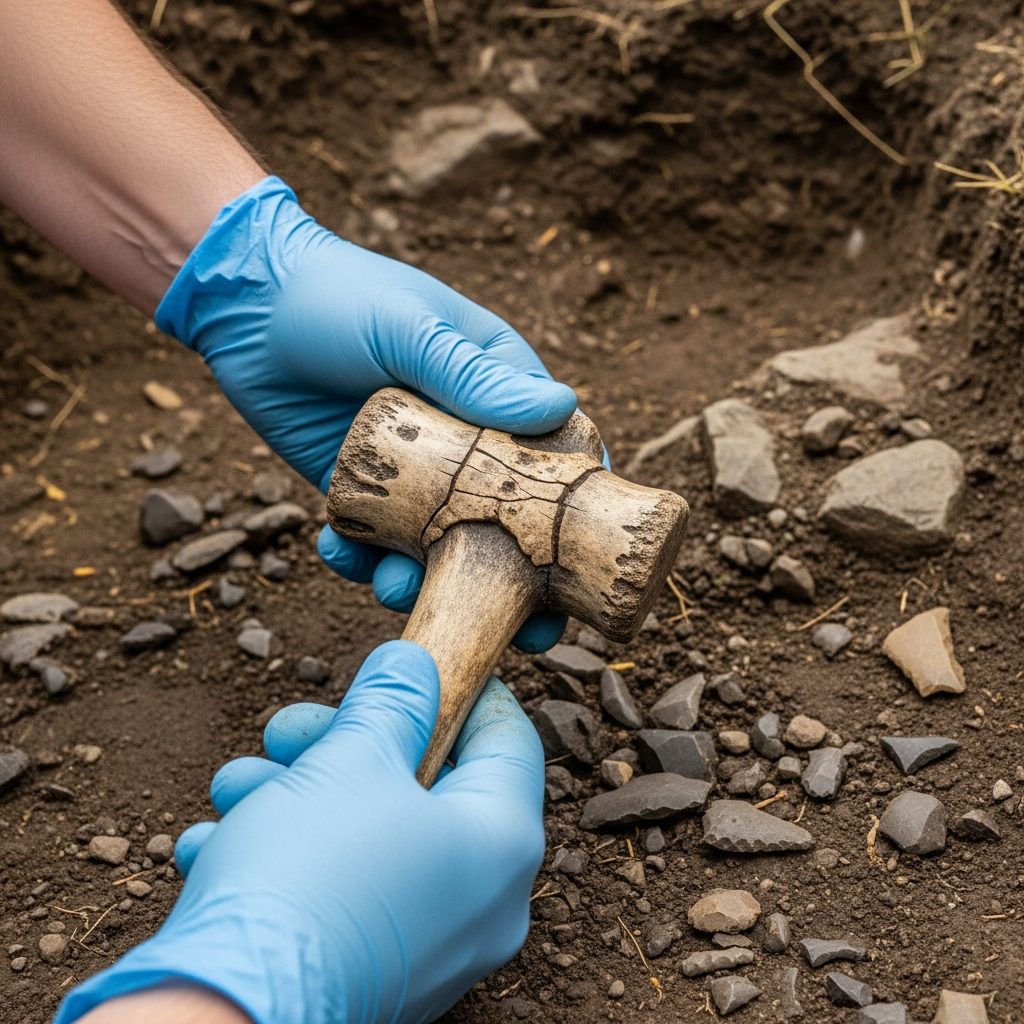
A remarkable archaeological discovery in England is actively reshaping our understanding of early human ingenuity and technical skill. Unearthed at the renowned Boxgrove archaeological site, a 500,000-year-old elephant bone fragment, initially considered just debris, has now been definitively identified as Europe’s oldest bone hammer tool. This groundbreaking revelation offers a direct glimpse into the sophisticated minds of our ancient ancestors, predating Homo sapiens by a staggering 200,000 years. It showcases their advanced planning, resourcefulness, and deep knowledge of their environment, challenging previously held assumptions about prehistoric tool-making in northern Europe.
A Glimpse into Prehistoric Ingenuity at Boxgrove
The Boxgrove site, near Chichester in West Sussex, England, has long been a treasure trove for archaeologists. Decades of excavation have yielded thousands of meticulously crafted stone tools, butchered animal bones, and rare hominin fossils, painting a vivid picture of life during the Middle Pleistocene era. It was here, in the 1990s, that a team from University College London (UCL) and the Natural History Museum, London, first uncovered the unassuming bone fragment. For years, its true purpose remained a mystery, merely a piece of ancient bone among many.
The Boxgrove Bone: From Fragment to Masterpiece
Recent advancements in archaeological science, however, allowed researchers to revisit the Boxgrove find. Applying sophisticated 3D scanning methods and electron microscopes, scientists conducted a detailed re-examination of the object. What they uncovered was extraordinary: distinct notches, impact marks, and tiny fragments of flint embedded within its surface. These crucial clues confirmed its identity not as a random bone shard, but as a deliberately shaped and intensely used tool. At 11 centimeters long, 6 centimeters wide, and 3 centimeters thick – roughly the size of a bar of soap – this ancient artifact was no accident; it was a carefully crafted implement.
Unearthing Europe’s Oldest Elephant Bone Hammer
Published in the esteemed journal Science Advances, the study definitively established the bone as a “soft hammer” tool, specifically designed for precision work. This isn’t just an old tool; it’s the oldest elephant bone tool ever found in Europe. Its age alone makes it a critical piece of the human story, pushing back the timeline for complex bone tool use on the continent and revealing an unexpected level of cognitive ability among early inhabitants. This discovery fundamentally alters our perception of the capabilities of prehistoric humans residing in Britain during this period.
Who Crafted This Ancient Implement?
Given its immense age, predating the emergence of Homo sapiens, the creators of this ancient hammer were an earlier species of human. Researchers suggest it was likely crafted by either early Neanderthals or a contemporaneous species known as Homo heidelbergensis. The sophisticated construction of the tool indicates these early hominins were not merely opportunistic scavengers; they were skilled craftspersons with an intricate understanding of materials and a strategic approach to technology. This find offers compelling evidence of an advanced level of complex thinking and abstract thought, demonstrating a significant leap in cognitive development.
The Science Behind the Discovery: How it Worked
The detailed analysis using advanced imaging techniques provided definitive proof of the hammer’s function. The embedded flint fragments and wear patterns on its flat striking surface clearly indicate its use as a soft hammer. This type of tool was essential for ‘knapping’ – a precise process critical for shaping and sharpening stone implements. By striking the edges of dull stone tools with the bone hammer, early humans could detach controlled flakes, restoring and refining their sharpness.
The Art of Knapping: Precision in Prehistoric Toolmaking
Using a soft hammer made from bone or antler offered significant advantages over harder stone hammers. While stone-on-stone percussion is effective for initial shaping, soft hammers provide greater control. This precision allowed early humans to remove smaller, more delicate flakes, creating finer edges and more symmetrically shaped tools. The prevalence of soft hammers at Boxgrove, as evidenced by this elephant bone retoucher, points to advanced stone-working techniques. It shows that the artisans of Boxgrove were not only skilled but also employed sophisticated methods for fine-tuning their equipment, transforming rough rock into highly efficient cutting tools like handaxes.
Why Elephant Bone? A Resourceful Choice
The selection of elephant bone as the material for this tool is particularly telling. Bone, being softer than stone, was ideal for the nuanced precision required in knapping. However, elephant or mammoth bone offered an additional, crucial benefit: its exceptional thickness and dense outer cortical layer provided remarkable durability. This made it superior to the bones of most other animals available in Britain at the time, ensuring the hammer could withstand repeated, intensive use.
Strategic Sourcing and Curating Valuable Tools
Elephants and mammoths, though present in Europe 500,000 years ago, were uncommon in southern England. This scarcity suggests that the hominins who crafted this tool recognized the immense value of such a resource. Rather than discarding a rare find, they actively sought out and preserved these valuable bones. The researchers note that the tool likely came from a naturally deceased or scavenged animal, as finding or hunting an elephant was a monumental task. Crucially, evidence suggests the bone was shaped and utilized while still “green” (fresh), and that cut marks indicate soft tissue was removed before the tool was finished, pointing to a planned and staged bone-working process. Furthermore, the absence of initial shaping flakes at the Boxgrove “Waterhole Site” suggests the tool was manufactured elsewhere and then transported, indicating early humans curated and carried their valuable tools across the landscape, rather than discarding them after a single use. This demonstrates strategic planning and foresight in maintaining their equipment.
Boxgrove: A Window into Early Human Life in Ancient Britain
The Boxgrove archaeological site, situated on an ancient river shoreline, continues to provide unparalleled insights into the lives of these early human ancestors. Beyond the elephant bone hammer, excavations have yielded numerous expertly crafted handaxes, flint tools, and butchered animal bones. These finds collectively illustrate a community with sophisticated hunting, butchering, and tool-making capabilities. The sheer quantity of finished and unfinished handaxes at specific locations, like the “Waterhole Site,” indicates a consistent mastery of techniques among the artisans. These inhabitants were resourceful gatherers of available materials, savvy about their properties, and strategic in their use, painting a picture of remarkably adaptive and intelligent early human populations in prehistoric Britain.
A Global Perspective: Bone Tools Across Continents
While the Boxgrove discovery marks Europe’s oldest elephant bone tool, the use of bone tools by hominins has a much longer global history. The oldest known examples date back as far as 1.5 million years ago, found at Olduvai Gorge in Tanzania. These early African tools, crafted primarily from the limb bones of large mammals like hippopotamuses and elephants, demonstrate that hominins in East Africa were employing similar bone-working technologies far earlier. However, such ancient bone tool discoveries in Lower Paleolithic Europe have been scarce and often debated. The Boxgrove elephant bone hammer, therefore, stands as an exceptionally rare and significant piece of evidence, pushing back the timeline for sophisticated bone technology in northern Europe and highlighting a previously underestimated level of cognitive and technical skill among its early inhabitants.
Frequently Asked Questions
What is the significance of the Boxgrove elephant bone tool?
The Boxgrove elephant bone tool is significant because it’s the oldest known bone hammer tool in Europe, dating back 500,000 years. Its discovery challenges previous assumptions about the ingenuity and cognitive abilities of early humans in northern Europe. It shows advanced planning, resourcefulness, and a sophisticated understanding of materials by species like Homo heidelbergensis or early Neanderthals, long before the emergence of Homo sapiens.
Where was the 500,000-year-old elephant bone tool discovered?
This ancient tool was discovered at the Boxgrove archaeological site, located near Chichester in West Sussex, England. The site, an ancient river shoreline, has been extensively excavated for decades and is renowned for yielding numerous prehistoric artifacts, including handaxes, other flint tools, and butchered animal bones, providing rich context for the bone hammer’s use.
How does the Boxgrove discovery change our understanding of early human intelligence?
The Boxgrove discovery significantly enhances our understanding of early human intelligence by demonstrating advanced cognitive complexity and abstract thought. The strategic selection of rare elephant bone, its deliberate shaping into a precision tool, and its repeated use for sharpening stone tools reveal a sophisticated level of planning and resourcefulness. It illustrates that these ancient ancestors were not just tool producers but also “maintainers” of valuable equipment, showcasing foresight in their technological adaptations.