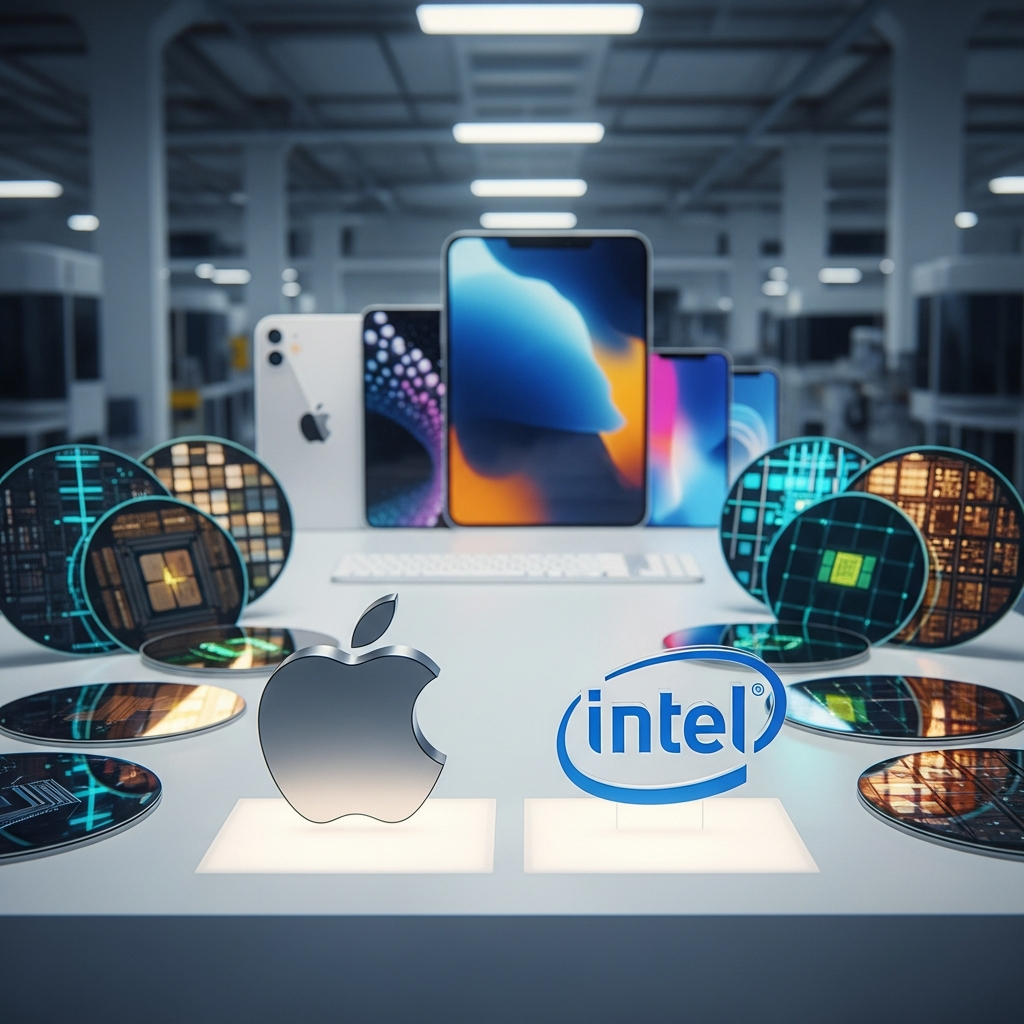
Apple, the tech titan renowned for its groundbreaking proprietary chip designs, is reportedly on the cusp of a significant reunion with its former collaborator, Intel. This isn’t a nostalgic return to Intel-designed processors, but rather a strategic pivot towards Intel’s advanced manufacturing capabilities for future iPhone and Mac chips. This potential partnership signals a fundamental shift in Apple’s supply chain strategy, aiming to diversify production beyond its primary foundry, TSMC, and bolster its technological resilience amidst escalating global semiconductor demands. For consumers, this could mean enhanced device availability and potentially stable pricing in the long run.
Apple’s Strategic Pivot: Partnering with Intel for Chip Manufacturing
Recent reports from prominent analysts, including Jeff Pu of GF Securities and Ming-Chi Kuo of Tianfeng Securities, indicate a strong likelihood of Apple utilizing Intel Foundry Services (IFS) for a portion of its future chip production. This collaboration marks a critical evolution in Apple’s approach to silicon, shifting from a near-exclusive reliance on TSMC to a more diversified manufacturing base. The core principle remains: Apple will continue to design its own chips, leveraging its ARM-based architecture, while Intel would step in as a crucial manufacturing partner.
The specifics of this rumored deal paint a clear picture. Analyst Jeff Pu anticipates that Intel could begin producing chips for Apple’s non-Pro iPhone models as early as 2028, utilizing Intel’s future 14A process technology. This could include chips like the A21 or A22, powering devices such as the “iPhone 20” or “iPhone 20e.” Furthermore, Ming-Chi Kuo suggests an even earlier timeline for Mac and iPad components, with Intel potentially shipping Apple’s “lowest-end M processor” – possibly the M6 or M7 chip – for select models by mid-2027, leveraging Intel’s advanced 18A process. This phased integration allows Apple to strategically validate Intel’s capabilities.
Why Apple Needs Foundry Diversification Now More Than Ever
Apple’s decision to explore additional manufacturing partners is driven by several compelling strategic imperatives. Chief among these is the escalating need to diversify its supply chain and reduce its profound reliance on a single primary manufacturer, Taiwan Semiconductor Manufacturing Company (TSMC).
The financial commitment to TSMC highlights this dependency: Apple’s annual investment has soared from $2 billion in 2014 to an anticipated $24 billion in 2025. Manufacturing purchase obligations reached a staggering $71 billion in 2022. This massive investment makes Apple highly susceptible to competitive pressures and capacity constraints. For instance, Nvidia is projected to consume more N3 wafers than Apple by late 2027, significantly impacting pricing and availability. Apple’s share of TSMC’s advanced N2 process is also expected to drop to 48%, increasing vulnerability to disruptions.
Beyond competition, geopolitical risks loom large. Heightened tensions surrounding Taiwan, coupled with potential shifts towards domestic manufacturing initiatives globally, compel Apple to fortify its supply chain. Partnering with Intel, a U.S.-based manufacturer, aligns with broader political pushes for domestic production, serving as a critical risk management strategy rather than mere political posturing. This move builds “antifragility” into Apple’s production ecosystem, protecting against unforeseen global disruptions.
Intel’s Resurgence: A Foundry Powerhouse in the Making
The viability of this rumored partnership hinges significantly on Intel’s remarkable technological resurgence in its foundry division. After years of challenges, Intel Foundry Services (IFS) has made impressive strides, particularly with its 18A process. This advanced technology entered volume production in mid-2025, positioning Intel as a global leader in 2nm-class production. Yield rates for 18A chips were reported at a robust 60-65% by November, with a target of 70% by the end of 2025 – a testament to Intel’s renewed focus on manufacturing excellence.
Technologically, Intel’s 18A process offers substantial advantages. It boasts up to 25% higher performance or 36% lower power consumption compared to its Intel 3 process, alongside a 30% improvement in transistor density. Crucially for Apple’s power-efficient designs, Intel’s innovative PowerVia backside power delivery architecture enhances efficiency by moving power delivery to the back of the chip. This aligns perfectly with Apple’s unified memory architecture and thermal design principles, promising significant gains for devices like the MacBook Air and iPad.
The partnership appears to be moving beyond mere speculation. Apple has reportedly already signed a Non-Disclosure Agreement (NDA) with Intel and received the 18AP PDK 0.9.1GA, an essential set of design tools. Apple is now awaiting Intel’s release of more mature development tools, expected in the first quarter of 2026. This timeline underscores a serious strategic commitment from both companies, validating Intel’s substantial investments in rebuilding its foundry capabilities.
What This Means for Your Next Apple Device
It’s vital to clarify what this partnership does not mean. Apple is unequivocally committed to its proprietary Apple Silicon architecture, which powers its Macs, iPads, and iPhones. Intel’s involvement is strictly limited to fabricating Apple’s designs, not designing the chips themselves. Consumers should not expect a return to Intel-designed x86 processors in Macs or a departure from Apple’s custom A-series or M-series chips.
Instead, this collaboration indicates a sophisticated segmentation strategy. Intel is expected to handle the production of standard M-series chips for entry-level devices such as the MacBook Air and iPad models. These chips, potentially the M6 or M7, could see annual volumes of 15-20 million units starting in 2027. Meanwhile, TSMC would likely continue to manufacture the higher-performance Pro, Max, and Ultra variants of Apple’s M-series, as well as the flagship Pro iPhone chips. This allows Apple to validate Intel’s manufacturing at scale without compromising its premium product lines.
For the consumer, this diversification could translate into several benefits. A more resilient supply chain means more reliable availability of new Apple devices, reducing the risk of product delays due to manufacturing bottlenecks. Increased competition among foundries might also lead to better long-term pricing, which could indirectly benefit consumers. Ultimately, Apple’s commitment to designing all its chips ensures that even entry-level devices manufactured by Intel will meet Apple’s stringent performance and power efficiency standards.
Broader Industry Implications and a Full Circle Moment
This rumored partnership represents a significant development for the entire semiconductor industry. For Intel, securing Apple as a foundry customer provides crucial validation for its massive investments in Intel Foundry Services. It offers a substantial revenue stream for continued research and development, enabling Intel to become a stronger competitor to TSMC on a global scale. This rivalry could foster innovation and healthy competition, benefiting all tech companies seeking advanced manufacturing.
From a historical perspective, this collaboration marks a remarkable role reversal. Intel, which once supplied the x86 processors for Macs before Apple transitioned to its own silicon, is now returning as a manufacturing partner for the very chips that displaced its own. Intel also previously supplied cellular modems for iPhones, from the iPhone 7 through the iPhone 11. This new chapter is not about nostalgia; it’s about strategic necessity and mutual benefit in a rapidly evolving technological landscape. It underscores Intel’s evolution into a foundry-first service provider, directly competing with industry giants. The move strengthens the global chip supply chain, pushing towards a more robust and geographically distributed manufacturing ecosystem.
Frequently Asked Questions
What kind of Apple chips will Intel potentially manufacture?
Intel is reportedly in line to manufacture Apple-designed chips, not Intel’s own designs. This includes lower-end M-series chips for select Mac and iPad models (like the M6 or M7), anticipated to use Intel’s 18A process. Additionally, Intel could produce non-Pro iPhone chips (such as the A21 or A22) for future iPhone generations, starting around 2028, leveraging its 14A process technology. Apple will retain full control over the chip architecture and design, while Intel provides the fabrication services.
When can consumers expect to see Apple devices with Intel-manufactured chips?
According to analyst projections, consumers could see the first Apple devices featuring Intel-manufactured M-series chips as early as mid-2027. These would likely be integrated into entry-level Mac and iPad models. The partnership for non-Pro iPhone chips is expected to materialize slightly later, with devices potentially shipping with Intel-fabricated A-series chips starting in 2028. These timelines are based on current analyst forecasts and Intel’s projected readiness for mass production of its advanced processes.
Why is Apple considering Intel as a chip manufacturer, given its previous split?
Apple’s decision is a strategic move to diversify its supply chain, rather than a reversal of its Apple Silicon strategy. The primary driver is to reduce its growing dependence on TSMC, which is facing increasing demand from other tech giants like Nvidia. Diversification mitigates geopolitical risks associated with concentrating manufacturing in one region (Taiwan) and aligns with efforts to bolster domestic production. Intel’s significant advancements in its foundry technology, particularly its 18A process, also make it an attractive and capable partner for Apple’s future chip manufacturing needs.
Conclusion: A New Era for Apple’s Silicon Strategy
Apple’s rumored partnership with Intel for chip manufacturing signals a pivotal moment for both companies and the broader technology sector. This is a pragmatic, forward-looking decision by Apple to fortify its supply chain, mitigate risks, and ensure reliable access to cutting-edge fabrication technology. For Intel, it represents a monumental validation of its renewed commitment to foundry services and a significant step towards regaining its prominence in advanced chip manufacturing.
While Apple will continue to innovate with its custom Silicon designs, leveraging multiple foundry partners offers unprecedented flexibility and resilience. This strategic shift could lead to more robust product availability for consumers and intensify competition within the semiconductor industry, ultimately driving further innovation and potentially influencing global pricing strategies. The tech world will be watching closely as this strategic alliance unfolds, potentially reshaping the future of how our devices are powered.