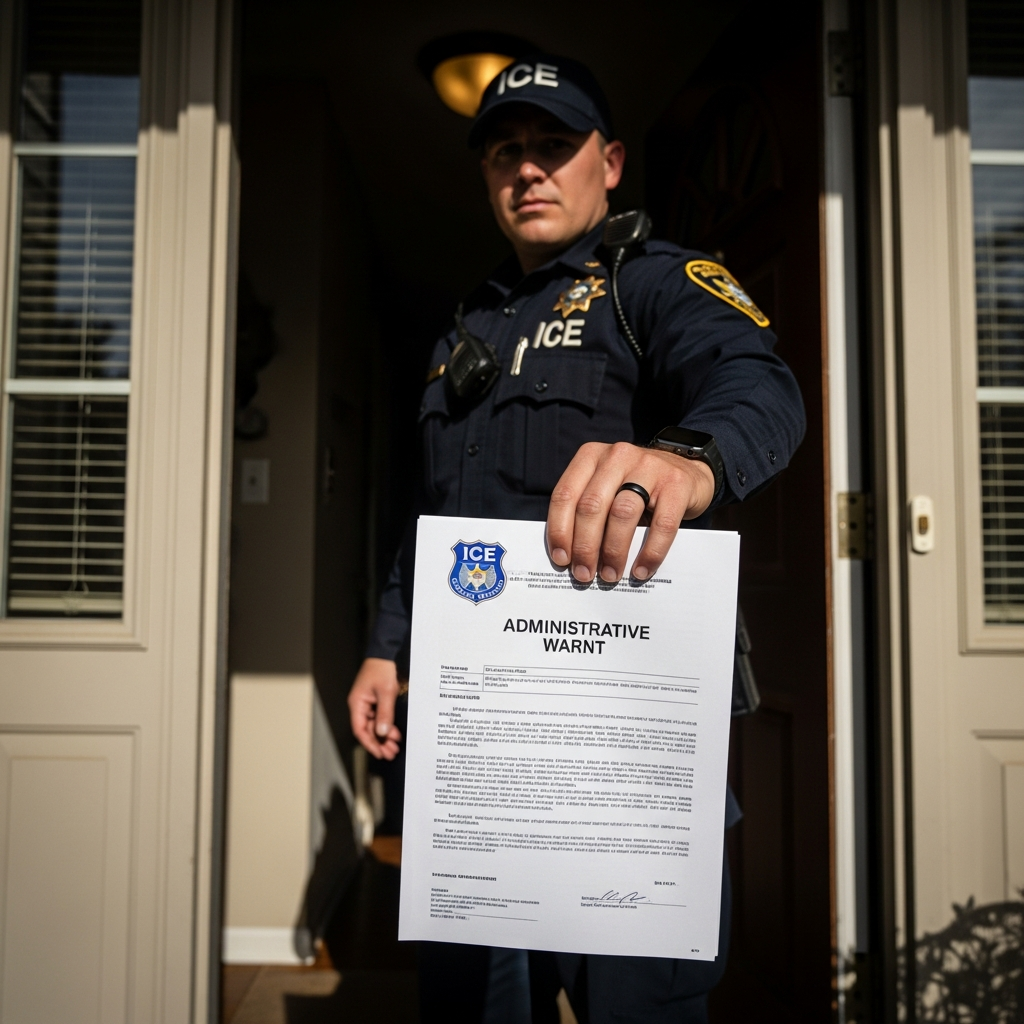
A groundbreaking internal memo from U.S. Immigration and Customs Enforcement (ICE) has ignited a firestorm of controversy, revealing a significant shift in federal immigration enforcement. This new directive, dated May 2025, grants ICE officers permission to forcibly enter individuals’ homes to make arrests using only an administrative warrant, bypassing the traditional requirement for a judge’s signature. This policy change, disclosed by whistleblowers, directly challenges long-standing interpretations of Fourth Amendment protections and has sparked widespread concern among civil liberties advocates and legal experts across the nation.
The Controversial New ICE Policy Explained
At its core, the newly unveiled ICE policy, stemming from a May 12, 2025 memo signed by then-Acting Director Todd Lyons, asserts that officers can use administrative warrants (specifically, a Form I-205) to force entry into private residences. This applies to individuals subject to a “final order of removal” issued by an immigration judge, the Board of Immigration Appeals, or a U.S. district or magistrate judge. Lyons himself acknowledged this represents a departure from past U.S. Department of Homeland Security (DHS) procedures, which historically did not rely solely on administrative warrants for residential arrests.
The rationale provided by DHS’s Office of General Counsel is that the U.S. Constitution, the Immigration and Nationality Act, and existing immigration regulations do not explicitly prohibit this reliance on administrative warrants for home entries. Officers are instructed to “knock and announce” their identity and purpose, giving residents a “reasonable chance to act lawfully.” If admittance is refused, they are then authorized to use “only a necessary and reasonable amount of force” to enter, typically between 6 a.m. and 10 p.m. Crucially, the memo clarifies that a Form I-205 is not a search warrant but solely for conducting an immigration arrest.
Administrative vs. Judicial Warrants: A Critical Distinction
Understanding the difference between an administrative warrant and a judicial warrant is central to grasping the controversy surrounding this ICE policy.
Administrative Warrants (Form I-205): These are internal documents issued by immigration authorities themselves. They authorize an individual’s arrest for immigration violations but traditionally do not grant permission for forcible entry into private property without consent or a separate judicial warrant.
Judicial Warrants: These are issued and signed by a neutral judge or magistrate. They require a showing of “probable cause” to the court and explicitly authorize law enforcement to enter a specific property for a specific purpose, such as a search or arrest. These have historically been considered essential for home entries due to Fourth Amendment protections.
The shift, therefore, moves from a system requiring external judicial oversight for home entry to one relying on internal agency authorization. This change has triggered alarm bells for many who see it as a direct challenge to fundamental constitutional rights.
Legal and Constitutional Challenges Emerge
The primary legal concern revolves around the Fourth Amendment of the U.S. Constitution, which protects against unreasonable searches and seizures and generally requires a warrant issued by a “neutral and detached magistrate” for entries into homes. Immigrant advocates and legal experts argue that administrative warrants, being internal agency documents, do not satisfy this constitutional requirement.
Professor Lindsay Nash from Yeshiva University’s Cardozo School of Law, sharply criticized the memo, stating it “flies in the face” of Fourth Amendment protections and historical ICE authorities. She warned of “enormous potential for overreach, for mistakes and we’ve seen that those can happen with very, very serious consequences.”
Whistleblower Aid, representing the individuals who exposed the memo, asserted that the “policy” directly contradicts longstanding federal law enforcement training rooted in constitutional assessments. They maintain that the Form I-205 does not authorize ICE agents to enter a home and expressed “grave concern” about training new recruits to seemingly disregard the Fourth Amendment.
Senator Richard Blumenthal (D-Conn.) condemned the policy as “legally and morally abhorrent,” stating it “should terrify Americans” and exemplifies “dangerous, disgraceful abuses.” He emphasized the rarity of government entry into homes without a judge’s explicit authorization in a democracy.
DHS Assistant Secretary Tricia McLaughlin defended the policy, stating that individuals served administrative warrants have undergone “full due process” and received a “final order of removal.” She contended that officers issuing these warrants found probable cause, and both the Supreme Court and Congress have long recognized the propriety of administrative warrants in immigration enforcement. However, critics argue this defense conflates the authority to arrest with the authority to forcibly enter a home* without judicial review.
Secretive Implementation and Real-World Impact
Concerns have been amplified by reports of the policy’s secretive rollout. Despite being labeled “all-hands” and addressed to “All ICE Personnel,” whistleblowers allege the memo was not widely distributed. Instead, its contents were reportedly shared through verbal briefings, with some agents allowed to view the document but not retain copies. There were also implied threats of termination for anyone openly speaking against the new directive. Immigration attorney Rosanna Berardi highlighted that this opaque method creates a “dangerous accountability vacuum,” potentially contradicting established written training materials.
The impact of this policy has already been documented in specific incidents. In Minneapolis, on January 11, 2026, ICE officers in tactical gear used a battering ram to break down the front door of Garrison Gibson’s home. Documents later confirmed the agents possessed only an administrative warrant, not a judge’s warrant, for Gibson, who had a deportation order from 2023. This incident serves as a stark example of the policy’s real-world implications, raising questions about the safety and constitutional rights of residents, including U.S. citizens who have reportedly been subjected to warrantless home entries.
Political Context and Escalating Tensions
This policy shift unfolded less than five months into President Donald Trump’s second term, a period marked by his campaign promises of mass deportations and aggressive immigration enforcement. The Trump administration’s immigration crackdowns have fueled widespread protests and unrest, particularly in “blue” cities and states. Minneapolis, a focal point of these tensions, witnessed ongoing demonstrations following the fatal shooting of Renee Good, a U.S. citizen, by an ICE agent in early January.
The broader context includes the administration’s frequent deployment of federal agents for immigration operations and other responses, alongside legal battles challenging ICE tactics. An appeals court recently blocked a ruling that aimed to restrict ICE agents from using pepper spray and making arrests against peaceful protesters in Minneapolis, further intensifying the clash between federal enforcement priorities and civil liberties concerns. Data from the University of California, Berkeley’s Deportation Data Project indicates a significant increase in ICE arrests, with many individuals having no criminal records. This data underscores the sweeping nature of the administration’s immigration agenda and the potential for increased encounters under the new home entry policy.
Frequently Asked Questions
What is the new ICE policy regarding home entry, and why is it facing legal challenges?
The new ICE policy, outlined in a May 2025 memo from Acting Director Todd Lyons, authorizes officers to forcibly enter homes using only an administrative warrant (Form I-205) to arrest individuals with final deportation orders. This departs from previous practice, which generally required a judicial warrant for home entry. It faces significant legal challenges because critics argue administrative warrants, issued internally by ICE, do not satisfy the Fourth Amendment’s requirement for a warrant signed by a “neutral and detached magistrate” to protect against unreasonable searches and seizures.
Who authorized the use of administrative warrants for home entry, and what is a Form I-205?
The policy was authorized by then-Acting ICE Director Todd Lyons, based on a determination by the U.S. Department of Homeland Security (DHS) Office of General Counsel. They concluded that neither the Constitution nor immigration laws prohibit using administrative warrants for this purpose. A Form I-205 is an administrative warrant, specifically a removal or deportation warrant, issued by immigration authorities. Unlike a judicial warrant, it is not signed by a judge but rather by an immigration official.
How does this ICE policy impact the Fourth Amendment, and what concerns are raised by civil liberties groups?
This ICE policy significantly impacts the Fourth Amendment by potentially undermining its protection against warrantless home entries. Civil liberties groups, such as Whistleblower Aid, and legal experts contend that administrative warrants do not provide the same constitutional safeguards as judicial warrants, which are subject to review by a judge. Concerns include a “dangerous accountability vacuum,” the potential for overreach and mistakes by agents, and the fear that new recruits, many without prior law enforcement experience, are being trained to disregard established constitutional principles, leading to severe consequences for residents.
Conclusion
The revelation of ICE’s new policy allowing forcible home entry based solely on administrative warrants marks a pivotal moment in U.S. immigration enforcement. While DHS defends the policy as legally sound and aligned with existing due process for deportation orders, critics vehemently argue it poses a direct and dangerous threat to Fourth Amendment protections and civil liberties. The secretive implementation, combined with real-world incidents like the battering ram entry in Minneapolis, underscores the urgency and gravity of this policy. As legal challenges are almost certain to mount, the debate surrounding administrative versus judicial warrants for home entry will continue to shape the landscape of immigration law and individual rights in America. Residents and advocates alike are urged to remain informed about these evolving enforcement tactics and their broader implications for constitutional safeguards.