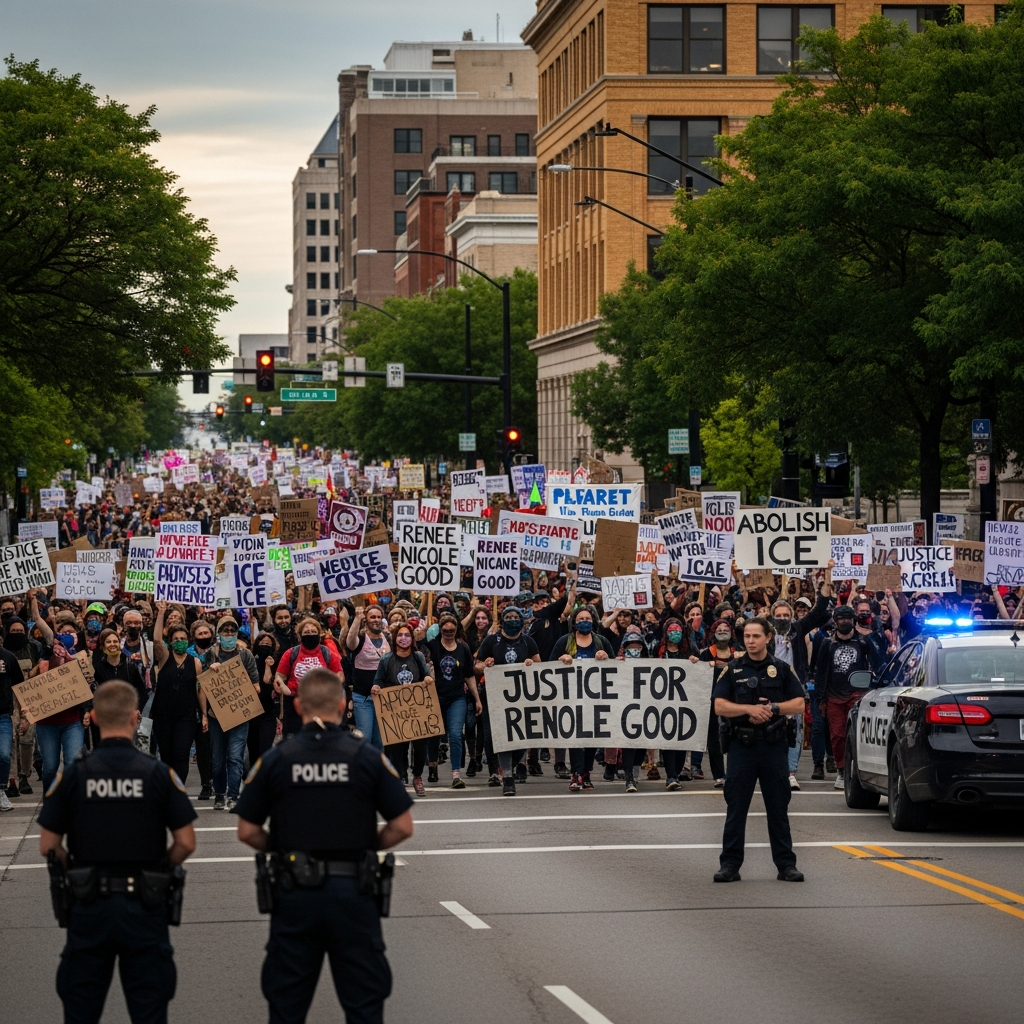
Minneapolis erupted in widespread protests following the tragic shooting death of Renee Nicole Good by a U.S. Immigration and Customs Enforcement (ICE) agent. These demonstrations, marked by thousands taking to the streets, highlighted deep-seated frustrations with immigration enforcement policies and ignited a fierce debate over accountability and transparency. The ensuing unrest saw dozens of arrests, an officer injured, and stark disagreements between federal and local authorities regarding the incident and its investigation.
The Catalyst: Renee Good’s Fatal Encounter with ICE
The series of protests began in the wake of the fatal shooting of 37-year-old Renee Nicole Good. On a Wednesday, Good was shot and killed in her car by a veteran ICE agent, Jonathan Ross, during what her wife described as an act of supporting neighbors involved in immigration enforcement activity. This incident immediately sparked outrage and became the central focus of the subsequent demonstrations across Minneapolis and beyond.
Videos of the encounter depict ICE agents approaching Good’s vehicle in the street, instructing her to exit, and one agent attempting to open her driver’s side door. As Good’s car began to move away, the agent positioned at the front of the vehicle fired multiple shots. Her car subsequently crashed a short distance away. This visual evidence has fueled conflicting narratives regarding the events leading to her death.
Conflicting Narratives and Calls for Justice
The circumstances surrounding Renee Good’s death remain highly contentious. Federal officials, including Homeland Security Secretary Kristi Noem, quickly asserted that Agent Ross acted in self-defense, claiming Good attempted to run him over with her car. This account was, however, vehemently rejected by local authorities. Democratic Minneapolis Mayor Jacob Frey publicly dismissed the federal narrative as “false,” stating that video evidence clearly showed Good was attempting to leave the scene, not attack an agent. Local officials further insisted that Good posed no immediate danger. This sharp disagreement underscores the deep chasm in perspectives between federal and local interpretations of law enforcement actions.
Agent Ross’s history also surfaced, noting he had previously been injured in the line of duty when struck by a car. This detail added another layer to the complex discussion around the incident, as both sides presented their version of events to the public. The differing accounts have only intensified calls for a thorough and unbiased investigation into the shooting.
Waves of Outrage: Protests Sweep Minneapolis and Beyond
In the days following Good’s death, Minneapolis became the epicenter of a significant wave of protests. Thousands of people marched through the city, expressing their anger and demanding justice for Renee Good and greater accountability from federal immigration agencies. While Minneapolis police acknowledged that the “vast majority of community members have demonstrated peacefully,” certain instances of civil disobedience and confrontation emerged.
On Friday night, authorities declared an unlawful assembly outside the Canopy Hotel, where ICE agents were reportedly staying. Hundreds of protesters gathered, with some reportedly forcing entry through an alley, using bright lights, whistles, and drums to voice their discontent. Police reported incidents of individuals throwing ice, snow, and rocks at officers and vehicles, although no serious injuries were reported beyond one officer sustaining minor injuries from a thrown chunk of ice. Another local hotel also suffered property damage, including broken windows and graffiti.
These demonstrations were not confined to Minneapolis. Similar anti-ICE protests erupted in other major U.S. cities, including Austin, Seattle, New York, and Los Angeles, signaling a broader national sentiment against current immigration enforcement practices.
Federal vs. Local: The Investigation Divide
The investigation into Renee Good’s death quickly became a point of significant friction between federal and state authorities. The FBI initiated an investigation, typically taking precedence in cases involving federal agents. However, Minnesota officials, including the Minnesota Bureau of Criminal Apprehension, accused the FBI of initially pledging a joint investigation only to later “reverse course” and freeze them out.
In response to this perceived obstruction, Minnesota officials announced they would launch their own independent inquiry into the shooting. This move highlighted a rare public disagreement over jurisdiction and transparency in a high-profile case. The U.S. vice-president reiterated the federal nature of the investigation, further complicating efforts to achieve a unified investigative approach. This ongoing dispute raises crucial questions about inter-agency cooperation and the public’s right to a comprehensive understanding of such critical events.
Congressional Scrutiny and Calls for Transparency
Adding a political dimension to the unfolding events, three Democratic Congresswomen from Minnesota – Ilhan Omar, Kelly Morrison, and Angie Craig – attempted to tour an ICE facility in Minneapolis. Their objective was to exercise congressional oversight and gain insight into the federal agency’s operations. However, they reported being initially allowed entry before being told to leave, effectively being denied full access.
The Congresswomen publicly accused ICE and the Department of Homeland Security of obstructing their congressional duties and violating federal law. Congresswoman Craig stated that federal agencies “do not care that they are violating federal law,” while Congresswoman Omar emphasized the public’s right to know what transpires within ICE facilities. These accusations underscored concerns about a lack of transparency and accountability within federal immigration enforcement, resonating with a public demanding answers.
The Broader Context: Escalating Tensions Over Immigration
The Minneapolis protests are not isolated incidents but rather a powerful manifestation of wider, escalating tensions surrounding immigration enforcement across the United States. Minneapolis Police Chief Brian O’Hara noted the significant local frustration with ICE operations, revealing his department received dozens of phone calls daily regarding the federal agency’s activities. This indicates a pervasive sense of unease and dissatisfaction within the community regarding federal immigration policies and their local impact.
The death of Renee Good, coupled with the national spread of protests and the ongoing disputes between different levels of government, underscores the profound societal divisions over immigration. These events bring to the forefront crucial discussions about the use of force by federal agents, the rights of protesters, the extent of government transparency, and the delicate balance between federal mandates and local community concerns. The situation in Minneapolis reflects a critical juncture in the national dialogue on immigration and justice.
Frequently Asked Questions
What sparked the Minneapolis protests against ICE?
The Minneapolis protests were primarily sparked by the fatal shooting of 37-year-old Renee Nicole Good by a U.S. Immigration and Customs Enforcement (ICE) agent, Jonathan Ross, on a Wednesday. Good was killed in her car during an immigration enforcement activity, leading to immediate public outrage and calls for justice and accountability from federal agencies. Her death became a rallying point for broader frustrations with immigration policies and the actions of federal agents.
How are federal and local authorities involved in the Renee Good shooting investigation?
The investigation into Renee Good’s death involves both federal and local authorities, but with significant friction. The FBI is leading a federal investigation. However, Minnesota state officials, including the Minnesota Bureau of Criminal Apprehension, announced their own independent inquiry after claiming they were initially promised a joint investigation but were then “frozen out” by the FBI. This has led to public disputes over jurisdiction and transparency between state and federal agencies.
What actions were taken by protesters in Minneapolis, and what were the consequences?
Protesters in Minneapolis engaged in large-scale marches, with thousands taking to the streets to demonstrate against ICE and in memory of Renee Good. While largely peaceful, some actions included declaring an unlawful assembly outside a hotel believed to house ICE agents, where some individuals reportedly forced entry. There were also reports of protesters throwing ice, snow, and rocks, resulting in one police officer sustaining minor injuries. Over the weekend, city officials reported 30 arrests, though those arrested on Friday night were later released.
—