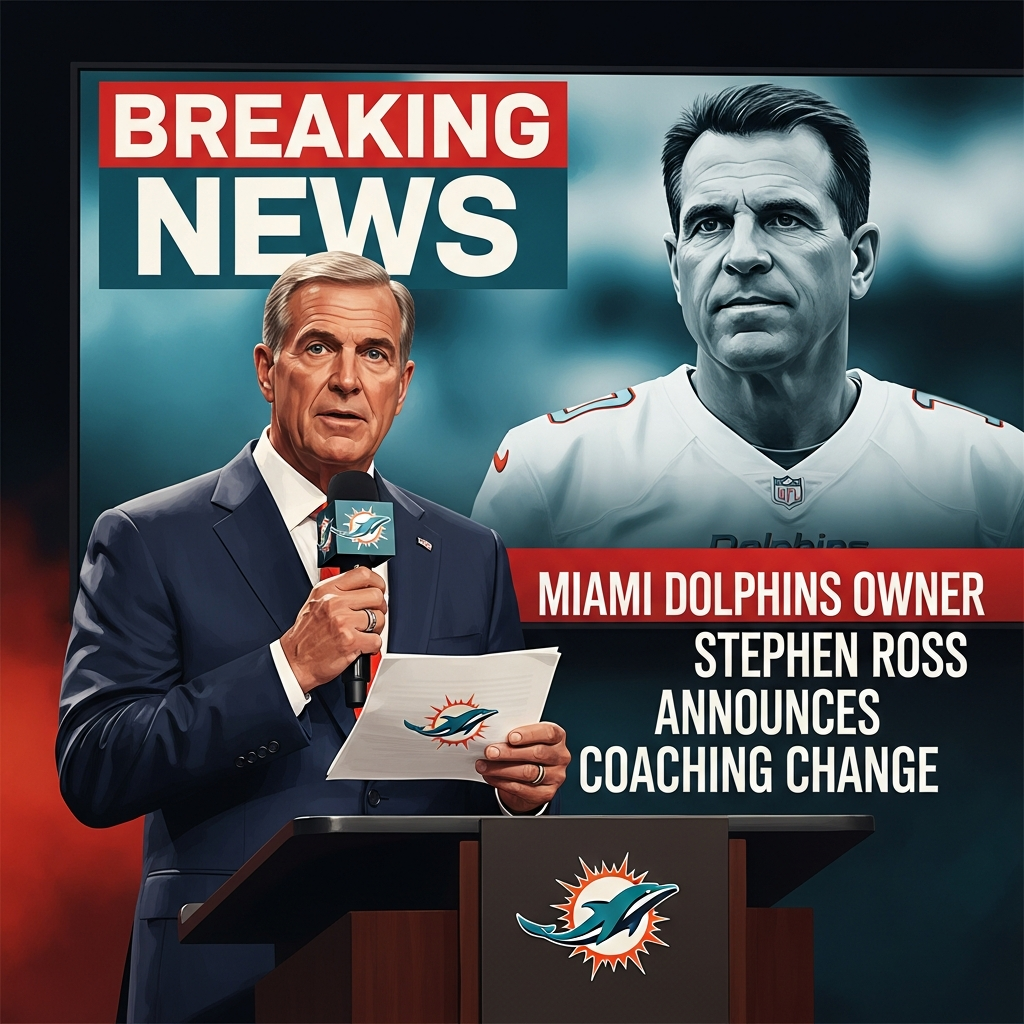
Breaking news from South Florida has sent shockwaves through the NFL: the Miami Dolphins have officially fired head coach Mike McDaniel. This pivotal decision, announced by owner Stephen Ross, comes after four seasons and a disappointing 7-10 record in 2025, marking the team’s second consecutive year missing the playoffs. The move signals a critical moment for the Dolphins franchise, as the coaching carousel accelerates with high-profile names like John Harbaugh now in play.
This comprehensive overview delves into the reasons behind McDaniel’s dismissal, the tumultuous final season, his controversial tenure with quarterback Tua Tagovailoa, and the immediate implications for both McDaniel’s future and the Dolphins’ path forward.
The End of an Era: Why McDaniel Was Fired
Stephen Ross wasted no time in articulating the rationale behind the significant change. He emphasized the need for “comprehensive change” within the organization after a thorough evaluation of the team’s performance. While Ross acknowledged McDaniel’s “hard work, commitment, and the energy he brought,” describing him as an “incredibly creative football mind” whose passion was evident, the bottom line remained clear: the on-field results were not sufficient.
Sources close to McDaniel, however, indicated a genuine sense of shock and bewilderment on his part regarding the dismissal. His camp reportedly “fully expected him to be retained,” a reaction many observers found perplexing. Concrete signals, such as the Dolphins opening their offseason by interviewing General Manager candidates and Ross’s noticeable silence on McDaniel’s future in the preceding week, painted a stark picture of his precarious position. The timing, just two days after the Baltimore Ravens’ surprising split with Super Bowl-winning coach John Harbaugh, further fueled speculation about the Dolphins’ true intentions.
A Tumultuous Final Season (2025)
The 2025 season proved to be a “nightmare” for the Dolphins, characterized by a series of critical losses and internal strife that ultimately sealed Mike McDaniel’s fate. The team stumbled out of the gate with three consecutive losses, including an ugly 33-8 road defeat against the Indianapolis Colts where they were significantly out-gained.
The injury bug also hit hard: star wide receiver Tyreek Hill suffered a season-ending dislocated knee and torn ACL in Week 4, a devastating blow to the offense. Quarterback Tua Tagovailoa’s struggles became a central theme, highlighted by a public call-out of teammates for tardiness and questioning team leadership, for which he later apologized. The team’s overall scoring efficiency plummeted from second to a dismal 22nd. General Manager Chris Grier also mutually agreed to part ways mid-season, another clear indicator of a deeper overhaul in progress. Despite a brief four-game winning streak that brought the team to a respectable 6-7 record, McDaniel’s Dolphins ultimately reverted to old habits, losing key games and showcasing a troubling lack of consistency.
McDaniel’s Dolphins Journey: From Promise to Perplexity
Mike McDaniel’s tenure as Dolphins head coach began with considerable optimism. Hired in January 2022 after a successful stint as the San Francisco 49ers’ offensive coordinator, he was seen as a creative offensive mind. His arrival immediately boosted Miami’s offense, improving their scoring rank from No. 22 to No. 11 in his inaugural year. The team secured back-to-back playoff appearances in his first two seasons, finishing 9-8 in 2022 and securing the No. 7 AFC seed, though both campaigns ended in first-round eliminations.
The 2023 season saw flashes of brilliance, including a remarkable 70-point victory against the Denver Broncos and boasting the NFL’s No. 2 ranked scoring offense. However, critical late-season collapses became a recurring concern. Needing a home win against the Buffalo Bills in Week 18 to clinch the AFC East and the No. 2 playoff seed, the Dolphins faltered, losing 21-14 before falling to the Chiefs in the AFC Wild Card Round. The team’s performance then saw a clear decline in 2024, finishing 8-9, marred by Tua Tagovailoa’s six missed games and Tyreek Hill playing through injuries. The 2025 season’s 7-10 finish was the culmination of this downward trend.
The Tua Tagovailoa Dilemma: A Complicating Factor
The relationship between Mike McDaniel and quarterback Tua Tagovailoa was often a “rock and a hard place” scenario. McDaniel had notably coached Tagovailoa to ninth in MVP voting one year and fifth in Comeback Player of the Year voting the next, showcasing his ability to elevate the young quarterback’s play. However, Tagovailoa’s performance ultimately regressed in later seasons, compounded by an “unsustainably bad” talent pool around him and consistent injury concerns.
In a telling sign of the team’s struggles, Tagovailoa was eventually benched in Week 15 of the 2025 season after an “ugly” Monday Night Football loss to the Pittsburgh Steelers. Rookie seventh-round pick Quinn Ewers took over, bypassing veteran Zach Wilson. Adding another layer of complexity, Tagovailoa, now 27, has reportedly expressed a desire for a “fresh start” elsewhere, and McDaniel had even announced plans for a quarterback competition for the 2026 season before his firing. This dynamic certainly complicated McDaniel’s ability to consistently deliver winning results.
The Coaching Carousel Accelerates: The Harbaugh Factor
McDaniel’s surprising dismissal is widely being framed as the “first casualty” in the burgeoning “Harbaugh Wars,” referring to the highly anticipated availability of former Baltimore Ravens head coach John Harbaugh. Reports indicate the Dolphins had already been “in touch” regarding Harbaugh, making the timing of McDaniel’s firing particularly intriguing.
Owner Stephen Ross has a well-documented history of pursuing high-profile coaching talent, previously making overtures to individuals like Sean Payton and Jim Harbaugh, John’s brother. The strategic decision to fire longtime General Manager Chris Grier before McDaniel suggests a desire for a “macro” overhaul, indicating a focus beyond just schematic issues to the fundamental way the organization identifies and pipelines talent. Harbaugh, a Super Bowl-winning coach freshly available after 18 seasons with the Ravens, represents a compelling opportunity for Ross to finally achieve the consistent winning culture that has largely eluded the Dolphins since the Dan Marino era.
Beyond McDaniel: Deeper Franchise Issues
While Mike McDaniel ultimately shoulders the responsibility for the Dolphins’ performance, many analysts suggest he may have been a “fall guy” for deeper, systemic issues plaguing the franchise. The harsh reality is that the Miami Dolphins have not won a playoff game since 2000, illustrating a decades-long struggle that extends far beyond any single head coach.
The article suggests McDaniel couldn’t consistently win in Miami without a significantly better talent pipeline and a more robust organizational structure—a level of success the 85-year-old, Super Bowl-hungry Ross desperately desired. While McDaniel’s coaching style, described as a “momentary revolution in the NFL” based on kindness and authenticity, garnered respect, it couldn’t overcome the team’s historical shortcomings. The challenge for Stephen Ross remains immense: to inspire a fundamental “Mike Vrabel-like turnaround” and restore a consistent winning culture that has been absent for far too long.
What’s Next for Mike McDaniel and the Dolphins?
For Mike McDaniel, the future remains bright despite this setback. With a respectable 35–33 record and two playoff appearances in four seasons, he is expected to quickly secure another offensive coaching position. He will likely be a strong candidate for head coaching interviews, with Atlanta and Cleveland potentially interested due to his past ties. His unique coaching philosophy and proven offensive prowess make him a highly sought-after commodity, capable of significantly impacting the next NFL hiring cycle.
Meanwhile, the Miami Dolphins join eight other NFL teams, including the Giants, Titans, Browns, Raiders, Cardinals, Falcons, and Ravens, in an active search for a new head coach. All eyes are on South Florida as the team navigates this critical juncture. The next head coach will face the immediate challenge of addressing the lingering quarterback situation with Tua Tagovailoa and overhauling a roster that has shown flashes of brilliance but lacked consistency. The high stakes in Miami mean the decision will reverberate throughout the league.
Frequently Asked Questions
Why was Mike McDaniel fired by the Miami Dolphins?
Mike McDaniel was fired after four seasons as the Miami Dolphins head coach, following a disappointing 7-10 record in 2025, which marked the team’s second consecutive year missing the playoffs. Owner Stephen Ross cited a need for “comprehensive change” within the organization. Factors contributing to the decision included a tumultuous 2025 season with key injuries, inconsistent quarterback play from Tua Tagovailoa, a significant regression in offensive efficiency, and the mid-season firing of General Manager Chris Grier. Despite McDaniel’s initial success with back-to-back playoff appearances, the team’s inability to win important games and achieve sustained success ultimately led to his dismissal.
Who are the top candidates to replace Mike McDaniel as Dolphins head coach?
Following Mike McDaniel’s firing, speculation has rapidly intensified around prominent coaching candidates. John Harbaugh, recently released by the Baltimore Ravens after 18 seasons and a Super Bowl championship, is considered a top contender, with reports suggesting the Dolphins had already been “in touch” regarding his availability. Other names, like Kevin Stefanski, have also been mentioned as potential replacements. Owner Stephen Ross’s history of pursuing high-profile coaches indicates a strong desire to secure a proven leader capable of inspiring a significant turnaround for the franchise. The Dolphins are now among eight NFL teams actively searching for a new head coach, making it a highly competitive market for top talent.
What does Mike McDaniel’s firing mean for Tua Tagovailoa’s future with the Dolphins?
Mike McDaniel’s firing introduces significant uncertainty for Tua Tagovailoa’s future with the Miami Dolphins. Tagovailoa’s performance was a central issue during McDaniel’s final seasons, leading to his benching in Week 15 of 2025 for rookie Quinn Ewers. Before his dismissal, McDaniel had even announced plans for a quarterback competition in 2026. Furthermore, reports indicate that Tagovailoa, now 27, has expressed a desire for a “fresh start” elsewhere. The incoming head coach will likely have a new vision for the quarterback position, potentially leading to Tagovailoa’s departure or a fierce competition for the starting role, making his tenure in Miami highly precarious.
Conclusion: A New Chapter for Miami
The firing of Mike McDaniel as Dolphins head coach signals a dramatic shift for a franchise desperate for consistent success. While McDaniel brought energy and an innovative offensive mind, the team’s inability to break its long playoff drought and overcome critical late-season collapses ultimately led to Ross’s decision for a “comprehensive change.” This move instantly elevates the ongoing NFL coaching carousel, with the Dolphins now positioned to potentially pursue one of the biggest names in football, John Harbaugh.
As the Dolphins embark on a new chapter, the stakes are incredibly high. The incoming head coach faces the monumental task of addressing deep-seated organizational issues, a perplexing quarterback situation, and the pressure to deliver the long-awaited winning culture that has eluded Miami for decades. The decisions made in the coming weeks will undoubtedly shape the team’s trajectory for years to come.