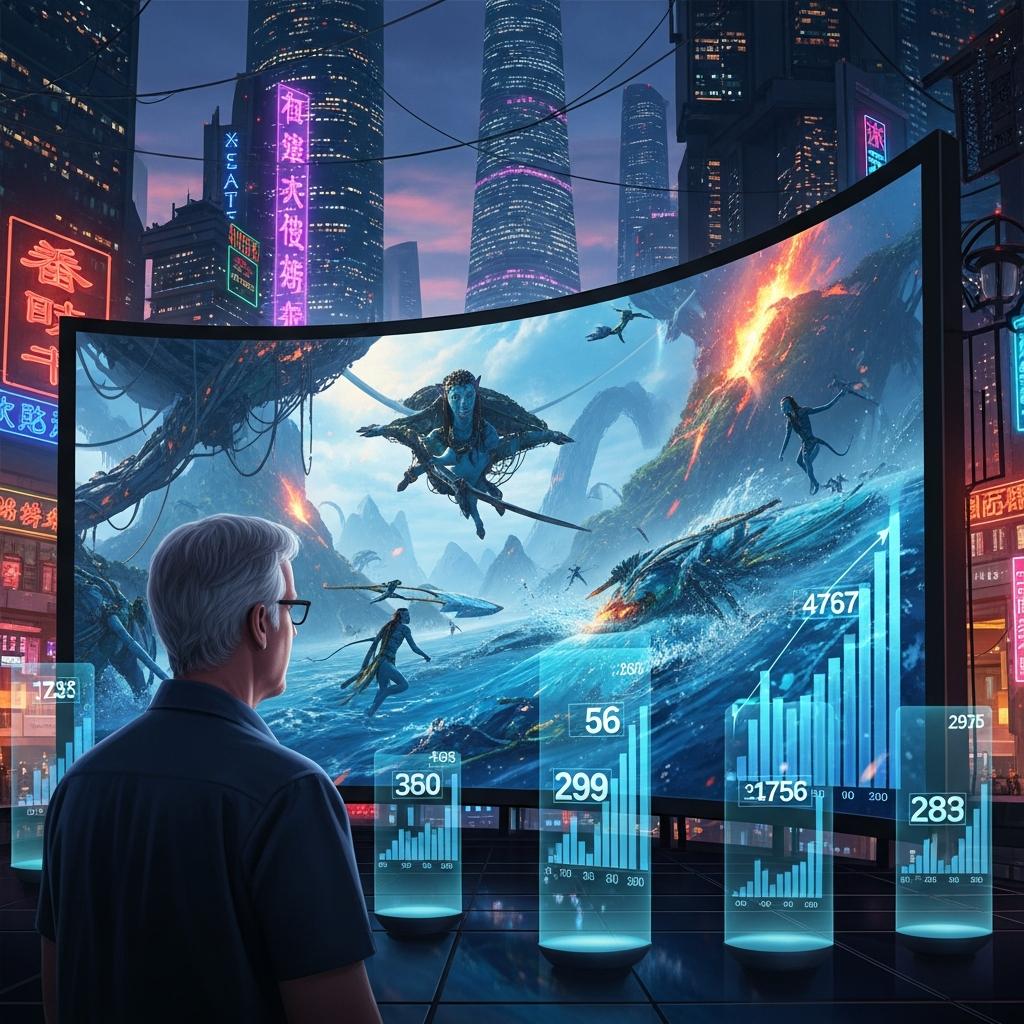
Hollywood’s once-unshakeable grip on the lucrative Chinese box office has faltered dramatically in recent years. Now, with the release of James Cameron’s highly anticipated “Avatar: Fire and Ash,” Disney is making a strategic bet, hoping to reignite Chinese audiences’ passion for American blockbusters. This crucial test for Hollywood arrives as the Chinese film market, now boasting over 80,000 screens—double that of the U.S.—has increasingly turned its attention inward, celebrating its own cinematic triumphs.
The trajectory of the Chinese box office has shifted profoundly since the original “Avatar” premiered in 2009. Back then, the groundbreaking sci-fi epic grossed over $200 million in China, a significant portion of its staggering $2.92 billion global total, helping to usher in a new era for China’s burgeoning film industry. For many international executives, the pre-pandemic Chinese market represented Hollywood’s “savior.” However, that sentiment has entirely transformed post-2020.
The Fading Luster: How Hollywood Lost Its Way in China
A decade ago, Hollywood films dominated the Chinese cinematic landscape. In 2012, seven of the top ten highest-grossing movies in China were American productions. Fast forward to 2024, and not a single U.S.-made film cracked the top ten. This dramatic reversal stems from a confluence of factors, fundamentally altering the dynamics between Hollywood and China.
One significant hurdle has been the Chinese government’s stringent control over foreign film imports. Strict quotas limit the number of international movies shown, coupled with rigorous censorship of content deemed sensitive to Chinese history or politics. In the past, Hollywood studios often made significant concessions to appease these demands. For example, Disney controversially altered the villain Mandarin’s ethnicity and backstory in Marvel’s 2013 “Iron Man 3,” even adding extra scenes featuring Chinese actors for its local release. Similarly, 20th Century Fox integrated prominent product placement for the Chinese messaging service QQ and cast Chinese actor Angelababy in 2016’s “Independence Day: Resurgence.”
The Rise of Chinese Blockbusters
While Hollywood was adjusting its narratives, China’s local film industry was undergoing a rapid and sophisticated transformation. Chinese producers began crafting their own spectacle-driven blockbusters, challenging the perception that only American studios could deliver world-class cinematic experiences. Films like the 2016 fantasy comedy “The Mermaid” and the 2019 animated epic “Ne Zha” captured local imaginations, proving the immense potential of domestic storytelling.
This ascendancy was further accelerated by external disruptions. The COVID-19 pandemic, followed by prolonged Hollywood actors’ and writers’ strikes between 2020 and 2023, significantly slowed U.S. film production. This created a vacuum in the global release schedule, which local Chinese producers eagerly filled. As one international executive observed, “Local producers stepped in and filled the void. And Chinese movies got better.” This evolution culminated in phenomena like “Ne Zha 2,” which shattered Chinese box office records in 2024 with over $2 billion in earnings, becoming the world’s highest-grossing animated movie of all time, largely driven by its mainland China success.
“Avatar: Fire and Ash”: Disney’s Play for Redemption
Despite these profound shifts, Disney sees a unique opportunity with “Avatar: Fire and Ash.” The original “Avatar” cultivated a deeply passionate Chinese fanbase, and director James Cameron himself acknowledged this support during a recent visit to the Hainan Island International Film Festival. Cameron lauded the Chinese audience’s enthusiasm for “big films, splendor, emotion, 3D,” all hallmarks of the “Avatar” experience.
This optimism isn’t entirely unfounded. Disney recently enjoyed a rare post-pandemic success with “Zootopia 2,” which has grossed over $500 million in China since its November opening, making it the most successful American film there in years. The original 2016 “Zootopia” resonated deeply with Chinese audiences due to its relatable themes of rural-to-urban migration, a major societal trend in China. Disney capitalized on this connection with an aggressive marketing campaign for the sequel, including a Starbucks branding deal and a popular “Zootopia” attraction at Shanghai Disneyland.
Can Pandora’s Magic Translate?
“Avatar: Fire and Ash” is projected to open globally between $340 million and $380 million. For the film to join its predecessors in the exclusive $2 billion global club, a robust turnout in China is absolutely essential, especially as North American moviegoing faces challenges. While the previous installment, 2022’s “The Way of Water,” grossed $247 million in China as one of the first major Hollywood films to screen post-pandemic, “Fire and Ash” needs to build on that foundation.
The film continues the saga of Jake Sully (Sam Worthington) and Neytiri (Zoe Saldaña) as they confront the “evil Mangkwan tribe,” a group of raiders dwelling near a volcano. Colonel Quaritch (Stephen Lang) also returns, still seeking revenge against the Sullys. Early box office indicators show a promising domestic preview of $12 million and an additional $43.1 million from 43 international markets, projecting a global launch between $340 million and $365 million. However, it faces increased competition this holiday season compared to “The Way of Water.”
Cameron is keenly aware of the financial stakes, stating the film cost “one metric f—k ton of money, which means we have to make two metric f—k tons of money to make a profit.” While confident in profitability, he questions if it will justify future installments, acknowledging the challenge of avoiding “diminishing returns” that have plagued other major franchises. Critics generally praise the visual splendor of Pandora, though some suggest the narrative, at nearly three hours, occasionally repeats beats from “The Way of Water,” focusing heavily on spectacle over groundbreaking story.
The Future of Hollywood in China
Despite the shifting landscape, industry experts like IMAX China CEO Daniel Manwaring believe Hollywood still has a role in China. “People show up. The ceiling is still so high,” Manwaring notes, but he cautions, “the requirements for a good movie have gotten higher.” This implies that simple spectacle or past brand loyalty might no longer be enough. Studios must adapt their strategies, potentially focusing on stories that resonate universally or even expanding their franchises through new mediums.
James Cameron himself is exploring these avenues, proposing an animated Avatar anthology series and potentially a feature film to Disney. Inspired by “The Animatrix,” he aims to tell “stories that you wouldn’t have expected from that world,” collaborating with “boutique filmmakers.” This forward-thinking approach might offer a blueprint for Hollywood to diversify its engagement with the Chinese market, moving beyond traditional live-action theatrical releases and into new, culturally resonant storytelling formats. The performance of “Avatar: Fire and Ash” will serve as a crucial barometer, signaling whether Hollywood can truly recapture the hearts, minds, and wallets of Chinese moviegoers.
Frequently Asked Questions
Why has Hollywood’s box office presence in China declined so significantly?
Hollywood’s decline in China is due to several intertwined factors. The Chinese government imposes strict foreign film quotas and censorship, leading studios to make content concessions. Simultaneously, China’s local film industry has rapidly matured, producing high-quality, spectacle-driven blockbusters like “Ne Zha 2,” which now dominate the market. Furthermore, the void created by the COVID-19 pandemic and Hollywood strikes between 2020-2023 allowed Chinese productions to flourish, improving their quality and appeal to domestic audiences.
How is “Avatar: Fire and Ash” uniquely positioned to potentially succeed in the Chinese market despite these challenges?
“Avatar: Fire and Ash” benefits from the immense and passionate Chinese fanbase established by the original “Avatar,” which helped grow China’s modern film industry. Director James Cameron’s emphasis on immersive 3D, emotional storytelling, and grand spectacle resonates strongly with this audience. Disney also has recent optimism from “Zootopia 2″‘s surprising $500M+ success in China, demonstrating that compelling American content can still thrive. This prior success, combined with the “Avatar” brand’s legacy, offers a unique opportunity for “Fire and Ash” to recapture market share.
What new strategies are Hollywood studios exploring to regain traction with Chinese audiences?
Hollywood studios are recognizing the need for significant adaptation. Beyond content adjustments and careful navigation of censorship, the focus is shifting towards elevating overall film quality to meet higher audience expectations. There’s also exploration into diversified content, such as James Cameron’s proposed Avatar animated anthology series and feature film, aimed at telling unexpected stories within established universes. This could allow for more creative freedom and potentially cater to specific Chinese tastes without directly competing with local blockbusters in the traditional live-action space.
Word Count Check: 1060 words