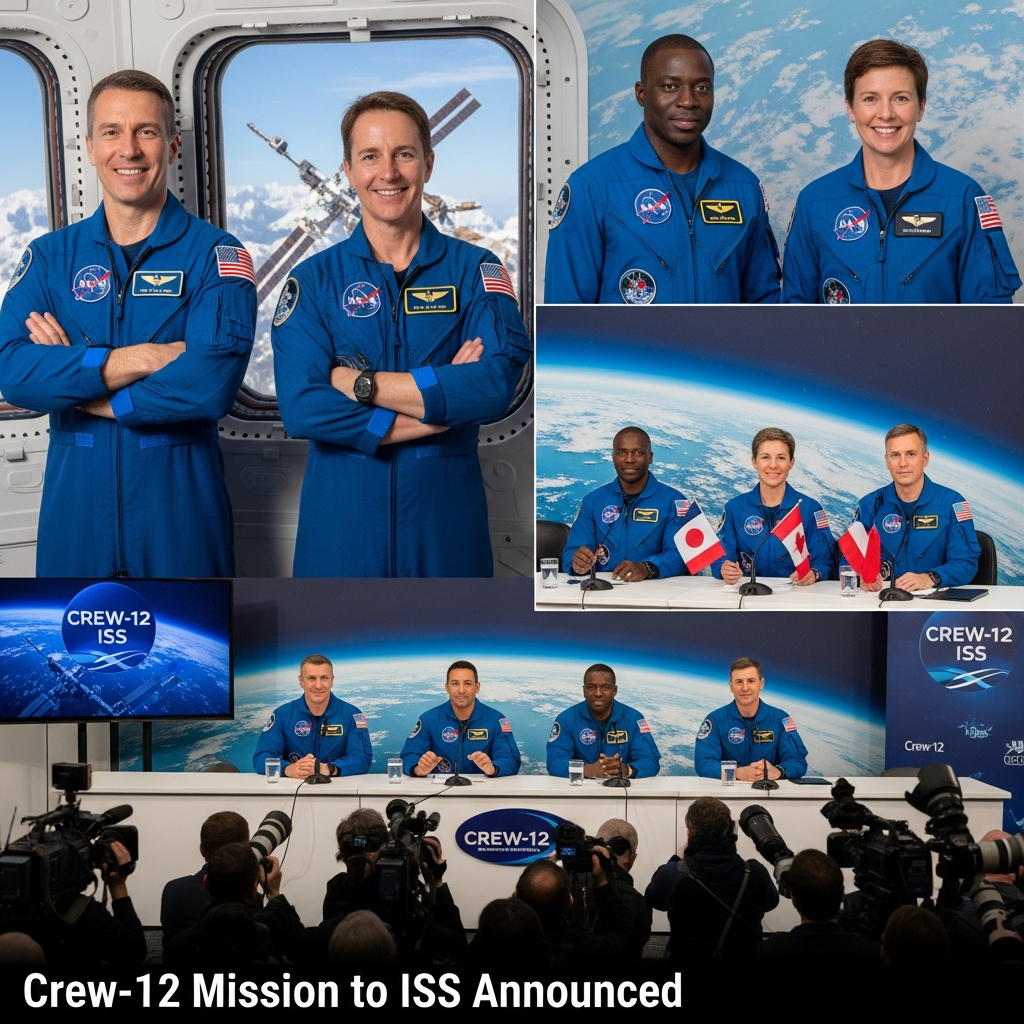
Prepare for a groundbreaking chapter in human spaceflight! NASA has announced the highly anticipated crew assignments for its SpaceX Crew-12 mission, set to launch to the International Space Station (ISS) in early 2026. This pivotal mission will send four international space explorers to the orbiting laboratory for an extended science expedition. Their vital work will not only expand our understanding of the universe but also pave the way for humanity’s next giant leaps to the Moon and Mars.
A Crucial Mission: Unveiling SpaceX Crew-12’s Objectives
The SpaceX Crew-12 mission is slated for launch no earlier than Sunday, February 15, 2026. This marks the 12th crew rotation flight to the International Space Station under NASA’s highly successful Commercial Crew Program. Astronauts and cosmonauts will embark on a long-duration science expedition, joining the Expedition 74 crew members already aboard the station.
The mission’s core objectives are ambitious. Crew-12 will conduct a diverse array of scientific investigations and technology demonstrations. These experiments are critical for understanding the challenges of prolonged spaceflight. Insights gained will directly contribute to preparing humans for future deep-space exploration. This includes lunar missions as part of the Artemis campaign and, ultimately, human missions to Mars. Beyond these ambitious goals, the research conducted on the ISS consistently yields tangible benefits for people here on Earth.
The Commercial Crew Program: A Legacy of Innovation
The SpaceX Crew-12 mission exemplifies the triumph of NASA’s Commercial Crew Program (CCP). This initiative has revolutionized human space transportation. It successfully delivers on its goal of providing safe, reliable, and cost-effective access to the ISS from U.S. soil. The program leverages strategic partnerships with American private industry, fostering innovation. This public-private model ensures continuous and independent U.S. access to the orbiting laboratory. It is a cornerstone of NASA’s vision for a robust low Earth orbit economy, empowering commercial companies to provide essential transportation services.
Meet the Elite Team of SpaceX Crew-12
This international mission brings together a diverse and highly experienced team. Four crew members from three distinct space agencies will journey to the ISS. Each brings a unique background and invaluable expertise to the expedition.
Commander Jessica Meir (NASA)
NASA astronaut Jessica Meir will lead the mission as spacecraft commander. This will be her second journey to the International Space Station. Selected as an astronaut in 2013, Meir holds an impressive academic record. She earned degrees in biology, space studies, and marine biology. Hailing from Caribou, Maine, Meir’s first spaceflight was a 205-day stint as a flight engineer during Expedition 61/62. During this time, she made history. She completed the first three all-woman spacewalks with fellow NASA astronaut Christina Koch. Their combined spacewalking time totaled over 21 hours outside the station. Since then, Meir has continued to serve in key leadership roles within NASA.
Pilot Jack Hathaway (NASA)
Commander Jack Hathaway, a decorated officer in the United States Navy, will serve as the mission’s pilot. This will mark Hathaway’s inaugural spaceflight. He was selected as part of the 2021 astronaut candidate class. Hathaway’s extensive background includes degrees in physics, history, flight dynamics, and national security. A graduate of the prestigious Empire Test Pilot’s School, he brings significant operational experience. Hathaway has logged more than 2,500 flight hours across 30 different aircraft. His impressive career also includes over 500 carrier arrested landings and 39 combat missions. He is a native of South Windsor, Connecticut.
Mission Specialist Sophie Adenot (ESA)
ESA (European Space Agency) astronaut Sophie Adenot joins the crew as a mission specialist. Crew-12 will be her first spaceflight experience. Adenot was selected as an ESA astronaut in 2022. She holds an engineering degree specializing in spacecraft and aircraft flight dynamics. She also earned a master’s degree in human factors engineering from MIT in Cambridge, Massachusetts. Her distinguished career prior to astronaut selection is notable. It includes roles as a helicopter cockpit design engineer and a search and rescue pilot. Later, she became a helicopter experimental test pilot for the French Defence Procurement Agency. Adenot has accumulated over 3,000 hours flying 22 different types of helicopters. She trained extensively in Toulouse, France.
Mission Specialist Andrey Fedyaev (Roscosmos)
Roscosmos cosmonaut Andrey Fedyaev will serve as a mission specialist. This upcoming mission marks his second long-duration stay aboard the International Space Station. A graduate of the Krasnodar Military Aviation Institute, Fedyaev is a qualified pilot engineer. Before his selection as a cosmonaut in 2012, he served as a deputy commander of an Ilyushin-38 aircraft unit. His first space station mission was as a mission specialist on NASA’s SpaceX Crew-6 in 2023. During that mission, he spent 186 days in orbit as an Expedition 69 flight engineer. For his outstanding achievements, Fedyaev has been honored with the title Hero of the Russian Federation and the Yuri Gagarin Medal.
The International Space Station: A Beacon of Discovery
For over 25 years, humans have continuously lived and worked aboard the International Space Station. This incredible orbital laboratory remains a critical testbed for scientific innovation. It advances scientific knowledge and achieves research breakthroughs simply not possible on Earth. The ISS is invaluable for understanding and overcoming the complex challenges of long-duration spaceflight.
The research conducted by crews like Expedition 74 and the incoming SpaceX Crew-12 is incredibly diverse. It spans from crucial investigations into brain health and blood circulation in microgravity to studies in artificial intelligence (AI). Astronauts explore advanced exercise regimens and conduct groundbreaking physics research. These endeavors yield benefits for Earth-based industries and future space exploration. The station also supports stem cell research, materials science experiments, and critical technology demonstrations. All this work supports NASA’s wider strategic vision.
Paving the Way to the Moon and Mars
The SpaceX Crew-12 mission is not just about the International Space Station. It represents a vital stepping stone in humanity’s larger journey into deep space. The scientific and technological advancements made on the ISS are directly applicable to future exploration goals. These include the Artemis campaign, which aims to return humans to the Moon, and subsequent missions to Mars.
NASA is strategically focusing its resources on these ambitious deep-space missions. This shift comes as commercial companies increasingly provide reliable human space transportation services and develop destinations in low Earth orbit. This collaboration marks a “new golden age of exploration and innovation.” The groundwork laid by missions like Crew-12 is essential. It helps ensure the safety and success of future lunar landings and eventual human missions to the Red Planet. The continuous presence on the ISS, facilitated by programs like Commercial Crew, provides the experience and data needed for these monumental endeavors.
Frequently Asked Questions
What is the main purpose of the SpaceX Crew-12 mission to the ISS?
The primary purpose of the SpaceX Crew-12 mission is to conduct a long-duration science expedition aboard the International Space Station. This involves a wide array of scientific investigations and technology demonstrations. These experiments are crucial for preparing humans for future deep-space exploration missions, including the Artemis campaign to the Moon and eventual human missions to Mars. The research also provides tangible benefits for life on Earth, advancing our understanding of various scientific fields.
Who are the key members of the SpaceX Crew-12 mission and where are they from?
The SpaceX Crew-12 mission comprises an international crew of four. NASA astronaut Jessica Meir (from Caribou, Maine) will serve as spacecraft commander. NASA astronaut Jack Hathaway (from South Windsor, Connecticut) is the pilot. ESA (European Space Agency) astronaut Sophie Adenot (from Toulouse, France) joins as a mission specialist. Roscosmos cosmonaut Andrey Fedyaev (from Krasnodar, Russia) will also serve as a mission specialist, marking his second long-duration stay on the ISS.
How does the Crew-12 mission contribute to NASA’s broader exploration goals like Artemis?
The SpaceX Crew-12 mission directly contributes to NASA’s broader exploration goals, including the Artemis campaign and future Mars missions, by serving as a critical testbed. The scientific investigations and technology demonstrations performed on the ISS help humanity understand and overcome the challenges of prolonged spaceflight. This knowledge is essential for designing spacecraft, developing life support systems, and ensuring astronaut health for deep-space journeys. As commercial entities take on low Earth orbit transportation, NASA can focus its resources on pushing the boundaries of human presence further into the solar system.
A Bold Step Forward for Human Spaceflight
The upcoming SpaceX Crew-12 mission represents a significant milestone in human spaceflight. It underscores the power of international collaboration and the success of public-private partnerships. As Commander Jessica Meir, Pilot Jack Hathaway, Mission Specialist Sophie Adenot, and Mission Specialist Andrey Fedyaev prepare for their journey, they carry the hopes of humanity. Their work on the International Space Station will propel scientific discovery forward. It will also help lay the essential groundwork for humanity’s ambitious future among the stars. Stay tuned for launch and follow their incredible journey.