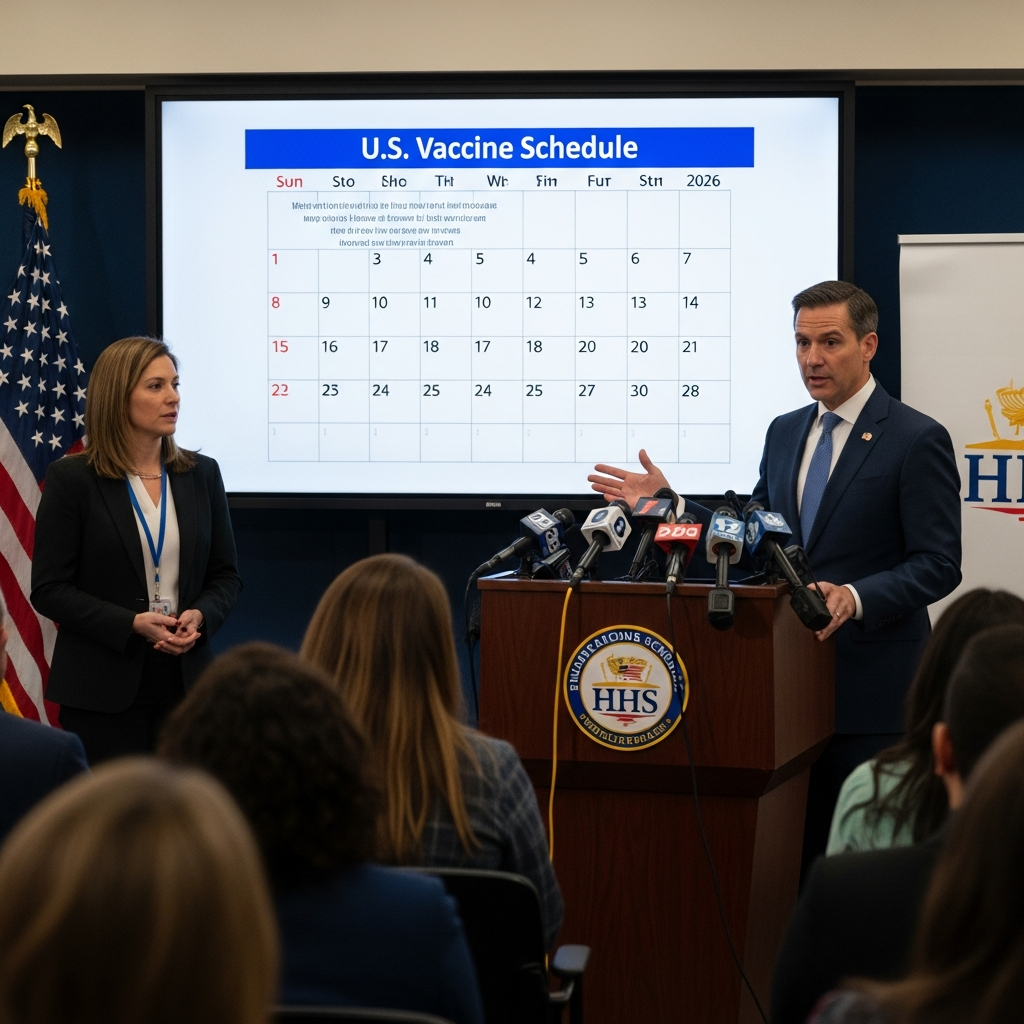
Major shifts are on the horizon for the U.S. childhood vaccine schedule. The Department of Health and Human Services (HHS) is reportedly planning a significant overhaul. This move could reduce the number of recommended vaccinations for American children. Slated for an official announcement in 2026, this initiative aims to align U.S. guidelines more closely with other developed nations. Parents and public health experts are watching closely. The implications for child health and public policy are substantial.
The Proposed Overhaul: A Closer Look at HHS Vaccine Schedule Changes
The U.S. Department of Health and Human Services is evaluating its long-standing childhood vaccine recommendations. Under Secretary Robert F. Kennedy Jr.’s leadership, the goal is to decrease the total number of recommended shots. This potential HHS childhood vaccine schedule overhaul comes from a directive signed by President Donald Trump in December. He called for aligning “core childhood vaccine recommendations” with “best practices from peer, developed countries.” These nations often suggest fewer childhood vaccinations.
The Denmark Model: A Global Comparison
Reports suggest the new U.S. vaccination schedule might resemble Denmark’s approach. Denmark currently recommends vaccines for 10 diseases. This contrasts sharply with the current U.S. recommendation for 18 diseases. Other countries like Japan recommend 14, and Germany recommends 15. The existing U.S. schedule includes several vaccines not typically recommended in Denmark’s 2025 guidelines. These include immunizations for:
Respiratory syncytial virus (RSV)
Rotavirus
Pneumococcal disease
Hepatitis A
Meningococcal disease
Chickenpox
Such a change would represent a dramatic shift in U.S. vaccine recommendations. However, an HHS spokesperson, Andrew Nixon, advised caution on these reports. He stated in December, “Unless you hear from HHS directly, this is pure speculation.”
Immediate Impact: A Shift in Hepatitis B Vaccine Policy
Even before a full overhaul, Kennedy’s administration has already influenced immunization policy. A vaccine advisory panel, appointed by Kennedy, made a pivotal decision. They ended the long-standing recommendation for all newborns to receive the hepatitis B vaccine. This move is significant.
The new guidance advises giving hepatitis B shots only to newborns whose mothers test positive for the virus. It also applies to infants whose mothers’ status is unknown. For parents still wishing to vaccinate against hepatitis B, the panel suggested waiting until the child reaches two months of age. This change highlights the immediate impact of new leadership on the CDC vaccine panel.
Expert Reactions and Public Health Concerns
The anticipated HHS childhood vaccine schedule overhaul has sparked strong reactions. Public health advocates express significant criticism. Kayla Hancock, Director of Public Health Watch, labeled the move a “Trump-Kennedy scheme to gut the child vaccine schedule.” She argues these proposed changes are “clearly not based on any credible data or science.” Hancock claims the administration denied leading medical experts a seat at the table. Instead, she asserts, they “packed their advisory committee with likeminded vaccine skeptics.” These individuals, she states, “latch onto unfounded pseudoscience to fulfill their ideological agenda.” This approach, Hancock warns, “will leave millions of American children far more vulnerable to preventable and dangerous diseases.”
Leading medical experts share these concerns. Dr. Paul Offit and Dr. Peter Hotez have voiced significant worries. They argue that adopting a Denmark-style vaccine schedule could endanger children’s health. This would happen by omitting crucial vaccinations. Dr. Offit suggested Denmark’s reduced vaccine recommendations might be driven by financial considerations. He noted they might not be solely based on public health needs. Dr. Hotez called the proposal “unusual.” He warned it could lead to decreased vaccine availability in the U.S. Such outcomes could undermine decades of progress in disease prevention.
Understanding the Differences: US vs. Denmark Healthcare
Directly comparing vaccine schedules between the U.S. and Denmark requires careful consideration. The healthcare systems of these two nations differ significantly. Experts highlight these disparities. Dr. Tracy Beth Hoeg pointed out that Denmark’s approach is less politicized. It also benefits from a fundamentally different public health infrastructure.
Dr. Adam Langer, an expert on hepatitis B, further elaborated on these differences. He emphasized factors that could impact health outcomes if the U.S. adopted a similar schedule. Key distinctions include:
Population Size: Denmark has a much smaller population of 6 million residents. This is far less than New York City’s 8 million. Different population sizes mean different epidemiological considerations.
Screening Rates: Denmark boasts higher screening rates for hepatitis B among pregnant women. This ensures better identification of at-risk infants.
Prenatal Care: Universal prenatal care is available to all women in Denmark. This ensures comprehensive health support from pregnancy onwards.
National Health Registry: Denmark maintains a national health registry. This facilitates efficient follow-ups for at-risk infants.
These crucial elements are largely absent or less comprehensively implemented in the U.S. They play a vital role in child health protection and public health outcomes. Implementing a similar immunization policy without these supporting structures could have unintended consequences.
Reforming the Vaccine Injury Compensation Program
Beyond the schedule itself, RFK Jr. has expressed intentions to “revolutionize” the Vaccine Injury Compensation Program (VICP). The VICP is a crucial federal program. Congress established it in 1986 through the National Childhood Vaccine Injury Act. Its purpose was to address lawsuits against vaccine manufacturers. These lawsuits arose from potential injuries, especially from the whole-cell pertussis vaccine. The Act aimed to shield manufacturers from direct litigation. It established a no-fault compensation system. This system is funded by a 75-cent excise tax on each covered vaccine dose.
Current Challenges of the VICP
While vital, many experts agree the VICP needs updates. It must reflect changes since 1986. Key issues include:
Increased Workload: Only eight special masters manage a dramatically increased caseload. More vaccines are now covered by the program.
Outdated Damages Cap: The $250,000 damages cap was set in 1986. It has not been adjusted for inflation, significantly diminishing its value.
Strict Statute of Limitations: A three-year statute of limitations often causes claimants to miss their opportunity for compensation.
Coverage Gaps: While expanded in 2023 to include vaccines for pregnant women, it still does not cover adult-only vaccines like shingles. Claims for COVID-19 vaccines are handled by a separate, often criticized, system.
These “friendly amendments” have bipartisan support. Kennedy himself has acknowledged them. However, a 2021 bill attempting these reforms failed to advance.
Kennedy’s Radical Proposals for VICP
RFK Jr.’s plans for the VICP could go beyond these bipartisan reforms. His comments imply a desire to dismantle the system entirely. This would be a far more difficult and unpredictable undertaking. Straight structural changes require Congressional amendment of the 1986 law. They also need the President’s signature, facing significant legislative hurdles.
Two less direct but potentially drastic avenues exist:
The Autism Link: A Discredited Claim Revisited
Kennedy has historically supported discredited claims linking vaccines to autism. The VICP has historically acted as a “bulwark” against scientifically unsubstantiated claims. A years-long court process from 2002 to 2010 definitively concluded that autism was not a vaccine injury. This process involved 50 expert reports, 939 medical articles, and 28 expert testimonies. To add autism to the list of presumed vaccine injuries, Kennedy would need to navigate a lengthy administrative process. This includes feedback from an advisory committee and the public. Such a move would be highly controversial. Public health and medical groups are already mobilized against Kennedy’s vaccine policy moves. A failure to follow legal procedures could lead to lawsuits.
Shifting Liability: Opening the Door to Manufacturer Lawsuits
Kennedy could potentially use a reconstituted Advisory Committee on Immunization Practices (ACIP). This panel might withdraw recommendations for certain vaccines. Such an action would remove those vaccines from VICP eligibility. This could then allow lawsuits against manufacturers to proceed in regular courts. The Department of Health and Human Services (HHS) announced the revival of a childhood vaccine safety task force in August 2025. This might indicate a step in this direction. Kennedy also supports legislation to shift VICP claims to regular courts. Such reforms would essentially dismantle the VICP. While claimants might seek higher damages through civil lawsuits, they would face a higher bar for scientific evidence in regular courts. They would also face the challenge of suing large corporations directly. This is a situation Congress originally sought to avoid by creating the VICP.
Frequently Asked Questions
What specific changes is HHS proposing for the childhood vaccine schedule?
The U.S. Department of Health and Human Services (HHS) is reportedly planning an overhaul of the recommended childhood vaccine schedule, aiming to reduce the total number of required shots. This initiative, anticipated for announcement in 2026, seeks to align U.S. guidelines with those of other developed countries, particularly Denmark. This could mean fewer recommended vaccines for children than the current U.S. standard, potentially impacting immunizations for diseases like RSV, Rotavirus, Pneumococcal disease, Hepatitis A, Meningococcal disease, and Chickenpox.
How does the proposed U.S. vaccine schedule compare to Denmark’s recommendations?
The proposed U.S. vaccine schedule is expected to resemble Denmark’s approach more closely. Denmark currently recommends vaccines for 10 diseases, while the current U.S. schedule recommends 18. This means the U.S. might drop recommendations for several vaccines that are not part of Denmark’s 2025 more selective approach. These include shots for Respiratory syncytial virus (RSV), Rotavirus, Pneumococcal disease, Hepatitis A, Meningococcal disease, and Chickenpox. However, significant differences in healthcare infrastructure between the two countries exist, making a direct comparison complex.
What are the main concerns raised by medical experts about the potential overhaul?
Medical experts and public health advocates have raised significant concerns. Critics argue that adopting a reduced vaccine schedule could endanger children’s health by omitting crucial vaccinations. They suggest that the proposed changes are not based on credible data or science and could be driven by political or financial considerations rather than public health needs. Experts also highlight fundamental differences between the U.S. and Denmark’s healthcare systems, such as population size, screening rates, universal prenatal care, and national health registries, which could make a direct adoption of Denmark’s schedule unsafe for American children.
The Road Ahead: Navigating Policy and Science
The debate surrounding the potential HHS childhood vaccine schedule overhaul continues to intensify. It underscores the critical need for a thorough evaluation of health strategies. Such evaluations must ensure the safety and well-being of American children. This policy shift is complex. It draws strong reactions from various stakeholders. The implications could be profound, influencing everything from individual family decisions to national public health outcomes. As 2026 approaches, the world will watch closely to see how the U.S. navigates this intricate intersection of policy, public health, and scientific consensus.