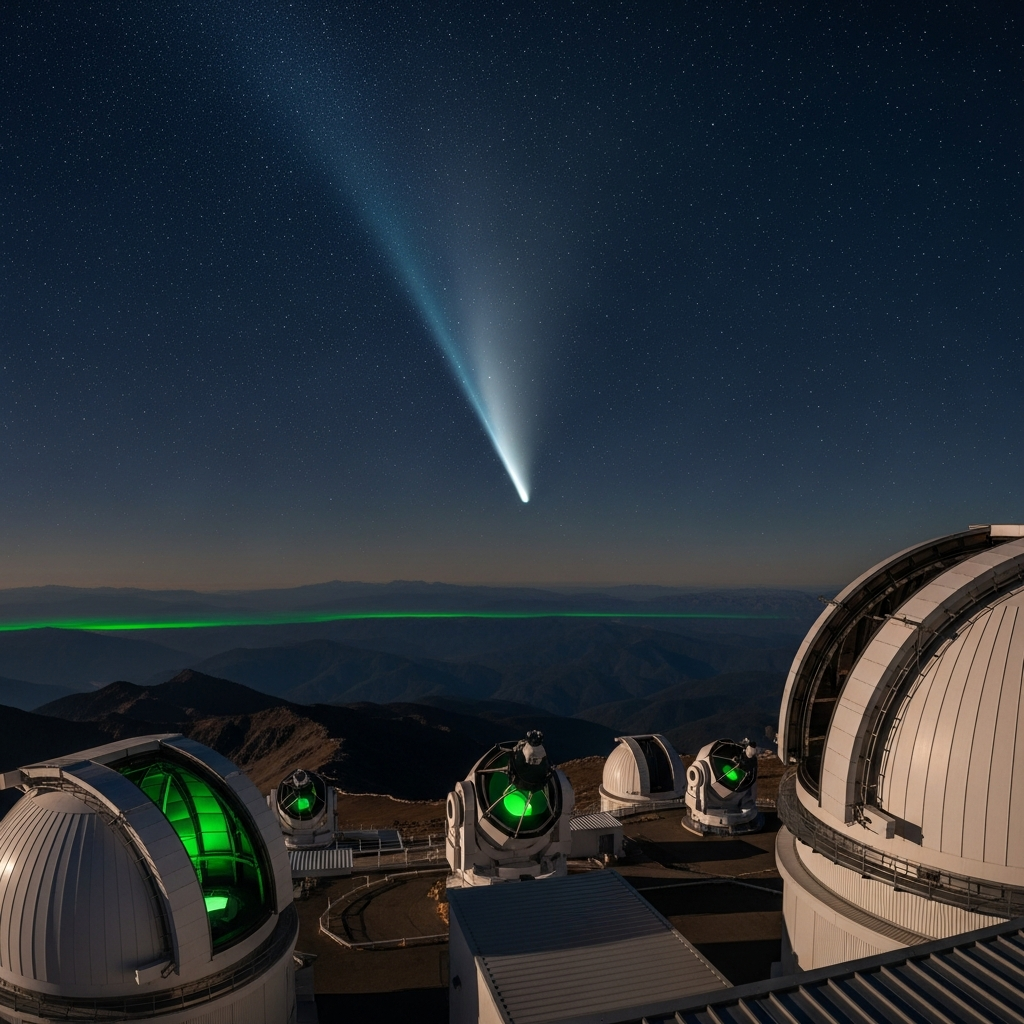
The year 2025 delivered an extraordinary celestial spectacle: the close passage of interstellar comet 3I/ATLAS. On December 19, this unique visitor from another star system made its closest approach to Earth, sparking immense scientific interest and public fascination. While it offered no threat to our planet, its journey through our solar system provided invaluable data, distinguishing it as a “cosmic time capsule.” Astronomers eagerly seized this rare opportunity to study a true alien traveler before it began its permanent departure into the vastness of interstellar space.
The Grand Flyby: When and How Close?
On Friday, December 19, 2025, interstellar comet 3I/ATLAS zoomed past Earth, reaching its closest point around 1 a.m. EST (0600 GMT). This fleeting encounter saw the comet pass within 168 million miles (270 million kilometers) of our planet. To put this into perspective, that’s nearly twice the distance between Earth and the sun, ensuring absolutely no danger of impact. The comet was moving at a breathtaking speed of 144.1 thousand mph (231.9 thousand kph), underscoring the dynamic nature of its journey. This flyby marked a significant moment for scientists, offering one of the final opportunities for detailed observation.
A Glimpse Beyond Our Star: Unraveling 3I/ATLAS’s Secrets
Comet 3I/ATLAS holds a special place in astronomical history as only the third confirmed interstellar object to visit our solar system. Its “3I” designation highlights this rare status, following 1I/’Oumuamua in 2017 and 2I/Borisov in 2019. This remarkable celestial body was first spotted on July 1, 2025. Astronomer Larry Denneau, working with the ATLAS (Asteroid Terrestrial-impact Last Alert System) telescope at the University of Hawaii’s Institute for Astronomy, made the initial discovery.
After making its closest approach to our sun in October, Comet 3I/ATLAS began its long journey outward. It is projected to pass Jupiter in early 2026, then cross the orbits of Saturn, Uranus, and Neptune by 2028. Ultimately, this ancient wanderer will exit our solar system permanently, returning to interstellar space never to return. Scientists consider these interstellar visitors to be “cosmic time capsules,” providing unique samples from distant exoplanetary systems that would otherwise be beyond our reach. Studying them allows astronomers to compare extraterrestrial material with that of our own solar system, opening new avenues in astrophysics.
Scientific Insights: What We’ve Learned from an Alien Comet
The close approach of Comet 3I/ATLAS provided an unprecedented chance to collect data, revealing fascinating details about its nature and origin. Numerous ground-based and space-based telescopes meticulously tracked its every move.
Unveiling Its Wobble: Rotation and Outgassing
One of the most surprising discoveries involved the comet’s rotation. Researchers detected the first-ever wobbling jet emanating from an interstellar comet. This rhythmic motion confirmed a rotation period of 14-17 hours, a finding published in Astronomy & Astrophysics. What surprised scientists most was how “extraordinarily normal” its behavior appeared. Despite forming around another star, 3I/ATLAS behaved much like comets native to our solar system, complete with sunlight-driven jets.
This observation also shed light on its “non-gravitational acceleration.” Contrary to speculative theories, this subtle change in trajectory is a common comet phenomenon. It results from the uneven outgassing of frozen materials as the comet approaches the sun. These gas jets provide a gentle, propulsive force, subtly altering the comet’s path. Measurements showed this acceleration to be tiny, around ½ a micron per second squared. Based on this, scientists estimated Comet 3I/ATLAS’s nucleus to be roughly 375 meters wide, with a pre-perihelion mass of about 44 million metric tons—equivalent to seven Great Pyramids of Giza. This evidence strongly supports a natural cometary explanation, firmly debunking any “alien spaceship” theories, as NASA officials also emphasized.
Shining Bright in X-rays
Further insights came from observations in X-ray light. The European Space Agency’s XMM-Newton observatory, along with the Japanese XRISM mission, revealed a vast 250,000-mile (400,000-kilometer) X-ray glow extending from the comet’s nucleus. This X-ray light is emitted by gases interacting with the solar wind. Analyzing this signature will provide critical information about the comet’s composition and the high-energy environment it experienced after its incredibly long interstellar journey. Such detailed spectroscopic data helps scientists understand how these ancient visitors are influenced by our star.
Europa Clipper’s Unexpected View
In an opportunistic move, NASA’s Europa Clipper spacecraft, currently en route to Jupiter, observed Comet 3I/ATLAS on November 6. This observation occurred when the comet was approximately 102 million miles (164 million kilometers) away—a perspective even closer than its flyby of Earth. The spacecraft’s Ultraviolet Spectrograph (UVS) instrument, though designed for Jupiter’s moon Europa, successfully detected signs of oxygen, hydrogen, and dust features. This data supported conclusions of high outgassing activity shortly after the comet’s closest approach to the sun. The Europa Clipper’s adaptable use of its instruments provided a unique and nuanced view of the comet, demonstrating the versatility of NASA’s robotic missions.
Hubble and Psyche’s Contributions
Other missions also contributed valuable data. In July, the Hubble Space Telescope helped determine that 3I/ATLAS has a “solid, icy nucleus” estimated to be between 1,000 feet and 3.5 miles in diameter, surrounded by a teardrop-shaped dust cocoon. Its chemical composition suggests it formed in a cold, distant region of its parent star system’s disk, under very different environmental conditions than our own. NASA’s Psyche mission also acquired data in early September, which helped refine the comet’s trajectory and allowed for further study of its faint gaseous coma. Scientists theorize that this comet could be incredibly old, possibly between three and 14 billion years, significantly predating our solar system.
How to Observe and Track This Fleeting Visitor
Given its considerable distance from Earth, Comet 3I/ATLAS was far too faint to be seen with the unaided eye. Even standard backyard telescopes would have found it challenging. Observers typically needed a medium-to-large telescope, around 8-12 inches in size, to spot it as a faint, fuzzy patch of greenish light. Through such equipment, it might have been seen near the bright star Regulus in the constellation Leo.
For those eager to witness the event, the easiest way was through dedicated online resources. Astrophysicist Gianluca Masi of the Virtual Telescope Project hosted a free online livestream of the comet’s close approach. While initially postponed due to rain over his observatory in Ceccano, Italy, the broadcast was rescheduled for 11 p.m. EST on December 19 (0400 GMT on December 20).
Numerous digital tools also allowed enthusiasts to track the comet’s progress:
NASA’s Eyes on the Solar System: This website provided a dynamic 3D model, letting users follow the comet’s path in real-time and even use a “Distance Tool” to calculate its separation from other celestial bodies.
Comet Observation Database: Amateur astronomers contributed observations, allowing tracking of the comet’s brightness over time.
Smartphone Astronomy Apps: Popular apps like Sky Tonight, Sky Guide, Stellarium, and SkySafari 7 Pro included 3I/ATLAS in their databases, helping users pinpoint its location in the sky.
Smart Telescopes: Modern GoTo or smart telescopes, such as the Seestar S50 or Unistellar eVscope 2, likely featured 3I/ATLAS in their control applications, simplifying observation for equipped users.
The Legacy of 3I/ATLAS: A Window to Other Worlds
Comet 3I/ATLAS, as the third interstellar object ever discovered, represents a monumental opportunity for astronomy. These rare visitors are crucial for understanding the diversity of material present in other star systems, offering direct evidence of exoplanetary formation. By studying its composition, rotation, and interaction with our solar environment, scientists gain direct insights into conditions far beyond our own cosmic neighborhood. Its departure signifies not an end, but a new chapter in our understanding of the vast universe. This brief, breathtaking encounter solidifies Comet 3I/ATLAS’s place in history as a pivotal subject in the ongoing quest to unravel the mysteries of interstellar space.
Frequently Asked Questions
What makes Comet 3I/ATLAS an “interstellar” object?
Comet 3I/ATLAS is classified as an interstellar object because its trajectory indicates it originated from beyond our solar system, meaning it was not gravitationally bound to our sun. Its high speed and hyperbolic orbit are key indicators that it’s just passing through, rather than being a native member of our solar system’s comet population. It is the third such object ever detected, following 1I/’Oumuamua and 2I/Borisov, providing scientists with rare opportunities to study material from other star systems. After its brief visit, it will depart our solar system forever.
How could I have observed or tracked Comet 3I/ATLAS during its close approach?
Given its distance, Comet 3I/ATLAS was not visible to the naked eye and required large telescopes (8-12 inches) to be seen as a faint, fuzzy patch. The easiest public viewing method was a free online livestream hosted by astrophysicist Gianluca Masi of the Virtual Telescope Project, though it was subject to weather conditions. For tracking its real-time position, tools like NASA’s Eyes on the Solar System website, the Comet Observation Database, and various smartphone astronomy apps (e.g., SkySafari) were invaluable resources, offering detailed positional data and 3D models.
Was Comet 3I/ATLAS ever a threat to Earth, or could it have been an alien spacecraft?
No, Comet 3I/ATLAS posed absolutely no threat to Earth. At its closest, it was 168 million miles away, nearly twice the distance between Earth and the sun. While speculation about “alien spaceship” origins did arise, NASA and other scientific bodies officially confirmed it is unequivocally a comet. Its observed “non-gravitational acceleration” and other behaviors, such as the detection of a wobbling gas jet, are scientifically understood phenomena caused by the outgassing of frozen materials, typical of natural cometary activity.