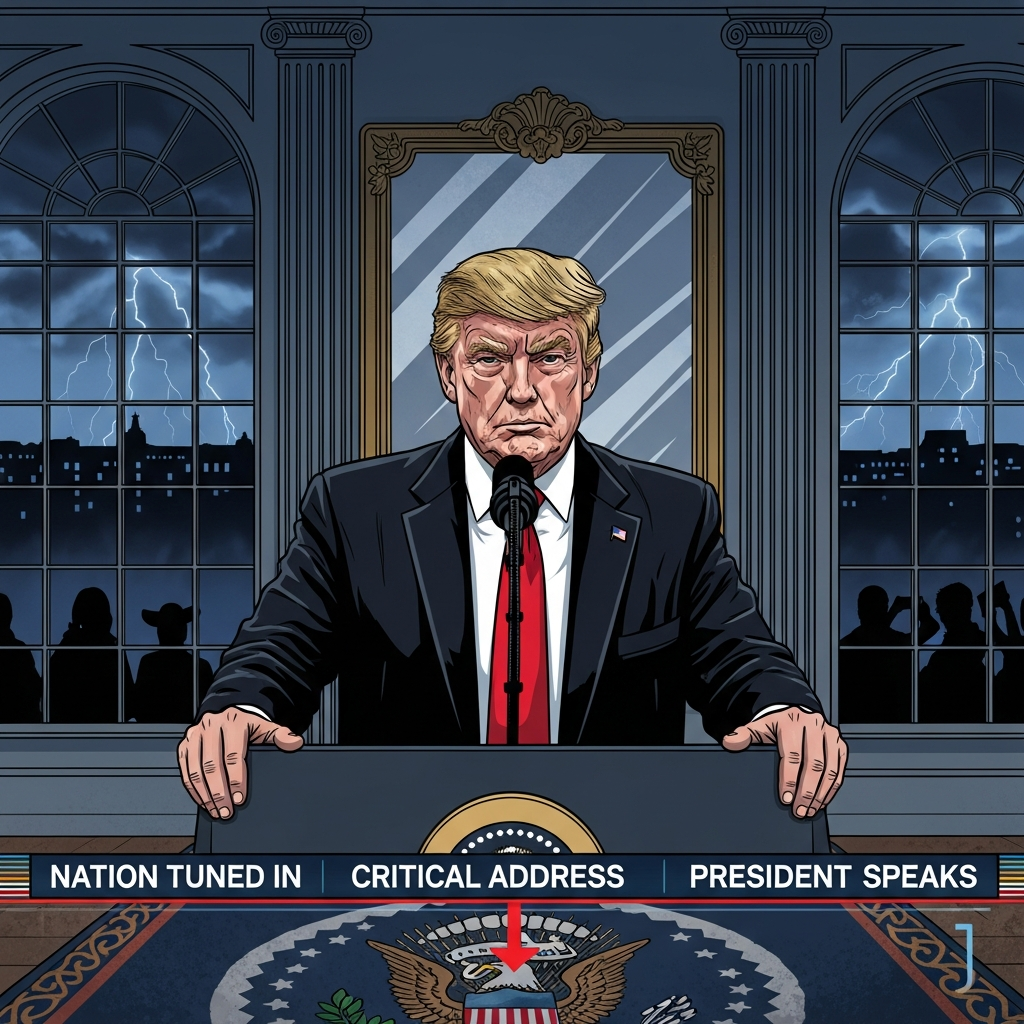
In a pivotal moment during late 2025, former President Donald Trump delivered a primetime national address from the White House, aiming to reset narratives and bolster his political standing. This highly anticipated speech, broadcast from the Diplomatic Reception Room, stirred significant discussion and drew immediate scrutiny from political analysts and fact-checkers alike. Presented amidst flagging approval ratings and growing economic anxieties among Americans, the address served as a strategic platform for Trump to highlight perceived achievements, launch criticisms at his successor, and outline future ambitions. However, many of his key assertions were quickly challenged, prompting a deeper dive into the substance and political implications of his televised remarks.
The White House Address: A High-Stakes Platform
President Trump’s address, which took place on December 18, 2025, was more than just a typical presidential statement; it was a carefully orchestrated media event designed to reach a broad audience. His prior announcement on Truth Social hinted at a celebratory tone, promising “a great year for our Country, and THE BEST IS YET TO COME!” White House press secretary Karoline Leavitt further clarified the intent, indicating Trump would recap his administration’s accomplishments and detail plans for the coming years.
Strategic Timing Amidst Economic Woes
The timing of this national address was particularly significant, coinciding with a period of considerable political pressure. Public opinion polls revealed a “gloomy outlook” among Americans regarding the economy, with Trump’s economic approval rating at its lowest point across his two terms—only 31% of Americans approving of his handling of the economy, a sharp drop from earlier in the year. With the 2026 midterm elections less than a year away, Democrats had intensified their criticism, blaming Trump’s economic policies for an “affordability crisis” and directly challenging his campaign promise to reduce the cost of living. Against this backdrop of waning popularity and an urgent need to counter negative perceptions, the primetime speech offered a valuable opportunity to recalibrate public sentiment.
Key Themes and Controversial Claims
During his address, President Trump launched into a series of claims, primarily focusing on economic conditions. He attributed the nation’s economic challenges to his predecessor, President Joe Biden, alleging that the U.S. was “absolutely dead” when he took office and suffering from “the worst inflation in 48 years.” Trump then contrasted this with his administration’s performance, declaring the U.S. had become the “hottest country anywhere in the world,” with “wages up, prices down,” and a promise of an unprecedented “economic boom” in 2026. A notable announcement was the “warrior dividend” of $1,776 checks for approximately 1 to 1.5 million military service members, which he claimed was funded by tariff revenues. Beyond the economy, the speech included attacks on familiar targets and touched on immigration, healthcare, and social policy.
Unpacking Trump’s Economic Assertions: A Fact-Check
While the speech was presented as a testament to economic resurgence, many of President Trump’s specific economic claims were met with immediate skepticism and rigorous fact-checking. Analysts quickly pointed out discrepancies between his statements and official data.
The “Warrior Dividend” and Funding Questions
The “warrior dividend” of $1,776 checks, promised to military servicemembers, was a highlight of the address. Trump stated these payments were “on the way” for Christmas, partially funded by tariffs. The White House later clarified eligibility for active-duty servicemembers in specific pay grades and reserve component members. While the estimated cost neared $2.6 billion, the funding mechanism raised questions, particularly concerning Congress’s constitutional “power of the purse” and the true source of the funds.
Inflation and Consumer Prices: Reality vs. Rhetoric
Trump asserted that grocery prices were “falling rapidly” and made specific claims regarding the decline of egg and Thanksgiving turkey prices. He stated egg prices were down 82% since March and turkey prices fell 33% compared to the previous year. However, Consumer Price Index (CPI) data indicated a 43.9% decrease for eggs, with prices still up over 10% from the year’s start. Wells Fargo’s Agri-Food Institute tracked a more modest 2-3% decrease for comparable Thanksgiving baskets. Despite Trump’s claim that “everything else is falling rapidly,” the CPI showed monthly price increases since April, with inflation at 3.0% in September. Furthermore, his figures for auto prices, gasoline, hotel rates, and airfares under Biden were found to be overstated compared to CPI data.
Investment Figures and Tariff Impact
The President claimed a “record-breaking $18 trillion of investment” into the U.S. This figure was disputed by fact-checkers, with official White House figures stating $9.6 trillion and other analyses suggesting closer to $7 trillion, often comprising vague pledges. Trump also attributed his administration’s economic success to tariffs, yet a Goldman Sachs report indicated that American consumers bore as much as 55% of these costs, directly contributing to the higher cost of living that was a primary driver of his declining poll numbers.
Beyond Economics: Other Contentious Points
The address was not solely focused on the economy, venturing into other areas that also drew significant criticism and fact-checking.
Immigration Figures Under Scrutiny
President Trump claimed that 25 million undocumented immigrants had entered the U.S. under Biden, many supposedly from prisons and mental institutions. However, U.S. Customs and Border Protection (CBP) statistics showed 7.4 million illegal crossings, or 10.2 million including those without documentation at legal points of entry, plus 800,000 through legal Biden-era programs. These figures were considerably lower than Trump’s assertion and did not support the claim of a large influx of criminals or individuals from mental institutions.
Healthcare, Social Security, and Community Critiques
Trump incorrectly stated his “One Big Beautiful Bill” eliminated taxes on Social Security, when it actually referred to a tax deduction for seniors, with Social Security income remaining taxable. He also blamed Democrats for rising healthcare costs, despite the fact that Affordable Care Act (ACA) premiums were set to spike due to a Republican-controlled Congress failing to extend enhanced subsidies. The speech also reiterated past criticisms of Minnesota’s Somali community, accusing them of “stealing billions” and “destroying our country,” a claim that lacked substantiation.
Expert Analysis: A “Pointless” Address or Strategic Maneuver?
Political observers offered diverse interpretations of the primetime address, with many questioning its overall effectiveness and underlying strategy.
Signs of a “Sinking” Administration?
Zack Beauchamp of Vox characterized Trump’s speech as revealingly “pointless,” suggesting it signaled a “desperate and failing administration.” Traditionally, such national addresses are reserved for matters of grave national significance. Beauchamp argued that the content, described as a “disorganized jumble of familiar, often false or impossible claims,” lacked the serious import expected of a presidential address. He viewed the occurrence of this aimless speech as an indicator that the administration was “sinking” without a clear strategy. Beauchamp had previously labeled Trump’s governing style as “haphazardism”—an approach driven by authoritarian ambitions but lacking coherent planning, leading to self-defeating actions, such as tariffs contributing to high living costs and plummeting poll numbers.
Political Motivations and Public Reception
The speech was widely described as a “campaign-style rant” or “rally-style speech,” characterized by a loud, “shouting,” and “frustrated” delivery. This prompted social media reactions likening it to an “Old man yells at cloud.” Confronted with abysmal poll numbers and growing divisions, the administration appeared to be resorting to “desperate measures,” using the primetime slot to “try other stuff and see if something, anything, might work.” Beauchamp suggested that under normal circumstances, such a “weird pseudo-stump speech” would neither be approved by a White House nor likely broadcast by major networks, hinting at potential coercion given the administration’s capacity to threaten private sector actors. White House communications director Steven Cheung, however, hailed the address as “epic.”
Broader Political Landscape at the Time
President Trump’s address did not occur in a vacuum; it was set against a backdrop of several other significant political and administrative developments unfolding in Washington D.C. and beyond.
Congressional Battles and Policy Debates
In Congress, moderate House Republicans joined Democrats in signing a discharge petition to force a vote on a three-year extension of enhanced ACA subsidies, highlighting divisions within the Republican party. The House also approved a Republican healthcare bill that notably excluded this ACA subsidy extension, focusing instead on expanding association health plans and increasing pharmacy benefit manager transparency. Controversially, the House passed legislation that would criminalize providing transition-related medical care to minors as a felony, a bill expected to fail in the Senate and criticized for politicizing care. Meanwhile, the Senate passed the National Defense Authorization Act, including a provision restricting the Defense Secretary’s travel budget until unedited video of controversial U.S. Southern Command strikes was provided to Congress.
Legal and Administrative Developments
Several other significant events captured headlines during this period. Former special counsel Jack Smith was set to testify privately before the House Judiciary Committee, with his attorney asserting “proof beyond a reasonable doubt” of Trump’s “criminal scheme” to overturn the 2020 election and obstruct justice regarding classified documents. FBI Deputy Director Dan Bongino announced his impending departure, while the Department of Health and Human Services terminated millions in grants to the American Academy of Pediatrics, escalating a conflict over vaccine policy. A federal judge blocked a Trump administration policy requiring a 7-day waiting period for congressional oversight visits to ICE facilities, ruling it unlawful. The Justice Department also faced a December 19 deadline to release investigative files related to Jeffrey Epstein. These concurrent developments underscored the intense political and legal environment surrounding the Trump administration at the time of the primetime address.
Frequently Asked Questions
What was the primary focus and impact of Donald Trump’s White House address in late 2025?
President Donald Trump’s primetime address in late 2025 primarily focused on the U.S. economy, aiming to attribute high prices to his predecessor and highlight perceived economic gains during his own administration. He also announced a “warrior dividend” for military members. The speech’s impact was largely controversial, sparking immediate fact-checks that challenged many of his economic and immigration claims. Analysts viewed it as a “campaign-style rant” and a sign of a “desperate” administration struggling with low approval ratings and an impending midterm election.
Where did critics argue Trump’s primetime address fell short of traditional presidential expectations?
Critics, notably Zack Beauchamp, argued that Trump’s primetime address fell short of traditional presidential expectations by lacking serious national significance. Such addresses are typically reserved for major policy announcements or declarations of war, but Trump’s speech presented a “disorganized jumble” of familiar, often unverified claims. The content was described as “pointless,” and the delivery as unusually angry and rapid, contrasting sharply with the gravitas expected of a formal White House address. Its aim, according to critics, appeared more aligned with a political rally than a sober national update.
How did Donald Trump’s economic claims during his address compare with independent fact-checks and market data?
Donald Trump made several economic claims during his address, including an “record-breaking $18 trillion of investment,” an 82% drop in egg prices, and a 33% fall in Thanksgiving turkey prices. However, independent fact-checks and market data contradicted these assertions. Official figures for investment were significantly lower, egg prices had decreased by 43.9% but were still up year-over-year, and turkey prices saw only a 2-3% decrease. Overall inflation had risen monthly, and tariffs, which Trump championed, were found to impose significant costs on American consumers.
Conclusion
Donald Trump’s primetime address from the White House in late 2025 was a defining moment in his administration, serving as a forceful attempt to redefine his narrative amidst challenging political headwinds. While framed as a comprehensive update on national progress, particularly concerning the economy, the speech generated widespread debate. Many of Trump’s claims were immediately challenged by fact-checkers, highlighting a significant divergence between his rhetoric and verifiable data. Expert analysis further suggested the address was less about substantive policy and more a reflection of an administration grappling with declining public approval and an uncertain political future. Ultimately, the speech underscored the charged political environment of the time, leaving a lasting impression of a presidency deeply mired in controversy and strategic maneuvering as critical elections approached.