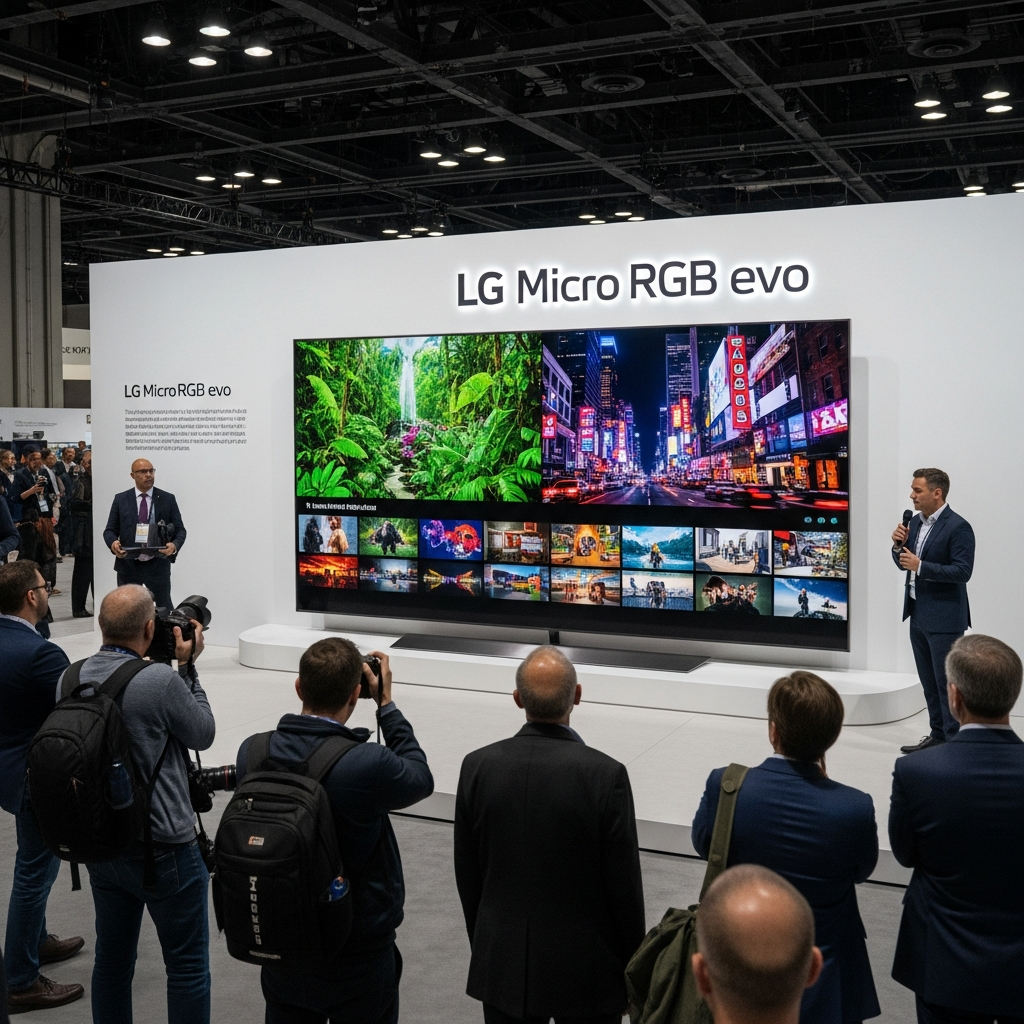
The future of home entertainment is taking a groundbreaking leap forward with the official announcement of the LG Micro RGB evo TV. Set to debut at CES 2026 and launch later that year, this flagship display promises to redefine visual standards for premium LCD televisions. Leveraging advanced Micro RGB technology and LG’s celebrated AI processing, this innovation is poised to deliver an unparalleled viewing experience that could even challenge top-tier OLEDs. Consumers eagerly awaiting cutting-edge picture quality will find the LG Micro RGB evo TV an exciting prospect for their living spaces.
Introducing LG’s Micro RGB evo TV: A Paradigm Shift in Display Technology
LG Electronics is making waves with its forthcoming LG Micro RGB evo TV, an innovation so significant it has already secured a CES 2026 Innovation Award for its 100-inch MRGB95B model. This unveiling marks LG’s definitive entry into the high-end RGB display market, promising a vibrant, detailed, and immersive picture previously considered impossible for LCD technology. The highly anticipated launch in 2026 signals a pivotal moment for advanced display solutions.
This new flagship display, known by its model number MRGB95, aims to significantly elevate picture quality. LG’s engineers have utilized their smallest individual RGB LEDs yet, refining the color accuracy and visual fidelity in the LCD category. The announcement follows LG’s prior recognition for a “premium LCD TV with Micro RGB technology” in November, building anticipation for its full reveal.
Decoding Micro RGB: Not Your Average MicroLED
It’s crucial to understand that LG’s Micro RGB technology is distinct from MicroLED. While both use microscopic LEDs, the underlying architecture differs significantly. MicroLED displays are self-emissive, meaning each individual microscopic red, green, and blue LED forms a single pixel, offering pixel-level lighting control.
In contrast, LG’s Micro RGB evo TV utilizes clusters of red, green, and blue LEDs as a sophisticated backlight system. These “incredibly small” LEDs illuminate multiple pixels simultaneously. Although these LEDs are tiny, they still necessitate a color filter to accurately produce color for each individual pixel. This innovative approach offers a substantial upgrade over conventional LED displays, which typically rely on a single blue or white backlight source.
Unprecedented Visuals: Color, Contrast, and Brightness Redefined
The LG Micro RGB evo TV is engineered to deliver stunning visual performance, pushing the boundaries of what LCD televisions can achieve. This advanced display promises a superior experience across critical metrics like color accuracy, contrast, and brightness. Viewers can expect a noticeable leap in image quality compared to existing premium LCD models.
Beyond Brilliant Color Reproduction
A standout feature is the television’s “RGB Primary Color Ultra” technology. This capability enables a full spectrum of color reproduction, leading to an outstanding color range. The LG Micro RGB evo TV has been independently certified by Intertek for 100 percent color gamut coverage across BT.2020, DCI-P3, and Adobe RGB color spaces. This achievement represents the highest possible color reproduction and is ideally suited for professional applications like digital editing and HDR cinema. These certifications underscore LG’s commitment to delivering truly accurate and vibrant visuals for any content.
Pinpoint Contrast and Dazzling Brightness
For contrast, the LG Micro RGB evo TV employs “Micro Dimming Ultra,” precisely orchestrating over a thousand local dimming zones. This intricate control system achieves what LG describes as exceptional contrast among LCD TVs, revealing intricate details in both the darkest shadows and brightest highlights. While some competitors like the TCL QM8K feature even more dimming zones (upwards of 5,000), LG’s refined management of its zones, drawing on “OLED precision,” is expected to yield impressive results. Experts anticipate peak brightness levels will “easily eclipse 5,000 nits,” delivering incredibly impactful HDR content.
The Alpha 11 AI Processor Gen 3: The Brain Behind the Beauty
At the heart of the LG Micro RGB evo TV’s advanced performance is the newly upgraded Dual AI Engine-based α (Alpha) 11 AI Processor Gen 3. This marks the first time LG’s flagship processor, typically reserved for its premium OLED models like the LG G5, will power a non-OLED display. Its integration here is a testament to the Micro RGB evo’s elite positioning.
This powerful processor drives several key innovations. The “Dual Super Upscaling” capability processes two distinct types of AI upscaling simultaneously. This results in enhanced sharpness and natural, balanced images with unparalleled clarity. The α (Alpha) 11 AI Processor Gen 3 also provides precise backlight control and advanced 4K upscaling. This intelligent processing ensures every pixel benefits from LG’s 13 years of OLED technical excellence, applying “OLED precision to control each of the RGB LED backlights.” This refined control system was once deemed impossible for this display category. The Alpha 11 Gen 3 processor also supports 4K/165Hz gaming, making the LG Micro RGB evo TV a strong contender for serious gamers.
Smart Features and Seamless Connectivity
Beyond its stunning picture quality, the LG Micro RGB evo TV integrates an intuitive and deeply personalized user experience. It leverages the latest iteration of LG’s award-winning webOS interface, ensuring enhanced personalization options. This updated smart TV platform aims to improve user interaction and overall convenience.
Key features include Voice ID for personalized profiles, an AI Picture/Sound Wizard to optimize settings, and a customizable “My Page” home screen. Further enhancing the user experience are an upgraded AI Concierge, AI Chatbot, and AI Search. These tools are designed to help users effortlessly explore content-related information and navigate their entertainment options with ease. While specific connectivity details are forthcoming, mirroring LG’s high-end OLEDs, it is hoped the TV will offer at least four HDMI 2.1 sockets to support its advanced gaming capabilities.
A Competitive Landscape: The Future of Premium Displays
The launch of the LG Micro RGB evo TV is part of a broader industry movement toward advanced RGB LED technology. CES 2026 is expected to showcase numerous RGB TV models from various manufacturers, signifying a major shift in the premium display market. LG is entering a rapidly evolving arena.
Samsung, for instance, introduced its own 115-inch Micro RGB TV prior to LG’s announcement, following its display at CES 2025. Hisense debuted its impressive 116-inch 116UX at CES 2025 as well. Other key players include TCL, which has already launched two RGB TV models in the Chinese market, and Sony, slated to release its TrueRGB TV early in 2026. Reviewers have lauded the “incredibly impressive” performance of early Hisense and Samsung RGB LED implementations. They reported “punchy, vibrant images that are better than anything currently on the market,” setting a high bar for LG’s offering.
Availability and Anticipated Pricing
The LG Micro RGB evo TV (model MRGB95) will be available in substantial screen sizes. Consumers can choose from 75-inch, 86-inch, and a massive 100-inch model. While specific US pricing and exact availability dates are yet to be confirmed, more detailed specifications are expected during the CES 2026 event.
Early versions of these RGB LED televisions from competitors have been very large and costly, often priced in the tens of thousands of dollars. However, industry experts are optimistic that as more manufacturers enter the market and offer these displays in smaller sizes, prices for RGB TVs will hopefully become “more reasonable” and accessible to a wider audience. This competitive trend bodes well for consumers.
Frequently Asked Questions
What is LG Micro RGB evo technology, and how does it differ from MicroLED?
LG Micro RGB evo technology uses tiny clusters of red, green, and blue LEDs as a backlight system for multiple pixels, requiring a color filter. It’s a significant upgrade from traditional backlights, offering enhanced color and brightness. In contrast, MicroLED displays are self-emissive, meaning each individual microscopic red, green, and blue LED forms a single pixel, providing pixel-level light control without the need for a separate backlight or color filter. LG’s approach leverages its OLED expertise for precise backlight control in a high-performance LCD format.
How does the LG Micro RGB evo TV compare to high-end OLEDs or other premium LCD TVs?
The LG Micro RGB evo TV aims to challenge OLEDs with its “OLED precision” control over its RGB LED backlight and anticipated peak brightness exceeding 5,000 nits. It boasts 100% color gamut coverage for BT.2020, DCI-P3, and Adobe RGB, making it highly competitive for color accuracy. While it utilizes over a thousand dimming zones, some premium LCDs like the TCL QM8K feature more. However, LG’s advanced Alpha 11 AI Processor Gen 3, a component usually found in top-tier OLEDs, promises superior image processing and upscaling, potentially delivering a viewing experience that could make “OLED users feeling envy.”
When will the LG Micro RGB evo TV be available, and what screen sizes can consumers expect?
The LG Micro RGB evo TV is set to be officially unveiled at CES 2026 in January, with its full release anticipated later in 2026. Consumers interested in this next-generation display can look forward to three large screen sizes: 75-inch, 86-inch, and a grand 100-inch model. While specific US pricing details have not yet been disclosed, industry trends suggest that as more manufacturers enter the Micro RGB market, prices for these advanced televisions are expected to become more accessible over time.
The Dawn of a New Visual Era
The LG Micro RGB evo TV represents a pivotal moment in display technology, marrying advanced Micro RGB backlighting with LG’s proven AI processing power. With its stunning color accuracy, anticipated peak brightness, and smart features, it promises to deliver an unparalleled home entertainment experience. As LG pushes the boundaries of what’s possible with LCD technology, this new flagship could redefine expectations for visual fidelity, setting a new benchmark for televisions in 2026 and beyond. Stay tuned for further details and a closer look at this game-changing display at CES 2026.