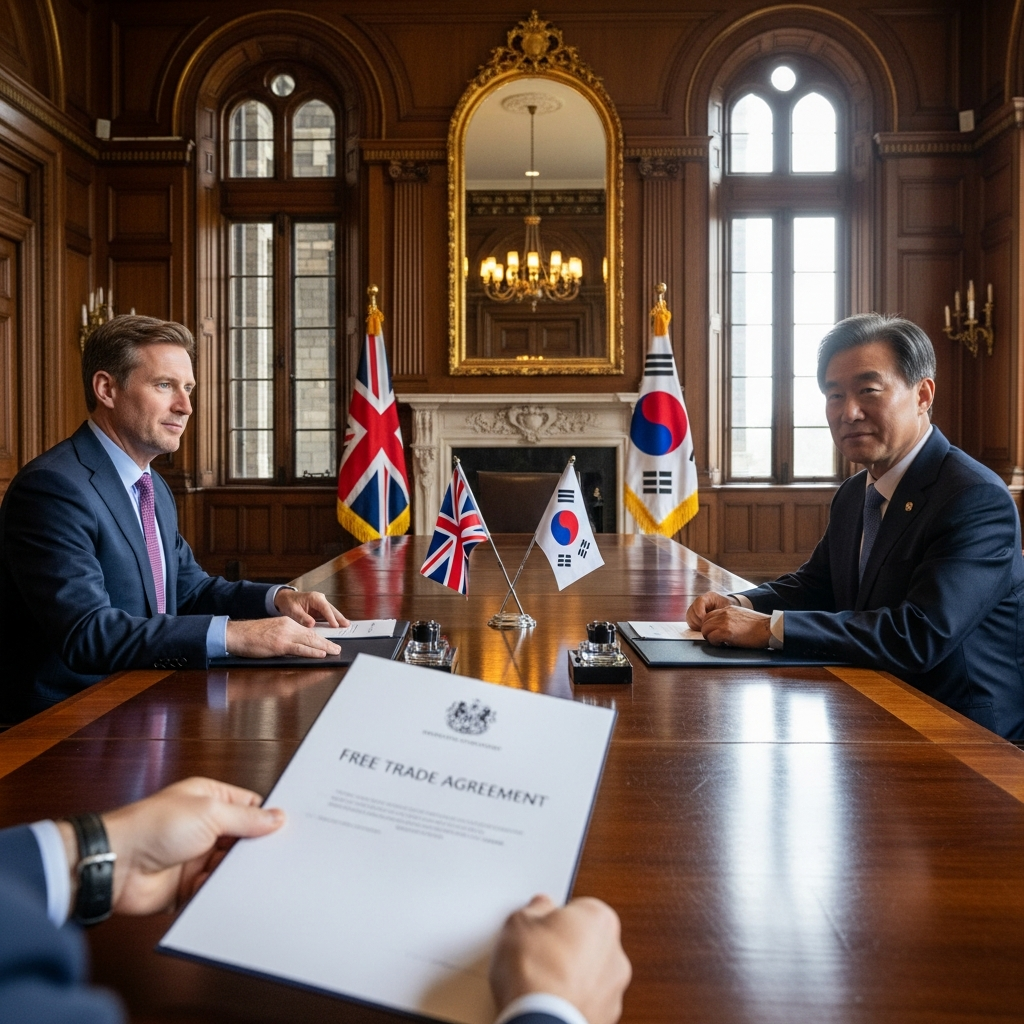
The UK and South Korea have signed a landmark upgraded free trade agreement, poised to inject billions into both economies, safeguard vital jobs, and significantly boost exports across key sectors. This strategic deal modernizes bilateral trade, addresses evolving global supply chains, and solidifies economic ties between two dynamic nations. Signed in London by UK Trade Minister Chris Bryant and his South Korean counterpart, Yeo Han-koo, the agreement ensures tariff-free access for 98% of goods, protecting £2 billion of UK exports from potential tariff hikes. It’s a pivotal moment aiming to foster greater economic collaboration and secure market access for businesses in both countries.
A Landmark Agreement: The New UK-South Korea Trade Deal
This freshly inked UK-South Korea trade deal is the culmination of two years of intense negotiations, including six rounds of talks and five ministerial meetings. It builds upon an earlier free trade agreement established in 2019 and enacted in 2021, which followed Britain’s departure from the European Union. That initial arrangement largely mirrored the EU-South Korea FTA from 2011, making this new pact a crucial step in tailoring the trade relationship specifically to the needs and ambitions of both countries.
Building on Past Success: From Brexit to Bilateral Boost
The updated agreement is designed to not only maintain but expand an already robust annual trade relationship, which presently exceeds £15 billion. It strategically aligns the UK’s trade terms with Seoul more closely with the European Union’s existing deal with South Korea. The UK government projects an additional £400 million per year for the British economy, particularly through a surge in services exports. For South Korea, the deal aims to significantly streamline trade regulations and widen market access for its firms within the UK.
Key Victories for UK Industries and Consumers
British businesses stand to gain considerably from the enhanced UK-South Korea trade deal. The agreement offers “cast-iron protections” for critical industries, paving the way for accelerated economic growth. From luxury cars to fine spirits, the deal ensures that iconic British exports remain highly competitive in South Korea’s rapidly growing import market, forecast to expand by 26% by 2035.
Automotive Overhaul: Easier Access for Car Exports
A central pillar of the new agreement is the significant adjustment to “rules of origin” for the automotive sector. Previously, 55% of a car’s components needed to originate from the UK or the EU to qualify for zero tariffs when exported to South Korea. This threshold has now been drastically reduced to 25%. This change offers profound flexibility for carmakers like Bentley Motors and Jaguar Land Rover. They can now source crucial components, such as batteries or battery elements, from a broader global supply chain, including countries like China, while still benefiting from duty-free exports to the South Korean market. Industry leaders like Bentley CEO Frank-Steffen Walliser have welcomed this, emphasizing its importance for maintaining access to a key luxury vehicle market.
Services, Pharma & Beyond: Expanding Market Horizons
The deal is a boon for the UK’s services sector, which recorded £1.1 billion in financial and insurance exports to South Korea in 2024. British firms will now gain enhanced access to South Korea’s expanding financial market. Beyond this, new opportunities are opening up for UK companies to bid for public procurement contracts in Seoul and offer legal services. The agreement also safeguards key sectors such as pharmaceuticals and specific food and drink products. Exports of Scottish salmon and Guinness, despite being brewed in Dublin but canned in Runcorn and Belfast, are explicitly supported, with Diageo noting the deal will help meet increasing South Korean consumer demand. The Scotch Whisky Association also anticipates enhanced access for its products, especially single malts, in the Asia-Pacific region, a vital market.
Strategic Gains for South Korean Exports
The upgraded free trade agreement is equally transformative for South Korean exporters, addressing long-standing trade barriers and fostering new avenues for growth. It underscores a mutual commitment to strengthening the free-market system amidst rising global uncertainties.
Driving Korean Automakers to Success
Mirroring the UK’s benefits, the rules of origin revision is particularly impactful for South Korean automakers. With automobiles accounting for a substantial 36% of South Korea’s total exports to the UK, reducing the value-added requirement for tariff-free treatment from 55% to 25% is a game-changer. This adjustment is crucial for the electric vehicle industry, where the value of imported raw materials like lithium and graphite for batteries can fluctuate widely. Easing this requirement makes it considerably simpler for South Korean carmakers to export their vehicles to Britain competitively.
Beauty, Food, and Tech: Broadening Market Reach
Beyond cars, various South Korean consumer goods are set to benefit from relaxed rules of origin. Tariffs of up to 8% on beauty and other chemical products will now be waived, provided essential processing steps, such as chemical reactions and mixing, occur in Korea. This comes as Korean cosmetics exports to the UK surged by nearly 240% between 2019 and 2024. Similarly, processed foods like gimbap and kimchi will qualify for tariff-free status, even if key ingredients are sourced from third countries and then processed in Korea. The agreement also provides broader access for Korean firms to the UK’s high-speed rail procurement market and opens up areas like online gaming, where Korean firms have a strong global presence.
Digital Frontiers and Supply Chain Resilience
Both nations recognize the increasing importance of digital trade and robust supply chains in the modern global economy. The UK-South Korea trade deal introduces advanced provisions to foster greater efficiency and security in these critical areas.
Modernizing Trade with E-Contracts and AI
The agreement legitimizes the use of e-contracts and other digital technologies, simplifying and expediting trade processes for businesses on both sides. This forward-thinking digital provision aligns with the UK’s trade strategy, positioning the UK-South Korea partnership as one of the most advanced globally in this field. The deal also covers cross-border data transfers, online consumer protection, and promotes joint development and investment in artificial intelligence, providing greater legal certainty for emerging technology-based services. This ensures that trade practices evolve with technological advancements, supporting innovation rather than hindering it.
Securing Future Supply Chains
In recognition of global supply chain shifts, the agreement institutionalizes cooperation through a dedicated chapter. This includes mechanisms such as a designated hotline and the ability to convene emergency meetings within 10 days to coordinate joint responses to potential supply disruptions. Furthermore, a Korea-UK Innovation Committee will be established to hold regular discussions on collaboration in advanced technology fields like artificial intelligence, autonomous vehicles, and biotechnology. This proactive approach aims to build resilience and foster shared progress in critical future industries.
Economic Impact and Future Prospects
While the UK government, led by Prime Minister Keir Starmer, hails this as a “huge win for British business and working people,” projecting thousands of jobs and billions into the economy, a balanced perspective is essential. The deal is framed as a “new golden age” in UK-South Korea relations, further exemplified by Virgin Atlantic’s planned daily flights from London to Seoul starting in 2026.
Beyond the Headlines: The Broader Economic Context
It’s important to contextualize this agreement within the broader landscape of post-Brexit trade deals. While beneficial for specific sectors, independent budget forecaster the Office for Budget Responsibility (OBR) has suggested that such agreements with larger partners are unlikely to have a “material impact” on the overall UK economy by 2030. South Korea, while a significant partner, is currently the UK’s 25th largest trading partner, accounting for a modest 0.8% of the UK’s total trade. Recent data also showed declines in bilateral trade for the 12 months leading up to June this year, with UK exports to South Korea down 16.4% and South Korean exports to the UK falling 10.8%.
However, Minister Yeo Han-koo emphasizes the complementary nature of the two economies, suggesting the deal’s primary focus transcends tariffs to reduce non-tariff barriers and establish new digital and investment protections. He envisions Britain serving as a gateway for South Korea’s trade with Europe, while South Korea could reciprocate as a gateway to Asia for British companies. This long-term strategic view, coupled with the rising popularity of South Korean culture in the UK, builds a strong foundation for continued economic and cultural collaboration.
Frequently Asked Questions
What is the primary focus of the new UK-South Korea trade deal?
The new UK-South Korea trade deal primarily focuses on upgrading and modernizing an existing agreement to significantly ease trade regulations, expand market access, and secure supply chains for both nations. Key areas of focus include relaxing “rules of origin” for exports, particularly in the automotive, beauty, and food sectors, enhancing digital trade provisions like e-contracts and cross-border data, and establishing frameworks for cooperation in advanced technologies like AI and autonomous vehicles. The goal is to make trade smoother and more resilient in a changing global economic landscape.
Which key industries in both the UK and South Korea stand to benefit most from this agreement?
For the UK, major beneficiaries include the automotive sector (e.g., Bentley, Jaguar Land Rover, benefiting from relaxed rules of origin for parts), the services sector (financial services, legal services), pharmaceuticals, and specific food and drink exports (e.g., Scottish salmon, Guinness). South Korean industries poised for significant gains are its automotive sector (especially electric vehicles, due to easier tariff-free access), beauty and chemical products, processed foods (like gimbap and kimchi), online gaming, and firms seeking to enter the UK’s high-speed rail procurement market.
How does the new UK-South Korea trade deal compare to previous agreements, and what is its broader economic significance?
This upgraded UK-South Korea trade deal builds upon an earlier agreement implemented in 2021 post-Brexit, which was largely modeled on the EU-South Korea FTA. The new pact is more tailored, offering specific advantages like the significant reduction in “rules of origin” requirements and advanced digital trade clauses. While the UK government projects hundreds of millions in economic boosts and job creation, independent analyses, such as those from the OBR, suggest that the overall macroeconomic impact of such bilateral deals on the UK economy might be limited by 2030. However, its strategic significance lies in securing preferential market access, modernizing trade practices, and fostering future-focused cooperation amidst global uncertainties and protectionism.
The upgraded UK-South Korea trade deal represents a forward-looking step in bilateral relations. By addressing critical aspects like rules of origin, digital commerce, and supply chain resilience, it aims to unlock substantial economic opportunities for businesses and consumers alike. As both nations navigate an evolving global economic landscape, this agreement stands as a testament to their commitment to open markets and strategic collaboration, paving the way for strengthened ties and mutual prosperity in the years to come.