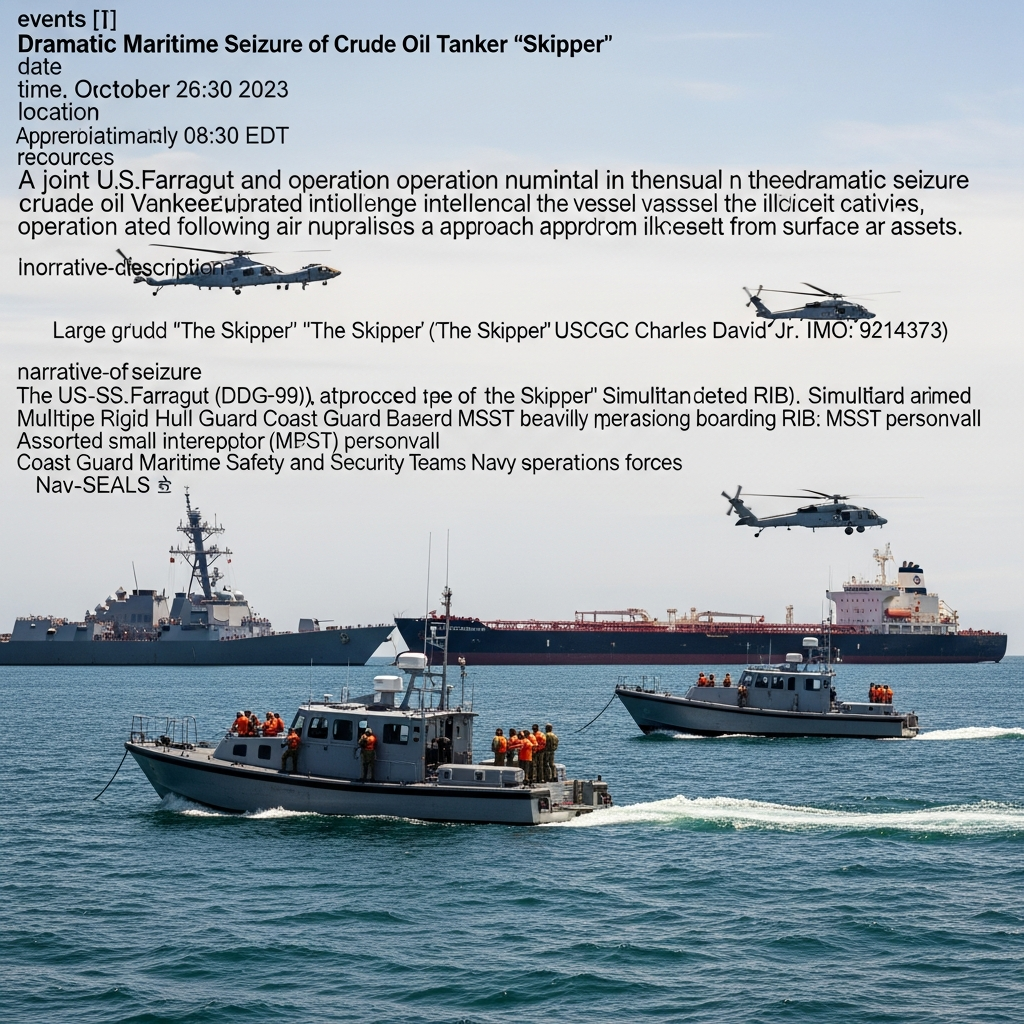
In a dramatic maritime operation, U.S. forces recently seized the crude oil tanker “The Skipper” off the Venezuelan coast, unveiling a sophisticated scheme of location data manipulation aimed at circumventing international sanctions. This high-stakes interdiction highlights the escalating global battle against illicit shipping, where advanced tracking technologies are exposing the “dark fleet” and its complex tactics. The vessel, carrying an estimated 1.85 million barrels of Venezuelan crude, is now reportedly en route to Houston, Texas, marking a significant escalation in geopolitical tensions.
The Seizure Unveiled: A Bold Interdiction at Sea
The seizure of “The Skipper” was no ordinary arrest. Conducted by a joint operation involving the FBI, Homeland Security Investigations, and the U.S. Coast Guard, the dramatic event saw Coast Guard personnel rappelling from helicopters onto the vessel. This bold move, widely publicized by U.S. officials, underscores a firm commitment to enforcing sanctions and disrupting illicit trade. The tanker, initially sanctioned by the U.S. in 2022 under its former name “Adisa,” was intercepted north of Trinidad and Tobago, beyond Venezuelan waters, according to Venezuelan authorities. Its cargo, largely Venezuelan heavy sour Merey crude, including oil reportedly belonging to a Cuban state-run importer, will undergo legal forfeiture procedures in the U.S.
Unmasking Maritime Deception: AIS Spoofing and Dark Activity
At the heart of “The Skipper’s” illicit operations lay a calculated strategy of deception: Automatic Identification System (AIS) spoofing and “dark activity.” AIS transponders, mandated by international treaties, broadcast a ship’s position, speed, and identity. However, “The Skipper” deliberately manipulated this critical data.
The Illusion of Location
For instance, between November and December, digital signals from the vessel’s transponder, tracked by analytics company Kpler, placed “The Skipper” near Guyana’s offshore. Yet, a meticulous analysis of over a dozen satellite images, verified by ABC News, contradicted this. These images confirmed the tanker was, in fact, operating approximately 550 miles away, off the coast of Barcelona, Venezuela, during the identical period (October 30 to December 4). This substantial discrepancy exposed a clear attempt to conceal its true whereabouts.
Operating in the Shadows: “Dark Activity”
Beyond spoofing, “The Skipper” frequently engaged in “dark activity,” a term for ships intentionally switching off their transponders to avoid detection. Matt Smith, an analyst at Kpler, confirmed that in mid-November, the vessel “covertly” loaded 1.1 million barrels of crude at Venezuela’s José Oil Terminal without its transponder active. Satellite imagery from two providers, including Planet Labs and TankerTrackers.com, later corroborated its presence at the terminal on November 14 and 18. This dual approach of faking signals and going dark demonstrates a sophisticated effort to evade maritime surveillance.
The Skipper’s Shadowy Past and Network of Evasion
“The Skipper’s” history is deeply entwined with a global “dark fleet” designed to bypass sanctions. Sanctioned by the U.S. in 2022 as “Adisa,” the vessel, along with its registered owner Triton Navigation Corporation, faced penalties for alleged ties to Hezbollah and Iran’s Islamic Revolutionary Guard Corps-Qods Force. Public records from MarineTraffic identify Triton Navigation Corporation (Marshall Islands) as the registered owner and Thomarose Global Ventures (Nigeria) as the beneficial owner. The U.S. Treasury previously alleged Triton was used by a sanctioned Russian oil magnate to facilitate an “oil smuggling network,” often employing obscurely registered ships.
A Global Trail of Illicit Cargo
This tanker has left a long trail of suspect movements across continents. Extensive satellite imagery analysis by TankerTrackers.com in 2025 documented “The Skipper’s” activities off the coasts of Iran and China from March to September. Estimates suggest it transported 1.87 million barrels of oil from Iran to China in February and another 1.95 million barrels in July of that year. Later, it was spotted off Madagascar in October before crossing the Atlantic, approaching Venezuela by October 29, and then spending over a month off the coast of Barcelona, engaged in illicit loading.
False Flags and Ship-to-Ship Transfers
Adding to its deceptive practices, “The Skipper” was found to be falsely flying Guyana’s flag, a common tactic among shadow vessels to skirt safety regulations and international oversight. The Guyanese government quickly disavowed the 20-year-old tanker, confirming it was not registered in their country. The vessel also utilized ship-to-ship (STS) transfers, an “extremely uncommon” practice in these contexts, according to former Belgian naval lieutenant Frederik Van Lokeren, often used to obscure the origin and destination of sanctioned oil by transferring it to less scrutinized vessels. Kpler analysts noted instances where “The Skipper” loaded crude from Iran and Venezuela while spoofing its position, sometimes even conducting STS transfers off Malaysia before final delivery to China under “falsely declared” circumstances.
Geopolitical Fallout and the War on Sanctions Evasion
The seizure of “The Skipper” has ignited a furious response from Venezuela. President Nicolás Maduro condemned the action as a “criminal and illegal act,” a “military assault, kidnapping and robbery, like Caribbean pirates.” He accused Washington of theft, claiming the operation was “to steal Venezuela’s oil.” Maduro announced intentions to pursue legal and diplomatic action, instructing Venezuelan institutions to protect all vessels transporting the country’s crude.
US Intent and Broader Implications
Conversely, U.S. officials framed the seizure as part of “Operation Southern Spear,” aimed at stopping illegal drug trafficking and enforcing the administration’s robust sanctions policy against entities like Iran’s IRGC. While President Trump confirmed the seizure, White House press secretary Karoline Leavitt clarified it was not a prelude to a broader conflict, emphasizing a desire for peace and an end to illicit activities. Experts widely agree the seizure serves as a significant “propaganda win” for the U.S., intensifying pressure on Maduro’s government and further crippling Venezuela’s oil industry by forcing “shadow tanker” owners to demand higher freight rates as an “insurance premium” against future U.S. operations. The operation also highlights the ongoing U.S. pressure campaign against Venezuela, part of what many see as an ultimate goal to overthrow the Maduro regime.
Cutting-Edge Tracking: The Eyes in the Sky
The successful interdiction of “The Skipper” is a testament to the power of modern maritime intelligence. Organizations like Kpler, TankerTrackers.com, and Planet Labs leverage sophisticated satellite imagery, digital broadcast signals, and data analytics to pierce through the veil of deception created by shadow fleets. BBC Verify, for instance, collaborated with these firms, confirming the vessel’s identity in U.S. government footage of the raid. This advanced capability allows authorities to reconstruct vessel movements, verify false declarations, and ultimately pinpoint illicit activities, making it increasingly difficult for sanctioned entities to operate undetected in the global shipping lanes. As the tactics of evasion become more complex, so too do the methods of detection, creating a dynamic and critical frontier in international law enforcement.
Frequently Asked Questions
What is AIS spoofing and how does it facilitate sanctions evasion in maritime trade?
AIS (Automatic Identification System) spoofing is a deceptive practice where a vessel deliberately transmits false location data, speed, or identity through its transponder. This manipulation makes it appear as if the ship is in one location when it is actually hundreds of miles away, often in a sanctioned zone or performing illicit transfers. For “The Skipper,” signals placed it near Guyana, while satellite images confirmed it was loading oil off Venezuela’s sanctioned coast, allowing it to circumvent restrictions imposed by U.S. sanctions and continue trading illicit crude oil undetected by conventional tracking.
Which organizations are crucial for tracking illicit maritime activities like those of the Skipper?
Several specialized organizations are critical in exposing illicit maritime activities. Analytics companies like Kpler and MarineTraffic process vast amounts of digital broadcast signals and vessel data. Satellite imagery providers such as Planet Labs and organizations like TankerTrackers.com specialize in analyzing high-resolution satellite photos to verify vessel positions, identify suspicious activities like “dark activity” (transponders off), and track the global movements of the “dark fleet.” News organizations like ABC News and BBC Verify also play a crucial role by synthesizing this data for public awareness and verification.
What are the broader geopolitical and economic implications of the US seizing sanctioned oil tankers?
The seizure of sanctioned oil tankers like “The Skipper” has significant geopolitical and economic implications. Geopolitically, it dramatically escalates tensions with countries like Venezuela and Iran, who condemn such actions as acts of piracy and theft of national resources. Economically, it aims to cripple sanctioned regimes by disrupting their oil exports, increasing the cost of doing business for the “dark fleet,” and making it riskier to transport illicit cargo. This forces shadow tanker owners to demand higher freight rates, acting as an “insurance premium” against potential U.S. interdictions, and ultimately limiting the reach and profitability of sanctioned oil trade.
This interdiction of “The Skipper” serves as a stark reminder of the sophisticated methods employed by those seeking to bypass international sanctions and the equally advanced counter-measures used to enforce them. As maritime surveillance technology continues to evolve, the cat-and-mouse game between illicit shippers and global enforcement agencies will undoubtedly intensify, with each seizure sending powerful ripples through the geopolitical landscape and the clandestine world of dark fleet operations.