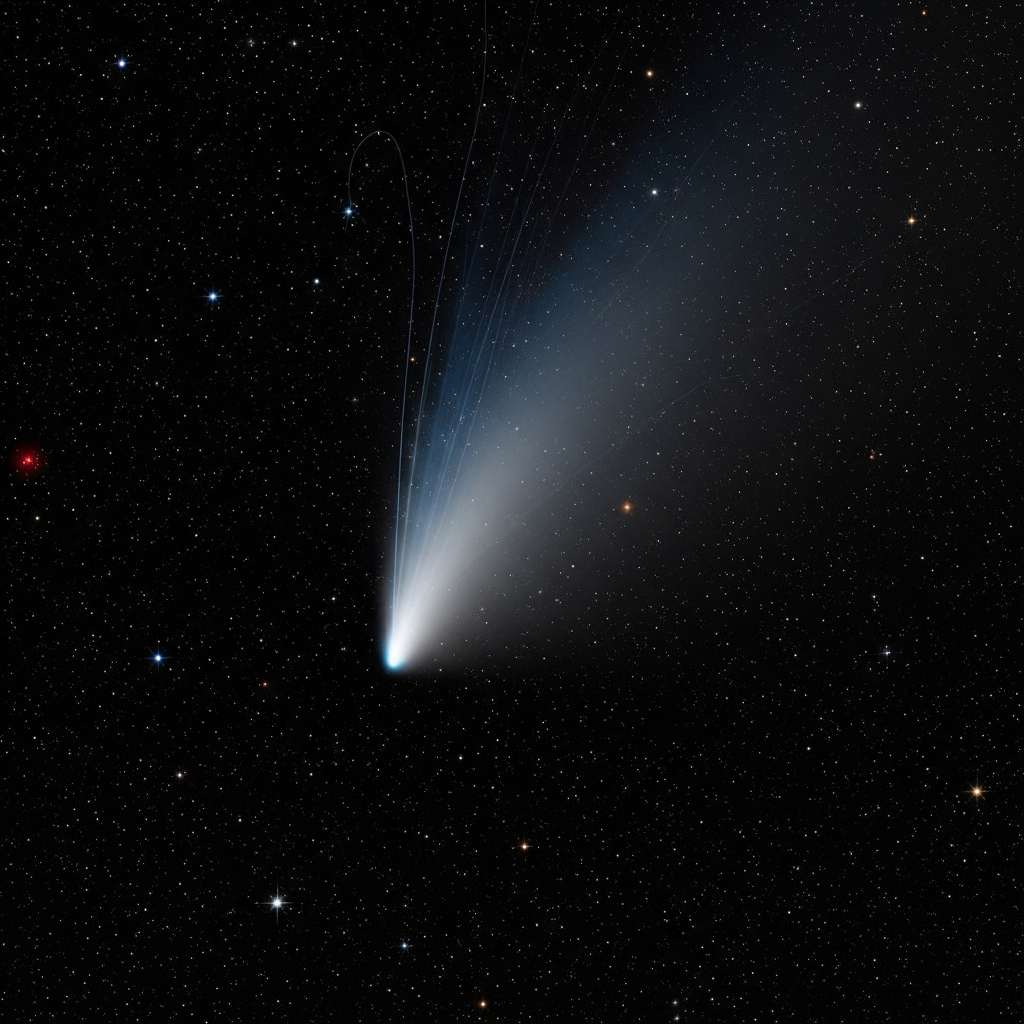
Exciting new astronomical observations are captivating skygazers and scientists alike. Recent stunning images of Comet 3I/ATLAS, captured by the iconic Hubble Space Telescope, offer unparalleled views of this intriguing celestial visitor. These detailed photographs promise to unlock secrets about the comet’s composition and trajectory. They also highlight the incredible capabilities of orbital observatories like Hubble in pushing the boundaries of our cosmic understanding. Dive in to discover why these images are a monumental step forward in deep-space exploration.
Unveiling Comet 3I/ATLAS: A Mysterious Interstellar Traveler
Comet 3I/ATLAS is not just another icy wanderer in our solar system. Classified as an interstellar comet, it originated from beyond our sun’s gravitational influence. Such objects are exceedingly rare. Their study offers a unique window into the diverse environments of other star systems. Scientists are eager to analyze its characteristics, hoping to find clues about its birthplace. Every new image helps piece together this cosmic puzzle.
This particular comet first gained attention for its unusual behavior. It exhibited a rapid brightening followed by an unexpected fragmentation. This made it a prime target for high-resolution telescopes. Understanding what causes such events can reveal much about cometary structures and evolution. Observing 3I/ATLAS in detail provides valuable data for comparative planetology.
Why Interstellar Comets Matter to Science
Interstellar comets are true messengers from other stars. They travel vast cosmic distances. Unlike comets native to our solar system, they offer a glimpse into materials formed in entirely different stellar nurseries. Studying their chemical makeup can tell us if the building blocks of planets are universal. It also helps us understand the conditions in other star-forming regions.
These celestial vagabonds provide crucial data points. They challenge our assumptions about planetary system formation. Each new discovery like Comet 3I/ATLAS refines our models of the galaxy. It expands our knowledge of the universe beyond our immediate neighborhood. The journey of these comets is a testament to the dynamic nature of space.
The Hubble Space Telescope: Our Eye on the Cosmos
For decades, the Hubble Space Telescope has been humanity’s most powerful optical eye in orbit. It has revolutionized astronomy since its launch. By orbiting Earth, Hubble bypasses atmospheric distortions. This allows it to capture images with extraordinary brightness, clarity, and detail. Ground-based telescopes simply cannot match this precision.
The U.S. Congress authorized Hubble in 1977. NASA meticulously supervised its construction. It was named after Edwin Hubble, a pioneering American astronomer. The space shuttle Discovery successfully deployed it on April 25, 1990. This moment marked a new era in space observation.
A Legacy of Breakthroughs and Resilience
Hubble is a large reflecting telescope. It features a 2.4-meter (94-inch) primary mirror. A smaller secondary mirror gathers light. This light is then directed to its suite of recording instruments. These include two cameras and two spectrographs. They can detect visible, ultraviolet, and infrared light, providing a full spectrum of data.
Initially, Hubble faced a significant challenge. A manufacturing flaw caused fuzzy images. The primary mirror was ground to the wrong shape. However, a heroic servicing mission by the space shuttle Endeavour in December 1993 rectified this. Astronauts installed corrective optics. This repair allowed Hubble to operate at its full potential. It began delivering breathtaking cosmic photographs.
Subsequent missions further enhanced its capabilities. New instruments, including an updated wide-field camera, were added. Hubble’s resilience and adaptability ensured its continued scientific output. It has endured far beyond its initial expected lifespan.
Hubble’s Role in Capturing 3I/ATLAS
The unique capabilities of the Hubble Space Telescope make it ideal for observing faint and fast-moving objects like Comet 3I/ATLAS. Its ability to detect objects 50 times fainter than ground-based telescopes is crucial. This ensures that even distant, dim comets can be studied in detail. The high-resolution images reveal intricate structures within the comet’s coma and tail.
Hubble’s position above Earth’s atmosphere is a game-changer. It captures ultraviolet light. This light is typically absorbed before reaching ground observatories. Ultraviolet data is vital for analyzing the chemical composition of cometary gases. It helps scientists understand the volatile materials present in Comet 3I/ATLAS. These observations provide a complete picture of its characteristics.
Deciphering the New Images
Astronomers are now meticulously studying these fresh images of Comet 3I/ATLAS. They hope to track its trajectory with greater precision. Changes in its tail and coma structures could indicate ongoing activity. This might include outgassing or further fragmentation. The data also helps refine models of how interstellar objects interact with our solar environment.
These observations contribute directly to our understanding of the universe. They enhance the vast legacy of Hubble’s discoveries. From measuring the universe’s expansion rate to capturing the “Hubble Deep Field,” Hubble continues to push scientific frontiers. Now, it adds interstellar comets like 3I/ATLAS to its illustrious list of contributions.
The Future of Cosmic Exploration
While Hubble remains operational, its eventual successor, the James Webb Space Telescope (JWST), has already begun its own groundbreaking work. JWST boasts a mirror seven times larger than Hubble’s. It specializes in infrared astronomy. This allows it to peer even further back in time and through dust clouds.
Together, these telescopes provide complementary views of the cosmos. Hubble excels in visible and ultraviolet light, offering detailed, close-up observations. JWST focuses on the infrared, revealing the earliest galaxies and exoplanet atmospheres. This dual approach ensures a comprehensive understanding of celestial phenomena, including new cometary visitors. The combined data from both observatories will undoubtedly accelerate our pace of discovery.
Frequently Asked Questions
What makes Comet 3I/ATLAS unique compared to other comets?
Comet 3I/ATLAS is unique because it is an interstellar comet. This means it originated from outside our solar system, unlike most comets which are native to our sun’s gravitational field. Its interstellar origin allows scientists to study material that formed around a different star. This offers rare insights into the chemical diversity and formation processes of other planetary systems. Its unusual behavior, including rapid brightening and fragmentation, further sets it apart.
How does the Hubble Space Telescope help observe distant and faint comets?
The Hubble Space Telescope is exceptionally well-suited for observing distant and faint comets due to its orbital position and advanced instrumentation. By being in orbit approximately 600 km above Earth, Hubble avoids the blurring effects and absorption of Earth’s atmosphere. This allows it to capture images with superior clarity and detail. Its sensitive instruments can detect objects 50 times fainter than those observable from the ground, and it can collect crucial ultraviolet light data that reveals cometary composition.
Why are images of interstellar comets like 3I/ATLAS important for astronomy?
Images of interstellar comets like 3I/ATLAS are vital for advancing astronomy because they provide direct samples from other star systems. Studying these comets helps us understand if the chemical building blocks of planets are common across the galaxy. They offer unique data on material compositions and conditions in other stellar nurseries. Observing their behavior and characteristics allows astronomers to refine models of planetary system formation and the dynamic processes that govern our universe.
Embracing the Wonders of Deep Space
The new images of Comet 3I/ATLAS from the Hubble Space Telescope are more than just pretty pictures. They are scientific treasures. Each pixel holds potential new information. They remind us of the vastness and mystery that still exist beyond our planet. As we continue to gaze into the cosmos, every discovery builds upon the last.
Our understanding of the universe is constantly evolving. Tools like Hubble are at the forefront of this journey. They help us connect with distant worlds and unravel cosmic secrets. Stay curious, as the universe always has more to reveal.