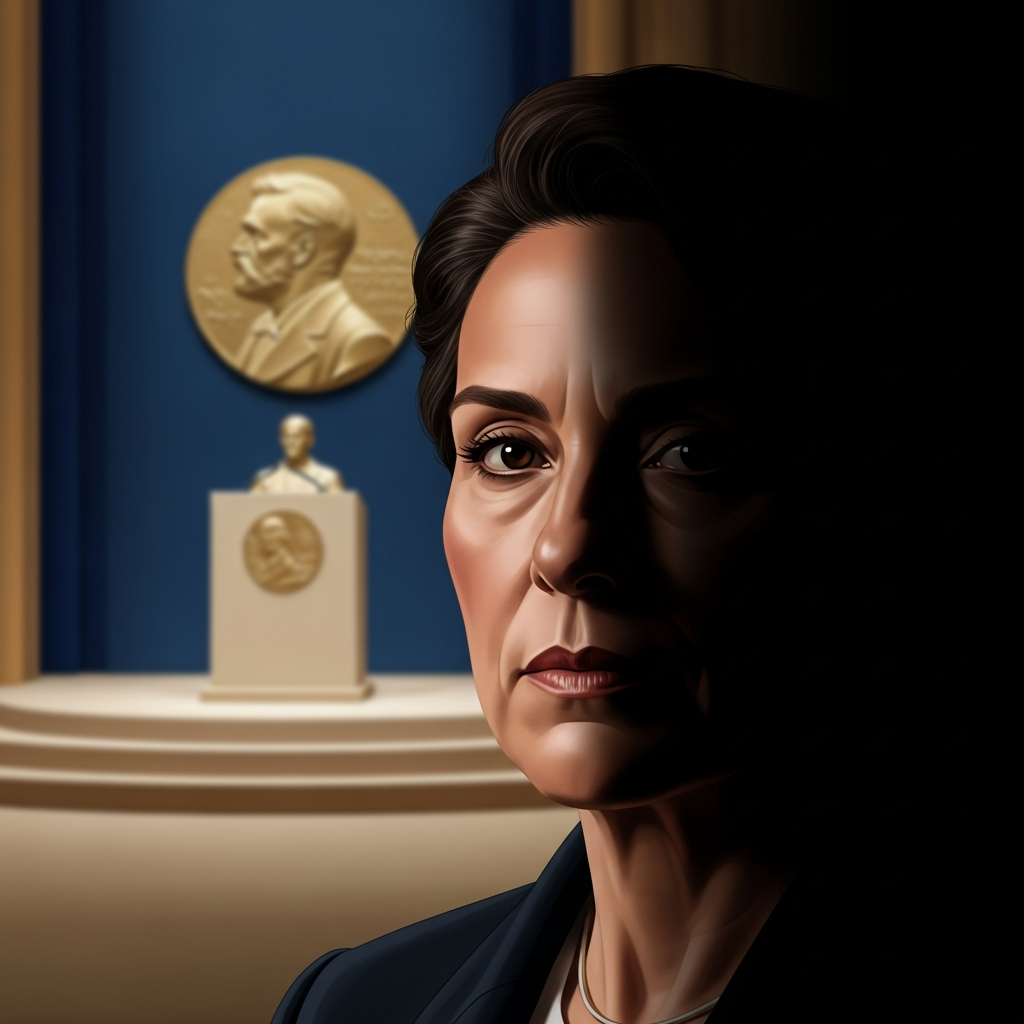
The world’s gaze was fixed on Oslo, Norway, awaiting a momentous occasion: the return of Venezuelan opposition leader María Corina Machado to the international stage to accept her Nobel Peace Prize. Instead, a shroud of mystery descended, as reports confirmed her dramatic disappearance just hours before her scheduled press conference. This unforeseen turn of events has cast a shadow of uncertainty over one of the year’s most anticipated Nobel ceremonies, leaving the Norwegian Nobel Institute and the global community “in the dark” about her whereabouts. Her absence underscores the immense personal risk and political turmoil that define her decades-long struggle for democracy in Venezuela.
The Nobel Laureate’s Dramatic Absence from Oslo
María Corina Machado’s highly anticipated public reappearance was scheduled to occur in Oslo. This event was meant to precede the prestigious Nobel Peace Prize award ceremony. However, her sudden disappearance jeopardized her attendance and led to the abrupt cancellation of her scheduled press conference. The Norwegian Nobel Institute, responsible for organizing the event, confirmed it had no information regarding her current location. A spokesperson frankly stated they were “in the dark” about when or how she might arrive in Norway. This created immediate international concern.
The cancellation of her press conference, a traditional precursor to the Nobel ceremony, signaled a significant setback. It prevented her re-emergence onto the global scene after nearly a year out of public sight. Despite the uncertainty, Machado’s family, including her 84-year-old mother and her children, successfully reached the Norwegian capital. Her mother, who had not seen Machado in a year, expressed profound emotional prayers for her daughter’s safe arrival. Her children also voiced hope for a reunion, though admitting they did not know when or if it would occur. This family’s presence highlights the deep personal stakes involved in Machado’s perilous journey.
Machado’s Unwavering Fight for Venezuelan Democracy
María Corina Machado was awarded the 2025 Nobel Peace Prize for her “tireless work promoting democratic rights for the people of Venezuela.” The Norwegian Nobel Committee specifically recognized her “struggle to achieve a just and peaceful transition from dictatorship to democracy.” This acknowledgement comes after decades of confronting Venezuela’s “brutal, authoritarian state” under President Nicolás Maduro. Her last known public appearance was on January 9, during a protest in Caracas. That demonstration was held against Maduro’s third-term inauguration, a contentious political event.
Machado’s dedication to democratic principles has made her a potent symbol of resistance within Venezuela. Her commitment often places her in direct opposition to the ruling regime. The Nobel Committee’s decision to honor her underscored the international community’s recognition of the severe challenges faced by those advocating for human rights and democracy in Venezuela. Her unwavering resolve, despite significant personal risks, embodies the spirit of the Nobel Peace Prize.
A Prize Beyond Political Claims: Machado’s Merit
The announcement of Machado’s Nobel win came amidst considerable anticipation. It also followed persistent claims for the prize by former US President Donald Trump. Trump had frequently and publicly asserted his entitlement to the coveted award. He often cited his contributions to stopping wars and achieving peace deals. Specifically, he claimed to have “solved eight wars in a period of nine months” and “stopped eight wars,” mentioning a “hasty peace deal to end the war in Gaza.” Due to his self-promotion and reported nominations from several countries, Trump was considered by some to be a frontrunner for the prize.
However, experts cited in the official reports suggested the Nobel Committee operates on specific criteria. These include the durability of peace and the promotion of international fraternity. They also consider the quiet work of institutions that strengthen these goals. This perspective implicitly contrasts with Trump’s claims, which often centered on direct, high-profile peace deals. The committee’s selection of Machado reaffirms its focus on grassroots activism and sustained efforts against oppression. This year, the Nobel Committee reviewed 338 nominations, comprising 244 individuals and 94 organizations. The five-member Norwegian Nobel Committee, chaired by human rights advocate Jørgen Watne Frydnes, carefully considered each candidate.
Journey to Oslo: Risks, Rumors, and Geopolitical Stakes
Machado herself had previously acknowledged the significant security challenges involved in her journey to Oslo. Traveling internationally as a prominent opposition figure, particularly from a country like Venezuela, carries inherent dangers. Unconfirmed reports hinted that she might already be in Europe. These rumors suggested potential aid from US officials, who reportedly assisted her exit from Venezuela via Puerto Rico. Such a clandestine departure would highlight the extreme measures required for her safety and freedom of movement.
Her dedication of the prize to the Venezuelan people and to US President Donald Trump also added a geopolitical layer. Trump’s administration had consistently supported her efforts. It had even recently ordered a significant naval deployment near Venezuela. This gesture underscored the international backing Machado receives, but also the contentious political landscape in which she operates. The uncertainty surrounding her travel plans and current location only intensified the focus on the complex political dynamics between Venezuela, the United States, and the wider international community.
The Global Significance of Her Voice
María Corina Machado’s voice, whether present in Oslo or silenced by her absence, carries immense global significance. Her struggle epitomizes the ongoing fight for human rights and democracy in authoritarian states worldwide. Her presence at the Nobel ceremony would have amplified the plight of the Venezuelan people. It would also have galvanized international support for democratic transitions. Her disappearance, however, paradoxically brings even more attention to her cause. It highlights the desperate circumstances faced by those who dare to challenge powerful regimes.
The Nobel Peace Prize is unique among the annual Nobel awards. It is the only one presented in Oslo, Norway, while others are awarded in Stockholm, Sweden. This distinction further elevates the event’s profile. Last year’s award recognized Nihon Hidankyo, a grassroots movement of Japanese atomic bombing survivors. They were honored for their decades-long efforts to maintain a taboo around the use of nuclear weapons. This history of honoring courageous figures and movements underscores the profound impact Machado’s story has on the global stage.
Frequently Asked Questions
Why was María Corina Machado chosen for the Nobel Peace Prize?
María Corina Machado was awarded the 2025 Nobel Peace Prize by the Norwegian Nobel Committee for her “tireless work promoting democratic rights for the people of Venezuela and for her struggle to achieve a just and peaceful transition from dictatorship to democracy.” The committee recognized her decades-long confrontation with Venezuela’s “brutal, authoritarian state” and her commitment to fostering democratic change in the face of significant personal and political risk. Her selection highlighted the international community’s acknowledgement of the ongoing crisis and the importance of advocating for human rights in the country.
What role did the Norwegian Nobel Institute play regarding Machado’s disappearance?
The Norwegian Nobel Institute organized the events surrounding the Nobel Peace Prize ceremony in Oslo, including María Corina Machado’s scheduled press conference. Following her disappearance, the Institute confirmed they had “no information” about her whereabouts or travel plans. They publicly stated they were “in the dark” about when or how she might arrive in Norway. The Institute’s role primarily involves hosting and facilitating the award ceremony, but in this unprecedented situation, they served as the point of contact reporting on the laureate’s unexpected absence.
What are the wider implications of Machado’s absence at the Nobel ceremony for Venezuela?
María Corina Machado’s absence casts a significant shadow over both the Nobel ceremony and the Venezuelan political landscape. It dramatically highlights the severe security challenges and political oppression faced by opposition figures in Venezuela, reinforcing the narrative of a “brutal, authoritarian state.” While her absence prevents a direct international address, it ironically draws more global attention to her plight and the ongoing struggle for democracy in Venezuela. It may intensify international pressure on the Maduro regime and rally further support for the Venezuelan opposition, even as it signals the deep personal risks involved in leadership.
Conclusion: An Unfolding Narrative
The story of María Corina Machado’s Nobel Peace Prize acceptance has become an unfolding narrative of courage, political struggle, and profound uncertainty. Her dedication to democratic ideals in Venezuela has been recognized on the highest international stage. However, the dramatic circumstances surrounding her anticipated appearance in Oslo underscore the immense personal cost of such activism. As the world watches, her absence serves as a powerful testament to the challenges faced by those who champion freedom against authoritarian rule. Whether she ultimately appears or remains unseen, her fight for Venezuela will resonate globally, urging continued attention to the country’s democratic future.