A significant and provocative Russia-China joint air patrol near Japan on December 9, 2025, has sent ripples of concern across the Indo-Pacific. This coordinated military maneuver by Moscow and Beijing, involving nuclear-capable bombers and advanced fighter jets, represents a potent “show of force” amid escalating regional tensions. Japan, alongside its key ally the United States, swiftly condemned the drills, viewing them as a serious challenge to national security and regional stability. This incident, occurring in international airspace but strategically close to Japanese territory, highlights the intensifying geopolitical dynamics and the critical role of alliances in deterring unilateral actions.
A Coordinated Display of Power: The Russia-China Joint Air Patrol
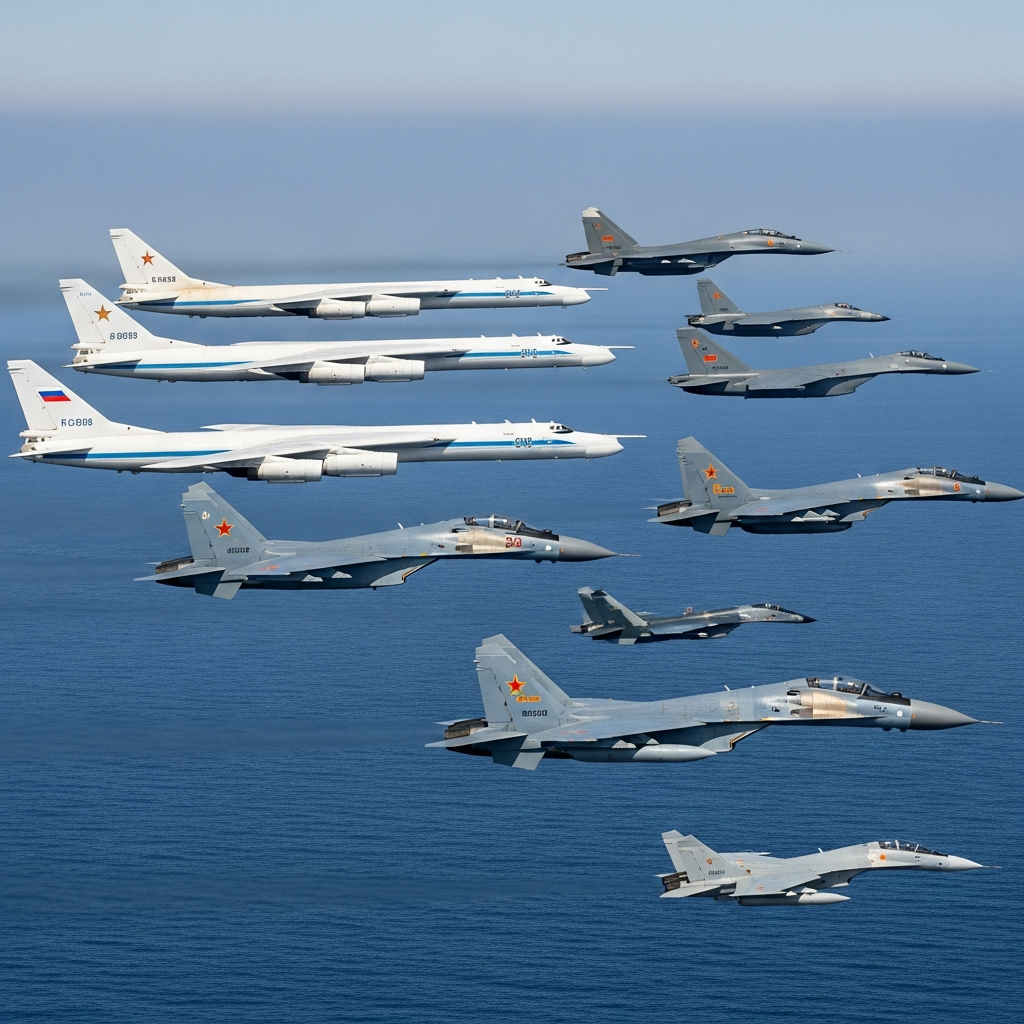
On December 9, 2025, a powerful Russia-China joint air patrol executed a sophisticated, long-distance flight operation around Japan. This marked the 10th joint strategic air patrol between the two nations, demonstrating a deepening military cooperation. The aerial formation comprised two Russian Tu-95 nuclear-capable strategic bombers and two Chinese H-6 bombers. They rendezvoused after the Russian aircraft flew from the Sea of Japan towards the East China Sea. This combined force then conducted a strategic “long-distance joint flight” across the Western Pacific.
Aircraft and Flight Paths Revealed
Adding to the complexity, four Chinese J-16 fighter jets provided escort for the bomber formation. This group performed a round-trip flight between Japan’s Okinawa and Miyako islands, specifically traversing the Miyako Strait—a crucial international waterway. Simultaneously, Japan’s Ministry of Defense reported detecting further Russian air force activity in the Sea of Japan. This separate operation involved one A-50 early-warning aircraft and two Su-30 fighters, underscoring the scale and coordination of Moscow’s and Beijing’s synchronized movements. The entire joint flight operation spanned approximately eight hours, signaling a significant logistical and operational capability.
Japan’s Swift Response and Deepening Concerns
Japan reacted immediately and decisively to the aerial incursions. The Japanese Air Self-Defense Force scrambled its fighter jets to monitor the Russian and Chinese aircraft closely. Japanese Defence Minister Shinjiro Koizumi voiced Japan’s profound concerns, stating on social media that the joint operations were “clearly intended as a show of force against our nation.” He emphasized that this event constituted a “serious concern for our national security.”
Monitoring the Skies: Japan’s Air Defense
Japanese fighter jets “strictly implemented air defense identification measures” to track the foreign aircraft. This swift response underscored Japan’s commitment to safeguarding its airspace and territorial integrity. Adding to the friction, Japan had also reported that Chinese carrier-launched fighter jets had aimed radar at Japanese military aircraft a day prior—an accusation Beijing vehemently denied. This radar incident further amplified the atmosphere of distrust and heightened military alert in the region.
Regional Ripples: South Korea’s Air Defense Zone Breach
The geopolitical ripples of the Russia-China joint air patrol extended beyond Japan. South Korea’s military also confirmed heightened activity, reporting that seven Russian planes and two Chinese planes had entered its Air Defense Identification Zone (ADIZ) on the same day. In response, Seoul scrambled its fighter jets and subsequently lodged diplomatic protests with both Beijing and Moscow. This repeated pattern of ADIZ breaches by Russian and Chinese aircraft underscores a broader challenge to regional air security protocols and national sovereignty claims.
The Unwavering US-Japan Alliance: A Unified Deterrent
In a powerful display of allied strength and deterrence, the United States and Japan conducted their own joint military exercise shortly after the Sino-Russian drills. On December 10, 2025, two U.S. nuclear-capable B-52 bombers flew over the Sea of Japan. They were escorted by three Japanese F-35 stealth fighters and three F-15 air-superiority jets. Tokyo explicitly stated the mission’s purpose: to reaffirm the allies’ commitment to regional stability.
Allied Airpower in Action
Japan’s defense ministry highlighted that this joint operation aimed to “reaffirm their strong resolve to prevent any unilateral attempt to change the status quo by force.” A U.S. official also weighed in on the preceding radar incident, describing it as “not conducive to regional peace and stability,” while reiterating the “unwavering” nature of America’s alliance with Japan. This coordinated response served as a clear message that the US-Japan alliance stands united against military assertiveness in the Indo-Pacific.
Taiwan’s Shadow: The Core of Escalating Tensions
The recent Russia-China joint air patrol is inextricably linked to the escalating tensions surrounding Taiwan. Japanese Prime Minister Sanae Takaichi had previously commented on November 14, 2025, that Tokyo would consider its response options if a Chinese military action against Taiwan threatened Japan’s security. Beijing strongly condemned these remarks, reaffirming its claim over Taiwan as its territory and not renouncing the use of force to incorporate the island.
Taiwan’s Vulnerability and Strategic Importance
Taiwan’s strategic location is undeniable; it lies just over 100 kilometers from Japan’s southern islands and along vital sea routes crucial to Tokyo’s economy. Concurrently, Taiwan’s defense ministry reported a surge in Chinese military operations around the island. This included detecting 27 aircraft, notably H-6K nuclear-capable bombers, engaged in “joint combat readiness patrols,” alongside multiple Chinese warships. Such intensified activity around Taiwan signals a heightened state of readiness and continued pressure from Beijing.
A Pattern of Collaboration: Sino-Russian Military Alignment
The recent air patrol is not an isolated incident but part of a discernible pattern of increasing military cooperation between China and Russia. Over recent years, the two nations have consistently ramped up their joint military exercises. These have included anti-missile training on Russian territory and live-fire naval exercises in the South China Sea. This consistent military alignment underscores a shared strategic outlook and a desire to challenge the existing security architecture, particularly in the Indo-Pacific region.
Geopolitical Ramifications for Indo-Pacific Stability
These recurring and increasingly provocative joint military exercises carry significant geopolitical ramifications for the stability of the Indo-Pacific. Such “shows of force” by China and Russia are perceived as attempts to assert dominance and test the resolve of regional alliances. They challenge the established international order and create an environment of heightened risk and unpredictability. The robust US military footprint in Japan and South Korea, including an aircraft carrier strike group and a Marine expeditionary force, remains central to maintaining a balance of power amidst this growing instability.
Challenges to the Regional Order
The long-term implications of these military collaborations are profound. They signal a potential shift in global power dynamics and pose direct challenges to the security interests of democratic nations in the region. Understanding these coordinated military actions is crucial for policymakers and global observers, as they reflect a deliberate strategy to reshape the geopolitical landscape. The response from Japan and its allies highlights the collective determination to uphold peace, security, and the rule of law in a critical global theater.
Frequently Asked Questions
What specific military aircraft were involved in the recent Russia-China joint air patrol near Japan?
The coordinated air patrol on December 9, 2025, involved a formidable array of aircraft. The core formation included two Russian Tu-95 nuclear-capable strategic bombers and two Chinese H-6 bombers. These bombers were notably escorted by four Chinese J-16 fighter jets. In a separate, simultaneous operation in the Sea of Japan, Russian forces also deployed one A-50 early-warning aircraft and two Su-30 fighters. This diverse deployment showcased a significant strategic and tactical capability between the two nations.
How did Japan and the United States respond to the Russia-China joint air patrol and escalating regional tensions?
Japan responded by scrambling its Air Self-Defense Force jets to monitor the foreign aircraft and strongly condemned the drills as a “show of force” and a “serious concern for national security.” The United States, in solidarity with Japan, conducted a joint military exercise involving two U.S. B-52 nuclear-capable bombers and three Japanese F-35 and three F-15 fighter jets over the Sea of Japan. This allied response aimed to reaffirm their strong resolve to deter any unilateral attempts to change the status quo by force and underscored the unwavering commitment of the US-Japan alliance.
Why are these joint Russia-China military operations a significant concern for regional security in the Indo-Pacific?
These joint military operations are a major concern due to several factors. Firstly, they are viewed as direct “shows of force” intended to intimidate and challenge the territorial integrity and national security of Japan and South Korea. Secondly, they occur within a broader context of escalating tensions around Taiwan, following Japanese Prime Minister Takaichi’s comments on potential responses to a Chinese attack on the island. Thirdly, the consistent pattern of Sino-Russian military cooperation signifies a challenge to the existing international order and risks destabilizing the vital Indo-Pacific region, impacting crucial sea lanes and global trade.