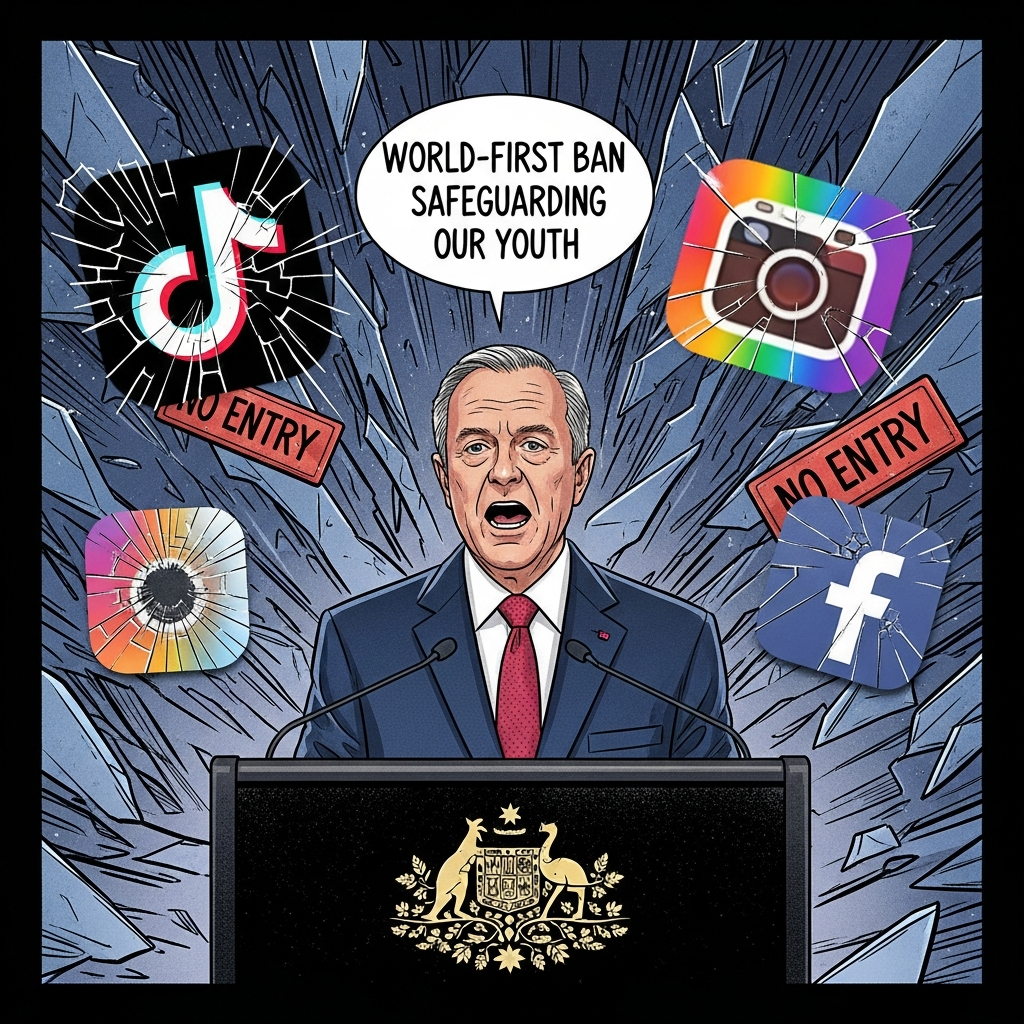
Australia has sparked a global debate with its landmark legislation, implementing a world-first ban on social media for children under the age of 16. This decisive policy, championed by Prime Minister Anthony Albanese, aims to shield young Australians from the pervasive harms of online content and exploitative algorithms. As the law takes effect, it mandates major platforms like Facebook, Instagram, TikTok, and YouTube to take “reasonable steps” to prevent under-16s from opening accounts, with severe financial penalties for non-compliance. While hailed as a “great reform” internationally, the ban faces immediate challenges, particularly from the very teenagers it seeks to protect.
Australia’s Landmark Social Media Ban Explained
The new federal law, enacted in November 2024 and commencing in December, sets a minimum age of 16 for accessing most social media platforms. This is a significant increase from the previous de facto age of 13. The policy is unique globally due to its higher age limit and the absence of any parental approval exemption, making it the strictest of its kind. Platforms like YouTube Kids and Google Classroom are exempt, as are messaging apps such as WhatsApp, focusing the ban on “endless scroll” and algorithm-driven content feeds.
The Australian government’s justification for the ban is rooted in protecting children’s mental health and wellbeing. Prime Minister Albanese emphasized giving Australian teens “three more years of being shaped by real-life experience, not algorithms.” Research indicates a strong link between excessive social media use and harms like misinformation, cyberbullying, and negative body image. The eSafety Commissioner, Julie Inman Grant, believes the law will push tech companies to “move fast and improve things” by deactivating under-16 accounts and prioritizing child safety.
Teenagers React: Frustration, Innovation, and Concerns
The immediate impact of the Australia social media ban teens has been met with a mix of frustration and ingenuity from young people. Many teenagers quickly found their existing accounts inaccessible or attempted to create new ones. For instance, Spencer and Aahil, both 13, readily admitted to using fake ages to bypass verification on platforms like Snapchat and Discord, essential for staying connected with friends from different schools. Isobel, also 13, claimed it took less than five minutes to outsmart Snapchat’s checks using a photo of her mother. Lulu, 15, also created a new account after her old ones were locked.
The sentiment among many teens is that the ban is ineffective and perhaps misguided. Charlotte, 15, articulated that social media is “cemented into the future,” suggesting the ban won’t solve device addiction. Breanna, a 15-year-old in rural Queensland, describes platforms like Snapchat as a “lifeline” for maintaining long-distance friendships, where friends live over 100km away. Jacinta Hickey, 14, expressed feeling “insulted,” believing she is mature enough to discern right from wrong online.
Overlooked Vulnerabilities
Critics highlight that the ban may disproportionately affect vulnerable groups. Zoe, 15, pointed out that the government might have overlooked those in remote areas, those experiencing bullying, or those in unsafe homes, for whom social media offers an escape or a safe space. A survey by Minus18, an LGBTQ+ youth support group, revealed that 96% of nearly 1,000 respondents relied on social media for friends and support. Sadie Angus, 13, used Instagram as a “safe space” within the queer community. Sharon Fraser of Reframing Autism also voiced concerns for autistic young people who often find online environments beneficial for communication and socialization.
While skepticism is widespread, some teenagers acknowledge potential benefits. Indiana, 14, felt that not seeing upsetting content would be better for mental health. Frankie, 14, a non-user, highlighted how much free time she gains for hobbies. Patrick, 14, agreed social media is “overused” and banning it could lead to more exercise and family time, supporting the push for better digital wellbeing.
Enforceability and Tech Company Strategies
The enforceability of the under 16 social media ban hinges on robust age verification. Australia expects social media companies to utilize AI and behavioural data to estimate user ages, rather than blanket verification processes. Luc Delaney from k-ID, a third-party age verification firm, admits verification is a “constant battle” requiring continuous software improvements.
Australia’s eSafety Commissioner anticipated “teething problems” and “blatant non-compliance” from tech companies, but asserted that regulators would remain undeterred. Ahead of the ban, some tech giants began adapting. Instagram’s parent company, Meta, announced significant global restrictions for teenage users (13-18), limiting content to a US PG-13 rating, altering AI interactions, restricting following of age-inappropriate accounts, and expanding blocked search terms. Notably, Instagram clarified that LGBTQ+ terms would not be blocked.
Other platforms have engaged with the eSafety Commissioner regarding their status under the ban:
YouTube argued its primary platform is a video-sharing service and should be exempt, though YouTube Kids is.
TikTok didn’t disagree with inclusion but suggested a “stripped down” version might fall outside the definition.
Snapchat maintains it’s primarily a messaging service.
Roblox, a gaming platform, is awaiting a final determination.
Communications Minister Anika Wells expressed confidence that companies “understand their obligations” under Australian law, signaling a firm stance from the government on compliance.
The Deep Divide: Winners and Losers in the Digital Age
The Australia social media ban teens has intensified a passionate debate over teen online safety, drawing clear lines between its proponents and critics.
Arguments For the Ban
Supporters primarily focus on child protection and mental health. Iris Nastasi, a Sydney principal, advocates for preserving “the innocence that comes through childhood,” citing the damaging “fallout” of late-night online activity. Lola Farrugia, 12, who happily uses a flip phone, supports the ban, influenced by her mother’s analogy that social media is “junk food for the brain.”
The architect of the legislation, South Australian Premier Peter Malinauskas, was greatly influenced by Jonathan Haidt’s book “The Anxious Generation,” which details the detrimental effects of smartphones on childhood development. Malinauskas states that “when you are talking about protecting young people, all other considerations become secondary.” A powerful advocate is Emma Mason, whose 15-year-old daughter died by suicide after severe online bullying. Mason describes social media as “agents of harm,” stressing the government’s duty to protect vulnerable children.
Arguments Against the Ban
Opponents raise significant concerns about social connection, parental autonomy, and potential unintended consequences. Megan Easton, a mother from rural Queensland, views the ban as “government overstepping,” arguing it removes parents’ power to educate their children about online safety. Critics worry that restricting access might push children towards less regulated corners of the internet, where they could be exposed to even greater risks.
Furthermore, mental health advocates and human rights groups express concerns about disconnecting young people from vital support networks. For LGBTQ+, neurodivergent, or rural communities, online spaces often serve as crucial hubs for finding friends, support, and role models not available offline. The ban also faces legal challenges, with two teenagers backed by a human rights group arguing in Australia’s High Court that the law infringes on the right to free communication. These groups advocate for enhanced education and moderation rather than an outright prohibition.
Global Implications: Australia’s Pioneering Role
Australia’s bold move has resonated globally, garnering significant international attention and praise. Prime Minister Albanese promoted the initiative at the United Nations General Assembly, highlighting the evolving challenges social media poses for children. European Commission President Ursula von der Leyen publicly stated her inspiration from Australia, noting, “We in Europe are watching and will be learning from you.” Countries like Denmark, Malaysia, Singapore, Greece, Brazil, and even the US state of Florida are closely monitoring Australia’s approach as a test case for similar measures to enhance digital wellbeing.
This strategy contrasts with approaches like the UK’s Online Safety Act, which focuses on platform accountability for harmful content (like pornography or self-harm) rather than an outright ban. While acknowledging that Australia’s age verification method “isn’t foolproof,” Albanese affirmed it as “a crucial step in the right direction.” Australia envisions a long-term impact, believing the world will eventually follow its lead, much like with previous reforms in areas such as plain tobacco packaging or gun control.
Frequently Asked Questions
What is Australia’s new social media ban for under-16s?
Australia has implemented a federal law prohibiting individuals under 16 from accessing most social media platforms. Enacted in November 2024 and in effect from December, this “world-first” ban mandates that tech companies take “reasonable steps” to prevent under-16s from opening accounts. The government’s primary goal is to protect young people from online harm, exploitative algorithms, and negative mental health impacts, giving them more “real-life experience” during crucial developmental years. Unlike other global efforts, Australia’s ban does not include an exemption for parental consent.
How are social media companies implementing the age verification for the Australian ban?
The Australian government expects social media companies to utilize a combination of artificial intelligence (AI) and behavioural data to estimate user ages for compliance. While Prime Minister Albanese acknowledges this method “isn’t foolproof,” it’s considered a crucial starting point. Companies like Meta (Instagram’s parent) have made global adjustments, including content moderation to a PG-13 rating for teens, enhanced parental controls, and expanded blocked search terms. Other platforms like YouTube, TikTok, and Snapchat are in discussions with the eSafety Commissioner about their specific implementation strategies and potential exemptions based on their service type.
What are the main arguments for and against Australia’s social media ban on teens?
Arguments for the ban center on child wellbeing, protecting developing brains from online harm, cyberbullying, and negative mental health impacts. Proponents, including Premier Peter Malinauskas and advocates like Emma Mason (who lost her daughter to online bullying), believe it’s the government’s duty to shield vulnerable youth. They argue social media is “junk food for the brain” and damages relationships. Opponents, including many teens and some mental health advocates, contend the ban infringes on communication rights, disproportionately affects vulnerable groups (e.g., LGBTQ+, rural youth who rely on online connections), and may push children to less regulated online spaces. They also question parental autonomy and the ban’s overall effectiveness, advocating instead for better digital literacy education and content moderation.
A Complex Path Forward
Australia’s social media ban teens under 16 represents a bold, globally significant step in the ongoing battle for teen online safety. While the government remains committed to its long-term vision of shaping a safer digital future for its youth, the immediate rollout is fraught with challenges. From tech companies grappling with complex age verification to teenagers finding ingenious ways to circumvent restrictions, and ongoing debates about fundamental rights and unintended consequences, the path forward is anything but simple. The world watches keenly as Australia navigates this complex landscape, offering crucial insights into how societies can balance digital innovation with the paramount need to protect their youngest citizens.