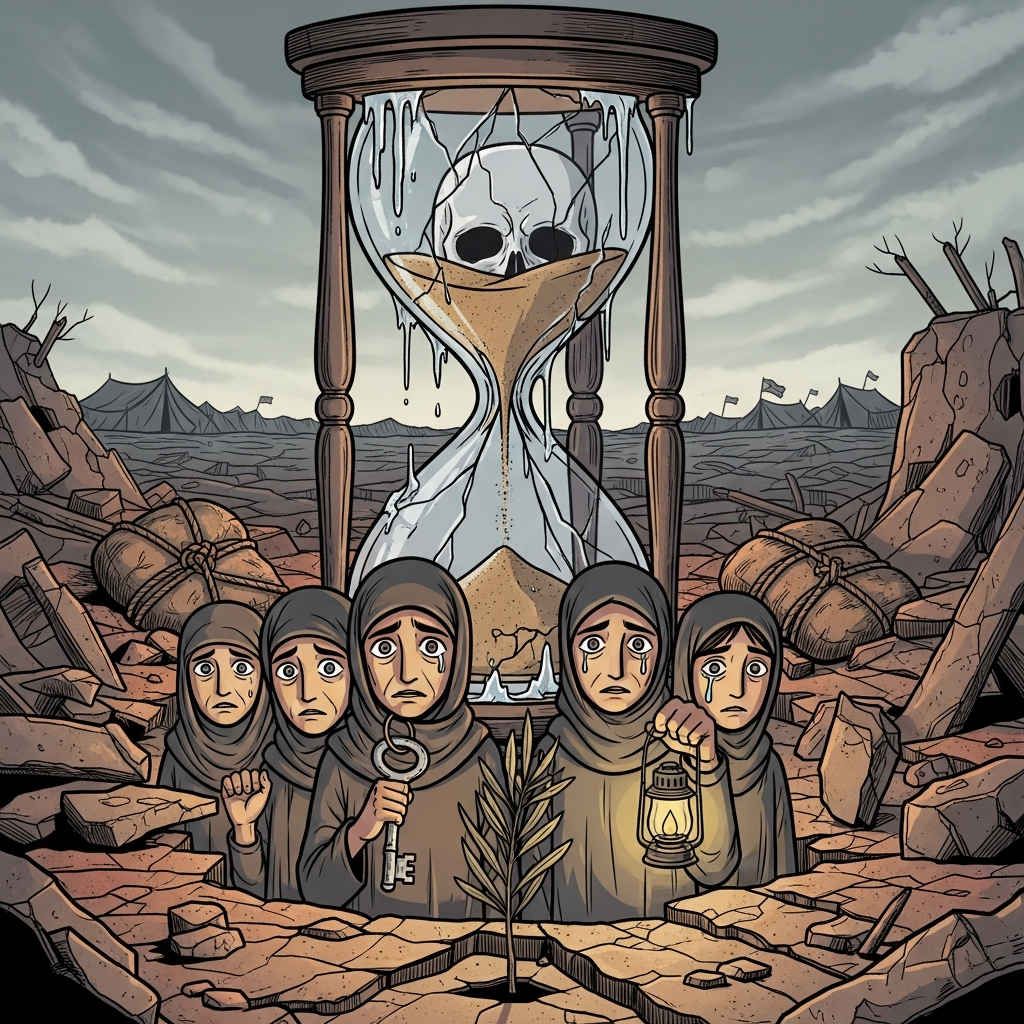
For the people of Gaza, the term “ceasefire” offers little comfort. Instead, life has devolved into a harrowing state of uncertainty, a perpetual limbo where the promise of peace is consistently overshadowed by the reality of ongoing conflict. Despite international efforts to de-escalate hostilities, residents find themselves caught in a cycle of fear, displacement, and profound loss, struggling daily for survival amidst relentless challenges. This article delves into the grim realities faced by Palestinians in Gaza, exploring the human cost of this prolonged stalemate and the complex political dynamics that sustain it.
The Illusion of Ceasefire: A Daily Struggle for Survival
The official “ceasefire” introduced in October was intended to suspend hostilities, offering a glimmer of hope to a populace ravaged by war. However, for many Palestinians in Gaza, this agreement has proven to be a deceptive illusion. Accounts from the ground reveal a stark disparity between diplomatic rhetoric and lived experience, with continuous Israeli attacks reported despite the supposed halt in conflict. Palestinian sources cite hundreds of ceasefire violations, resulting in significant civilian casualties, including women and children.
Faiq Ajour’s Harrowing Account
Faiq Ajour, a 29-year-old resident of Gaza City, vividly illustrates this brutal reality. His story begins near his home, targeted by an Israeli strike, leaving behind a burned-out car and shattered debris. Faiq recounts a miraculous escape, having just crossed the street to a vegetable stall when the strike hit. His immediate fear was for his home and family, a terror that resonated deeply with his three young daughters, who trembled at the thought of the “genocidal war” returning. “This is a nightmare, not a ceasefire,” Faiq asserts, describing how moments of calm can instantly erupt into scenes of “body parts, smoke, shattered glass, killed people, ambulances.” These are images, he notes, that haunt their memories and prevent healing.
Beyond Statistics: Personal Catastrophe
Faiq’s personal losses underscore the immense suffering endured by Palestinians in Gaza. In February 2024 alone, an Israeli strike claimed the lives of 30 members of his extended family, including his parents and his brother’s children. His wife sustained severe injuries, necessitating the amputation of a finger. This profound tragedy forced Faiq to constantly move his family across Gaza, desperately seeking a safety that remains elusive. He describes their current existence as adapting to a “so-called ceasefire” where waves of bombardment and targeted strikes can turn life upside down without warning. Faiq, who once worked with his father in the clothing trade, has lost everything. His home now lies within Israel’s “yellow line,” an area under total Israeli control with severely restricted Palestinian access, devoid of infrastructure, work, or safety. “Life in Gaza is 99 percent dead,” he states, a poignant reflection of widespread despair.
Political Quagmire: Why Gaza Remains in Limbo
The continuation of this precarious state is not merely accidental but is argued by some analysts to be a deliberate strategy. Political analyst Ahed Farwana suggests that Israel actively seeks to perpetuate the current limbo, delaying any move toward the critical “second phase” of a ceasefire, which would address sensitive issues like the reconstruction and administration of Gaza. This strategy, he believes, aims to maintain chaos and avoid political obligations.
Israeli Strategy: Perpetuating Chaos
Farwana draws parallels to the situation in southern Lebanon, where periodic escalations and assassinations have become a recurring pattern even after agreements. He highlights incidents such as the killing of a Hezbollah military commander in Beirut and an attack on a Palestinian refugee camp in southern Lebanon in November, indicating a broader regional strategy. These actions, Farwana argues, are designed to expand Israeli control over the Gaza Strip, providing leverage in any future arrangements for the enclave. By entrenching a state of continuous low-level conflict, Israel reportedly avoids committing to a definitive end to the war, prolonging the uncertainty for Palestinians in Gaza.
Netanyahu’s Domestic Calculations
The reluctance to fully commit to an end to the conflict is also deeply intertwined with Israeli domestic politics. Prime Minister Benjamin Netanyahu faces significant pressure from his far-right allies. Moving forward with the ceasefire deal and its subsequent phases could jeopardize his political career, potentially accelerating corruption trials and investigations into his role concerning the October 7 attack. With Israeli politics increasingly polarized around support for or opposition to Netanyahu, avoiding a definitive resolution in Gaza offers a way to navigate these domestic pressures. However, Farwana notes that international pressures, particularly from the US administration and its support for a specific peace plan, may limit the scale of Israeli attacks from returning to pre-ceasefire intensity, yet the overall state of limbo persists.
A Humanitarian Crisis Ignored: The Toll on Families
Beyond the geopolitical maneuvers, the humanitarian crisis in Gaza continues to worsen, impacting every aspect of daily life for its residents. The perpetual “limbo” means that genuine calm remains an unattainable dream, leaving families in a constant state of vulnerability and distress.
Raghda Obeid’s Endless Displacement
Raghda Obeid, a 32-year-old mother of four, embodies the profound human cost. Her home in the Shujayea neighborhood of Gaza City is utterly destroyed, leading to countless cycles of displacement. Now, living in a tent in western Gaza City, the fear of war’s return is her greatest torment. A recent strike near her makeshift home brought back the raw terror of the conflict’s initial days. “We could see the smoke from afar, people were running and screaming in the streets, carrying the killed and their torn bodies,” Raghda recounts, her own adult fear mirroring that of her terrified children. “I said, ‘That’s it, the war is back, and it’s our turn now.'”
The Desperate Search for Sustenance
Like the majority of Palestinians in Gaza, Raghda and her family are entirely reliant on aid organizations. Work opportunities are virtually non-existent, making the daily quest for food and water a mission of sheer survival. Her children often search for community kitchens just to secure a meal. The prospect of facing winter in a tent adds another layer of hardship. “Our life is nonexistent. We live off the community kitchen and water,” Raghda explains. “Our life is a war without an actual war.” This desperate plea for a solution, a return to normalcy, echoes across the beleaguered enclave, underscoring the urgent need for genuine peace and reconstruction.
The Path Forward: Debated Solutions and Persistent Challenges
The question of Gaza’s future remains a subject of intense debate, both within the region and internationally. Proposed solutions, such as the US-backed plan for a transitional technocratic government and an international “board of peace,” aim to signal stability and progress. However, significant hurdles persist. The rejection of any future role for Hamas by the US and Israel, coupled with the immense devastation wrought upon Gaza, means that a comprehensive rebuild will undoubtedly take years. The core challenge lies in overcoming political intransigence and bridging the gap between proposed frameworks and the deeply entrenched realities on the ground. Without a genuine commitment from all parties to end the current state of “limbo,” the suffering of Palestinians in Gaza is set to continue.
Frequently Asked Questions
What does “Gaza’s limbo” mean for its residents?
“Gaza’s limbo” describes a state of perpetual uncertainty and precarity for its Palestinian residents. Despite official ceasefires, they experience ongoing Israeli attacks, displacement, and severe humanitarian crises. Basic services, infrastructure, and economic opportunities are largely absent, leaving families like Faiq Ajour’s and Raghda Obeid’s constantly in fear, struggling for daily survival, and unable to rebuild their lives or plan for a stable future. This situation leaves them without any real calm or security.
Why has the ceasefire in Gaza failed to bring lasting peace?
The ceasefire has failed to bring lasting peace due to various complex factors. Palestinians report hundreds of violations by Israel since the October agreement, leading to continued casualties. Political analyst Ahed Farwana suggests Israel intentionally prolongs this state of uncertainty to avoid moving to reconstruction and administration phases. Additionally, Israeli Prime Minister Benjamin Netanyahu faces domestic political pressures that disincentivize a definitive end to the conflict, as it could accelerate corruption trials and investigations into his past actions.
What are the primary obstacles to Gaza’s reconstruction and recovery?
Gaza’s reconstruction and recovery face numerous obstacles. Firstly, the ongoing state of “limbo” with intermittent attacks prevents any systematic rebuilding efforts. Secondly, political disagreements, such as the US and Israel’s rejection of Hamas’s future role, complicate governance and international aid coordination. Thirdly, areas like Faiq Ajour’s home, within Israel’s “yellow line,” have heavily restricted access, preventing vital reconstruction. The sheer scale of devastation also means any rebuild would take years, requiring massive, sustained international commitment and political will that has not yet materialized.
The situation in Gaza remains a profound humanitarian and political tragedy. The stories of Faiq Ajour and Raghda Obeid are not isolated incidents but represent the collective despair of a population trapped in an unending cycle of violence and uncertainty. Until genuine political solutions address the root causes of the conflict and prioritize the well-being of its people, the “living nightmare” of Gaza’s limbo will tragically persist.