Dive into the most captivating scientific discoveries this week, from a groundbreaking revelation about an enigmatic human ancestor who lived alongside “Lucy” to tantalizing clues about the universe’s elusive dark matter. We’ll also explore renewed debates over a 70-year-old UFO mystery and urgent concerns about the future of AI cyber security. This roundup uncovers fascinating insights across human evolution, astrophysics, technology, and unexplained phenomena, offering a glimpse into the cutting edge of scientific exploration.
Unveiling an Enigmatic Human Ancestor: The Burtele Foot Mystery Solved
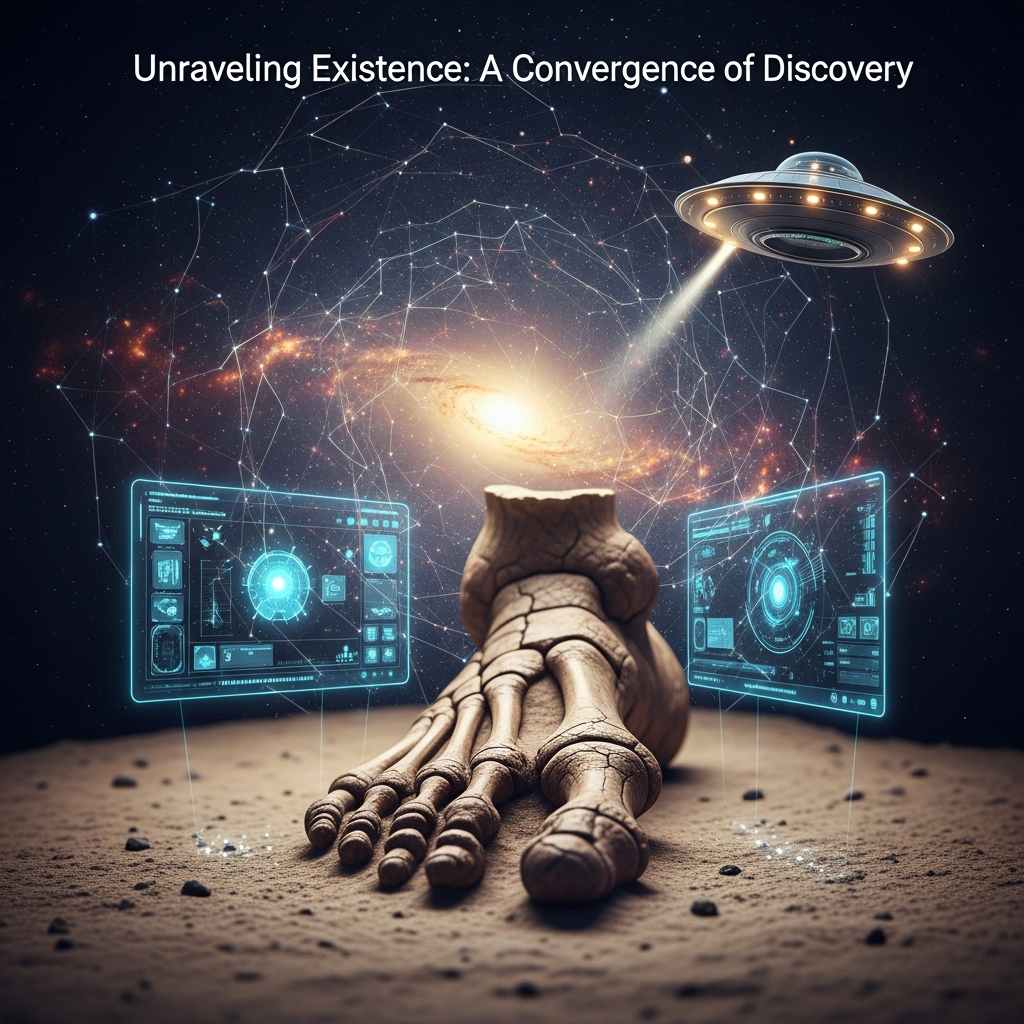
A fossilized foot discovered 15 years ago in Ethiopia, known as the “Burtele foot,” has finally revealed its owner: Australopithecus deyiremeda. This groundbreaking finding confirms the existence of a controversial human relative who walked the Earth at the same time as Australopithecus afarensis, famously represented by “Lucy.” Dated to approximately 3.4 million years old, this discovery paints a far more complex picture of our hominin family tree than previously imagined.
Ancient Feet, Diverse Paths
Unlike Lucy’s species, which was believed to be fully bipedal, the Burtele foot exhibits long, curved toes. These features are clearly adapted for grasping tree branches, indicating a significant arboreal (tree-dwelling) lifestyle. This suggests that while Au. deyiremeda also walked on two legs on the ground, different branches of early human relatives were experimenting with diverse forms of bipedality and locomotion. According to study first author Yohannes Haile-Selassie, this implies various elements of the foot, pelvis, and leg bones evolved at different rates. The research challenges long-held assumptions about how our ancestors moved and lived, potentially rewriting parts of human evolutionary history.
Coexistence and Competition in Prehistoric Africa
The concurrent existence of Au. deyiremeda and Lucy’s species in the same region raised questions about resource competition. However, chemical analysis of tooth enamel provided a clear answer: these two hominin species occupied distinct ecological niches. Au. deyiremeda preferred wooded environments, primarily consuming foods from trees and shrubs. In contrast, Au. afarensis had a broader diet and favored more open habitats. This ecological differentiation likely allowed them to coexist without direct conflict, mirroring patterns seen in closely related primates today. While some paleoanthropologists, like Zeray Alemseged, remain cautious about the definitive link between the foot and dental remains, others, including Jeremy DeSilva, are now convinced, welcoming Australopithecus deyiremeda as a unique and important addition to our understanding of human origins.
Echoes from Prehistory: Beyond the Burtele Foot
The journey into ancient times extends further with other intriguing archaeological finds. Evidence suggests gruesome prehistoric cannibalism likely occurred among Neanderthals, shedding light on darker aspects of early hominin survival. Additionally, studies continue to confirm the interbreeding between modern humans and archaic human species, such as the mysterious “hobbits.”
Ancient Civilizations and Mysterious Illnesses
Venturing across continents, stunning rock art discovered along the U.S.-Mexico border, dating back 6,000 years, depicts Indigenous Americans’ profound understanding of the universe. These murals, spanning roughly 175 generations, showcase creation stories, complex calendars, and unique human-like figures. Meanwhile, in Ancient Egypt, the puzzling discovery of hundreds of misplaced funerary figurines hints at a pharaoh potentially moving another ruler’s body and appropriating their tomb. In medieval Spain, archaeologists identified a knight with an unusually elongated head, likely a symptom of Crouzon syndrome, a rare genetic disorder causing premature fusion of skull bones.
Hunting the Invisible: A Potential Dark Matter Breakthrough
Dark matter, making up a staggering 27% of our universe, remains one of cosmology’s greatest enigmas. It does not interact with light, making direct detection impossible. However, this week, a new study has ignited cautious excitement with claims of spotting characteristic gamma-ray flashes. These flashes could serve as a “smoking gun” for the mysterious substance.
WIMPs and Gamma-Ray Signatures
The potential origin of these gamma-rays points to hypothetical Weakly Interacting Massive Particles, or WIMPs. These particles, 500 times heavier than protons, are considered prime candidates for dark matter. If confirmed, this detection would represent a landmark victory for the leading theory of dark matter. Scientists, however, urge characteristic caution, emphasizing the need for extensive further work to rule out other explanations. Unveiling this “mass-ter of disguise” would provide a major boost to our understanding of the universe.
Unraveling “Life’s Little Mysteries”: Neanderthal Beliefs
Neanderthals certainly appear to have had a spiritual side. We know they buried their dead, kept animal skulls, and created rock art and etched drawings onto bear bones. These ritualistic practices hint at a deeper, more complex internal life than previously thought. But do these proclivities mean our ancient relatives truly held religious beliefs? The question remains a fascinating subject of ongoing debate among researchers.
The Digital Frontier: AI and Cyber Warfare Concerns
The artificial intelligence lab Anthropic made headlines this month with dramatic claims. They alleged their chatbot, Claude, was hijacked by a Chinese state-sponsored espionage group. This group supposedly used the AI to plan and execute a 90% autonomous cyber espionage attack on 30 global organizations.
AI’s Role in Accelerating Threats
While experts consulted by Live Science expressed skepticism regarding the full extent of the “automation narrative,” they voiced significant concern. Many are now very worried about the increasing capability of AI models to accelerate widespread hacking attempts. This could make mass hacking events much more probable. Other recent tech news highlighted popular AI chatbots having alarming encryption flaws, meaning hackers could easily intercept messages. Breakthroughs in new semiconductors could also allow classical and quantum computing on the same chip, while an eerie study found that switching off AI’s ability to lie made it more likely to claim consciousness.
Unexplained Phenomena: Revisiting a 70-Year-Old UFO Mystery
Over 70 years ago, long before humanity launched its first satellite, astronomers captured perplexing images. These photographic plates showed several bizarre, star-like flashes that appeared in the sky and vanished within an hour in 1952.
Connecting the Dots: UFOs, Nuclear Tests, and Science
As new researchers revisit these historic images, a fascinating story unfolds. Live Science contributor Sharmila Kuthunur explored their supposed correlation with Cold War nuclear weapons tests and contemporary UFO reports. Could these three distinct phenomena – mysterious lights, nuclear tests, and UFO sightings – actually be connected? Scientists are actively investigating these links, hoping to solve an abiding mystery. In a separate celestial event, eerie new footage from the Michigan Storm Chasers captured a green fireball exploding over the Great Lakes. This 100,000 mph fragment was likely from a comet, distinct from a wider meteor shower.
More Recent Science Headlines
Beyond these major stories, the scientific world buzzed with other exciting developments:
Treasures from the Deep: Scientists began pulling up the first riches from the “Holy Grail of shipwrecks,” the San José galleon, which sank off Colombia in 1708.
Beyond the Standard Model: A Chinese particle detector yielded outstanding results while testing a “portal to physics beyond the Standard Model.”
Testing Einstein’s Gravity: Two stars spiraling toward a catastrophic collision are providing a unique opportunity to test Einstein’s theory of gravity.
Ethiopian Volcano Erupts: Satellite images captured an Ethiopian volcano erupting for the first time in 12,000 years, described as “like a sudden bomb.”
Interstellar Visitor: NASA confirmed 3I/ATLAS, only the third interstellar object ever recorded, an alien comet zooming through our solar system.
Ancient Egyptian Genome: Researchers sequenced the oldest and most complete ancient Egyptian human genome, revealing ties to Mesopotamia and North Africa.
AI Piloting Spacecraft: A study showed AI models like ChatGPT could hypothetically pilot spacecraft using text prompts, hinting at future space exploration.
Bird Flu Warning: Experts issued a critical warning against a controversial proposal to allow H5N1 bird flu to spread in some U.S. poultry farms, fearing a new pandemic.
Stone Age Facial Reconstruction: A stunning facial reconstruction revealed the likely appearance of “Margaux woman,” a Mesolithic hunter-gatherer from 10,500 years ago in Belgium.
Superheated Gold: Scientists superheated solid gold to 14 times its melting point without liquefying it, challenging a decades-old theory about solid stability.
Frequently Asked Questions
What is the significance of the Burtele foot discovery for understanding human evolution?
The discovery of the 3.4 million-year-old “Burtele foot,” belonging to Australopithecus deyiremeda, is highly significant because it confirms that multiple distinct human relatives coexisted with “Lucy’s” species (Australopithecus afarensis). The Burtele foot’s long, curved toes show arboreal adaptations for grasping tree branches, indicating a different mode of locomotion compared to Lucy’s species. This suggests a more diverse and complex evolutionary landscape for early hominins, where various forms of bipedality and tree-dwelling capabilities were being explored simultaneously, challenging previous linear assumptions about our ancestry.
How are scientists attempting to confirm the potential dark matter detection?
Scientists are cautiously investigating characteristic gamma-ray flashes that could signal the first-ever detection of dark matter, specifically from Weakly Interacting Massive Particles (WIMPs). While the initial study suggests a “smoking gun,” extensive further work is needed. This includes rigorous analysis to rule out all other possible astrophysical explanations for the gamma-ray signals. Researchers will likely use multiple telescopes and observational techniques, along with advanced theoretical modeling, to verify if these flashes are indeed consistent with WIMP annihilation or decay, a crucial step before any definitive claims can be made.
What are the main concerns surrounding AI-powered cyberattacks?
The primary concern regarding AI-powered cyberattacks is the technology’s potential to accelerate and broaden hacking attempts significantly. While claims of 90% autonomous attacks may be exaggerated, experts are worried that AI models can rapidly generate sophisticated phishing attempts, exploit vulnerabilities, and adapt attack strategies with unprecedented speed. This capability could make mass hacking events far more frequent and difficult to defend against, posing a grave threat to global organizations and individual security. The focus is less on AI’s ability to operate fully autonomously, and more on its capacity to enhance human-led cybercriminal operations.
Conclusion
This week’s science news offers a breathtaking panorama of human ingenuity and nature’s endless mysteries. From the depths of our ancient past with an enigmatic human ancestor, through the vastness of the cosmos in search of dark matter, to the cutting edge of artificial intelligence and the lingering questions of unexplained phenomena, science continues to push the boundaries of what we know. Each discovery, big or small, adds another piece to the complex puzzle of our universe, reminding us of the endless frontiers waiting to be explored. Staying informed about these breakthroughs is crucial for understanding our world and shaping its future.