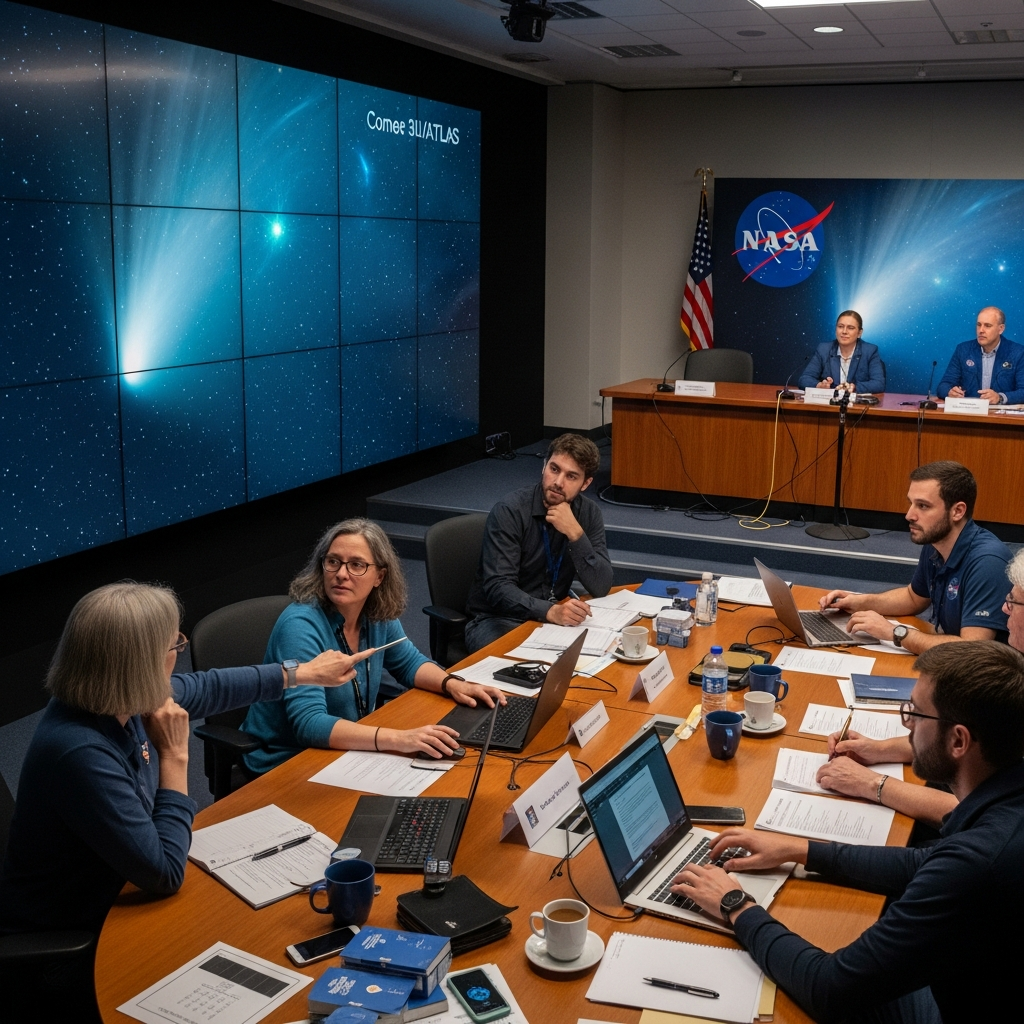
A rare visitor from beyond our solar system, Comet 3I/ATLAS, has captivated scientists and stargazers alike. NASA has now unveiled an extraordinary collection of images and data from over 15 space missions, offering unprecedented views of this interstellar object. These stunning observations debunk popular myths and provide a unique window into the composition of distant star systems. Dive into this cosmic gallery to explore the journey and discoveries surrounding Comet 3I/ATLAS, a truly ancient alien comet now passing through our own backyard.
Unveiling an Interstellar Wanderer: The Discovery of Comet 3I/ATLAS
Comet 3I/ATLAS first announced its arrival on July 1, 2025. It was initially spotted by the NASA-funded ATLAS (Asteroid Terrestrial-impact Last Alert System) survey telescope in Chile. What made this discovery particularly significant was the immediate confirmation of its origin: 3I/ATLAS is an interstellar comet. This means it did not form in our solar system. Instead, it journeyed from another star system entirely. Its designation, “3I,” marks it as only the third confirmed interstellar object ever observed passing through our cosmic neighborhood, following Oumuamua in 2017 and 2I/Borisov in 2019.
This celestial wanderer’s unique provenance sparked immense scientific curiosity. Astronomers eagerly anticipated the opportunity to study material from a distant stellar environment. Its presence offers invaluable clues about the formation and evolution of other planetary systems. Despite early public speculation, NASA officials have unequivocally stated that 3I/ATLAS is a natural comet. It exhibits all the expected behaviors and characteristics of comets, with no “technosignatures” suggesting it is anything other than a fascinating icy rock.
A Fleet of Eyes: Missions Tracking 3I/ATLAS
To capture every detail of this extraordinary visitor, NASA deployed an impressive armada of spacecraft and observatories. Over several months in 2025, these missions, often pushing their instruments beyond typical operational parameters, provided a comprehensive look at 3I/ATLAS. Their combined observations painted a detailed picture of the comet’s journey and composition as it traversed our inner solar system.
The observational campaign began soon after its discovery:
July 21, 2025: Hubble Space Telescope – From 277 million miles away, Hubble captured a clear image. It revealed a teardrop-shaped cocoon of dust emanating from the comet’s solid, icy nucleus.
August 6, 2025: James Webb Space Telescope (JWST) – The powerful JWST used its Near-Infrared Spectrograph (NIRSpec). It observed 3I/ATLAS, providing crucial data on its chemical makeup.
August 7-15, 2025: SPHEREx – NASA’s SPHEREx mission spent about a week observing the comet. It worked in conjunction with JWST to provide important infrared data.
September 8-9, 2025: Psyche Spacecraft – En route to its asteroid namesake, Psyche acquired four observations over eight hours. These helped refine the comet’s trajectory and study its coma.
September 11-25, 2025: STEREO-A – The Solar Terrestrial Relations Observatory (STEREO-A) provided colorized images. These observations revealed 3I/ATLAS as a bright, fuzzy orb. It was seen traveling at an incredible speed of 130,000 miles (209,000 kilometers) per hour.
September 16, 2025: Lucy Spacecraft – On its journey to the Trojan asteroids, Lucy spotted the comet from 240 million miles away. Its L’LORRI imager captured fuzzy images of the coma and tail. This provided a unique vantage point opposite Earth.
Martian Orbiters and Rovers Join the Hunt
As Comet 3I/ATLAS continued its path, spacecraft near Mars offered unparalleled close-up views. Its trajectory brought it significantly closer to the Red Planet than it would ever get to Earth.
September 20 – October 10, 2025: PUNCH Mission – The Polarimeter to Unify the Corona and Heliosphere (PUNCH) satellites provided combined images and a movie. They showed the comet’s tail as a short elongation. Observations occurred when 3I/ATLAS was between 231-235 million miles from Earth.
September 28, 2025: MAVEN – The Mars Atmosphere and Volatile Evolution (MAVEN) orbiter’s ultraviolet instrument imaged hydrogen atoms. These atoms were surrounding the comet, indicating evaporating water ice.
October 2, 2025: Mars Reconnaissance Orbiter (MRO) – MRO’s HiRISE camera captured significant images. The comet was approximately 19 million miles (30 million kilometers) from MRO. It appeared as a “fuzzy white ball,” revealing its diffuse coma of dust and ice.
October 4, 2025: Perseverance Rover – Even the Perseverance rover on Mars took a break from exploring Jezero Crater. It used its Mastcam-Z to snap faint pictures of the comet flying by.
October 9, 2025: MAVEN – MAVEN continued its observations, showing the distinct halo of gas and dust (coma) surrounding 3I/ATLAS. Its Imaging Ultraviolet Spectrograph also detected hydrogen atoms.
October 15-26, 2025: SOHO – The joint ESA/NASA Solar and Heliospheric Observatory (SOHO) mission also caught a glimpse. It observed the comet as it brightened on its approach to the Sun.
What Did We Learn? Unveiling Comet 3I/ATLAS’s Secrets
The extensive, multi-instrument observations allowed scientists to glean fascinating insights into this rare interstellar visitor. 3I/ATLAS provided a treasure trove of data about its physical characteristics and composition.
Scientists confirmed the presence of a distinct coma—a characteristic cloud of gas and dust. This forms as the comet heats up from solar radiation. Observations from PUNCH and Lucy clearly showed a short, faint tail. MAVEN’s ultraviolet images specifically detected hydrogen atoms. This is a tell-tale sign of water ice turning into vapor.
A particularly intriguing finding came from the combined JWST and SPHEREx infrared data. It revealed an abundance of carbon dioxide gas in the comet’s coma. More surprisingly, it showed the presence of both water ice and carbon dioxide in its nucleus. The comet was notably evaporating more carbon dioxide relative to water. This ratio is “very interesting,” according to Tom Statler, NASA’s lead scientist for solar system small bodies. Furthermore, a glowing nickel vapor was detected far from the Sun, where it should have been too cold for vaporization. The comet also emitted more nickel than iron, a truly “remarkable” discovery.
The comet displayed strikingly rapid brightening as it approached its closest point to the Sun. Initially traveling around 137,000 miles per hour, its speed accelerated to approximately 153,000 miles per hour due to the Sun’s gravity. While earlier observations hinted at a reddish hue, later analysis confirmed the comet to be “distinctly bluer than the Sun.” The perceived color change was due to the coma brightening, not an actual shift in the comet’s inherent color. Its precise size remains uncertain, obscured by dust, but estimates suggest it is thousands of feet to a couple of miles in diameter.
Journey Through Our Solar System and Beyond
Comet 3I/ATLAS undertook a remarkable journey through our solar system. NASA’s interactive 3D visualization tool, “Eyes on the Solar System,” generated detailed graphics. These depict its path from December 2023 to September 2028. Its trajectory was often challenging for Earth-based viewing, as our planet was frequently on the “wrong side.” This made the extensive network of spacecraft observations even more critical.
The comet reached its closest point to the Sun, its perihelion, at the end of October 2025. It passed within 19 million miles of Mars in October. This offered Martian orbiters and the Perseverance rover a unique observational advantage. While its path brought it relatively close to Mars, Comet 3I/ATLAS posed absolutely no threat to Earth. Its closest flyby of our planet occurred on December 19, 2025, at a safe distance of approximately 170 million miles.
Currently, 3I/ATLAS is journeying through the inner solar system, gradually departing our cosmic home. While temporarily obscured from ground-based telescopes due to its proximity to the Sun, it is expected to become visible again. This will be the comet’s only passage through our solar system. As it speeds away into the vastness of interstellar space, the James Webb Space Telescope will provide the final observations. These deep-space capabilities are essential for tracking it as it recedes.
The Profound Significance of an Interstellar Visitor
The study of Comet 3I/ATLAS goes far beyond simply marveling at pretty pictures. Its interstellar origin makes it a profoundly significant object for scientific research. It is a tangible piece of another star system. This offers scientists an unparalleled “window into the deep past,” as Dr. Tom Statler eloquently put it. It provides insights into environments that potentially predate our own solar system.
By analyzing its chemical composition, scientists can compare ancient dust and ice from a distant star system to our own. This helps us understand the fundamental building blocks of planets across the galaxy. The “tantalizing” differences observed in its composition, such as the nickel vapor and CO2-to-water ratio, highlight the diversity of planetary formation processes. Each observation helps refine our understanding of how solar systems form and evolve. It also helps to confirm or challenge existing astronomical models.
The ability to study an object from outside our solar system also pushes the boundaries of planetary defense strategies. Refining its trajectory with missions like Europe’s ExoMars Trace Gas Orbiter helps hone techniques for tracking potentially hazardous objects. Even though 3I/ATLAS poses no threat, the knowledge gained from tracking it improves our overall capability to monitor space. The intensive, multi-mission approach to studying 3I/ATLAS exemplifies international scientific collaboration. It underscores humanity’s collective drive to understand our place in the universe. More data is still being processed, and future observations promise even deeper revelations about this extraordinary cosmic messenger.
Frequently Asked Questions
What makes Comet 3I/ATLAS unique among celestial objects?
Comet 3I/ATLAS is unique because it is an interstellar object, meaning it originated from a star system beyond our own. Discovered on July 1, 2025, it is only the third such visitor confirmed to pass through our solar system. Its study offers scientists a rare opportunity to analyze material from a distant stellar environment, providing insights into the composition and evolution of other planetary systems that may even be older than our own.
Which NASA missions observed Comet 3I/ATLAS and what did they reveal?
Over 15 NASA and ESA/NASA missions observed Comet 3I/ATLAS. Key missions included the Hubble Space Telescope (showing its dusty cocoon), the James Webb Space Telescope (revealing carbon dioxide and water ice in its composition), MAVEN (detecting hydrogen atoms from evaporating water), MRO (capturing its coma near Mars), and Perseverance (snapping pictures from the Martian surface). These diverse observations helped scientists understand its speed, trajectory, coma, tail, and chemical makeup, including surprising nickel vapor emissions.
Is Comet 3I/ATLAS a threat to Earth, and when was its closest approach?
No, Comet 3I/ATLAS poses no threat to Earth. While it passed within 19 million miles of Mars in October 2025, its closest approach to Earth occurred on December 19, 2025, at a safe distance of approximately 170 million miles. The comet reached its closest point to the Sun (perihelion) at the end of October 2025 and is now traveling back out of our solar system into interstellar space.
This interstellar visitor, Comet 3I/ATLAS, has provided an unparalleled learning experience. Its journey through our solar system, meticulously documented by a global fleet of spacecraft, offers profound insights into the wider cosmos. As scientists continue to process the wealth of data, our understanding of other star systems deepens. This “ancient alien comet” will continue to inspire awe and fuel our curiosity about the universe’s vast and mysterious reaches.