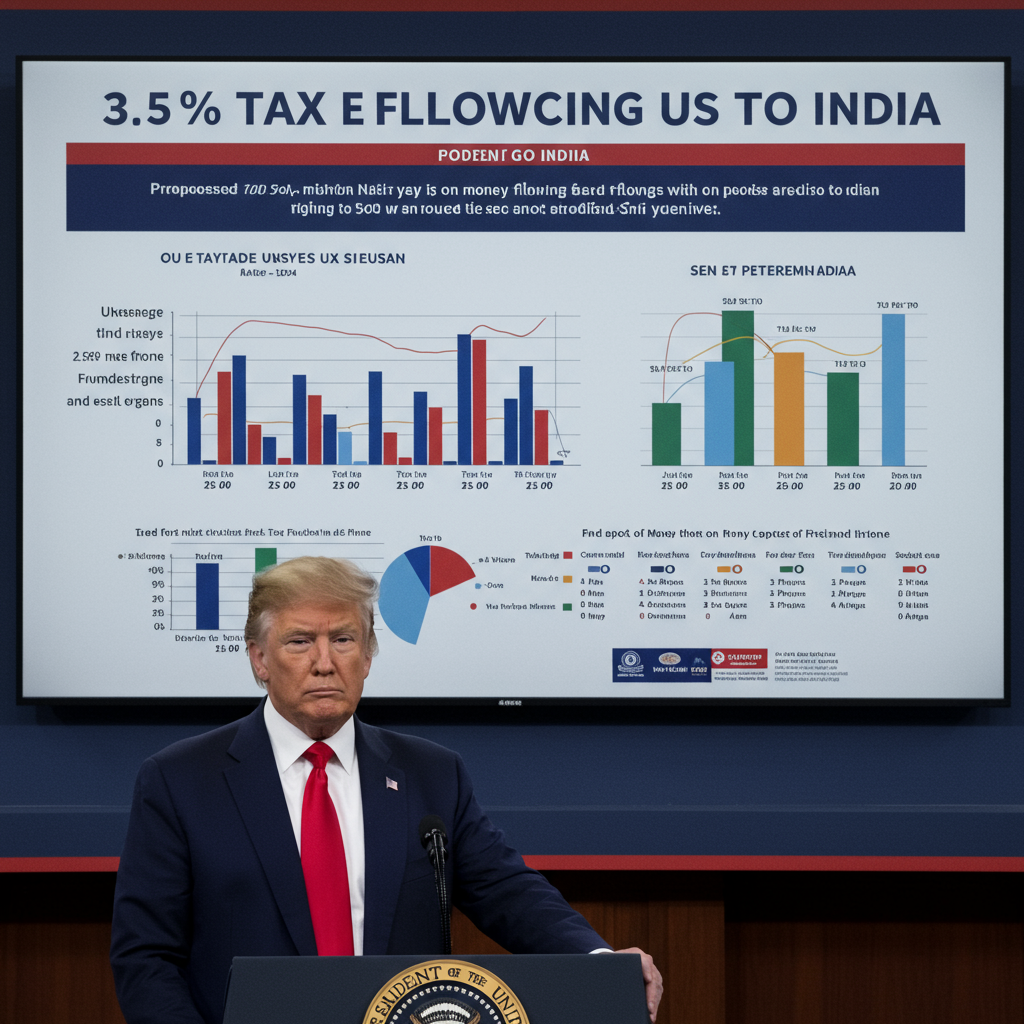
A proposal buried within former President Donald Trump’s extensive legislative package, the “One, Big, Beautiful Bill Act,” could quietly divert billions of dollars away from vital overseas remittances. At its heart is a clause suggesting a 3.5% tax on money sent abroad by foreign workers residing in the United States, including green card holders and those on temporary visas like H-1B.
This proposed levy carries significant implications, particularly for India, which stands as the world’s leading recipient of remittances. Experts warn that the impact could be substantial, extending beyond India to other major recipient nations such as Mexico, China, the Philippines, France, Pakistan, and Bangladesh.
India’s Remittance Powerhouse Status
In 2023, Indians living abroad sent home an impressive $119 billion (£88 billion), according to economists at the Reserve Bank of India (RBI). This staggering sum played a crucial role in the Indian economy, capable of financing half of the country’s goods trade deficit and even surpassing foreign direct investment inflows. The United States is the single largest source of these funds for India.
For millions of families back home, these remittances are not discretionary income; they are a lifeline used to cover essential expenses – from a parent’s medical bills to a nephew’s school tuition or a mortgage payment on a family home.
India has consistently held the top position globally for remittance receipts since 2008. The World Bank notes its share has grown from 11% in 2001 to 14% by 2024. The RBI projects this strong trend to continue, estimating remittances could reach $160 billion by 2029. Historically, these inflows have consistently represented around 3% of India’s Gross Domestic Product (GDP).
The growth in remittances is intrinsically linked to the increase in India’s international migrant population, which rose from 6.6 million in 1990 to 18.5 million in 2024. While the Gulf region remains a significant host, there’s been a marked increase in skilled migration to advanced economies like the US, bolstered by India’s prominence in the global IT sector. The US’s contribution to India’s remittances has surged, accounting for nearly 28% in 2023–24, partly attributed to a robust post-pandemic job market recovery and a rise in the foreign-born workforce. A notable 78% of Indian migrants in the US work in high-earning professional fields such as management, business, science, and the arts.
Potential Economic Blows for India
A direct tax on remittances could siphon billions from migrant workers, many of whom already pay income taxes in the US. Analysts predict two key outcomes: a likely surge in informal, untraceable cash transfers and a significant dent in what has been India’s most stable source of external financing.
Economists caution about the potential macroeconomic fallout. Ajay Srivastava of the Delhi-based think tank Global Trade Research Initiative (GTRI) estimates a 10-15% drop in remittances could cost India $12-18 billion annually. This could tighten the supply of US dollars, putting downward pressure on the Indian rupee and potentially requiring more frequent intervention from the central bank to stabilize the currency.
The most profound impact, however, could be felt at the household level. States such as Kerala, Uttar Pradesh, Bihar, Maharashtra, and Tamil Nadu are among the dominant recipients of remittances. In these regions, the funds are crucial for everyday needs like education, healthcare, and housing. The tax could “hit household consumption hard,” warns Srivastava, at a time when the Indian economy is already navigating global uncertainties and inflation.
A brief from the Centre for WTO Studies in Delhi reinforces these concerns, highlighting that the tax could squeeze Indian household budgets, dampen overall consumption and investment, and undermine a vital source of foreign exchange.
Remittances in India are typically used for household consumption, savings, and investment in assets such as housing, gold, and small businesses. A decline in these inflows would likely reduce domestic savings and investment. Households would face pressure to prioritize essential consumption (like food, healthcare, and education) over saving and investing in assets.
Global Impact and Uncertainty
Beyond India, studies suggest the proposed tax could significantly cut formal transfers globally. A report by the Center for Global Development in Washington indicated Mexico could face the largest annual hit, potentially over $2.6 billion, with India, China, Vietnam, and several Latin American nations also among those facing substantial reductions.
However, there remains some ambiguity surrounding the precise application of the tax, and its final approval hinges on action in the US Senate and the President’s signature.
Dilip Ratha, the World Bank’s lead economist for migration and remittances, offered a crucial clarification: the tax is proposed to apply to all non-citizens, but those who pay US taxes may be able to claim a tax credit. This suggests the levy might primarily impact migrants who do not pay US income taxes, largely unauthorized migrants, and potentially some diplomatic staff.
Circumventing Formal Channels?
Dr. Ratha anticipates that migrants, seeking to avoid the tax and other associated costs (like traditional transfer fees), may increasingly turn to informal remittance methods. These could include physically carrying cash, sending money via friends, couriers, or airline staff, arranging local currency payments through contacts in the US, or using age-old alternative systems like hawala/hundi, or even cryptocurrencies. This potential shift could undermine the transparency and traceability of funds. It’s noteworthy that India has become one of the most affordable destinations for formal remittances due to digital advancements and increased market competition, a trend the tax could inadvertently reverse.
Unlikely to Deter Migration
Despite the potential financial impact, Dr. Ratha questions whether the proposed tax would act as a significant deterrent to unauthorized immigration or encourage migrants to return home. He argues this is unlikely, citing the vast disparity in earning potential: a minimum wage job in the US offers over $24,000 annually, which is roughly four to 30 times higher than potential earnings in many developing countries. Migrants are primarily driven by the fundamental motivation to support their families back home, often sending between $1,800 and $48,000 per year. A 3.5% tax, in the context of such a massive wage differential, is unlikely to extinguish this core drive.
References
- https://www.bbc.com/news/articles/cvg98erzl8eo
- https://www.bbc.co.uk/news/articles/cvg98erzl8eo
- https://www.bbc.com/news/articles/c8xgdj9kyero
- https://www.bbc.com/news/articles/cwy6xz76z32o
- https://nz.news.yahoo.com/pakistanis-india-pay-huge-price-112427042.html