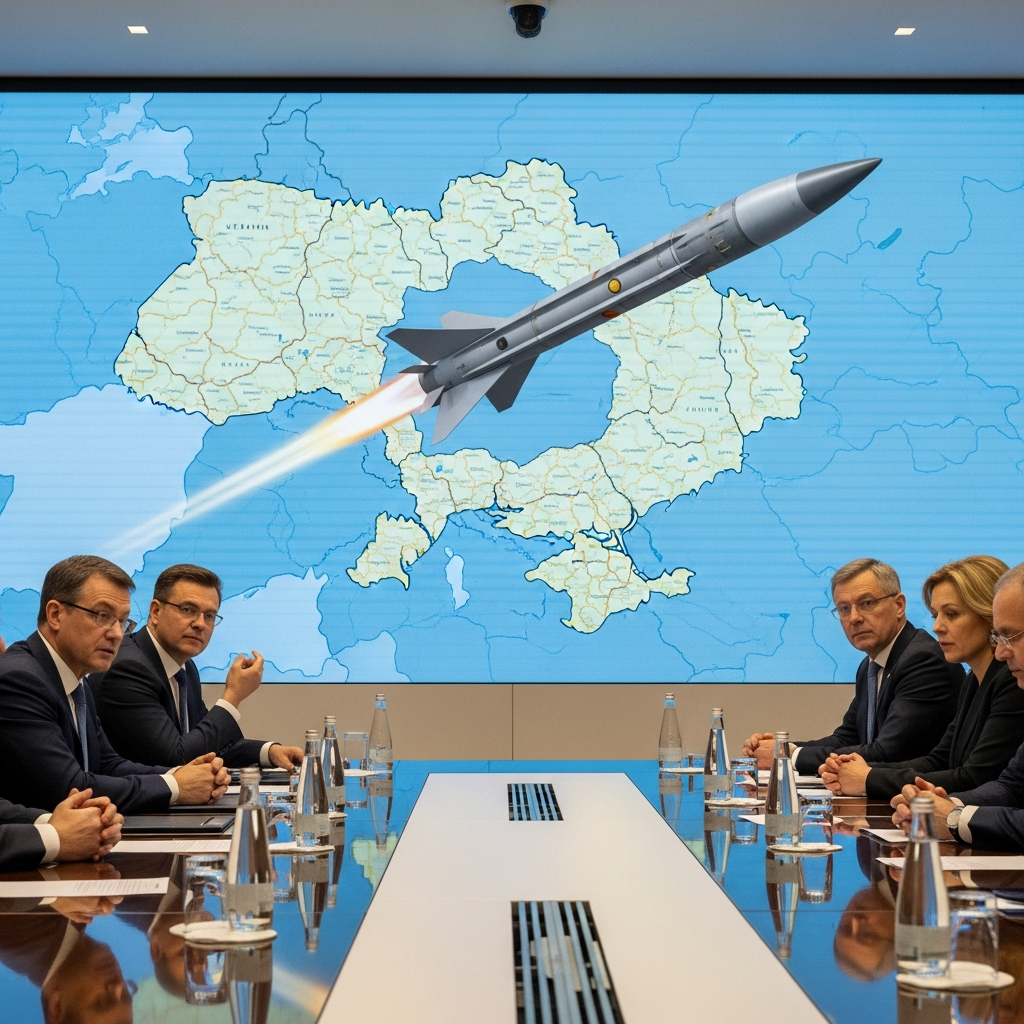
Europe faces a critical juncture in its defense strategy, with recent geopolitical shifts exposing a significant long-range strike capability gap. The unexpected cancellation of a planned US Tomahawk missile battalion in Germany, initially envisioned as a stopgap measure, has reignited urgent debates across the continent. Yet, as European leaders grapple with this challenge, a compelling and immediate answer is emerging from an unexpected quarter: Ukraine, a nation forging its own advanced missile technology amidst ongoing conflict. This strategic pivot highlights a crucial opportunity for Europe to redefine its security architecture and embrace indigenous defense solutions.
The Shifting Sands of European Defense
The recent decision by Donald Trump’s administration to scrap the deployment of US Tomahawk missiles in Germany, following an earlier announcement by Joe Biden and then-Chancellor Olaf Scholz for a 2027 deployment, has sent ripples through European defense circles. German Defense Minister Boris Pistorius openly admitted the cancellation “tears this capability gap open again.” This move, coupled with the Pentagon’s withdrawal of 5,000 US troops from Germany—with further reductions threatened in Italy and Spain—underscores a perceived weakening of American security commitments to Europe. For two years, Europe anticipated these Tomahawks as a temporary solution while it developed its own systems. Now, that bridge is gone, leaving a tangible void in long-range deterrence. The continent’s reliance on external powers for critical defense assets is under intense scrutiny, compelling a reevaluation of self-sufficiency.
Ukraine: An Unsung Arsenal Emerges
Amidst Europe’s strategic dilemma, a powerful voice from the Baltic states offers a provocative solution. Riho Terras, Estonia’s former defense chief and a Member of the European Parliament, urged leaders to stop blaming Washington and instead look to Kyiv. Speaking on national radio on May 5th, he highlighted Ukraine’s remarkable progress in developing indigenous long-range strike capabilities. This nation, bombed nightly by Russia, has been quietly building an impressive defense industrial base, born out of necessity and innovation.
Ukrainian engineers have rapidly accelerated the development of sophisticated missile systems. Their domestically built Flamingo and Long Neptune cruise missiles have already demonstrated their effectiveness. These advanced weapons have successfully targeted Russian oil refineries and ammunition depots, striking targets up to 1,000 km behind the front line. Such precision and reach provide invaluable deterrence and offensive capabilities—exactly what Europe currently lacks. Ukraine’s resilience and ingenuity in wartime conditions are not just a testament to its spirit but a practical blueprint for modern defense manufacturing.
Kyiv’s Expanding Defense Footprint
Ukraine’s burgeoning defense industry isn’t just serving its own immediate needs; it’s also positioning itself as a significant player on the international stage. Kyiv recently established a formal arms export framework under a “Drone Deals” initiative, signaling its intent to share its hard-won expertise and production capacity. This framework includes joint production lines in key European countries like Denmark, Finland, and Slovakia, along with export offices strategically located in Berlin and Copenhagen. Furthermore, Ukraine has secured 10-year defense deals with three Gulf states, indicating a broader global reach and a recognized quality of its defense products. This demonstrates Ukraine’s readiness to integrate into and bolster global security supply chains. These ventures offer a unique pathway for European nations to bypass lengthy development cycles and rapidly acquire proven, combat-tested technology.
The Geopolitical Chessboard: Putin’s Gains and Europe’s Inaction
The cancellation of the Tomahawk deployment carries profound geopolitical implications. According to Riho Terras, this move inadvertently hands Vladimir Putin a significant concession, fulfilling demands made during US-Russia negotiations. Terras views this as far more detrimental than the troop pullout itself, characterizing it as “Trump is giving away one of his cards.” This decision, from a European perspective, appears to weaken the West’s deterrent posture against Russian aggression at a critical time.
Terras also directly challenged European governments. He argued that before accusing Washington of “all the sins of the world,” European nations should commit at least 3% to 5% of their GDP to defense. This level of investment is crucial, especially considering the United States still provides roughly half of NATO’s military power. The logic, for the former chief of the Estonian Defense Forces, is strikingly simple: if Europe genuinely desires long-range deterrence against Russia, the necessary production lines are already active, and the export door is open, in Ukraine. This pragmatic approach shifts the focus from external blame to internal responsibility and strategic opportunity.
Bridging the Gap: A Path Forward for European Security
Europe’s current defense planning anticipates robust capabilities by 2030, but experts like Estonia’s military chief warn that Russia could be combat-ready again by 2027. This creates a dangerous two-year window that Europe cannot afford to ignore. The immediate and obvious answer to this looming threat lies in leveraging Ukraine’s rapidly maturing defense industry. Investing in and collaborating with Ukraine for long-range strike capabilities offers several strategic advantages:
Immediate Availability: Unlike European projects still in development, Ukrainian missiles are combat-proven and readily available.
Cost-Effectiveness: Joint production and procurement with Ukraine could offer more economical solutions compared to developing entirely new systems from scratch within Europe.
Enhanced Interoperability: Integrating Ukrainian systems now could foster deeper military cooperation and interoperability within a broader European security framework.
Geopolitical Signal: Embracing Ukraine as a key defense partner sends a strong message of solidarity and strategic foresight to both allies and adversaries.
This is not merely about acquiring weapons; it is about building a more resilient, self-reliant, and strategically agile European defense. The integration of Ukrainian defense capabilities presents a timely and effective pathway to ensure European security in a rapidly evolving global landscape.
Frequently Asked Questions
What is the core issue with Europe’s long-range defense capabilities?
Europe currently faces a significant gap in its long-range strike capabilities, a crucial component for modern deterrence. This issue was highlighted by the recent cancellation of a planned US Tomahawk missile battalion deployment in Germany, which was intended as a temporary solution until Europe could field its own systems by 2027. Without these Tomahawks, or comparable indigenous systems, European nations lack the immediate ability to project power and deter threats over long distances, creating a critical vulnerability in their defense posture.
Which Ukrainian-developed missile systems are offering solutions for Europe’s defense needs?
Ukraine has rapidly developed and deployed indigenous long-range missile systems that are now combat-tested. Key among these are the Flamingo and Long Neptune cruise missiles. These systems have proven their effectiveness by successfully striking Russian strategic targets, including oil refineries and ammunition depots, up to 1,000 km behind the front lines. Their proven operational capability makes them an immediate and viable option for European nations looking to quickly acquire advanced long-range strike capabilities.
What strategic advantages does military cooperation with Ukraine offer European nations?
Military cooperation with Ukraine presents several compelling strategic advantages for European nations. Firstly, it offers access to combat-proven, readily available long-range missile technology, bypassing lengthy and costly domestic development cycles. Secondly, Ukraine’s “Drone Deals” framework includes joint production lines and export offices across Europe, fostering deeper military-industrial integration and potentially more cost-effective procurement. Thirdly, such cooperation sends a strong geopolitical message of European self-reliance and solidarity, strengthening the overall deterrent against potential adversaries and enhancing regional security.
Charting a New Course for European Security
The withdrawal of US Tomahawks from Europe serves as a stark reminder of the imperative for self-sufficiency in defense. While the capability gap is undeniable, the solution is not distant or theoretical. Ukraine’s advanced, combat-proven missile systems, developed under immense pressure, offer a tangible and immediate answer. By engaging with Kyiv’s burgeoning defense industry, through joint production and strategic procurement, European nations can rapidly bolster their long-range deterrence. The time has come for Europe to invest in its own security, not just financially, but by forging strong strategic partnerships within the continent, particularly with a nation that has demonstrated unparalleled resilience and innovation in the face of aggression. The path to a more secure and sovereign Europe runs through Kyiv.
References
- en.as.com
- migrationobservatory.ox.ac.uk
- nchstats.com
- <a href="https://www.theregister.com/2026/02/03/amazonpowereurope/”>www.theregister.com
- www.irishexaminer.com