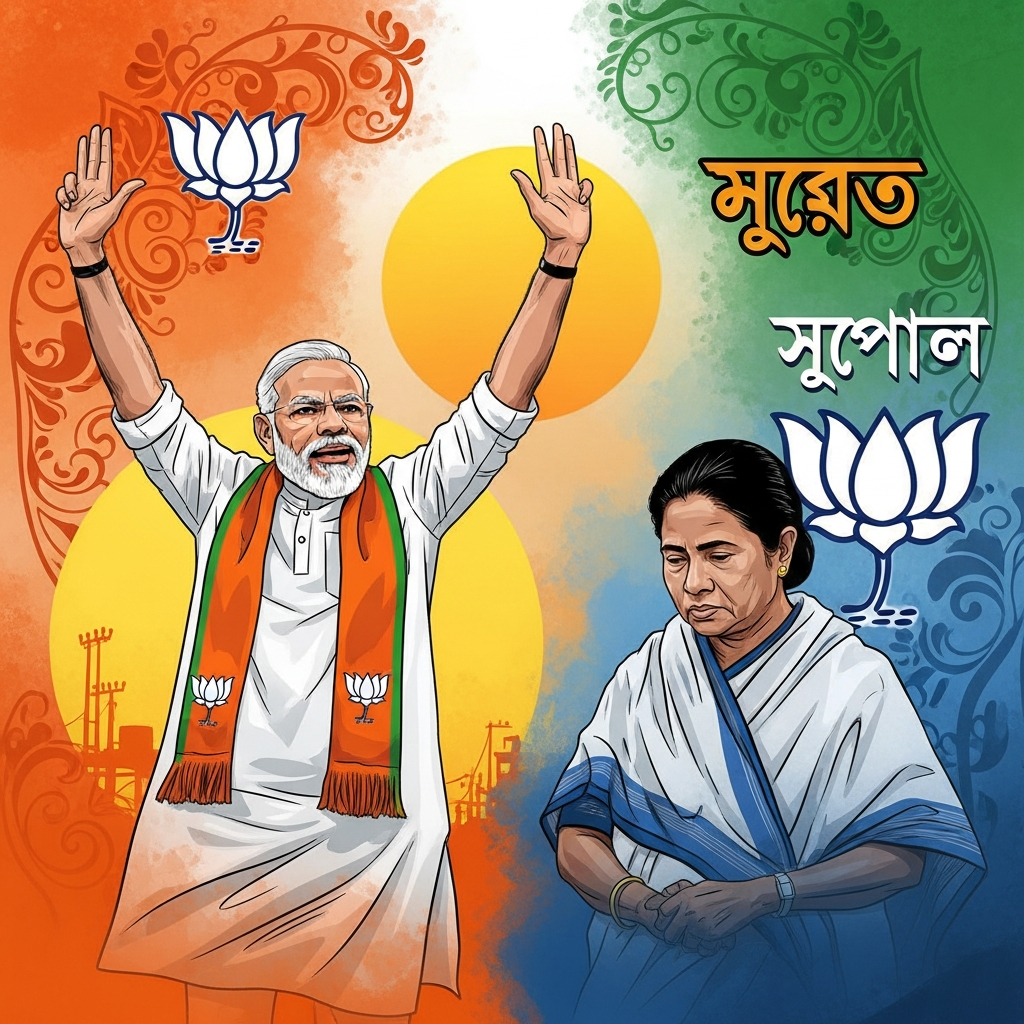
The political landscape of India has shifted dramatically with the Bharatiya Janata Party (BJP), led by Prime Minister Narendra Modi, achieving an unprecedented electoral victory in West Bengal. For the first time, Modi’s party has secured control of this crucial eastern state, long considered a bastion of opposition. This triumph marks a significant blow to Mamata Banerjee’s All India Trinamool Congress (TMC), which had governed West Bengal since 2011. Analysts are pointing to a confluence of factors, from deep-seated religious polarization to growing anti-incumbency sentiments, as pivotal to this historic win. This article delves into the strategies and circumstances that propelled the BJP to power in West Bengal and explores the broader implications for Indian politics.
A Seismic Shift: BJP’s Unprecedented Triumph in Bengal
The results, declared on May 4, 2026, sent ripples across India. The BJP, previously a marginal force in West Bengal, surged to a commanding position. Early figures indicated the party had won or was leading in an astounding 200 out of the state’s 294 legislative assembly seats. This performance dwarfed their previous best of 77 seats in the 2021 elections. In stark contrast, Mamata Banerjee’s TMC, often referred to as “Didi,” found itself leading or winning a mere 87 seats. This resounding BJP’s West Bengal victory was part of a broader set of state election results, yet it was widely deemed the most consequential. The outcome not only boosts Modi’s national standing but also reshapes the electoral map of India.
Unpacking the Victory: Key Factors Behind the Shift
Several interconnected factors converged to facilitate the BJP’s breakthrough in West Bengal. Political observers highlight both a calculated campaign by the BJP and inherent vulnerabilities within the TMC’s long-standing rule.
The Power of Religious Polarization and Hindu Consolidation
A dominant narrative contributing to the BJP’s West Bengal victory was the successful leveraging of religious polarization. The BJP, a Hindu majoritarian party, relentlessly accused the TMC of “Muslim appeasement.” This accusation resonated with a segment of the Hindu electorate. Seema Das, a househelp from New Delhi, exemplified this sentiment. She journeyed across states to vote, influenced by her mother-in-law’s belief that “Didi favours Muslims.” Das, a Hindu, stated, “Didi has lost the track and only appeases Muslims to stay in power.”
This strategic framing by the BJP targeted the TMC’s emphasis on religious pluralism and minority rights. Neelanjan Sircar, a senior fellow at the Centre for Policy Research, observed a significant “urban-rural gap” in voter preferences across West Bengal. He noted heightened polarization among urban men, suggesting this played a crucial role. Despite West Bengal having a substantial Muslim population—over a quarter of its residents—the BJP’s Hindu majoritarian appeal proved unexpectedly effective. Suvendu Adhikari, the BJP’s state leader, explicitly attributed the triumph to “Hindu consolidation.” He thanked “every Hindu Sanatani” and labeled the TMC a “pro-Muslim party.” This strategy taps into a century-long Hindu nationalist movement (Hindutva) rooted in the Rashtriya Swayamsevak Sangh (RSS), portraying Hindus as a unified race and Muslims as an external threat. This approach provides “wages of Hinduness” – a sense of dignity and inclusion for diverse Hindu groups, even amid economic challenges.
Anti-Incumbency Against the Trinamool Congress
Beyond religious dynamics, a strong wave of anti-incumbency swept across the state, eroding the TMC’s grip on power. Rahul Verma, an election observer, acknowledged Mamata Banerjee’s personal popularity. However, he pointed to widespread dissatisfaction with the “TMC machinery” and its perceived interference in daily life. Voters felt the party had become complacent and unresponsive. Praveen Rai, a political analyst, argued that the TMC failed to “offer anything new to the voters.” He highlighted “growing resentment against economic deprivation and aspirational needs of the common people.” The perception of the party system turning “hostile towards the people who did not subscribe to their ideology” further fueled voter discontent. This deep-seated fatigue with the incumbent administration created a “corridor” for the BJP to exploit.
The BJP’s Well-Oiled Election Machine and Ideological Depth
The BJP’s organizational prowess and strategic campaign management were undeniable. Rahul Verma noted that the BJP ran a “better-managed campaign this time.” This efficiency is characteristic of Modi’s political approach, honed during his tenure as Gujarat Chief Minister. His success lies in fusing promises of market-driven development with religious polarization. Supported by substantial corporate funding and high-tech communication, the BJP leveraged the extensive organizational capacity of the Sangh Parivar. This network, with millions of members, fosters a coherent identity across caste and class lines. This ideological bedrock, combined with effective campaign execution, allowed the BJP’s West Bengal victory to materialize. The win also holds symbolic significance, as West Bengal is the birthplace of Shyama Prasad Mukherjee, founder of the Bharatiya Jana Sangh, the BJP’s forerunner.
A Contested Electoral Environment: Allegations and Concerns
The West Bengal elections were not without controversy, raising questions about the fairness of the electoral process.
Disenfranchisement and Voter List Revisions
The Election Commission of India (ECI) conducted a Special Intensive Revision (SIR) of electoral rolls. This exercise controversially removed over nine million people—nearly 12 percent of the state’s 76 million voters—from the list. Millions were declared absentee or deceased, while others lost their voting rights due to a lack of tribunals for their cases. The TMC and other opposition parties accused the ECI of bias, suggesting the process disproportionately disenfranchised Muslims. Mamata Banerjee challenged this “opaque, hasty, and unconstitutional” revision in the Supreme Court. While analysts agree the revision alone couldn’t secure such a decisive win, it undeniably contributed to “polarization that the voter revision caused,” according to Neelanjan Sircar.
Paramilitary Deployment and Intimidation Claims
The Modi government’s deployment of a record 2,400 companies of paramilitary troops to West Bengal also drew criticism. While the federal government claimed these forces ensured violence-free elections, opposition parties viewed them as a means to intimidate or influence voters. Rahul Verma suggested that the heavy security presence might have favored the BJP, reassuring “fence sitters” who might have been apprehensive of TMC’s ground machinery. The low trust between opposition parties and the ECI further compounded these concerns.
Broader Implications for India’s Political Future
The BJP’s West Bengal victory carries profound implications, extending far beyond the state’s borders. It reshapes the national political discourse and strengthens Prime Minister Modi’s position.
Reinforcing Modi’s National Leadership
The win “substantially increases the national standing of Modi’s leadership,” stated Praveen Rai. This victory helps “offset the electoral setback” Modi’s party faced in the 2024 national elections, where it fell short of a majority. By securing West Bengal, the BJP reinforces its presence in a crucial eastern state and projects an image of continued electoral dominance, extending the party’s “hegemonic power to govern India.”
Weakening the Opposition and the “Long Unravelling”
The defeat in West Bengal significantly “decreases the political capital” of parties opposed to Modi, including the TMC. Mamata Banerjee’s hopes of emerging as a national challenger to Modi are now diminished. However, the South Asian Herald argues that while the BJP remains dominant, the “Modi Wave” era (2014-2024) is giving way to “Disaggregation.” This suggests that India is transforming into a patchwork of localized mandates. West Bengal, despite the BJP’s win, remains a unique political battleground. This “Long Unravelling” indicates that by 2029, the BJP may hold the center, but with a more precarious grip. The article highlights internal BJP friction, particularly rumored tensions between Amit Shah’s central command and Uttar Pradesh Chief Minister Yogi Adityanath. The RSS, the BJP’s ideological parent, also seeks a “generational transition,” preferring collective leadership over a personality cult. The youth, concerned with job shortages and inflation, are shifting from the “civilizational grievances” that previously mobilized voters. This complex environment points towards a more fractured and multi-polar Indian democracy.
Mamata Banerjee’s Defiance and the Road Ahead
Despite the decisive defeat, Mamata Banerjee is not expected to retreat quietly. In her initial reaction, she urged her party workers to remain vigilant at vote-counting booths. “It’s a total forceful use of central forces to oppress the Trinamool Congress everywhere,” she declared, vowing to fight “like the cubs of a tiger.” Her defiance signals continued political drama and a challenging path for the BJP in governing West Bengal. The state, with its rich cultural and political history, promises to remain a vibrant and contested arena in Indian politics.
Frequently Asked Questions
What key factors led to the BJP’s historic victory in West Bengal?
The BJP’s unprecedented victory in West Bengal was primarily driven by two main factors: significant religious polarization and widespread anti-incumbency against the incumbent Trinamool Congress (TMC). The BJP successfully campaigned on a narrative accusing the TMC of “Muslim appeasement,” fostering Hindu consolidation. Concurrently, public dissatisfaction with the TMC’s governance, perceived interference in daily life, and failure to address economic and aspirational needs created a strong anti-incumbency wave that the BJP capitalized on with its well-organized election machinery.
How does the West Bengal election outcome impact Prime Minister Modi’s national standing?
The outcome in West Bengal substantially bolsters Prime Minister Modi’s national standing and extends the BJP’s “hegemonic power” across India. This victory is crucial as it helps to “offset the electoral setback” his party faced in the 2024 national elections, where it failed to secure an absolute majority. By winning West Bengal, a state previously out of its grasp, the BJP strengthens its presence in eastern India and demonstrates its continued electoral might, reinforcing Modi’s leadership across the country.
What are the long-term implications of the West Bengal result for India’s political landscape?
The West Bengal result signals a complex future for India’s political landscape, suggesting a shift towards a period of “Disaggregation” rather than monolithic BJP dominance. While the victory strengthens Modi in the short term, it also highlights growing internal friction within the BJP and a desire within the RSS for generational leadership transition. Analysts predict a “Most Uncertain Decade,” where India may revert to a more federal and multi-polar democracy. The era of “Super-Majority” for any single party may be concluding, leading to a political environment defined by negotiation and diffused power across state capitals.
The BJP’s West Bengal victory represents a critical juncture in India’s political narrative. It highlights the evolving dynamics of electoral strategy, the enduring power of identity politics, and the growing complexity of governance in a diverse nation. As India moves into a new political decade, the outcomes in states like West Bengal will continue to shape the national trajectory, demanding close attention from observers worldwide.