The James Webb Space Telescope (JWST) has achieved a remarkable milestone, directly analyzing the surface of an exoplanet for the first time. This groundbreaking study reveals LHS 3844 b, a distant “super-Earth,” as a dark, hot, and barren world primarily composed of basaltic rock. Located nearly 50 light-years away, this tidally locked planet offers unprecedented insights into the geology of worlds beyond our solar system, marking a pivotal moment in our quest to understand alien landscapes.
This groundbreaking observation represents a significant leap forward. Most exoplanet research focuses on atmospheric compositions. However, the JWST’s advanced capabilities allowed astronomers to probe beneath any potential atmosphere. They instead examined heat emitted directly from the planet’s surface. These findings paint a picture of an airless world, possibly resembling Mercury. This direct interpretation of a distant planet’s geology is “the next step in unveiling their nature,” according to scientists.
Unveiling the Enigmatic LHS 3844 b
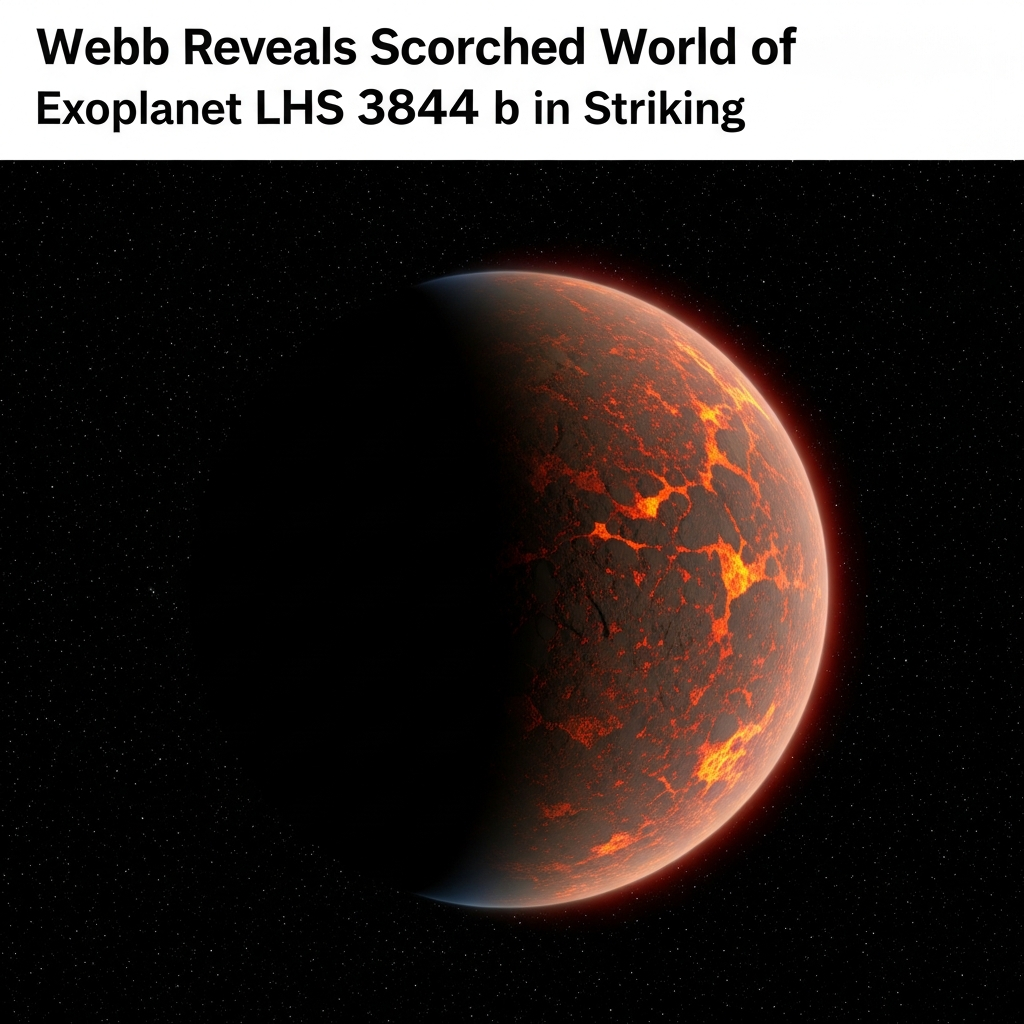
LHS 3844 b is a fascinating target. It is a “super-Earth,” roughly 30% larger than our home planet. This exoplanet orbits a cool red dwarf star. Its orbital period is incredibly short, lasting just 11 hours. A key characteristic of LHS 3844 b is that it is tidally locked. This means one side perpetually faces its star, bathed in constant daylight. The other side remains in perpetual darkness. The dayside of the planet experiences extreme temperatures. Scientists estimate these temperatures reach about 1,340 degrees Fahrenheit (725 degrees Celsius).
Discovered in 2019, LHS 3844 b quickly became a subject of intense scientific interest. Its proximity and distinct characteristics make it an ideal candidate for detailed study. Researchers sought to understand its fundamental properties. This included its potential for a substantial atmosphere or signs of geological activity. The direct surface analysis provided by JWST offered answers to these critical questions.
Webb’s Revolutionary Technique: Peering into Alien Geology
Laura Kreidberg of the Max Planck Institute for Astronomy led the JWST observations. She highlighted the telescope’s “amazing sensitivity.” This allowed the team to “detect light coming directly from the surface of this distant rocky planet.” Between 2023 and 2024, Kreidberg’s team observed three secondary eclipses. This occurs when the planet passes behind its host star.
During these eclipses, the Mid-Infrared Instrument (MIRI) on the JWST measured infrared light. This light emanated from the planet’s intensely hot dayside. By analyzing this thermal signature, scientists could deduce surface properties. They compared the observed infrared signal with spectra from known rocks and minerals. These included samples from Earth, the Moon, and Mars. This comparative spectroscopy proved crucial. It allowed the team to rule out certain compositions.
A World Forged in Fire: The Basaltic Truth
The JWST data definitively ruled out an Earth-like crust. Earth’s crust is rich in silica and granite. These crust types typically form through water-driven geological processes. Plate tectonics also play a vital role. These processes recycle rock and allow lighter minerals to rise. Instead, the evidence points strongly to a surface dominated by basalt.
Basalt is a dark, volcanic rock. It is rich in iron and magnesium. We commonly find basalt on Earth, especially in oceanic crusts. It is also prevalent on the Moon and Mercury. Study lead author Sebastian Zieba of the Center for Astrophysics, Harvard & Smithsonian, noted the implications. He stated that LHS 3844 b “likely only contains little water.” This finding is significant. An infrared spectrum, comparing JWST and Spitzer data with models, confirms this. It shows consistency with mantle or lava rock. An Earth-like crust, however, is incompatible with the observations.
Unraveling the Mystery: Volcanic Activity or Space Weathering?
The discovery of a basaltic surface on LHS 3844 b leads to two primary hypotheses. Both offer explanations for the planet’s current state. One possibility suggests a relatively young surface. This surface would be shaped by recent volcanic activity. Fresh lava flows might not yet be significantly altered. Micrometeorite impacts, for example, would have had less time to act.
However, this scenario faces a challenge. Volcanic activity typically releases gases. These include carbon dioxide or sulfur dioxide. MIRI, despite its sensitivity, detected none of these gases. “If present on LHS 3844 b in reasonable amounts, MIRI should have detected it,” the researchers indicated. The absence of these gases casts doubt on widespread, ongoing volcanism.
The alternative explanation points to space weathering. This scenario proposes a thick layer of dark, fine-grained material. Such material forms over long periods. Radiation and meteorite impacts cause this breakdown. This process gradually darkens and alters rock. It is common on airless bodies like the Moon and Mercury. LHS 3844 b’s lack of an atmosphere makes its surface especially vulnerable to such processes. This second hypothesis implies long periods of geological inactivity. This stands in stark contrast to the first scenario.
Beyond LHS 3844 b: Webb’s Broadening Exoplanet Frontier
The James Webb Space Telescope’s mission extends far beyond surface analysis. Its unparalleled sensitivity and diverse instruments are revolutionizing exoplanet science in multiple ways. This includes understanding planet formation and directly imaging distant worlds.
Redefining Planet Formation with 29 Cygni b
JWST, combined with ground-based observations, is also clarifying how massive exoplanets form. A study focused on 29 Cygni b, an exoplanet about 15 times Jupiter’s mass. This “super-Jupiter” orbits its star at a distance similar to Uranus. Its mass and orbital distance place it at a theoretical boundary. Either accretion (planet-like formation) or disk fragmentation (star-like formation) could explain its existence.
Webb’s Near-Infrared Camera (NIRCam) directly imaged 29 Cygni b. Researchers looked for signs of carbon dioxide and carbon monoxide in its atmosphere. They found strong evidence of significant metal enrichment. This included carbon and oxygen. The detected heavy elements equal roughly 150 Earths. This metal abundance strongly suggests formation through accretion. It indicates the planet accumulated large quantities of metal-rich solid material. Ground-based CHARA observations further confirmed an orbit aligned with its host star. This alignment is characteristic of objects forming within a protoplanetary disk.
First Glimpses: Directly Imaging TWA 7 b
The JWST also achieved its first direct image discovery of a new exoplanet, TWA 7 b. This Saturn-mass gas giant orbits a young star named TWA 7, located 111 light-years away. This achievement is particularly notable. TWA 7 b is ten times lighter than any exoplanet previously directly imaged.
Researchers utilized JWST’s coronagraph. This specialized instrument blocks out the host star’s intense light. This allowed the faint infrared signature of TWA 7 b to be observed. The planet is carving a path through a debris disk around its star. This observation offers crucial insights into the very early stages of planetary systems. It shows that gas-rich planets can form rapidly after a star’s birth.
Why These Discoveries Matter: Reshaping Our Cosmic Understanding
The James Webb Space Telescope is providing unprecedented detail. It reveals the diversity and complexity of exoplanetary systems. Analyzing the surface of LHS 3844 b offers a crucial benchmark. It shows what rocky worlds without atmospheres might truly look like. Understanding its basaltic nature provides clues about its geological history. It informs models of planetary evolution. The lack of detected gases also impacts our understanding of volatile retention on such worlds.
Meanwhile, observations of 29 Cygni b and TWA 7 b expand our knowledge. They shed light on the mechanics of planet formation. From gas giants to “super-Earths,” JWST is painting a more complete picture. These findings contribute to a deeper understanding of our own solar system. They also enhance the ongoing search for life beyond Earth. Each discovery refines our theories about how planets form, evolve, and potentially harbor conditions for life.
Future Glimpses: What’s Next for Webb?
Scientists are not stopping here. Follow-up JWST observations are already planned for LHS 3844 b. These will further refine the planet’s surface properties. Researchers aim to determine whether it is solid rock or loose, weathered material. Laura Kreidberg is confident in the technique. She believes it “will allow us to clarify the nature of LHS 3844 b’s crust and, in the future, other rocky exoplanets.”
This pioneering work continues to push boundaries. The findings about LHS 3844 b were published recently in the journal Nature Astronomy. As Webb continues its mission, we can anticipate many more groundbreaking revelations. These discoveries promise to further reshape our understanding of the universe.
Frequently Asked Questions
What is LHS 3844 b and why is its direct surface study significant?
LHS 3844 b is a “super-Earth” exoplanet, about 30% larger than our planet and located nearly 50 light-years away. It is tidally locked, meaning one side permanently faces its star, reaching extreme temperatures. Its direct surface study by the James Webb Space Telescope (JWST) is highly significant because it marks the first time astronomers have directly analyzed the geological composition of an exoplanet’s surface, moving beyond just atmospheric studies. This provides unprecedented insights into the fundamental nature of distant rocky worlds.
How did the James Webb Space Telescope analyze the surface of an exoplanet so far away?
The JWST utilized its Mid-Infrared Instrument (MIRI) to study LHS 3844 b. Astronomers observed secondary eclipses, when the planet passed behind its host star. By measuring the infrared light emitted from the planet’s scorching dayside during these events, they gathered data on its thermal signature. This infrared signal was then compared to known spectra of rocks and minerals found on Earth, the Moon, and Mars. This comparative spectroscopy allowed scientists to deduce the surface composition, ruling out an Earth-like crust and identifying basalt as the dominant material.
What does the basaltic surface of LHS 3844 b tell us about the potential for life?
The discovery of a basalt-dominated surface on LHS 3844 b, coupled with the lack of detected volcanic gases and the absence of an atmosphere, suggests a world with “little water” and long periods of geological inactivity. Basalt is common on airless bodies like the Moon and Mercury, which are considered barren. While not a definitive ruling out of life, these characteristics point to an environment vastly different from Earth, making the conditions for life as we know it highly improbable. The findings inform our understanding of planetary habitability limits and geological processes on rocky exoplanets.