A groundbreaking discovery is reshaping our understanding of the distant reaches of our solar system. Astronomers have detected a thin atmosphere around a surprisingly small celestial body far beyond Pluto, designated (612533) 2002 XV93. This unprecedented finding challenges decades of scientific assumptions about the conditions necessary for an atmosphere to form and persist on such cold, tiny worlds. It paints a vivid new picture of the Kuiper Belt as a far more active and dynamic region than previously imagined.
The Impossible Discovery: An Atmosphere Beyond Pluto
For generations, scientists believed that only larger celestial bodies, like dwarf planet Pluto, possessed the gravitational pull and internal activity to retain an atmosphere in the frigid outer solar system. The Kuiper Belt, a vast ring of icy, rocky remnants from our solar system’s formation, was considered a static, frozen graveyard. Yet, a team of Japanese astronomers, led by Ko Arimatsu, has unveiled a remarkable secret: 2002 XV93, a modest “plutino” roughly 500 kilometers (310 miles) across, harbors a tenuous gaseous envelope. This object is significantly smaller than Pluto, which spans 2,377 kilometers (1,477 miles). Its atmosphere is estimated to be an astonishing 5 to 10 million times thinner than Earth’s. It is even 50 to 100 times more rarefied than Pluto’s already wispy atmosphere.
Unveiling 2002 XV93: A Small World with a Big Secret
(612533) 2002 XV93 is a trans-Neptunian object (TNO) located in the Kuiper Belt. It orbits the Sun in a stable resonance with Neptune, much like Pluto. These icy worlds are often described as “fossil records” of the early solar system. They offer vital clues about its initial composition and the dramatic events that shaped it, such as Neptune’s outward migration. Until now, the consensus was that their weak gravity and extreme cold would prevent them from sustaining any kind of gaseous layer. The discovery on 2002 XV93 fundamentally overturns this established view, forcing scientists to reconsider fundamental theories of planetary evolution and volatile retention in deep space.
How Astronomers Uncovered This Rare Phenomenon
Studying objects as distant and dim as 2002 XV93 presents immense challenges. Direct imaging of such a tiny atmosphere is impossible with current technology. Instead, astronomers employed an ingenious indirect detection method known as stellar occultation. This technique relies on precisely observing what happens when a distant celestial body passes in front of an even more distant, bright star.
The Stellar Occultation Method Explained
On January 10, 2024, a rare opportunity arose. 2002 XV93 was predicted to pass directly in front of a background star, as seen from Japan. If the object were a bare, airless rock, the starlight would abruptly “wink out” and then sharply reappear. However, Ko Arimatsu and his colleagues observed something different. Using multiple observatories across Japan, including Kyoto, Nagano, and a citizen scientist-run telescope in Fukushima, they recorded a gradual dimming and subsequent brightening of the star’s light. This subtle transition lasted for approximately 1.5 seconds on both sides of the main occultation event. This gradual change is the tell-tale signature of an atmosphere. As starlight passes through a gaseous envelope, it is bent or refracted. This bending causes the light to fade and recover smoothly, rather than disappearing instantly.
Japanese Observatories Lead the Charge
The precise timing and multi-site observations were crucial. They allowed the researchers to develop sophisticated refraction models. By comparing these models to the observed light curves, they confirmed the presence of an extremely thin atmosphere. The team assumed a composition likely dominated by volatile gases such as methane, nitrogen, or carbon monoxide, common in these cold environments. This collaborative effort, combining professional observatories with citizen science, highlights the power of global astronomical networks. It underscores how meticulous observations can reveal profound secrets of the cosmos.
Why a Thin Atmosphere on 2002 XV93 Is So Significant
The existence of a thin atmosphere on 2002 XV93 is not just an intriguing anomaly; it has profound implications for planetary science. It forces a re-evaluation of our basic understanding of how atmospheres form and persist. This discovery hints at a more dynamic outer solar system than previously conceived.
Challenging Long-Held Planetary Science Theories
For decades, scientific models suggested that objects the size of 2002 XV93 simply couldn’t hold onto an atmosphere. Their low surface gravity, combined with the extreme cold and radiation of deep space, should cause any volatile gases to quickly escape into the vacuum. As Dr. Scott S. Sheppard, a staff scientist at the Carnegie Institution for Science, noted, “It was thought that objects like 2002 XV93 would be too small to have an atmosphere, but this result shows that is not true.” This finding broadens the spectrum of celestial bodies capable of hosting atmospheres. It potentially expands our search for habitable environments beyond what was previously considered. It challenges the assumption that only “large” worlds can support such features.
Unlocking Secrets of the Early Solar System
These small, icy worlds are time capsules, preserving conditions from the solar system’s birth 4.5 billion years ago. Understanding how an atmosphere can form and be sustained on such a body offers new insights into the movement and retention of volatile materials like methane, nitrogen, and carbon monoxide. These are fundamental building blocks that were present in the protoplanetary disk. Such discoveries could shed light on how icy materials, essential for life, were distributed and evolved throughout our own solar system and potentially others. The Kuiper Belt is now seen not as a dormant region, but as a place “teeming with activity,” as Sheppard put it.
The Mystery of Its Origin: Cryovolcanoes or Cosmic Impact?
With the discovery confirmed, the next crucial question for astronomers is: what created and sustains this unexpected atmosphere? Researchers have proposed two leading hypotheses, each with different implications for the longevity and activity of 2002 XV93.
Two Leading Hypotheses for Atmospheric Formation
The first possibility suggests the atmosphere is a product of ongoing cryovolcanic activity. This process involves eruptions of icy sludge and volatile gases from beneath the object’s surface. Similar to geological volcanoes on Earth, cryovolcanoes on an icy body like 2002 XV93 could continuously release gases such as methane, nitrogen, or carbon monoxide. This steady replenishment would allow the atmosphere to persist over long periods. If this hypothesis is true, it implies a surprisingly active interior for such a small, distant object. The second hypothesis proposes a more temporary origin: a recent impact event. A collision with another Kuiper Belt object, like a comet, could have disturbed 2002 XV93’s subsurface, releasing trapped gases. While this could explain the initial formation, models suggest such an impact-generated atmosphere would be short-lived, dissipating within a few hundred to a thousand years.
The exact composition of the atmosphere cannot yet be directly determined. However, these volatile compounds are the most plausible candidates given the extremely low temperatures of the outer solar system. Distinguishing between these two scenarios is vital for understanding the true nature of 2002 XV93 and similar TNOs.
What’s Next? Probing Deeper into 2002 XV93’s Secrets
Astronomers are not stopping at this initial discovery. The detection of a thin atmosphere on 2002 XV93 has opened new avenues for research, with future observations aimed at unraveling its mysteries and searching for other “Pluto cousins.”
The Role of James Webb and Future Occultations
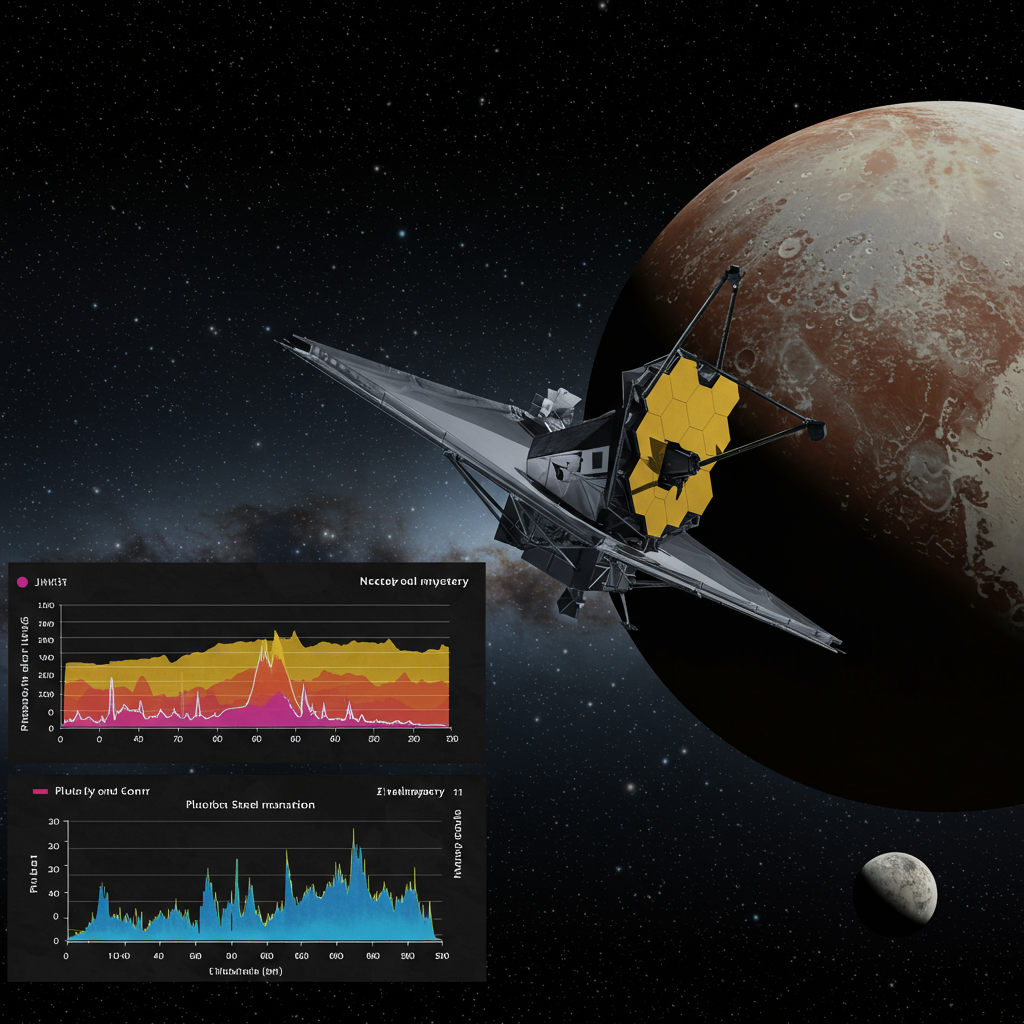
Future observations will be crucial for characterizing the atmosphere’s nature and determining its origin. More stellar occultations, if they occur, could provide further data on atmospheric pressure and changes over time. A steady decrease in pressure during subsequent occultations might suggest an impact origin. Conversely, consistent pressure readings would lean towards ongoing cryovolcanism. The powerful James Webb Space Telescope (JWST) is also poised to play a significant role. The JWST could detect specific methane or carbon monoxide emissions. This would directly identify the atmosphere’s chemical composition. Its advanced infrared capabilities are ideal for studying the faint signatures from such cold, distant objects. Arimatsu’s team continues to search for atmospheres around other TNOs. This ongoing work will help determine if 2002 XV93 is a rare exception or if small, atmospheric objects are more common than we ever imagined.
Frequently Asked Questions
Why was it previously thought that small TNOs couldn’t have atmospheres?
Scientists traditionally believed that small Trans-Neptunian Objects (TNOs) in the Kuiper Belt, like 2002 XV93, lacked sufficient surface gravity to retain an atmosphere. The extreme cold and constant solar radiation in the outer solar system were expected to cause any volatile gases to escape into space quickly. Dwarf planet Pluto, with its larger size and thin atmosphere, was considered a rare exception to this rule among TNOs, making the discovery on 2002 XV93 a significant challenge to these long-held assumptions about planetary science.
How did astronomers detect this thin atmosphere on 2002 XV93?
Astronomers detected the thin atmosphere through a technique called stellar occultation. When 2002 XV93 passed in front of a distant star, a team of Japanese astronomers, led by Ko Arimatsu, observed a gradual fading and brightening of the starlight over 1.5 seconds. This gradual change, recorded from multiple observatories, indicates that the starlight was bent by a gaseous envelope, unlike the abrupt disappearance that would occur with an airless body. This indirect method confirmed the presence of the atmosphere.
What does the discovery of an atmosphere on 2002 XV93 mean for our understanding of the Solar System?
The discovery fundamentally reshapes our view of the outer solar system, suggesting it is far more dynamic than previously thought. It challenges theories that only large bodies can sustain atmospheres. This means even small icy worlds might host geological activity, like cryovolcanism, or experience recent cosmic impacts. It also offers unprecedented insights into the retention and movement of volatile gases, which are crucial for understanding planetary formation and the distribution of life’s building blocks in our solar system and potentially beyond.
A Glimpse into a Dynamic Frontier
The discovery of a thin atmosphere on 2002 XV93 is a monumental achievement in planetary science. It serves as a powerful reminder that our solar system still holds countless secrets, waiting to be revealed by ingenious observation and scientific persistence. This tiny world, once thought to be a simple frozen rock, now hints at a surprisingly active Kuiper Belt. It suggests a future where even the smallest, most distant celestial bodies could yield vital clues about the origins of atmospheres, the evolution of planets, and the potential for complex activity across the cosmos. This is not merely a collection of frozen, unchanging worlds, but a vibrant, dynamic frontier.
References
- <a href="https://mezha.net/eng/bukvy/f8a93b0eastronomersdetect_atmosphere/”>mezha.net
- www.sciencealert.com
- gizmodo.com
- www.newscientist.com
- unn.ua