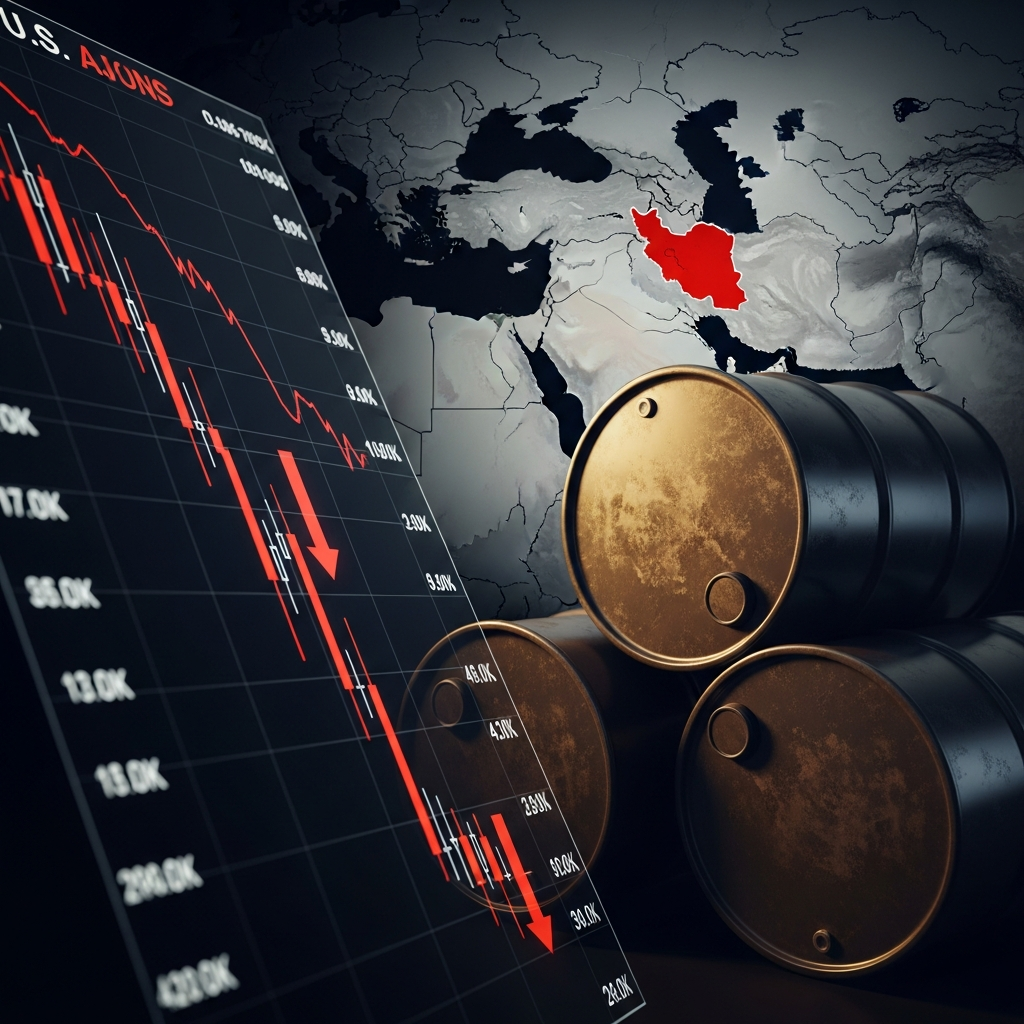
US equity markets faced a challenging period recently, culminating in a significant sell-off that marked a brutal end to the trading week. Persistent geopolitical tensions in the Middle East, particularly concerns surrounding the “Iran war,” combined with surging crude oil prices and stubborn inflation, triggered widespread investor caution. Major benchmark indices like the Dow, S&P 500, and Nasdaq Composite experienced notable declines. This market turbulence raised critical questions about the Federal Reserve’s monetary policy trajectory and the broader economic outlook for 2026.
Market Tumble: A Week in Review
The trading week that concluded on March 20, 2026, saw a pronounced downturn across Wall Street. Futures for the S&P 500, Dow Jones Industrial Average, and Nasdaq Composite all indicated a negative open, trading lower by 0.4%, 0.3%, and 0.5% respectively. This pre-market dip foreshadowed continued struggles for investors. By the week’s close, both the S&P 500 and the Dow Jones Industrial Average were on track for their fourth consecutive week of losses.
The Dow’s Dive and S&P 500’s Slide
The Dow Jones Industrial Average notably slipped to its lowest level since mid-November earlier in the week. It recorded a nearly 9% decline from its recent highs, pushing it close to the threshold of correction territory. This significant drop highlighted the pervasive bearish sentiment. Similarly, the S&P 500, a key barometer of the broader market, reflected this widespread caution. Its sustained downward trend underscored the deep apprehension felt by investors concerning global economic stability and future growth prospects. The market’s reaction clearly signaled a collective retreat from riskier assets.
Geopolitical Storm: The Middle East Factor
At the heart of the market’s woes were escalating geopolitical tensions in the Middle East, often referred to as the “Iran war.” This conflict directly fueled investor anxiety. The fear of broader regional instability significantly impacted global energy markets. Such developments inevitably ripple through economies worldwide, affecting everything from supply chains to consumer confidence. The market’s sensitivity to these events was evident in the daily fluctuations.
Crude Oil Volatility and the Hormuz Strait Threat
A primary channel through which Middle East tensions affected markets was crude oil prices. Brent crude futures, a global benchmark, experienced significant volatility. They dipped to $105 per barrel earlier in the day on March 20, after reaching $105 in the prior session. However, the week overall saw crude oil prices still on track for a substantial 7% gain. Economists warned that if disruptions in the Strait of Hormuz — a vital shipping lane for oil — persisted, Brent crude prices could surge to an alarming $180 per barrel. Such a dramatic increase would have severe global economic consequences.
De-escalation Hopes vs. Long-Term Risks
Despite the ongoing tensions, some reports offered temporary relief. News emerged that US Treasury Secretary Scott Bessent suggested Washington might lift sanctions on Iranian crude to ease supply disruptions. Additionally, Israeli Prime Minister Benjamin Netanyahu reportedly indicated no further attacks on Iran’s oil infrastructure. US President Donald Trump also announced no plans to deploy American ground troops to the Middle East. These statements offered a brief glimmer of hope. However, the underlying risks remain high, with Saudi Arabian oil officials anticipating severe price spikes if energy disruptions continue beyond late April.
Inflation’s Shadow and the Fed’s Dilemma
The sustained high crude oil prices directly contributed to renewed inflation concerns. These concerns placed the Federal Reserve in a difficult position. The central bank had been grappling with persistent price pressures throughout the year. High energy costs translate into increased prices for transportation, manufacturing, and consumer goods. This effect directly impacts household budgets and overall economic stability.
Persistent Inflation and Delayed Rate Cuts
Many investors initially hoped for interest rate cuts from the Federal Reserve to stimulate the economy. However, the fear of sustained high crude oil prices threatened to delay these anticipated cuts. Policymakers now suggested that any easing might not occur until as late as 2026. This assessment significantly dampened hopes for near-term rate reductions. The Fed explicitly flagged inflation risks, emphasizing that price pressures were likely to persist. They indicated that rate reductions would only happen with clear evidence of cooling inflation.
The Fed’s “Wait-and-Watch” Approach
In their recent meeting, the Federal Reserve maintained key benchmark rates unchanged for the second consecutive time. This decision reflected a “wait-and-watch” approach, carefully monitoring economic indicators amidst the geopolitical backdrop. Policymakers signaled only one rate cut for the entire year, with its timing remaining uncertain. This cautious stance underscores the central bank’s commitment to tackling inflation, even if it means prolonged higher borrowing costs. Prior to this pause, the Fed had reduced short-term interest rates three consecutive times, pausing in January.
Economic Headwinds: Beyond Geopolitics
Beyond the immediate geopolitical concerns, the US economy also faced significant internal challenges. These broader economic headwinds compounded the market’s unease. The combination of external shocks and internal vulnerabilities created a complex picture for analysts and investors alike. Understanding these underlying factors is crucial for predicting future market movements.
Sputtering Job Growth and Economic Slowdown
The US job market, once a strong point, showed signs of sputtering. Employers cut 92,000 jobs last month, a concerning indicator. For the entire year of 2025, fewer than 10,000 jobs were added per month. This represented the weakest hiring figures outside recession years since 2002. Simultaneously, economic growth slowed sharply in the last three months of 2025. The Commerce Department reported a mere 0.7% expansion in the fourth quarter, a significant drop from the strong 4.4% growth seen in the third quarter. These figures painted a picture of a decelerating economy.
The Looming “Worst-Case Scenario”
Economists voiced increasing concern over a “worst-case scenario” for central bankers: a combination of rising prices and higher unemployment. Elevated oil prices were expected to divert more household income towards fuel, reducing consumer spending on other goods and services. This shift could potentially lead to further job losses. Many economists anticipated the Fed would need to raise its inflation forecast to as high as 3% by late 2026. This would make any further interest rate cuts difficult to justify, tightening financial conditions for businesses and consumers.
Bright Spot Amidst the Gloom: The FedEx Exception
Amidst the widespread market caution, FedEx Corporation provided a notable exception. Its shares experienced a significant jump, trading 7% higher at $381.50 apiece in pre-market trading, after earlier rising by 10%. This surge followed the release of the company’s strong fiscal third-quarter results. FedEx also raised its full-year profit forecast, reporting steady shipping demand despite geopolitical tensions and escalating fuel costs. The company’s adjusted earnings per share for the third fiscal quarter came in at $5.25, significantly surpassing analyst estimates. FedEx, often seen as a barometer of broader business activity, highlighted that global demand remained steady and fuel surcharges helped shield profits from rising expenses.
What This Means for Investors: Navigating Volatility
The recent stock market sell-off underscores the complex interplay of global events and domestic economic factors. Investors must contend with persistent market volatility driven by Middle East tensions, crude oil price fluctuations, and the Federal Reserve’s cautious stance on interest rates. Understanding these interconnected challenges is crucial for making informed investment decisions. Companies like FedEx demonstrating resilience offer valuable insights into specific sector strengths. However, the broader picture points to a period requiring careful monitoring of inflation data, Fed announcements, and geopolitical developments. Investors should consider diversified portfolios and stay abreast of these key economic indicators to navigate current market conditions effectively.
Frequently Asked Questions
What key factors contributed to the recent US stock market sell-off?
The recent US stock market sell-off was primarily driven by a confluence of factors. Escalating geopolitical tensions in the Middle East, particularly concerns about the “Iran war,” significantly heightened investor anxiety. This translated into surging crude oil prices, which then fueled persistent inflation worries. These inflation concerns, in turn, complicated the Federal Reserve’s monetary policy, leading to expectations of delayed or fewer interest rate cuts. Additionally, a sputtering US job market and slowing economic growth further contributed to the bearish sentiment across major indices like the Dow, S&P 500, and Nasdaq.
How are crude oil prices influencing the Federal Reserve’s interest rate decisions?
Crude oil prices play a critical role in shaping the Federal Reserve’s interest rate decisions due to their direct impact on inflation. When oil prices rise, they increase costs across various sectors, from transportation to manufacturing, ultimately leading to higher consumer goods prices. The Fed’s primary mandate is to maintain price stability, targeting a 2% inflation rate. Persistently high crude oil prices make it challenging for the Fed to achieve this target, forcing them to adopt a “wait-and-watch” approach. This often means delaying anticipated interest rate cuts or even considering rate hikes to curb inflation, as seen with policymakers signaling only one potential cut for 2026.
What is the “worst-case scenario” for central bankers, and how might it affect the economy?
The “worst-case scenario” for central bankers is a combination of persistently high inflation and rising unemployment. This difficult situation arises when high prices reduce consumer purchasing power, leading to decreased spending on non-essential goods and services. Businesses, facing reduced demand and higher operating costs (due to energy prices), may then cut jobs. This creates a negative feedback loop where higher unemployment further suppresses demand, while inflation continues to erode the value of money. Such a scenario could force central banks to raise inflation forecasts and maintain higher interest rates for longer, potentially leading to a period of stagflation (slow growth with high inflation).
Conclusion
The market’s performance during the week ending March 20, 2026, highlighted a deeply interconnected global economic landscape. Geopolitical events in the Middle East profoundly influenced energy markets, which in turn amplified inflation concerns and complicated the Federal Reserve’s monetary policy decisions. As the Dow, S&P 500, and Nasdaq experienced significant setbacks, investors grappled with uncertainty. While some individual companies like FedEx showed resilience, the overall picture suggested continued vigilance is necessary. The coming months will likely test the strength of the US economy against ongoing geopolitical risks, inflation pressures, and the Fed’s evolving strategy.