A groundbreaking discovery has rocked the world of paleontology: a previously unknown baby dinosaur species, Doolysaurus huhmini, has been unearthed in South Korea. This remarkable find marks the first new dinosaur species discovered in the country in 15 years. Crucially, it’s also the first Korean dinosaur fossil ever found with preserved skull portions. Using revolutionary micro-CT scanning technology, researchers peered inside a rock block to reveal the secrets of this 113-million-year-old creature. This breakthrough not only introduces a fascinating new member to the dinosaur family tree but also highlights the transformative power of advanced imaging in unraveling ancient mysteries.
Unearthing an Ancient Korean Secret: The Doolysaurus Huhmini
The story of Doolysaurus huhmini began quietly on Aphae Island, off South Korea’s southwestern coast. In 2023, researcher Hyemin Jo made the initial discovery. At first glance, the fossil appeared modest. Only a few leg bones and vertebrae were visible on the surface of a hard, dense block of reddish mudstone. Traditional excavation methods would have been incredibly difficult and risky, potentially damaging the delicate fossilized remains.
However, a critical clue hinted at more: a cluster of well-preserved gastroliths, or stomach stones, nestled between the visible bones. These stones suggested the animal’s body hadn’t been scavenged or scattered after death. This indicated that more of the skeleton might be hidden within the rock. This exciting possibility prompted researchers to investigate further, leading to a collaboration that would change Korean paleontology.
CT Scanning: The Game-Changer in Paleontology
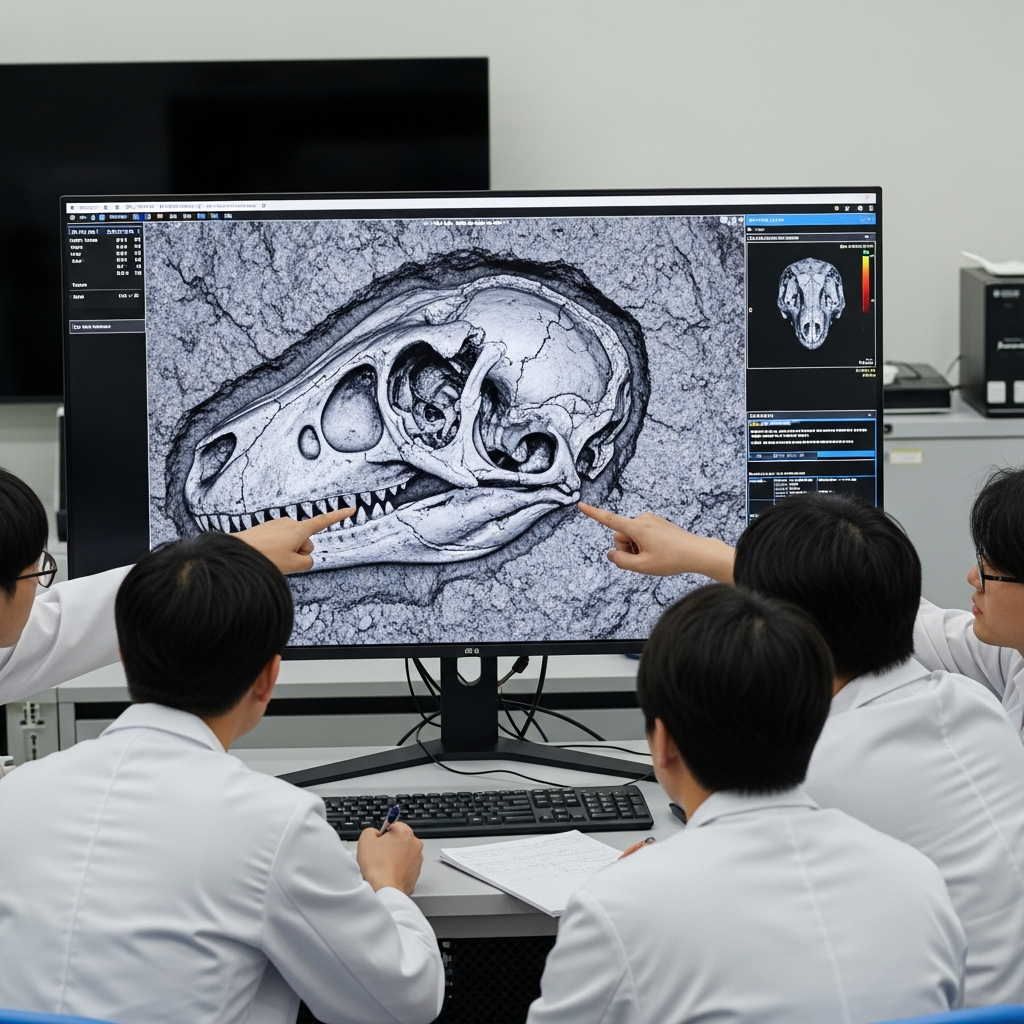
The true extent of the Doolysaurus huhmini fossil was unveiled through cutting-edge technology. Encouraged by co-author Julia Clarke, a professor at the University of Texas at Austin’s Jackson School of Geosciences, the research team brought the rock block to the University of Texas High-Resolution X-ray Computed Tomography (UTCT) facility. This facility pioneered CT scanning for fossils almost 30 years ago.
Manual preparation of such a delicate and hard-encased fossil could have taken a decade. Instead, the advanced micro-CT scans provided comprehensive anatomical data in a matter of months. The scans exceeded all expectations. They revealed intricate skull bones, jaw elements, and parts of the braincase, all previously hidden. Lead researcher Jongyun Jung, a visiting postdoctoral researcher at UT, described seeing the CT data as “truly exciting.” This non-invasive method allowed scientists to reconstruct the first dinosaur skull material ever found in Korea. This technology continues to revolutionize how paleontologists study “difficult” specimens, unlocking secrets once considered lost.
Meet Doolysaurus: A “Cute” Omnivore with a Fuzzy Past
Doolysaurus huhmini was a juvenile dinosaur, estimated to be around two years old at its time of death. Its size was comparable to a modern-day turkey. Researchers believe an adult Doolysaurus could have grown to twice that size. Anatomical analysis classified it as a thescelosaurid. This group of lightly built, bipedal dinosaurs was common in East Asia and North America.
Interestingly, some thescelosaurids are known for potentially having fuzzy, filament-like coats. This suggests that Doolysaurus might have sported a “cute” or “fluffy” appearance, much like a small lamb. Such details provide rare insights into the integument of juvenile dinosaurs from the mid-Cretaceous period. Living approximately 113 to 94 million years ago, Doolysaurus adds a unique piece to the puzzle of ancient life.
The discovery of dozens of gastroliths, small pebbles swallowed to aid digestion, provided crucial information about its diet. These stones, measuring 2-10mm wide, were still clustered together within the fossil. Similar to modern omnivorous birds, Doolysaurus likely used these stones to grind down food. Its triangular, leaf-shaped teeth also support the conclusion that Doolysaurus was an omnivore. It consumed a diverse diet of plants, insects, and small animals. The presence of these small, lightweight stones in place further indicated the animal was not fully disarticulated before fossilization.
A Name Steeped in Korean Culture and Scientific Tribute
The naming of Doolysaurus huhmini beautifully bridges modern pop culture with ancient history and scientific dedication. “Doolysaurus” honors “Dooly the Little Dinosaur,” an iconic and beloved Korean cartoon character. Dooly, a mischievous green baby dinosaur, has been a staple of South Korean television since the 1980s. Given the fossil’s juvenile status, researchers, including Jongyun Jung, felt the name was a perfect fit. It resonates across all generations in Korea.
The specific epithet, huhmini, pays tribute to Professor Min Huh. He is a prominent Korean paleontologist who founded the Korean Dinosaur Research Center. His three decades of contributions to Korean dinosaur studies, alongside his work with UNESCO to preserve dinosaur fossil sites, are widely recognized. This dual naming highlights the cultural impact of scientific discoveries and acknowledges the tireless work of local experts.
Redrawing the Map of Dinosaur Evolution: Korean Implications
The discovery of Doolysaurus huhmini holds significant implications for paleontology, particularly in South Korea. While the country boasts a rich record of “trace fossils”—such as dinosaur tracks, nests, and eggs—skeletal dinosaur fossils have historically been rare. This scarcity is partly due to geological factors. Much of Korea’s Mesozoic fossil-bearing rock is exposed on coasts and islands, making systematic excavation challenging. Widespread Late Cretaceous volcanic activity also transformed many sedimentary layers, often destroying fossils or making extraction extremely difficult.
Aphae Island, however, proved an exception. Its fine-grained sandy mudstone provided excellent, three-dimensional preservation conditions. Prehistoric floodplain conditions, with rapid and steady sediment deposition, were ideal for preserving fragile remains. Doolysaurus begins to fill a significant gap in Korea’s skeletal fossil record. Its phylogenetic analysis places it within the Thescelosaurinae subdivision, surprisingly closer to North American relatives like Thescelosaurus than to some Asian members. This suggests that the primary divergence of thescelosaurid lineages may have occurred in Asia, with subsequent spread to North America.
This finding also underscores the potential for future discoveries. Researchers are optimistic that continued use of micro-CT technology will unlock many more hidden dinosaur species and other fossilized remains on Aphae Island and other small Korean islands. This is a critical step towards understanding the full diversity of Cretaceous fauna in the region.
Frequently Asked Questions
What is Doolysaurus huhmini and where was it discovered?
Doolysaurus huhmini is a newly identified baby dinosaur species from the mid-Cretaceous period, approximately 113 to 94 million years ago. It was discovered on Aphae Island, off South Korea’s southwestern coast, by researcher Hyemin Jo in 2023. This find is monumental, being the first new dinosaur species from Korea in 15 years and the first Korean dinosaur fossil to include preserved skull portions, which are vital for understanding its anatomy and evolutionary lineage.
How did advanced CT scanning technology aid in the discovery of Doolysaurus huhmini?
Advanced micro-CT scanning technology was absolutely crucial for this discovery. The fossil was encased in a hard, delicate rock block, making traditional manual excavation nearly impossible without damage. Researchers from the University of Texas at Austin’s UTCT facility used non-invasive CT scans to peer inside the rock. This revealed previously hidden skull bones, jaw elements, gastroliths, and other skeletal parts in just months, a process that might have taken decades manually. The technology allowed for a comprehensive, detailed analysis that would have been otherwise unattainable.
What does the discovery of Doolysaurus huhmini reveal about juvenile dinosaurs and their environment?
The Doolysaurus huhmini fossil, estimated to be about two years old and turkey-sized, offers rare insights into juvenile dinosaur morphology. Researchers believe adults could have been twice as large and potentially covered in fuzzy filaments, giving them a “cute,” lamb-like appearance. Its classification as an omnivorous thescelosaurid, evidenced by its leaf-shaped teeth and 40-50 gastroliths (stomach stones), indicates a diverse diet of plants, insects, and small animals. The well-preserved nature of the fossil, including clustered gastroliths, suggests rapid burial and minimal disarticulation, providing a snapshot of its ancient mid-Cretaceous floodplain environment.
The discovery of Doolysaurus huhmini marks a pivotal moment for South Korean paleontology. It not only introduces a fascinating new ancient species but also underscores the indispensable role of cutting-edge technology like micro-CT scanning. This allows scientists to unlock secrets hidden within the hardest rocks. This tiny, fuzzy, omnivorous dinosaur, named with a nod to beloved Korean culture, promises to be just the beginning. It offers hope for many more extraordinary discoveries from the Korean Peninsula in the years to come.