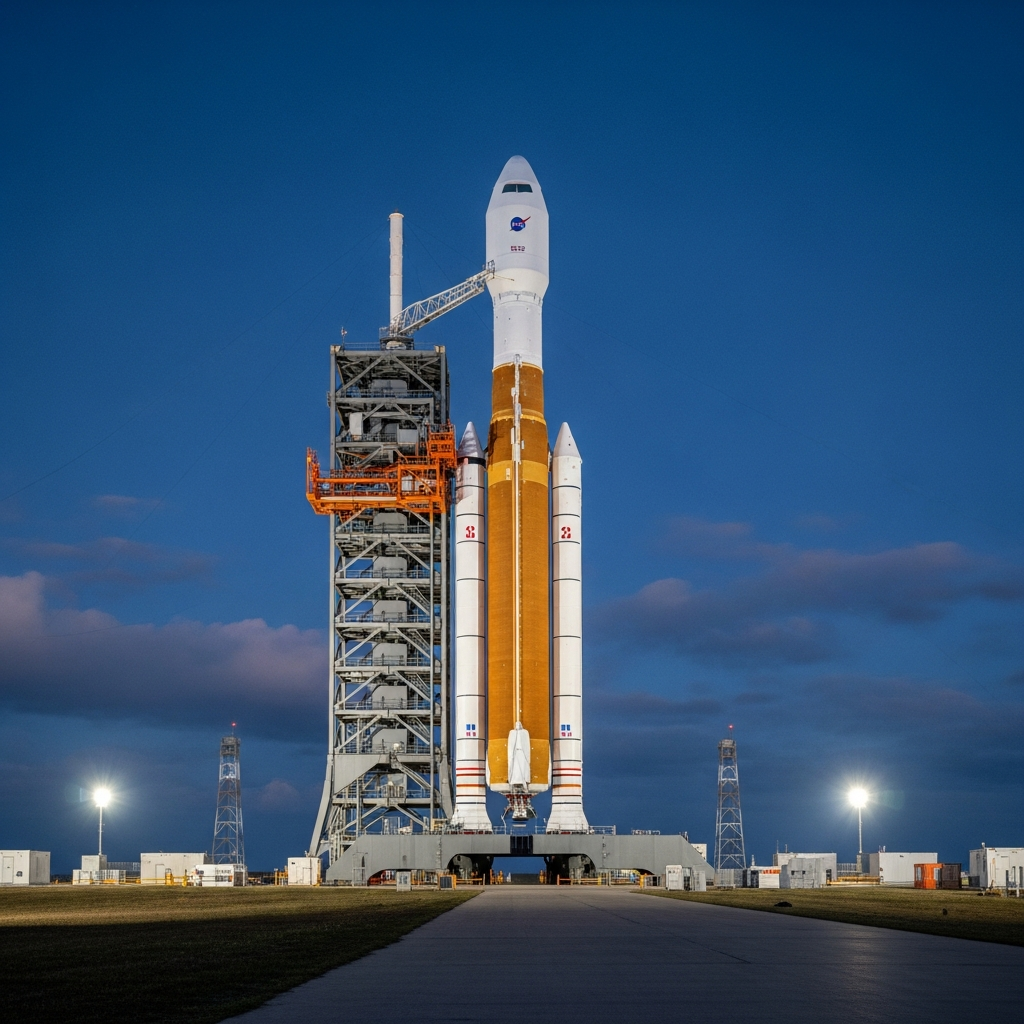
Historic Return: NASA’s Artemis 2 Rocket Ready for Lunar Mission
NASA’s monumental Artemis 2 moon rocket, comprising the towering Space Launch System (SLS) and its Orion crew capsule, has triumphantly returned to Launch Complex-39B (LC-39B) at Florida’s Kennedy Space Center (KSC). This critical milestone signals that the mission is now on track for its highly anticipated crewed flight around the Moon. After an overnight journey on March 20, 2026, the colossal stack is ready for final pre-launch preparations, with NASA targeting an early April launch window. This second rollout marks a significant step, moving the world closer to humanity’s return to deep space.
The vehicle stack arrived at Pad 39B at precisely 11:21 a.m. EDT on Friday, March 20, 2026. This capped an elaborate 11-hour, 4-mile (6.4 kilometers) trek. The journey began earlier that morning at 12:20 a.m. EDT, originating from the iconic Vehicle Assembly Building (VAB). Its return to the launch pad follows weeks of intensive maintenance and repairs within the VAB. Engineers diligently addressed issues that emerged during earlier testing.
Addressing the Setbacks: Why Artemis 2 Rolled Back
This recent rollout is, in fact, the second for Artemis 2. The rocket initially arrived at the pad on January 17, 2026, for its first launch campaign. During that period, NASA successfully completed one of two crucial “wet dress rehearsal” fueling tests. These tests practice propellant loading and countdown procedures. However, a significant problem soon arose. Engineers detected an issue with helium pressurization in the rocket’s upper stage, specifically involving a faulty seal. This particular issue could not be resolved while the rocket remained on the launch pad.
Consequently, NASA made the strategic decision to roll the SLS back to KSC’s VAB on February 25, 2026. Over the subsequent three weeks, dedicated teams worked tirelessly. They successfully addressed the helium issue and replaced flight batteries. Other minor component swaps were also performed. A last-minute replacement of an electrical harness, essential for the flight termination system, threatened further delays. However, the teams completed this work just in time, allowing the vehicle to meet its revised rollout target of March 19-20. This meticulous approach underscores NASA’s commitment to crew safety and mission success.
A Colossal Journey: The Crawler-Transporter’s Epic Trek
The Artemis 2 Space Launch System (SLS) is an engineering marvel. It stands an impressive 322 feet (98 meters) tall. Its dry weight is approximately 3.5 million pounds (1.6 million kg). When fully fueled with liquid hydrogen and liquid oxygen propellants, it soars to over 5.75 million pounds (2.61 million kg). Transporting this monumental vehicle, along with its Orion crew capsule and the Mobile Launch Platform (MLP), requires an equally colossal machine: NASA’s crawler-transporter 2.
This specialized vehicle is a beast in its own right. It weighs 6.6 million pounds and measures the size of a baseball infield. The combined weight of the crawler, SLS, Orion, and MLP exceeds 18 million pounds (8.1 million kg). To move this massive load without damage, the crawler-transporter 2 rolls at a glacial pace. Its eight sets of 7.5-foot (2.3 meters) treads move at a maximum speed of just 1 mph (1.6 kph), sometimes even slower at 0.82 mph. The 4-mile journey between the VAB and LC-39B takes between 11 and 12 hours. This trek occurs along a specialized roadway lined with imported river rocks. The immense weight crushes these rocks to near-sand as the treads pass over them.
This marks the second SLS rocket to travel this precise path. The first, which flew the uncrewed Artemis 1 mission, faced even more rollbacks to the VAB. That vehicle returned to the VAB three times before its successful launch in November 2022. The Artemis 1 mission successfully sent the Orion spacecraft into lunar orbit for nearly a month. It then returned to Earth, paving the way for future crewed flights.
Eyeing the Moon: Artemis 2’s Critical Mission Objectives
Artemis 2 is poised to become the first crewed flight of the Artemis program. It will also be the maiden voyage of the Orion spacecraft with astronauts aboard. This 10-day mission around the Moon and back represents the first human journey into lunar space in over half a century. The four-member crew for this historic journey includes:
Commander Reid Wiseman (NASA)
Pilot Victor Glover (NASA)
Mission Specialist Christina Koch (NASA)
Mission Specialist Jeremy Hansen (Canadian Space Agency – CSA)
The primary objective of this “shakedown cruise” is crucial. It aims to test the capabilities required for deep space flight. It will extensively study the effects of deep space environments on humans. Critically, it will perform the initial major test of the Orion spacecraft’s life-support systems with a human crew. This mission provides vital experience and data. It is an indispensable stepping stone for subsequent Artemis missions. These future missions aim to establish a sustained human presence on the Moon.
The Road Ahead: Pre-Launch Preparations and Astronaut Quarantine
With the Artemis 2 rocket now securely at Pad 39B, NASA teams are accelerating final pre-launch preparations. This intensive period includes thorough system checks and integrated testing. Ground teams will prepare the vehicle and ground systems for launch.
NASA is currently targeting the beginning of the next launch window, which opens as early as Wednesday, April 1, 2026. Should any delays occur, additional launch opportunities exist through Monday, April 6. Another significant window will open later in the month, specifically on April 30. NASA officials maintain a cautious, methodical approach. They acknowledge that monthly launch opportunities, typically lasting a few days to a week, will be available if needed.
In anticipation of their historic journey, the four Artemis 2 astronauts re-entered pre-flight quarantine. They began this period at NASA’s Johnson Space Center in Houston on March 18, 2026. They will remain in quarantine for about a week. Then, they will travel to KSC in Florida approximately five days before the planned launch. This strict quarantine protocol minimizes the risk of illness before critical human spaceflight missions.
Beyond Artemis 2: Paving the Way for a Sustained Lunar Future
The Artemis 2 mission is a cornerstone of NASA’s ambitious Artemis program. This program seeks to return humans to the Moon and establish a sustained lunar presence. Ultimately, it aims to use the Moon as a proving ground for future human missions to Mars. The overarching goal is to land astronauts back on the lunar surface before the end of 2028.
The programmatic roadmap has seen some adjustments. Artemis 3, now slated for 2027, will focus on a launch to Low Earth Orbit (LEO). Here, astronauts aboard Orion will rehearse rendezvous and docking maneuvers with commercial lunar landers. NASA has contracted two such landers: SpaceX’s Starship and Blue Origin’s Blue Moon. Both are still under development. NASA has indicated flexibility, willing to fly with whichever lander is ready.
Artemis 4 is now designated as the first mission to return astronauts to the lunar surface. It remains targeted for 2028. This mission will involve astronauts transferring from the Orion spacecraft to a lunar lander. It will also standardize the Space Launch System (SLS) rocket. Following this, Artemis 5 (late 2028) envisions an initial construction phase for a “moon base.” NASA projects yearly launches beyond Artemis 5 as part of its long-term lunar exploration strategy. This vision echoes the continuous human occupancy of the International Space Station (ISS). However, achieving this for lunar missions requires perfecting technologies for long-term excursions far from Earth, where emergency evacuations are far more complex.
Frequently Asked Questions
Why did NASA’s Artemis 2 rocket need to return to the VAB for repairs?
NASA’s Artemis 2 rocket experienced a critical helium pressurization issue in its upper stage, caused by a faulty seal, during initial testing at the launch pad in early 2026. This problem, along with necessary replacements for flight batteries and an electrical harness for the flight termination system, could not be fixed on the pad. Consequently, the colossal Space Launch System (SLS) and Orion stack were rolled back into the Vehicle Assembly Building (VAB) for several weeks of detailed diagnosis and repair work to ensure the rocket’s integrity and crew safety before launch.
When is the targeted launch window for the Artemis 2 moon mission?
The primary launch window for NASA’s Artemis 2 moon mission is currently targeted to open on Wednesday, April 1, 2026, and extend through Monday, April 6, 2026. Should any unforeseen circumstances or delays necessitate a postponement, additional launch opportunities are also identified for later in April, with another window opening around April 30. NASA maintains a cautious and methodical approach, highlighting that monthly launch opportunities of varying durations will be available if the mission needs to push past these initial dates.
What makes the Artemis 2 mission so crucial for future space exploration?
The Artemis 2 mission is critically important as the first crewed flight of NASA’s Artemis program, marking humanity’s return to deep space around the Moon after over 50 years. Its primary objectives include testing the Orion spacecraft’s life-support systems with astronauts aboard, assessing human endurance in deep space, and proving the capabilities required for future lunar missions. This 10-day journey is a vital precursor, providing indispensable data and experience to inform and enable subsequent Artemis missions, which aim to establish a sustained human presence on the Moon and ultimately pave the way for human exploration of Mars.
Conclusion: The Dawn of a New Lunar Era
The return of the Artemis 2 moon rocket to Launch Complex-39B is more than just a logistical feat. It is a powerful symbol of progress and resilience in human space exploration. After navigating technical challenges and executing meticulous repairs, NASA is poised for the next giant leap. This mission will carry astronauts around the Moon. It represents a critical test of hardware, systems, and human capabilities. The upcoming launch window in April promises an exciting period. It marks a significant step towards humanity’s long-term goal of establishing a sustained presence on the Moon and venturing onward to Mars. The world watches with anticipation as a new era of lunar exploration unfolds.