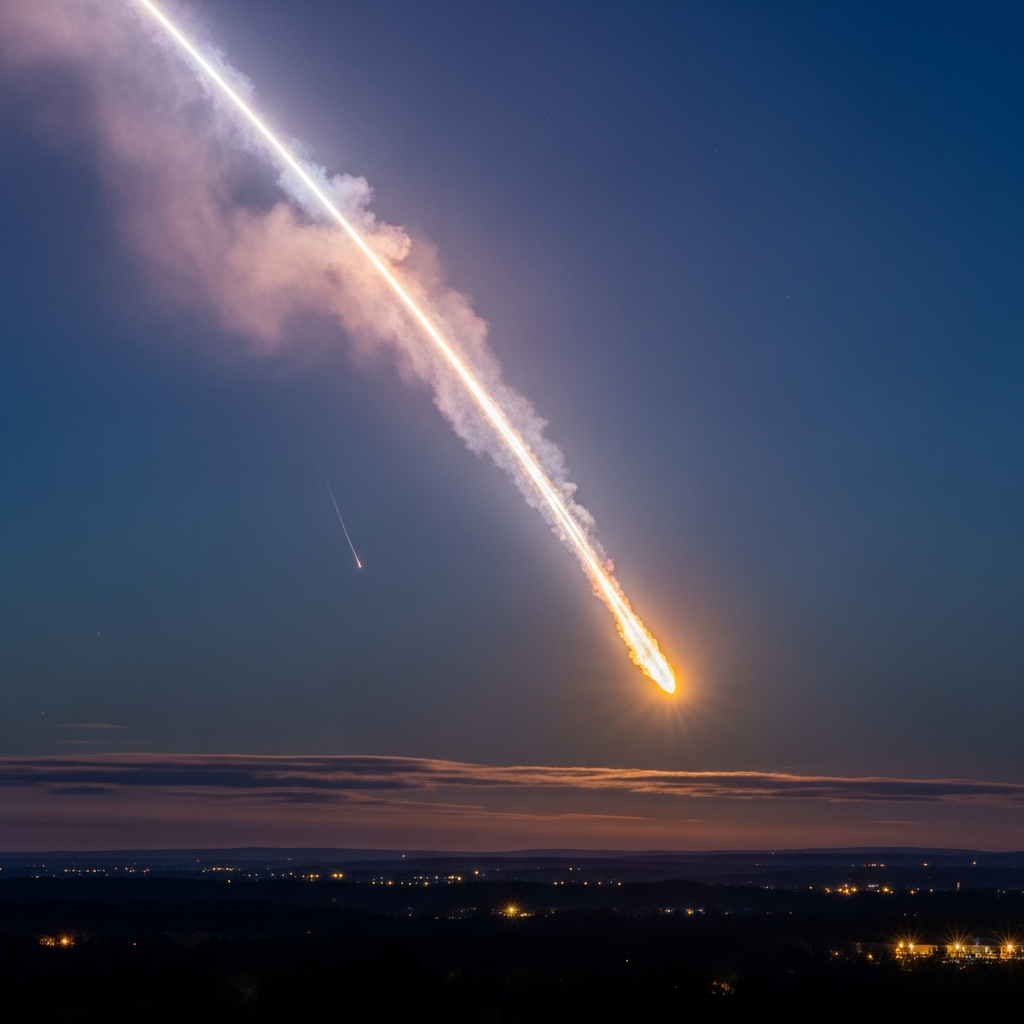
The predawn stillness over Ohio and Pennsylvania dramatically broke on Tuesday morning. Residents across both states reported seeing brilliant white streaks slice through the sky. A resounding “kaboom” followed, shaking homes and sparking widespread curiosity. Official sources quickly clarified the extraordinary event. Both the National Weather Service (NWS) and NASA verified a magnificent fireball, a type of exceptionally bright meteor, had descended into Earth’s atmosphere. Specifically, this celestial visitor made its dramatic entrance over Northeast Ohio, near the city of Cleveland.
This rare and captivating atmospheric display generated immediate buzz. Eyewitnesses shared stories of a luminous object moving rapidly overhead. The subsequent sonic boom confirmed the incredible speed of this cosmic phenomenon. Such events provide scientists with valuable data. They also offer a spectacular reminder of the dynamic universe we inhabit.
A Dazzling Display: Fireball Confirmed Over Ohio and Pennsylvania
On that memorable Tuesday morning, the skies above western Pennsylvania and eastern Ohio became a natural theater. Reports flooded in from concerned and awe-struck citizens. Many described a “loud boom” coupled with a “fireball” blazing across the firmament. The National Weather Service quickly took to online platforms. They acknowledged the numerous public reports. Their initial satellite data strongly suggested a meteor was responsible. It entered Earth’s atmosphere with considerable force.
NASA, a leading authority on space phenomena, independently confirmed these findings. Their analysis supported the identification of a true fireball. These agencies noted the meteor achieved supersonic speeds. This rapid descent caused it to break the sound barrier. The resulting atmospheric disturbance manifested as the widely reported “kaboom.” This powerful sound traveled for many miles, reaching communities far from the actual point of entry. Understanding the mechanics behind such an event helps us appreciate its scientific significance. It also puts into context the widespread public reaction.
Official Confirmation and Scientific Insights
The swift confirmation from NWS and NASA was crucial. It dispelled rumors and provided accurate information. Their statements offered relief and explanation to residents. Scientific instruments detected the atmospheric entry. This corroborated eyewitness accounts. Such coordination between public reports and scientific data is vital. It helps us understand and categorize these rare celestial visitors. This specific event offered a unique opportunity. Researchers could study the effects of a large meteor entering a populated region. The data collected helps refine our understanding of space debris. It also improves models for atmospheric entry events.
The distinct sound was a key indicator. A “kaboom” or “sonic boom” signifies extreme velocity. It confirms the object traveled faster than the speed of sound. This information helps estimate the meteor’s size and trajectory. Experts continue to analyze all available information. Their work sheds more light on the composition and origin of this particular space rock.
Decoding the Celestial Visitor: What is a Fireball Meteor?
When we talk about meteors, it’s important to clarify some key terms. A meteoroid is simply a small body of rock or metal in outer space. It can range in size from a dust grain to a small asteroid. When a meteoroid enters Earth’s atmosphere, it heats up due to friction with the air. This causes it to glow brightly. At this point, it becomes a meteor, often called a “shooting star.” If a meteor is exceptionally bright – brighter than the planet Venus – scientists classify it as a fireball. These are the spectacular events witnessed over Ohio and Pennsylvania. Should any part of the meteor survive its fiery journey and land on Earth, it is then called a meteorite.
The fireball seen over Ohio and Pennsylvania was also a bolide. This term refers to a large meteor that explodes in the atmosphere. The “kaboom” heard was a direct result of this atmospheric explosion and the meteor’s supersonic speed. These events are not everyday occurrences. They offer a breathtaking display of natural phenomena. Bolides provide invaluable scientific data. They allow us to study extraterrestrial material and its interaction with our planet.
The Dazzling Colors of Meteors
Interestingly, meteors don’t always appear white. Their color can vary greatly. This depends on several factors. The elemental composition of the meteoroid itself plays a significant role. As the space rock burns up, different elements emit light at specific wavelengths. This creates distinct colors. For instance:
Green hues often indicate the presence of nickel or magnesium.
Yellow glows typically point to iron burning in the atmosphere.
Red colors can result from nitrogen and oxygen molecules in the atmosphere. These atoms react to the meteor’s heat.
Blue tones usually suggest calcium.
The white streaks reported over Ohio and Pennsylvania indicate a mix of elements. They also show the intense heat generated during entry. The specific color profile can give clues about the meteor’s origin. It helps scientists understand the composition of space debris in our solar system. Every fireball provides a unique spectroscopic fingerprint.
The Astonishing Sound: Understanding the Sonic Boom
The most striking aspect of the Ohio and Pennsylvania fireball, aside from its visual grandeur, was the powerful “kaboom.” This loud sound is a classic example of a sonic boom. It occurs when an object travels through the air faster than the speed of sound. Sound travels at approximately 767 miles per hour (1,236 kilometers per hour) at sea level. When an object, like a supersonic jet or a fast-moving meteor, exceeds this speed, it generates a shockwave.
Imagine a boat moving faster than the waves it creates. The waves pile up in front of it. Similarly, an object moving supersonically pushes air molecules faster than they can get out of the way. This creates a cone-shaped shockwave of compressed air. When this shockwave reaches a listener on the ground, they hear a sudden, powerful burst of sound – the sonic boom. The larger the object and the faster it travels, the more intense the sonic boom. For the Ohio and Pennsylvania meteor, its significant size and velocity generated a “kaboom” that startled thousands of residents. It resonated across a wide geographic area.
Impact and Perception of Supersonic Events
Sonic booms from meteors are less common than those from aircraft. This makes the Ohio and Pennsylvania event even more remarkable. The sound provides critical information for scientists. It helps them estimate the meteor’s altitude and trajectory. It also helps calculate its energy release. For the public, hearing a sonic boom can be unsettling. It often triggers confusion or alarm. Buildings might rattle, and windows might vibrate. This explains why initial reports often mention tremors or shakes, alongside the loud noise.
The NWS correctly identified the source of the “kaboom.” This distinction is important. It prevents misidentification with other seismic or atmospheric events. Understanding the science behind these sounds empowers communities. It helps them react appropriately to such rare natural occurrences.
Witnessing a Celestial Event: What to Do Next
Witnessing a fireball is a truly unforgettable experience. If you are lucky enough to see such an event, your observations are valuable. Reporting your sighting can contribute significantly to scientific understanding. Organizations like the American Meteor Society (AMS) rely on public reports. They combine these with scientific data to track and study meteors. Your detailed account helps plot trajectories and potential impact zones.
If you suspect you have found a meteorite, it’s essential to follow certain guidelines. Do not touch it directly with your bare hands. Meteorites can be fragile. Contaminants from your skin could also alter scientific data. Instead, document your find with photographs. Note the exact location using GPS coordinates if possible. Then, contact a local university geology department or a reputable meteorite expert. They can analyze the sample properly. Handling a potential meteorite safely ensures its scientific integrity. It protects you from any unknown elements.
Differentiating from Other Phenomena
Sometimes, other atmospheric phenomena can be mistaken for meteors. Space junk, re-entering satellites, or even certain types of lightning can appear similar. This is why official confirmation from agencies like NASA and the NWS is so important. They use a combination of radar, satellite data, seismic sensors, and expert analysis. This helps them accurately identify the source of bright lights and loud booms. Their quick response after the Ohio and Pennsylvania sighting showcased this expertise. It provided clarity to a naturally curious public.
Staying informed about celestial events can also enhance your appreciation of the night sky. Many local astronomy clubs or observatories host public viewing nights. These are great opportunities to learn more about meteors, planets, and stars.
Beyond Our Skies: The Broader Context of Meteors
The recent fireball over Ohio and Pennsylvania reminds us of our place in the vast cosmos. Earth is constantly bombarded by small space debris. Most burn up harmlessly in the atmosphere. Larger events, like this fireball, offer a dramatic reminder of the active environment of our solar system. Such occurrences are not isolated incidents. Regular meteor showers, like the Perseids or Geminids, occur annually. These are caused by Earth passing through streams of debris left by comets or asteroids.
Studying meteors provides crucial information about the early solar system. Meteorites are ancient samples of rock from space. They often contain clues about the formation of planets and the origin of water on Earth. Continued research in this field enhances our understanding of planetary evolution. It also helps in identifying potential threats from larger space objects. The awe-inspiring sight over Ohio and Pennsylvania serves as a local connection to these grand cosmic processes. It ignites a sense of wonder and encourages further exploration of space.
Frequently Asked Questions
What causes a meteor to create a “kaboom” sound?
A meteor creates a “kaboom” sound, known as a sonic boom, when it travels faster than the speed of sound through Earth’s atmosphere. This extreme velocity generates a powerful shockwave of compressed air. As this shockwave expands and reaches an observer on the ground, it is heard as a sudden, thunderous noise. The Ohio and Pennsylvania fireball achieved supersonic speeds during its atmospheric entry, producing the widely reported loud boom.
Where can I report a meteor sighting in Ohio or Pennsylvania?
If you witness a meteor or fireball in Ohio, Pennsylvania, or anywhere else, you can report your sighting to the American Meteor Society (AMS). The AMS collects public observations to help track and study meteor events. Providing details like the date, time, location of observation, direction of travel, and perceived brightness greatly assists their scientific efforts. Official agencies like the NWS and NASA also monitor these events and may issue statements based on gathered data.
What should I do if I find a suspected meteorite?
If you believe you have found a meteorite, it’s crucial to handle it carefully to preserve its scientific value. Avoid touching it directly with your bare hands, as skin oils can contaminate the sample. Instead, take detailed photographs of the object in its original location, noting any unique features. Document the exact GPS coordinates if possible. Then, contact a local university’s geology or astronomy department, or a reputable meteorite identification service. They can guide you on proper collection and analysis.
Conclusion: A Glimpse into the Cosmos
The confirmed fireball streaking across the skies of Ohio and Pennsylvania on Tuesday morning was a truly remarkable event. It combined the visual splendor of a cosmic visitor with the raw power of a sonic boom. This rare occurrence offered residents a direct, albeit distant, connection to the vastness of space. Official confirmations from the National Weather Service and NASA provided crucial scientific context. These insights helped us understand the nature of this particular meteor.
This celestial spectacle reminds us of the constant interplay between Earth and its cosmic surroundings. It highlights the importance of both public observation and scientific analysis in unraveling the mysteries of our universe. As we continue to gaze skyward, such events serve as powerful catalysts. They inspire curiosity, encourage scientific inquiry, and deepen our appreciation for the wonders that unfold far above us. Stay informed, look up, and perhaps you too will witness the next breathtaking display from beyond our world.