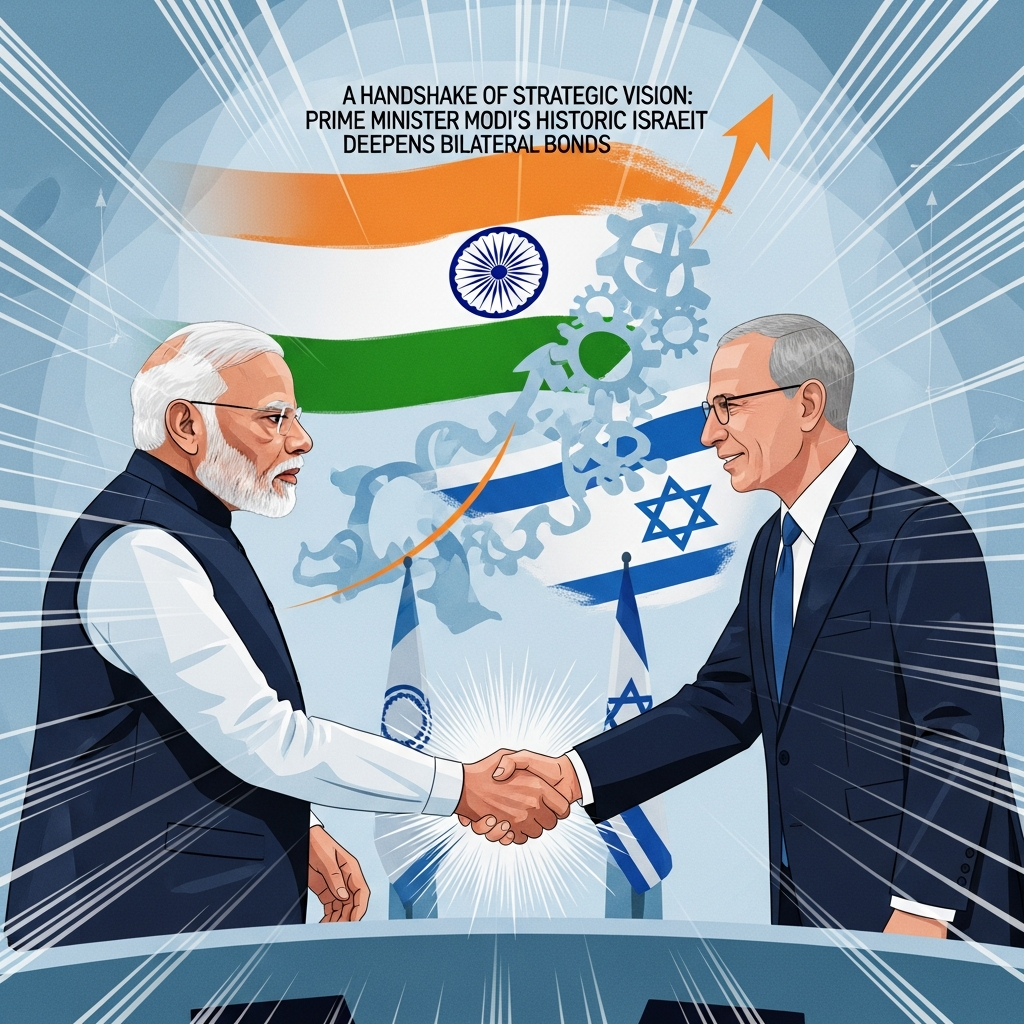
Prime Minister Narendra Modi embarked on a landmark two-day state visit to Israel in February 2026, marking his second trip to the nation during his tenure. This pivotal Modi Israel visit aimed to significantly elevate and deepen the strategic partnership between India and Israel across a multitude of crucial sectors. From bolstering defence capabilities to pioneering advancements in technology and fostering robust economic ties, the visit underscored a shared vision for a more resilient and prosperous future for both democracies.
The diplomatic engagement was framed as a “significant leap ahead,” seeking to position the India-Israel relationship on par with Israel’s closest global partners. Discussions focused intensely on expanding collaboration in areas vital for national development and security, including science and technology, defence, trade, agriculture, and water management. Beyond official talks, the visit included symbolic gestures reinforcing strong bilateral bonds and mutual respect.
Elevating a Strategic Partnership: A New Era of Cooperation
The February 2026 Modi Israel visit built upon the foundation laid during PM Modi’s groundbreaking 2017 trip, which was the first by an Indian Prime Minister to Israel. Both nations, recognizing their shared democratic values and common challenges, sought to establish new ambitious goals for their strategic partnership. Indian and Israeli leaders expressed confidence that these discussions would open new avenues for collaboration, fostering innovation and economic growth.
A central highlight was PM Modi’s historic address to the Israeli Parliament, the Knesset, making him the first Indian Prime Minister to be accorded this honor. This gesture symbolized the deep parliamentary and democratic ties binding the two countries. The Knesset building was even illuminated in the Indian tricolours in anticipation of his arrival, underscoring the warmth of the reception.
Key Pillars of Bilateral Engagement
The comprehensive agenda for the Modi Israel visit spanned a wide array of cooperation areas. Leaders reviewed substantial progress in the existing strategic partnership and explored future opportunities.
Defence and Security: A core pillar of the discussions. Both leaders reviewed and updated existing security agreements, emphasizing sharing cutting-edge military technologies and expanding joint development initiatives. Israel remains a crucial supplier of advanced defence systems to India. Notably, a Memorandum of Understanding (MoU) signed in November 2025 aimed to deepen military ties through enhanced cooperation in defence industrial production, research and development (R&D), and cybersecurity. Collaborative efforts on ballistic and laser defence systems were also explored.
Technology and Innovation: The visit prominently featured collaboration in emerging technologies. This included high-tech sectors like Artificial Intelligence (AI), quantum computing, and cybersecurity. Leaders stressed that these aren’t merely future prospects but “the present,” keen to position both nations at the forefront of these fields. PM Modi also participated in a technology exhibition showcasing Israeli innovation.
Trade and Economy: A significant focus was placed on boosting bilateral trade and investment. Negotiations for a Free Trade Agreement (FTA) commenced concurrently with Modi’s visit, with the first round set to conclude on February 26. This FTA is anticipated to be a “breakthrough” and a “powerful growth engine.” While bilateral merchandise trade saw a decline in the 2024-25 fiscal year, both countries aim to reverse this trend. Beyond traditional diamonds and petroleum, trade is increasingly diversifying into electronic machinery, high-tech products, communication systems, and medical equipment.
Agriculture and Water Management: India and Israel continued to advance cooperation in these vital sectors. Israel’s expertise in water technologies and arid agriculture offers significant benefits for India.
- People-to-People Ties: The cultural aspect of the visit included PM Modi’s interaction with the Indian Jewish community in Israel. He also paid homage to victims at Yad Vashem, Israel’s Holocaust memorial, a symbolic gesture reflecting shared values of remembrance and historical consciousness.
- sundayguardianlive.com
- www.pgurus.com
- www.hindustantimes.com
- www.deccanchronicle.com
- www.indiatoday.in
Geopolitical Context and Regional Vision
The timing of the Modi Israel visit was highly significant, unfolding amidst heightened geopolitical dynamics in the Middle East and broader global security challenges. Both India and Israel reiterated shared interests in fostering stability and combating terrorism. They affirmed a “zero tolerance” policy towards terrorism, pledging enhanced intelligence and information sharing, and strengthened multilateral cooperation.
Israeli Prime Minister Benjamin Netanyahu characterized India and Israel as part of an “axis of nations committed to stability and progress,” underscoring their alignment on larger regional challenges. He articulated a broader vision for a “hexagon” of alliances in and around the Middle East, specifically naming India among key partners alongside Arab, African, and Mediterranean nations. This ambitious vision aims to unite like-minded countries against radical forces and promote security and technological advancement. The India-Middle East Economic Corridor (IMEC) also featured in discussions, envisioned as the “new Silk Road of the 21st century.”
Controversies and Diplomatic Balancing Act
Despite the celebratory tone, the Modi Israel visit occurred against a backdrop of complex regional tensions, particularly the ongoing situation in Gaza. This aspect drew sharp criticism from the Indian National Congress. Party general secretary Jairam Ramesh accused the Modi government of abandoning Palestinians and criticized Modi for embracing Netanyahu.
Concerns were raised regarding intensifying Israeli actions in the occupied West Bank and the humanitarian crisis in Gaza. Congress leaders urged PM Modi to address the “genocide” in Gaza and uphold India’s historical commitment to peace and justice. This reflects India’s traditional stance on the Israel-Palestine conflict, advocating for a two-state solution, even while condemning the October 7, 2023, Hamas terror attack. The ruling BJP strongly rebutted these criticisms, accusing the Congress of “selective outrage.”
The visit underscored India’s evolving foreign policy, seeking to balance strategic partnerships with traditional diplomatic stances. Discussions between Modi and Netanyahu did feature the situation in Gaza prominently, highlighting the delicate tightrope walk in India’s foreign relations.
Frequently Asked Questions
What was the primary focus of PM Modi’s second state visit to Israel in February 2026?
The primary focus of PM Modi’s second Modi Israel visit was to significantly deepen and elevate the strategic partnership between India and Israel. The comprehensive agenda included strengthening cooperation across vital sectors such as defence and security, advanced technology (including AI and quantum computing), trade and investment, agriculture, and water management. The visit aimed to set new ambitious goals for bilateral ties and foster a shared vision for a resilient, innovative, and prosperous future.
How did PM Modi’s visit strengthen India-Israel economic and technological collaboration?
PM Modi’s visit advanced economic and technological ties significantly. Negotiations for a Free Trade Agreement (FTA) commenced, aiming for a “breakthrough” in bilateral trade. Discussions also focused on increasing trade in high-tech products, communication systems, and medical equipment. In technology, collaboration in cutting-edge fields like Artificial Intelligence, quantum computing, and cybersecurity was a key agenda item, with both leaders keen to position their nations as leaders in these emerging areas.
What were the geopolitical implications and controversies surrounding Modi’s Israel visit in February 2026?
The visit carried significant geopolitical implications, reinforcing India and Israel’s shared commitment to stability and security amidst heightened Middle East tensions. Israeli PM Netanyahu spoke of an “axis of nations” and a “hexagon” of alliances, positioning India as a key partner. However, the visit also faced controversy, particularly from India’s Congress party, which criticized PM Modi for embracing PM Netanyahu during the ongoing Gaza situation and accused the government of abandoning its traditional stance on Palestine. The visit required India to carefully balance its strategic partnerships with its long-standing diplomatic positions.
The February 2026 Modi Israel visit marked another crucial chapter in the burgeoning relationship between India and Israel. By consolidating existing strengths and forging new pathways in critical sectors like defence, technology, and trade, both nations are setting a course for an even more robust and multifaceted strategic partnership. Despite regional complexities and internal criticisms, the commitment to mutual growth, innovation, and security remains a powerful driving force, reflecting a determined effort to navigate global challenges through deeper bilateral engagement.